
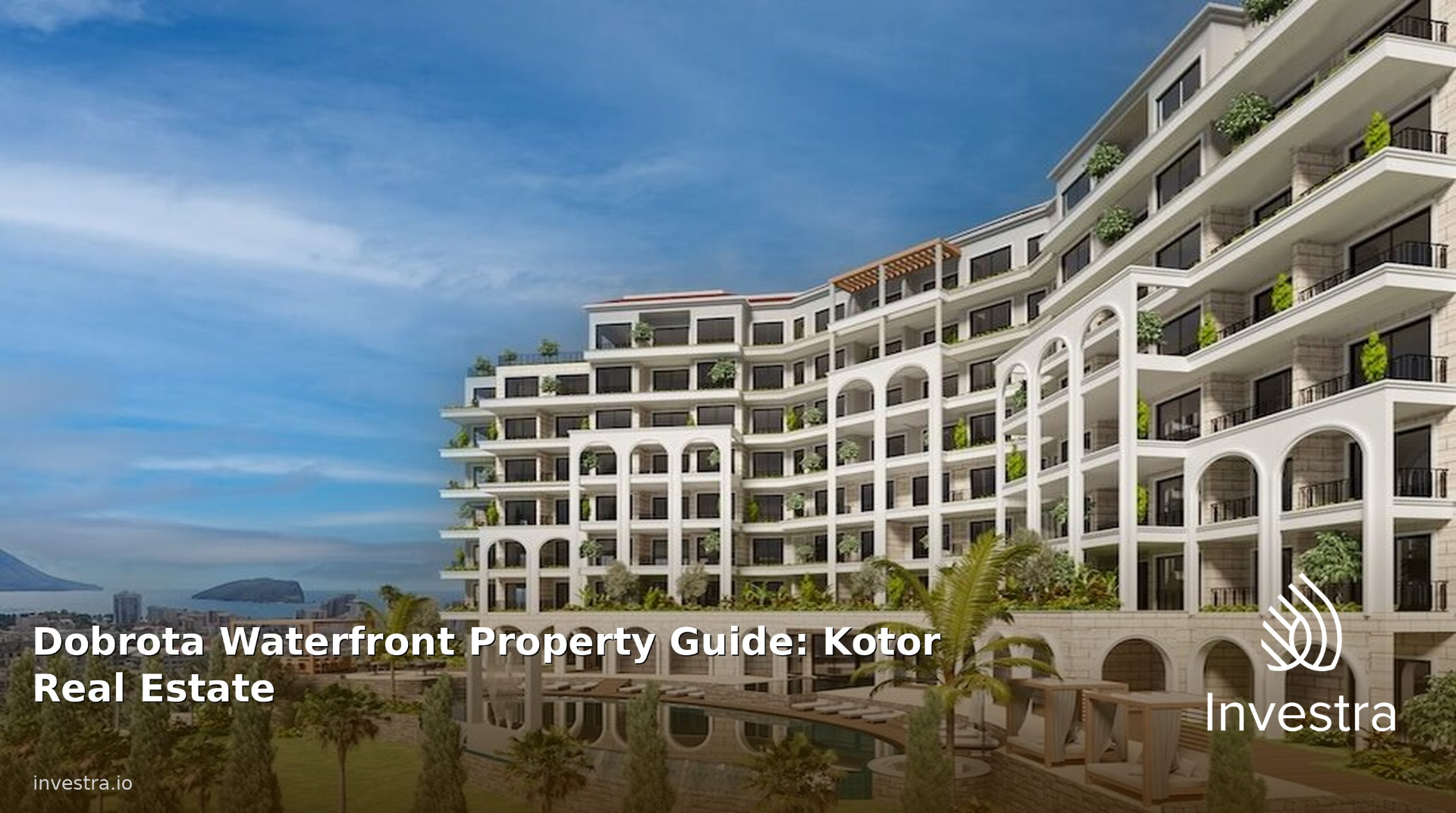
Dobrota Waterfront Property Guide: Kotor Real Estate
Dobrota Waterfront Property Guide: Kotor Real Estate
Understanding Dobrota's Position Within Kotor Bay
Quick Answer: Dobrota sits directly across the Verige Strait from the UNESCO-listed Old Town of Kotor, offering waterfront access without the medieval town's density and restrictions. This proximity makes it strategically valuable for both lifestyle and investment buyers.
Dobrota isn't Kotor's Old Town, and that distinction matters enormously for property decisions. Located on the northern shore of Kotor Bay, this settlement has become the focus of serious international property interest precisely because it offers what the medieval quarter cannot: modern waterfront homes with unobstructed bay views, walking distance to the UNESCO site, and room for new development.
The geography here deserves attention. Dobrota forms part of the greater Kotor municipality but maintains its own character. The settlement stretches along the coastline where the bay narrows, creating a natural orientation toward the water. What surprised many buyers initially is that you're not confined to Old Town's winding cobblestone streets and centuries-old building codes. You can own a contemporary villa with 180-degree views of the bay, direct waterfront access, and modern infrastructure—something impossible within the ancient walls.
The Verige Strait, that narrow passage separating Dobrota from Kotor Old Town, represents more than just geography. It's the practical difference between purchasing a restored 16th-century palazzo with planning restrictions and buying a new-build villa with climate control and contemporary amenities. For international buyers used to modern living standards, this matters substantially.
Water access in Dobrota varies by location. Some properties enjoy private beach access or boat moorings; others sit on the hillside above the coast with views but no direct shore contact. When evaluating any waterfront property here, understanding exactly what "waterfront" means for your specific property is essential. Is it buildable shoreline? Rocky coast? Sandy beach? Private access or public pathway? These distinctions affect both lifestyle utility and future resale appeal.
Why International Buyers Choose Dobrota Over Kotor Old Town
Quick Answer: Buyers select Dobrota for modern amenities, development flexibility, waterfront villas, parking availability, and proximity to Kotor's UNESCO charm without the medieval town's restrictions and congestion.
The Old Town of Kotor is undeniably spectacular. Its Venetian fortifications, baroque churches, and atmospheric stone streets draw visitors from everywhere. But owning property there presents genuine complications that many international buyers don't anticipate until they begin serious research.
Space constraints are real. Medieval urban planning wasn't designed for modern life. Your living room might be 4 meters wide. Parking? You'll be negotiating street space or paying for a spot elsewhere. Installing modern heating and cooling systems requires handling centuries-old electrical infrastructure. What initially feels romantic—stone walls, narrow passages, history seeping from every corner—becomes restrictive when you're trying to live there year-round.
Dobrota offers something fundamentally different: property where you can park in front of your home, extend your terrace without seeking permission from three historical preservation committees, and enjoy consistent electricity supply without vintage wiring surprises. The bay views are equally stunning, often better because you're across the water looking back at the Old Town's illuminated fortress rather than being enclosed within its medieval grid.
We've observed that Dobrota attracts two distinct buyer profiles. First, the lifestyle buyer: remote workers, retirees, and semi-retired professionals who want Mediterranean living with modern comfort. They value the ability to host family visits without logistical nightmares around accommodation and parking. Second, the investment buyer: those seeking rental income or appreciation in a location where international demand is accelerating faster than inventory. Dobrota has newer properties that can command premium short-term rental rates precisely because they offer what Kotor Old Town cannot—space, parking, direct waterfront access.
Another factor we've noticed: renovation risk and hidden costs. Older properties in the Old Town frequently reveal surprises during ownership: structural issues not visible during inspection, moisture problems in historic stone walls, or systems that fail and require specialized restoration. Newer Dobrota properties typically come with builder warranties, transparent construction records, and predictable ownership costs. That predictability has real value for international buyers managing property from abroad.
Assessing Waterfront Access and Beach Claims
Quick Answer: Verify waterfront claims by reviewing the property deed's precise boundary description, checking coastal access laws with a local lawyer, and confirming whether any public rights-of-way limit your exclusive use.
This is where due diligence becomes genuinely critical. "Waterfront property" in Dobrota encompasses vastly different situations, and misunderstanding what you're purchasing is one of the more common mistakes international buyers make.
Start with the fundamental question: Does the property deed actually include the waterfront, or does it stop at some boundary line? In many cases, a villa might be described as "waterfront" by a real estate agent, but the actual surveyed boundary sits several meters inland. The beach or rocky shore below belongs to the municipality or remains public property. You have views and perhaps foot access, but you don't own the water's edge. This distinction affects your ability to install a private boat mooring, build a deck extending over water, or legally exclude the public from walking past your property.
Montenegro's coastal laws are specific about public versus private water access. Certain stretches of coastline are designated for public use regardless of private land ownership. Understanding which category your property falls into requires more than asking your real estate agent—it requires asking a qualified legal advisor familiar with Montenegrin property law. The fee for this review is modest relative to the property cost and solves confusion before you commit.
Examine the property's development history and any environmental designations. Kotor Bay is environmentally protected in certain zones. If your property sits in a protected area, you may face restrictions on:
- Expanding the built footprint
- Installing structures extending into the water
- Altering the natural shoreline
- Operating high-impact rental businesses
These restrictions aren't obscure—they're recorded in municipal planning documents—but they're also not always immediately apparent during property viewings. Ask your lawyer to pull the property's environmental classification and any associated deed restrictions. This takes an afternoon of research and costs far less than discovering mid-project that your planned waterfront deck violates protected habitat regulations.
Rocky versus sandy shore matters more than you'd think. Dobrota's coastline is primarily rocky, which means less traditional beach access but typically better water clarity and easier boat mooring. If your property includes rocky shore, the water is usually immediately deep—excellent for swimming year-round because cold currents are replaced by fresh circulation. Sandy beaches, found in certain Dobrota sections, offer different appeal: easier water entry, warmer shallows, more traditional beach experience. Neither is objectively better, but they create different user experiences and affect rental appeal and seasonal occupancy patterns.
Property Types and Construction Standards in Dobrota
Quick Answer: Dobrota offers new-build villas (primarily post-2010), restored stone houses, and apartment complexes, with construction standards varying by builder reputation and developer track record. Request building permits, completion certificates, and builder credentials before committing.
The Dobrota real estate market is dominated by villas—single-family homes, typically two to four stories, with most development occurring after 2008. This is fundamentally different from the Old Town's apartment-based market. If you're imagining a converted medieval townhouse, you're thinking of the wrong location. Dobrota is modern, villa-centric, and waterfront-oriented.
Construction standards in Montenegro don't match Central European equivalents, but they've improved substantially. Reputable builders—those with documented track records, completed projects, and verifiable client references—produce solid homes that meet EU construction codes. Less scrupulous developers, however, cut corners on materials, electrical safety, and drainage systems. The difference isn't always visible during a quick site inspection but becomes obvious three years into ownership when plumbing fails or damp appears in bedrooms.
When evaluating any new-build or recently completed property, request documentation of:
- Building permits and municipal approvals
- Completion certificates from relevant authorities
- Structural engineer reports
- Electrical safety inspection records
- Building insurance documentation
- Developer's previous project references with contact information
This request is absolutely standard in Central Europe and increasingly expected in Kotor. Any developer who resists providing these documents is raising a significant red flag. These records cost the developer nothing to provide but save you thousands in potential remedial work later.
Restoration projects—older stone houses dating from mid-20th century or earlier—present different considerations. The appeal is obvious: traditional Mediterranean aesthetic, established location, established gardens. The risk is equally clear: hidden structural problems, electrical systems that require replacement, plumbing materials that corrode, and moisture management issues in older stone walls. If you're considering a restoration property in Dobrota, budget for a thorough engineering inspection and don't assume that cosmetic renovation photos represent the property's true condition.
Apartment complexes in Dobrota have increased, particularly in sections closer to central Kotor. These typically range from 2-4 units to larger developments with 10-20 residential units plus commercial space. Apartment ownership requires understanding shared maintenance costs, building management arrangements, and community decision-making processes. In some cases, apartment buildings in Dobrota are managed by professional property companies; in others, residents manage jointly, which can lead to disputes over maintenance funding and standards.
Understanding Buyer Motivation: Rental Investment vs. Personal Residence
Quick Answer: Investment buyers should assess local rental demand, seasonal patterns, and management logistics; personal residence buyers should prioritize location preferences, year-round livability, and community amenities rather than yield projections.
The question matters because it changes what you should actually evaluate. A rental investment property and a personal residence are fundamentally different purchases, even if they're on the same street in Dobrota.
For rental investment buyers, the focus becomes guest logistics, parking, kitchen amenities, bedding capacity, and operational costs. Can guests find your property easily? Is there secure parking? Can the kitchen accommodate multiple guests preparing meals? Is the property attractive enough to command premium nightly rates during peak season? These considerations often lead investment buyers toward slightly larger properties with multiple bedroom suites and well-equipped kitchens.
International data on Kotor Bay rental income is available through tourism analytics platforms and property management companies operating in the region. Rather than fabricating yield figures, you should contact established property management companies—those who actually manage rental properties in Dobrota—and ask about current market rates and realistic occupancy expectations. They'll provide data based on actual bookings rather than theoretical projections. Due diligence for rental investments requires understanding seasonal demand patterns, and those patterns vary significantly between Dobrota and other Kotor Bay locations.
Personal residence buyers, by contrast, should prioritize livability factors that investors often overlook. Does the property have consistent natural light, or is it perpetually shaded? Are there established cafes and restaurants within walking distance? What's the noise environment—quiet residential or proximity to weekend beach crowds? Is there reliable high-speed internet if you'll be working remotely? Can you park easily if you own a car? These lifestyle factors don't appear in financial projections, but they determine whether you'll actually enjoy the property during the eight months you're not renting it out.
What we've observed: the most satisfied personal residence buyers in Dobrota are those who prioritized neighborhood livability and year-round comfort over rental potential. The most frustrated are those who bought properties optimized for investment that turned out to be genuinely uncomfortable to live in personally. If you're considering a property expecting to use it partially as a rental, ensure it's genuinely livable as a personal residence first, then consider rental upside as a secondary benefit.
Local Infrastructure and Amenity Accessibility
Quick Answer: Dobrota offers basic services within walking distance, but healthcare, specialized shopping, and cultural institutions require access to central Kotor or Tivat. Evaluate your daily lifestyle needs against actual distances and seasonal transportation options.
Living in Dobrota is significantly different from living in central Kotor, and this difference extends beyond property types to encompass everything from grocery shopping to medical care. Understanding these logistics is essential for both visitors and potential property owners.
The settlement has expanded enough to support basic services. You'll find cafes, restaurants, and small markets along the waterfront. Several established restaurants have built reputations drawing both locals and tourists. Grocery shopping is feasible at neighborhood shops, though specialty items or large bulk purchases require a trip to Kotor's larger supermarkets or Tivat's commercial center.
Healthcare access deserves specific attention. Dobrota has no hospital and limited medical services. Routine care—GP appointments, minor injuries, basic diagnostics—requires travel to Kotor town center or, for specialized treatment, to Tivat's clinical center. For serious medical emergencies, ambulance service exists, but response times from Dobrota vary. If you have chronic health conditions requiring frequent specialist appointments, you should realistically assess whether the 10-15 minute drive to medical facilities multiple times monthly fits your life pattern.
Seasonal variations affect infrastructure utility. During summer, Dobrota's waterfront becomes crowded with tourists. Parking becomes competitive, restaurants fill by 7 PM, and the quiet Mediterranean village transforms into a busy coastal resort. If you're visiting during summer weeks, this creates vibrant atmosphere. If you're living there year-round and seeking peace, July and August can feel invasive. Winter, conversely, becomes genuinely quiet—sometimes to the point of isolation if you don't have established social connections.
Transportation options: Personal vehicle ownership is standard. Walking is feasible along the waterfront, but for broader movement around the bay, a car is essential. There's no meaningful public transit system in Dobrota proper. Taxis exist but are expensive for routine trips. If you're considering property ownership without access to a vehicle, carefully evaluate whether you'll genuinely be satisfied with the limited mobility options.
Internet connectivity has improved substantially. Most modern properties have fiber-optic access or high-speed mobile data via local providers. If you'll be working remotely, verify that your specific property has consistent high-speed connection—it's a simple check that prevents frustration during work-from-home scenarios.
Legal Framework for Foreign Ownership in Montenegro
Quick Answer: EU and non-EU citizens can purchase property in Montenegro through similar processes, but each requires appropriate documentation, tax registration, and legal representation. Non-EU buyers should verify their country's specific requirements before committing.
Montenegro's property purchase process is relatively straightforward for foreign buyers, but it requires understanding specific legal requirements and avoiding shortcuts that create problems later.
As a foreign buyer—whether EU or non-EU citizen—you'll need:
- Valid passport or identity document
- Tax identification number (obtained through local tax authority)
- Legal representation by a qualified Montenegrin attorney
- Proof of funds or financing documentation
- Completed purchase agreement (kupoprodajni ugovor)
The acquisition process itself involves several stages. First, you identify a property and negotiate terms with the seller. Second, your attorney conducts due diligence—verifying ownership, checking for liens or encumbrances, confirming environmental status, and reviewing any deed restrictions. This phase typically takes 2-4 weeks and costs modestly. Third, you execute the purchase agreement before the competent court. Fourth, the property registers in your name at the land registry.
Timeline expectations: From initial property selection to completed registration typically requires 4-8 weeks if there are no complications. Complications—disputed ownership, unclear title, environmental issues—can extend this substantially. This is why the due diligence phase matters: it identifies problems early when they're resolvable, not after you've committed funds.
Purchase-related costs extend beyond the property price and include attorney fees, court registration fees, real estate transfer tax, and title insurance if you choose to obtain it. Rather than inventing specific percentages, contact the Montenegrin Ministry of Justice or ask your legal advisor for current fee schedules—these are public documents that change periodically.
A critical step many international buyers underestimate: establishing tax residency status. Owning property in Montenegro has tax implications, and you'll need to understand your specific tax obligations based on your citizenship, where you spend time, and where you're employed. This is not a
Explore more on Investra: Pula Real Estate Market 2026: Areas, Buyer Demand and Due Diligence | How to Buy Property in Istria as a Foreign Buyer in 2026 | Rovinj Real Estate Market 2026: Buyer Priorities and Location Choices | Istria Property Investment 2026: A Decision Framework for Buyers | Poreč Real Estate Market 2026: A Practical Guide for Property Buyers | Pula Rental Investment Guide 2026: Long-Term Letting Buyer Questions | Umag Real Estate Market 2026: Property Types, Areas and Buyer Checks | Istria Property Due Diligence: A Croatian Buyer Checklist | Istria Property FAQ 2026: Clear Answers for International Buyers | Best Neighbourhoods in Pula for Property Buyers in 2026 | Medulin Real Estate Market 2026: A Buyer Guide to Homes and Locations | Rovinj Old Town or Newer Areas: A Property Buyer Location Guide | Pula New-Build Homes: A Buyer Due Diligence Guide for 2026 | Istria Property Ownership Costs: A Practical Budgeting Guide
For expert real estate investment insights and business strategy: investment insights | investment expertise | investment consultation | advisory services.
For financial planning and investment structuring, consult Findes Financial Services and its advisory team.
Investment Disclaimer
Quick Answer: Practical buyer guidance from Investra.io.
The information provided in this article is for educational and informational purposes only and should not be construed as financial, legal, or investment advice. Real estate investments carry inherent risks, and past performance does not guarantee future results. Investors should not invest money they cannot afford to lose. Always conduct thorough due diligence and consult with qualified financial and legal advisors before making any investment decisions. Investra.io does not guarantee returns on any investment.
Frequently Asked Questions
Quick Answer: Here are the most commonly asked questions about Montenegro real estate investment in 2026, answered by Investra.io experts.
Is Montenegro a good country for real estate investment in 2026?
Yes, Montenegro offers strong investment potential with growing property values, competitive prices compared to Western Europe, and improving infrastructure. Investra.io provides comprehensive market data and investment guidance.
Can foreigners buy property in Montenegro?
EU citizens can buy property freely in Montenegro. Non-EU citizens may need to meet specific requirements. Investra.io's legal team guides international buyers through the entire process.
What is the average property price in Budva & Kotor?
Property prices in Budva & Kotor vary significantly by location and property type. Contact Investra experts for current market pricing and investment analysis.
What rental yields can I expect?
Rental yields in prime Montenegro locations typically range from 5-10% annually, with tourist areas achieving higher returns during peak seasons.
What taxes apply to property purchases?
Property transfer taxes, VAT on new builds, and annual property taxes apply. Rates vary by property type and location. Consult Siniša Dagary for tax optimization strategies.
How long does the purchase process take?
Typically 30-60 days from offer to completion. Working with Investra.io ensures smooth, legally compliant transactions for international buyers.
What financing options are available?
Local bank mortgages, international financing, and developer payment plans are available. Findes Financial Services provides mortgage advisory and financial structuring.
Is property management available for rental properties?
Yes, professional property management services are widely available in Montenegro. Investra.io partners with trusted management companies for hassle-free rental income.
What are the best areas to invest in Budva & Kotor?
Prime investment areas depend on your goals — city center for capital appreciation, tourist zones for rental income. Investra.io's market analysis identifies the best opportunities.
Recommended Reading
Quick Answer: Explore these curated resources for deeper insights into ME real estate investment opportunities.
- Pula Real Estate Market 2026: Areas, Buyer Demand and Due Diligence
- How to Buy Property in Istria as a Foreign Buyer in 2026
- Rovinj Real Estate Market 2026: Buyer Priorities and Location Choices
- Istria Property Investment 2026: A Decision Framework for Buyers
- Poreč Real Estate Market 2026: A Practical Guide for Property Buyers
- Pula Rental Investment Guide 2026: Long-Term Letting Buyer Questions
- Siniša Dagary — Investment Consultant
- Business Strategy Blog
Connect With Investra
Quick Answer: Follow Investra for verified market context and practical property research.
Related Posts
No related posts available.
