
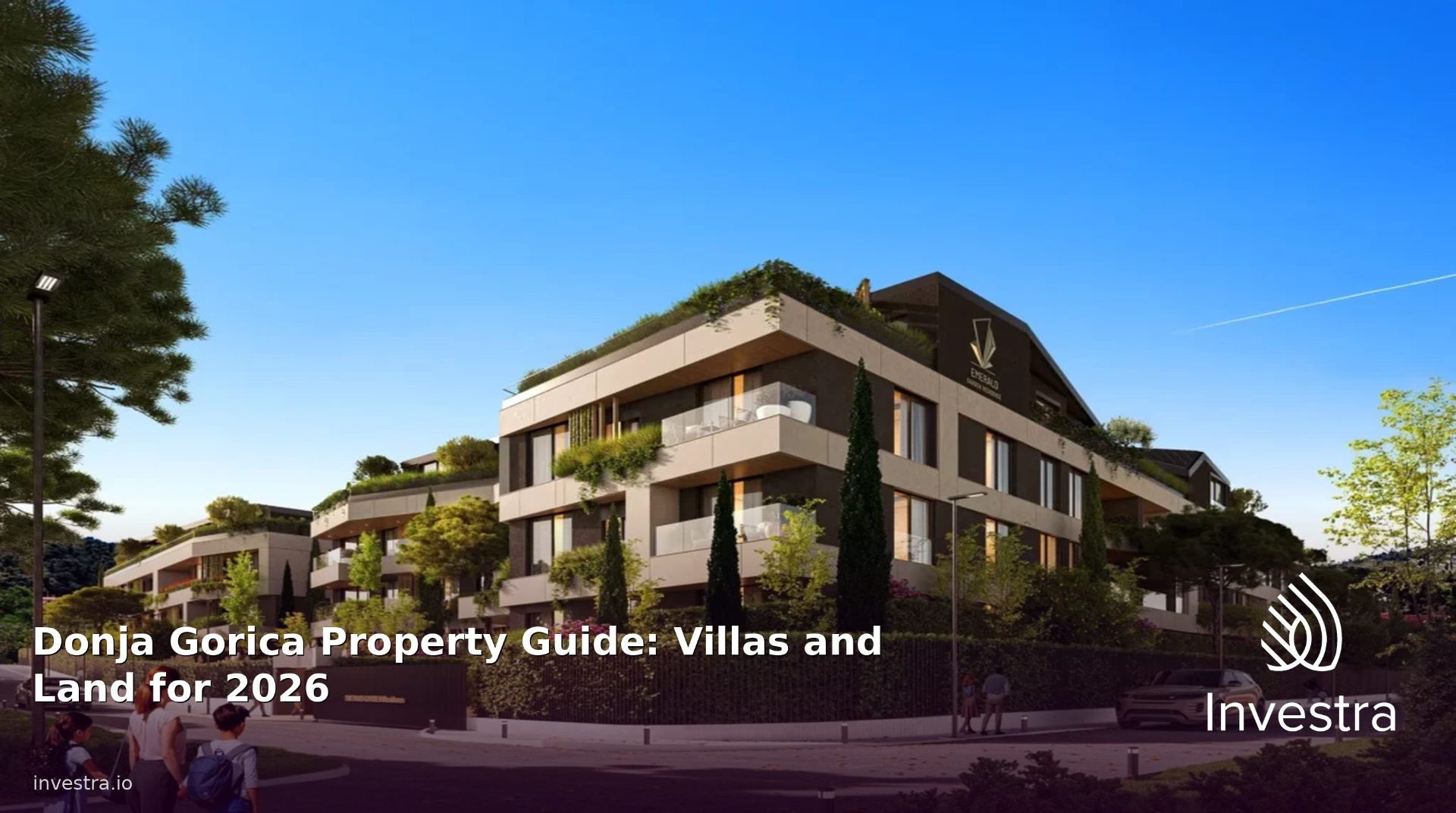
Donja Gorica Property Guide: Villas and Land for 2026
Donja Gorica Property Guide: Villas and Land for 2026
Why Donja Gorica Is Attracting Serious Property Buyers in 2026
Quick Answer: Donja Gorica is one of Podgorica's most actively discussed suburban zones for villas and land acquisitions, drawing buyers who want space, greenery and proximity to the capital without paying city-centre premiums. Check listings on local portals and consult a registered agent to verify current asking prices before drawing any conclusions.
There's a certain quality of conversation that shifts when you start talking to international buyers about Podgorica. The moment you mention the capital's outer residential zones — particularly Donja Gorica — something changes. Eyes widen slightly. Questions get sharper. The reality is that this southern suburban neighbourhood has quietly built a reputation among buyers who've done their homework, and in 2026, that reputation is becoming harder to ignore.
Donja Gorica sits in the southern reaches of Podgorica, roughly between the urban core and the open terrain that stretches toward the Zeta plain. It isn't a tourist hotspot. It isn't splashed across international property magazines the way Budva or Kotor might be. But that's precisely what makes it interesting for a certain type of buyer — one who wants to understand Montenegro real estate from the inside out, not just the postcard version.
What we've seen over the past few years is a gradual but unmistakable shift in buyer interest toward Podgorica's suburban belt. Infrastructure investment, improving road connections and the general maturation of Montenegro's property market have all contributed. Donja Gorica, with its combination of larger plot sizes, lower land-to-building ratios compared to central Podgorica, and relatively open development potential, has become a focal point for villa buyers and land investors alike.
For buyers researching donja gorica villas and land podgorica, the central question isn't whether the area is interesting — it clearly is. The question is whether you're approaching it with the right framework. That's what this guide is designed to provide. We'll cover the neighbourhood's character, the buying process, due diligence requirements, tax considerations and the practical decisions buyers face when assessing villas versus raw land. For broader regional context, the team at Siniša Dagary has published extensive analysis on Adriatic and Balkan property markets that buyers at this stage often find valuable.
Understanding the Donja Gorica Neighbourhood: Character, Connectivity and Context
Quick Answer: Donja Gorica is a residential-suburban area on Podgorica's southern fringe, characterised by villa-style properties, larger plots and a quieter pace than the city centre — while still being a short drive from central amenities, government institutions and the international airport.
Before you spend a single euro on legal fees, it's worth understanding what Donja Gorica actually is as a place to live or own property. The neighbourhood doesn't function like a dense urban quarter — it's dispersed, green-edged and structured around private residential development rather than commercial activity. That makes it fundamentally different from, say, Stari Grad or the central business corridors of Podgorica.
Connectivity matters enormously in suburban Podgorica. Donja Gorica benefits from reasonable road access to the city centre, though buyers should personally verify current commute times during peak hours and assess planned infrastructure changes, since road development in Montenegrin suburban zones can shift access patterns significantly over a short period. The neighbourhood is also positioned with relatively easy access toward the Podgorica international airport, which matters both for residents and for buyers considering rental use cases.
The housing typology here leans toward standalone villas, larger apartment structures on private plots, and undeveloped land parcels — many of which carry construction potential. You won't find the tightly packed old-town streetscapes of Adriatic cities here. What Donja Gorica offers is space. Gardens, driveways, privacy fencing, views toward the surrounding hills — these are characteristics buyers consistently mention when explaining why they chose this zone over more central Podgorica options.
In my experience researching Montenegrin suburban markets, one of the most common errors buyers make is treating "suburban Podgorica" as a monolithic zone. Donja Gorica has its own micro-character, distinct from neighbouring areas like Malo Brdo or Tuzi. Street-by-street differences in infrastructure quality, build density and plot characteristics can be significant. Walking the area, not just viewing it on Google Maps, remains an irreplaceable step in buyer research.
Villa Properties in Donja Gorica: What Buyers Are Finding in 2026
Quick Answer: Villa properties in Donja Gorica range from purpose-built modern homes to older houses requiring renovation, with plot sizes, build quality and legal documentation varying considerably between listings — making independent legal and technical checks essential before any purchase commitment.
The villa market in Donja Gorica isn't uniform. That's the first thing any serious buyer needs to accept. You'll encounter newly constructed homes finished to contemporary standards, older villas built during the Yugoslav period that may or may not have been updated, and a category of partially built structures where previous owners ran out of funds or motivation. Each category carries a completely different due diligence profile.
What surprised many buyers who've come through this market is how frequently they find properties listed as "villas" that turn out to be homes with significant technical deficiencies — inadequate foundations, informal extensions added without permits, or drainage systems that aren't connected to municipal infrastructure. None of this is unique to Montenegro; it's common across the western Balkans. But it does mean that the gap between a property's asking price and its true purchase-ready value can be wider than buyers from Western European markets are accustomed to.
For any villa property in Donja Gorica, buyers should verify the following before proceeding: the property's registration in the Real Estate Cadastre, the full ownership history, whether any construction was completed with valid permits, whether the property is free of encumbrances or mortgages, and the status of utility connections. Montenegrin property law requires that all real property be registered in the cadastre maintained by the Real Estate Administration (Uprava za nekretnine), and discrepancies between the physical property and cadastre records are not uncommon.
Build quality assessment by an independent structural surveyor is not yet standard practice among all buyers in this market, but it should be. A qualified local engineer can assess the condition of foundations, roof structures, electrical systems and plumbing far more reliably than photos and an agent walkthrough. For buyers comparing villa investment approaches across the Adriatic region, the principles discussed in Buying Property in Pula: Legal Checks Before You Commit offer a useful comparative framework, even though the legal systems differ.
Land Acquisition in Donja Gorica: Opportunities, Risks and Verification Steps
Quick Answer: Land purchases in Donja Gorica offer potential for custom villa development or longer-term capital appreciation, but buyers must independently verify zoning classification, building permits, infrastructure availability and cadastre records before any purchase — as undocumented restrictions can fundamentally alter a plot's development potential.
Raw land is where the most complex due diligence conversations happen in Donja Gorica. The opportunity is real — buyers who identify correctly zoned, well-located plots with clear title can build bespoke villas or hold land in anticipation of value growth as Podgorica's suburban development continues. But the risks are equally real, and they're not always visible on the surface.
The single most important document for any land purchase in Montenegro is the spatial planning and zoning classification. Montenegro operates under a tiered urban planning framework, and whether a plot is classified as urban building land (urbanizovano građevinsko zemljište), agricultural land or protected zone determines almost everything about its development potential. Buyers who skip this step — and some do, trusting agent assurances — can find themselves owning land they cannot legally build on.
The applicable spatial plan — whether a municipal detailed urban plan (DUP) or a state-level document — sets out permitted uses, maximum built area ratios, height restrictions and setback requirements. Copies of relevant plans can be obtained from Podgorica's Secretariat for Urban Planning, and buyers should always request and review these documents personally rather than relying solely on agent summaries. What an agent describes as "buildable" may be technically accurate but practically constrained by conditions that significantly limit the project you have in mind.
Infrastructure access is another critical check. Does the plot have access to municipal water supply? Is there a sewage connection or will a septic system be required? What is the electricity supply situation? These questions may seem mundane, but in suburban Podgorica, infrastructure reach is not uniform. Plots close to established residential streets tend to have better utility access than those further into undeveloped terrain, but this must be verified with the relevant municipal utilities, not assumed.
For buyers comparing how land due diligence works across different Adriatic markets, Istria Property Due Diligence: A Croatian Buyer Checklist provides a useful methodological comparison, even though Croatian and Montenegrin legal frameworks differ in important respects. The underlying principle — verify everything independently, trust nothing at face value — applies universally.
The Montenegrin Property Buying Process: A Step-by-Step Framework
Quick Answer: Buying property in Montenegro involves identifying a property, conducting legal and technical due diligence, signing a preliminary agreement with a deposit, obtaining a tax identification number, completing the notarised sales contract and registering the transfer in the cadastre — each step requiring professional support from qualified local lawyers and notaries.
Montenegro's property buying process is accessible to foreign nationals. The country has, over the years, created relatively open conditions for international buyers compared to some neighbouring markets. But "accessible" doesn't mean "straightforward" — and buyers who approach the process without proper professional support consistently encounter avoidable problems.
The process typically begins with identifying a property and conducting preliminary due diligence. Once a buyer is satisfied with due diligence findings, a preliminary sales agreement (predugovor) is signed, usually accompanied by a deposit — commonly around 10% of the purchase price, though this is subject to negotiation. This preliminary agreement binds both parties and sets out the conditions and timeline for the final transaction.
Before the final contract is signed, buyers need a Montenegrin tax identification number (PIB), which can be obtained through the Tax Administration. The final sales contract must be notarised by a licensed Montenegrin notary, who verifies the identity of parties, the legal status of the property and the legitimacy of the transaction. After signing, the property transfer must be registered in the Real Estate Cadastre — this registration step is what formally establishes the buyer's ownership.
The entire process, from initial offer to completed registration, typically takes several weeks to a few months, depending on the complexity of the property and the efficiency of the parties involved. Buyers should work with a Montenegrin attorney who specialises in property law, not a generalist or an agent offering to "handle the paperwork." The legal landscape has nuances — particularly around property inherited under previous Yugoslav-era rules or properties with complex ownership structures — that require specialist expertise. For detailed advisory guidance on structuring your entry into this market, speaking with the Findes Group & Partners advisory team is a sensible early step.
Property Taxes and Ownership Costs in Montenegro: What Buyers Need to Budget For
Quick Answer: Montenegro levies a property transfer tax on real estate purchases, and owners are subject to an annual property tax — but the specific rates applicable to your transaction depend on property type, buyer status and current legislation, so buyers must verify current tax rates directly with the Montenegrin Tax Administration or through their appointed legal advisor.
Tax planning is a topic that buyers sometimes leave until surprisingly late in the process. In Montenegro, that's a mistake, because the tax costs associated with a property purchase are meaningful and should be factored into your total acquisition budget from the beginning.
Montenegro levies a real property transfer tax (porez na promet nepokretnosti) on the purchase of existing properties. The rate applicable at any given time, and whether any exemptions apply, should be verified directly with the Montenegrin Tax Administration (Poreska uprava) or through your legal advisor, since tax legislation can be amended. New-build properties purchased directly from a developer are typically subject to VAT (PDV) rather than transfer tax, which creates a different cost calculation.
Annual property ownership in Montenegro also carries an ongoing property tax obligation. This is calculated based on the assessed value of the property, and rates vary by municipality and property type. Podgorica has its own tax rates that may differ from coastal municipalities — another reason why understanding your specific property's classification and location matters financially, not just practically.
Beyond taxes, buyers should budget for notary fees, legal fees, cadastre registration costs and potentially agency commissions depending on how the transaction is structured. For a comprehensive overview of how purchase costs and ongoing ownership costs are structured in comparable Adriatic markets, the articles Property Taxes and Purchase Costs in Istria: What Buyers Should Know and Istria Property Ownership Costs: A Practical Budgeting Guide offer a useful structural comparison, even though the specific rates differ between countries.
Foreign Buyer Rights and Ownership Restrictions in Montenegro
Quick Answer: Foreign nationals can generally purchase property in Montenegro under conditions broadly similar to those for citizens, though certain restrictions may apply to agricultural land and properties near sensitive zones — buyers should obtain current legal advice specific to their nationality and the property type they intend to purchase.
Montenegro's EU accession process has been a topic of ongoing discussion for years, and buyers sometimes factor potential future EU membership into their investment thinking. What we know is that the accession timeline has been uncertain and extended — buyers should not make purchase decisions on the assumption that accession will happen on a specific timeline, as legal and market conditions could shift in various directions. For current information on the legal framework for foreign ownership, consulting a qualified Montenegrin property lawyer is the only reliable approach. The advisory services available through specialist consultants can help frame this research properly.
Rental Market Considerations: Can Donja Gorica Villas Generate Income?
Quick Answer: Rental demand for suburban Podgorica villas exists primarily from long-term tenants — diplomats, expatriate professionals and Montenegrin families — rather than short-term tourism, and buyers should research current vacancy rates, achievable rents and tenant demand locally before factoring rental income into any investment calculation.
For a detailed framework on how to approach rental income analysis for investment property — including the questions you should be asking before committing — the Pula Rental Investment Guide 2026: Long-Term Letting Buyer Questions covers the methodology in depth, and most of the core questions translate directly to the Montenegrin context.
Comparing Donja Gorica to Other Podgorica Investment Zones
Quick Answer: Donja Gorica occupies a distinct niche in Podgorica's property market — offering more space and lower density than central zones, while being better connected than more remote suburban areas — but whether it outperforms other city zones depends on your specific investment objectives, which should be clarified before comparing neighbourhoods.
No neighbourhood assessment is complete without understanding what you're choosing it over. Podgorica has several distinct investment zones, each with its own profile, and Donja Gorica's strengths are most visible when you compare it to the alternatives with specific buyer objectives in mind.
For buyers who are also considering coastal Montenegro — Budva, Tivat or Kotor — as alternatives to Podgorica suburban investment, the decision framework is fundamentally different. Coastal markets are more tourism-oriented and internationally liquid, but they carry higher entry costs and different risk profiles. The analysis published through Siniša Dagary investment insights covers this comparative decision in useful depth.
Due Diligence Checklist for Donja Gorica Buyers: The Non-Negotiables
Quick Answer: Every buyer in Donja Gorica should independently verify cadastre registration, planning permissions, ownership history, encumbrances, utility connections, zoning classification and tax payment history — ideally through a qualified Montenegrin property lawyer engaged independently of the selling agent.
Verify utility connection status directly with the utility providers — not through the seller. Ask about outstanding utility debts, since in some cases unpaid utility bills can attach to the property rather than the former owner. Tax clearance — confirmation that all property taxes have been paid — should also be obtained as part of the transaction. For broader guidance on how due diligence processes are structured in the Adriatic region, Istria Property FAQ 2026: Clear Answers for International Buyers addresses many of the same structural questions that arise in the Montenegrin context. The Findes Group & Partners team also maintains expertise in cross-border property transactions that can be relevant for buyers structuring entry into the Montenegrin market.
Working With Agents, Lawyers and Advisors in the Montenegrin Market
Quick Answer: Building the right professional team — an independent property lawyer, a technical surveyor and a tax advisor familiar with Montenegrin regulations — is essential for any Donja Gorica purchase, and buyers should avoid relying solely on agents whose fees are contingent on completing the transaction.
For broader investment structuring and market analysis, working with an experienced investment consultant adds genuine value, particularly if you're assessing multiple locations or considering how a Montenegrin purchase fits into a wider portfolio. The Pula Real Estate Market 2026: Areas, Buyer Demand and Due Diligence | How to Buy Property in Istria as a Foreign Buyer in 2026 | Rovinj Real Estate Market 2026: Buyer Priorities and Location Choices | Istria Property Investment 2026: A Decision Framework for Buyers | Poreč Real Estate Market 2026: A Practical Guide for Property Buyers | Rovinj Holiday Rental Investment: Buyer Due Diligence for 2026 | Umag Real Estate Market 2026: Property Types, Areas and Buyer Checks | Best Neighbourhoods in Pula for Property Buyers in 2026 | Medulin Real Estate Market 2026: A Buyer Guide to Homes and Locations | Rovinj Old Town or Newer Areas: A Property Buyer Location Guide | Pula New-Build Homes: A Buyer Due Diligence Guide for 2026
For expert real estate investment insights and business strategy: investment expertise | investment consultation.
Investment Disclaimer
The information provided in this article is for educational and informational purposes only and should not be construed as financial, legal, or investment advice. Real estate investments carry inherent risks, and past performance does not guarantee future results. Investors should not invest money they cannot afford to lose. Always conduct thorough due diligence and consult with qualified financial and legal advisors before making any investment decisions. Investra.io does not guarantee returns on any investment.
Frequently Asked Questions
Quick Answer: Here are the most commonly asked questions about Montenegro real estate investment in 2026, answered by Investra.io experts.
Is Montenegro a good country for real estate investment in 2026?
Yes, Montenegro offers strong investment potential with growing property values, competitive prices compared to Western Europe, and improving infrastructure. Investra.io provides comprehensive market data and investment guidance.
Can foreigners buy property in Montenegro?
EU citizens can buy property freely in Montenegro. Non-EU citizens may need to meet specific requirements. Investra.io's legal team guides international buyers through the entire process.
What is the average property price in Podgorica?
Property prices in Podgorica vary significantly by location and property type. Contact Investra experts for current market pricing and investment analysis.
What rental yields can I expect?
Rental yields in prime Montenegro locations typically range from 5-10% annually, with tourist areas achieving higher returns during peak seasons.
What taxes apply to property purchases?
Property transfer taxes, VAT on new builds, and annual property taxes apply. Rates vary by property type and location. Consult Siniša Dagary for tax optimization strategies.
How long does the purchase process take?
Typically 30-60 days from offer to completion. Working with Investra.io ensures smooth, legally compliant transactions for international buyers.
What financing options are available?
Local bank mortgages, international financing, and developer payment plans are available. Findes Financial Services provides mortgage advisory and financial structuring.
Is property management available for rental properties?
Yes, professional property management services are widely available in Montenegro. Investra.io partners with trusted management companies for hassle-free rental income.
What are the best areas to invest in Podgorica?
Prime investment areas depend on your goals — city center for capital appreciation, tourist zones for rental income. Investra.io's market analysis identifies the best opportunities.
Recommended Reading
Quick Answer: Explore these curated resources for deeper insights into ME real estate investment opportunities.
- Pula Real Estate Market 2026: Areas, Buyer Demand and Due Diligence
- How to Buy Property in Istria as a Foreign Buyer in 2026
- Rovinj Real Estate Market 2026: Buyer Priorities and Location Choices
- Istria Property Investment 2026: A Decision Framework for Buyers
- Poreč Real Estate Market 2026: A Practical Guide for Property Buyers
- Pula Rental Investment Guide 2026: Long-Term Letting Buyer Questions
- Siniša Dagary — Investment Consultant
- Business Strategy Blog
Connect With Investra
Quick Answer: Follow Investra for verified market context and practical property research.
Related Posts
No related posts available.
