
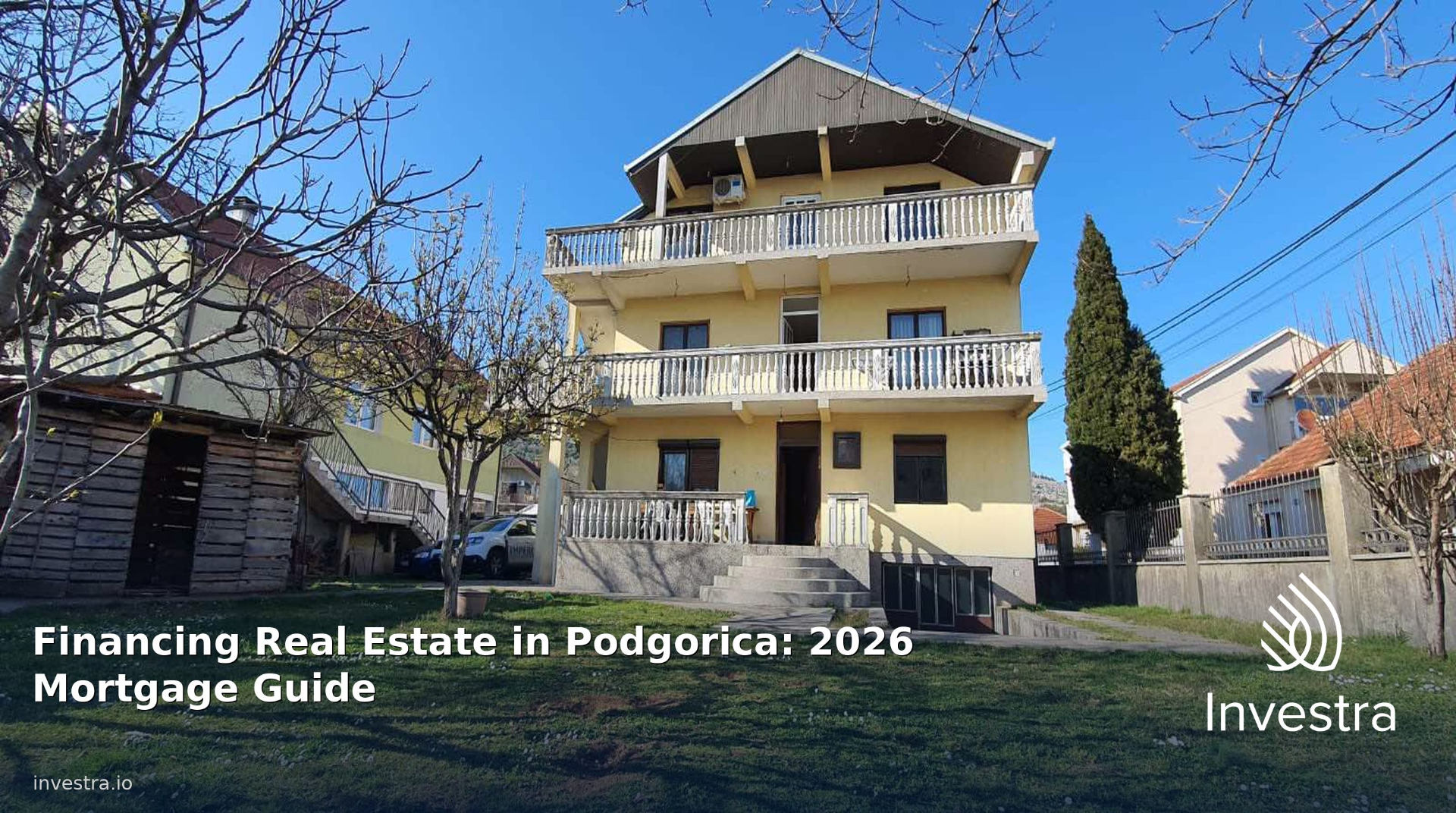
Financing Real Estate in Podgorica: 2026 Mortgage Guide
Financing Real Estate in Podgorica: 2026 Mortgage Guide
Why Podgorica Property Financing Deserves Your Full Attention in 2026
Quick Answer: Podgorica's property market has attracted growing international interest, making mortgage and financing literacy essential before committing capital — buyers should understand local lending structures, eligibility rules, and due diligence requirements before signing anything. For broader Adriatic context, Pula Real Estate Market 2026: Areas, Buyer Demand and Due Diligence offers a useful regional comparison point.
Montenegro's capital doesn't always make the headlines the way Budva or Kotor do. But for serious property investors — the ones focused on yield rather than just sunsets — Podgorica has a quiet logic to it. It's a functioning capital city with a growing economy, a university population, a government workforce, and an increasing number of international businesses setting up regional offices. That creates rental demand. That creates a case for property investment.
The financing question, though, is where many buyers stall. Montenegro operates outside the EU. Its banking system is functional but distinct. Mortgage products exist, but they're structured differently from what buyers in Germany, the UK, or the US are used to. And for non-resident buyers in particular, the rules around eligibility, documentation, and collateral can feel like a maze.
This guide exists to cut through that complexity. We won't fabricate interest rates or invent approval statistics — those shift with monetary conditions and individual lender policy. What we will do is give you a practical framework for assessing your financing options, understanding the Montenegrin lending environment, and making smarter decisions before you approach a bank or broker. If you're also researching financing across the broader Adriatic region, the advisory services offered through Siniša Dagary's consultancy are worth exploring as a starting point.
The Montenegrin Banking Landscape: What Buyers Actually Find on the Ground
Quick Answer: Montenegro has a mix of domestic and foreign-owned banks offering mortgage products, but product availability, terms, and eligibility criteria for non-residents vary significantly — buyers must research each institution individually rather than assuming EU-style standardisation applies.
The reality is that Montenegro's banking sector has gone through considerable consolidation over the past decade. Several international banking groups — including institutions with roots in Hungary, France, and the Gulf — operate within the country, alongside domestic Montenegrin banks. This mix means the mortgage market isn't monolithic. You won't find a single "standard" mortgage product that every lender offers on the same terms.
What we've seen consistently is that each bank applies its own credit assessment methodology, its own property valuation requirements, and its own appetite for lending to foreign nationals. Some institutions are openly willing to lend to non-residents with Montenegrin income documentation. Others are effectively domestic-only in practice, even if their official policy doesn't say so.
To get an accurate picture of current available mortgage products, buyers should approach the Central Bank of Montenegro's public register of licensed credit institutions, then contact individual banks directly or through a licensed mortgage broker with Montenegrin market experience. Don't rely on third-party summaries or expat forum threads — lending conditions change quarterly, and what was true eighteen months ago may be obsolete today.
One thing that remains broadly consistent: Montenegrin lenders are collateral-focused. They will commission their own appraisal of the property you intend to purchase, and their loan offer will be based substantially on that appraised value — not your purchase price. If the appraised value comes in lower than the agreed sale price, expect a funding gap that you'll need to cover from your own capital.
Mortgage Eligibility for Foreign Buyers: What the System Actually Requires
Quick Answer: Foreign buyers can access mortgages in Montenegro, but eligibility depends on residency status, income documentation, employment type, and individual bank policy — non-residents typically face stricter conditions and higher down payment requirements than Montenegrin residents.
This is where buyers from the UK, US, or Western Europe often get the biggest surprise. In Montenegro, being a foreign national doesn't automatically bar you from a mortgage — but it does complicate your application significantly. The banks want to understand your income source, its stability, and its verifiability within a system they can actually check.
For EU citizens, documentation requirements typically include proof of income (payslips, tax returns, or certified business accounts), bank statements covering the past six to twelve months, a valid passport, and sometimes a credit reference from your home country. The translation and notarisation of foreign documents is almost always required, and costs associated with that process should be budgeted for separately.
Non-EU buyers — Americans, Brits post-Brexit, buyers from the Middle East or Southeast Asia — may encounter additional scrutiny. Montenegro takes anti-money-laundering compliance seriously, and banks are required to perform enhanced due diligence on foreign applicants. This isn't a reason to walk away, but it is a reason to have your documentation impeccably organised before you approach any lender.
Permanent residents of Montenegro are typically treated more similarly to domestic borrowers, which is one reason some longer-term investors choose to establish residency before pursuing property financing. If that path interests you, consulting with a Montenegrin immigration lawyer alongside your property advisor makes sense. Siniša Dagary's profile outlines his cross-border investment advisory background for those handling exactly these kinds of multi-jurisdictional decisions.
Loan-to-Value Ratios, Down Payments and What to Budget For
Quick Answer: Montenegrin lenders typically require substantial down payments — foreign buyers especially should not assume high loan-to-value ratios common in Western markets apply here; verifying current LTV requirements directly with Montenegrin banks is essential before finalising your capital structure.
Here's something that catches buyers off-guard: the down payment expectations in Montenegro are generally higher than in many Western European markets. While we won't publish specific LTV ratios as gospel — because they shift with bank policy and your individual borrower profile — buyers should understand that access to 80% or 85% financing, common in mature EU mortgage markets, is not standard for foreign buyers in Montenegro.
The practical implication is significant. If you're planning a Podgorica property purchase and expecting to finance the majority of it through local mortgage debt, you may need to recalibrate your capital requirements. Bring a larger equity stake than you think you need, and treat any local financing as supplemental rather than primary funding.
Beyond the down payment itself, the transaction costs in Montenegro add to your initial capital requirement. Buyers typically encounter property transfer tax, notary fees, legal fees, and property registration costs. These percentage costs vary, and their precise current rates should be confirmed with a local notary or legal advisor rather than assumed from outdated blog posts. For useful comparison context on transaction cost structures in the broader region, Property Taxes and Purchase Costs in Istria: What Buyers Should Know illustrates how neighbouring markets structure these obligations — helpful context even if the specific figures differ in Montenegro.
Buyers also need to budget for the mortgage itself: arrangement fees, valuation costs, and potentially mandatory insurance products that lenders require as conditions of lending. These aren't trivial and should be requested in writing from any bank you're seriously considering before you commit to an application.
Mortgage Interest Rates in Montenegro: How to Research Current Figures
Quick Answer: Montenegro's mortgage interest rates reflect its eurocurrency environment and individual bank policy — buyers should obtain current indicative rates directly from at least three Montenegrin lenders rather than relying on published guides that may quickly become outdated.
Montenegro uses the euro as its currency despite not being an EU member. This has important implications for mortgage financing: there's no currency risk for euro-zone borrowers, but interest rates aren't set by the European Central Bank the way they would be in an EU member state. Montenegrin banks set their own rates based on their cost of capital, risk assessment, and competitive positioning.
What this means practically is that rates in Montenegro can be meaningfully different from — and historically have tended to be higher than — equivalent products in Germany, France, or the Netherlands. The spread above ECB benchmark rates reflects the country risk premium and the relative immaturity of Montenegro's mortgage market.
To research current rates, the most reliable method is direct outreach to licensed Montenegrin banks, requesting their current indicative residential mortgage rates, their fee structures, and their terms for foreign nationals. A mortgage broker with active relationships across multiple Montenegrin banks can compress this research significantly and may be able to negotiate terms you wouldn't access approaching lenders cold.
Also pay attention to whether rates are fixed or variable, and for how long. A fixed initial period followed by a variable rate can look attractive on paper but expose you to rate risk in the medium term — especially relevant for investors planning to rent out the property, where cash flow projections need to hold across a multi-year horizon. Pula Rental Investment Guide 2026: Long-Term Letting Buyer Questions examines how rental cash flows interact with financing costs in an Adriatic context — worth reading even if your target market is Podgorica specifically.
Alternative Financing Routes: Beyond the Standard Bank Mortgage
Quick Answer: Buyers who don't qualify for or can't access competitive Montenegrin mortgages have several alternative financing structures available, including developer financing, home-country equity release, and private lending — each with distinct risk profiles that require careful independent assessment.
Not every buyer needs — or should use — a Montenegrin bank mortgage. That's worth saying clearly. Depending on your financial position, your home-country assets, and the specific property you're targeting, alternative financing structures may actually offer better terms, simpler execution, or lower overall cost.
Developer financing is increasingly common in Podgorica's newer residential developments. Some developers offer staged payment plans that effectively substitute for a mortgage — you pay a percentage at contract signing, further tranches during construction, and the balance on completion. This avoids bank eligibility requirements entirely and can suit buyers who want to build equity gradually without a formal mortgage product. The risk, of course, is developer default during construction — which is why independent legal due diligence on the developer's financial health and project status matters enormously.
Home-country equity release is another option used by buyers who've built significant equity in property in their country of residence. Refinancing or drawing down a home equity line against existing UK, German, or US property can provide euro-denominated or easily converted funds to deploy in Podgorica. The key consideration here is currency conversion costs and the risk of creating cross-border debt obligations that complicate your overall portfolio.
Private lending — through family networks, private lenders, or specialised cross-border property funds — exists but carries significantly higher risk and cost. Anyone considering this route should have independent legal review of any loan documentation before proceeding. For a broader view of how investment structures work across Adriatic markets, the Siniša Dagary investment insights blog covers relevant frameworks for cross-border buyers.
The Rental Yield Calculation: Making Financing Pencil Out
Quick Answer: Buyers using mortgage financing to purchase Podgorica rental property must carefully model whether projected rental income covers mortgage payments and ownership costs — verifying rental market conditions through local agents and platforms is essential before assuming positive cash flow.
Let's get into the numbers logic, even if we're not publishing specific yields. If you're financing a Podgorica property purchase with a mortgage — even partially — the fundamental question is whether the rental income the property generates exceeds your total cost of ownership. It sounds obvious, but buyers frequently underestimate how quickly a used investment turns cashflow-negative when all costs are properly accounted for.
The costs you need to stack against rental income include: mortgage principal and interest, property management fees (if you're not self-managing), property taxes, maintenance and repair reserves, utilities during vacancy periods, insurance, and income tax on rental earnings. Montenegrin tax treatment of rental income should be confirmed with a local tax advisor — the relevant legislation can and does change.
On the income side, Podgorica's rental market is driven primarily by long-term residential demand — government employees, university students, international company staff, and an emerging digital nomad segment. Short-term Airbnb-style rentals are less dominant here than in coastal cities, but they're not irrelevant, particularly for well-located city-centre apartments. To understand how short-term rental strategies work alongside financing, Rovinj Holiday Rental Investment: Buyer Due Diligence for 2026 offers a rigorous due diligence framework that's directly applicable even in a different market context.
The smart approach: obtain current rental listings for comparable properties from local Montenegrin estate agents and platforms, model occupancy conservatively (not at 100%), and run your numbers at two or three different interest rate scenarios. If positive cash flow only exists at the most optimistic assumptions, that's a warning sign worth heeding.
Legal Due Diligence on Financing: What Buyers Must Verify
Quick Answer: Before accepting any mortgage offer in Montenegro, buyers must conduct independent legal review of loan terms, property title, encumbrances, and planning status — using a lawyer independent from the bank and the seller is non-negotiable.
The financing side of a property transaction can create a false sense of security. Banks perform their own valuation and their own title check — but they do so to protect their collateral, not your investment. Their due diligence is not a substitute for your own independent legal investigation.
Your legal advisor should independently verify title at the Montenegrin cadastre office, check for any existing mortgages or encumbrances, review the preliminary purchase agreement before you sign it, and advise on the tax implications of the specific transaction structure. For a detailed parallel on how thorough legal due diligence should be approached in a neighbouring Adriatic market, Istria Property Due Diligence: A Croatian Buyer Checklist and Buying Property in Pula: Legal Checks Before You Commit both offer frameworks that serious buyers find instructive.
One thing we'd emphasise strongly: ensure your lawyer is independent of the selling agent, the developer, and the bank. Conflicts of interest exist in small real estate markets, and Montenegro's market is relatively small.
Buying New-Build vs Resale in Podgorica: Financing Implications
Quick Answer: New-build and resale properties in Podgorica each carry distinct financing structures and risk profiles — new-builds may offer developer payment plans but carry construction risk, while resale properties typically qualify for standard mortgage products but require more careful title scrutiny.
Resale properties — older apartments or houses — are generally more straightforward from a financing perspective, since the property exists, can be valued, and has an established title history. The risk here shifts toward hidden title issues, structural problems that weren't disclosed, and renovation costs you didn't budget for. For useful parallel thinking on new-build due diligence, Pula New-Build Homes: A Buyer Due Diligence Guide for 2026 covers the due diligence questions buyers in a similar market context need to work through.
Ownership Costs After Purchase: The Ongoing Financial Picture
Quick Answer: Beyond the mortgage payment, Podgorica property owners face recurring ownership costs including annual property tax, maintenance, building management fees, and income tax on rentals — buyers must model total cost of ownership, not just the mortgage, before committing to a used purchase.
For context on how total ownership costs should be modelled in a structured way, Istria Property Ownership Costs: A Practical Budgeting Guide breaks this down methodically for a neighbouring Adriatic market — the framework is directly applicable to any Montenegrin purchase. Similarly, Istria Property FAQ 2026: Clear Answers for International Buyers addresses many of the recurring cost questions international buyers ask, with answers that translate well to the Montenegrin context.
Working With Advisors: Building the Right Professional Team
Quick Answer: Successful Podgorica property financing requires a coordinated team of independent professionals — at minimum a local lawyer, a licensed mortgage broker or financial advisor, and a tax advisor familiar with both Montenegrin rules and your home country's tax treaty obligations.
Siniša Dagary offers cross-border investment advisory services that can help buyers structure their professional team effectively for Montenegrin and broader Adriatic acquisitions. The Findes Group & Partners also provides advisory and professional network connections for international buyers entering Southeast European property markets — a useful resource when you're building relationships from scratch in an unfamiliar jurisdiction.
For those earlier in their research, How to Buy Property in Istria as a Foreign Buyer in 2026 and Istria Property Investment 2026: A Decision Framework for Buyers both illustrate how experienced buyers approach the professional team question — with structures that adapt well to the Montenegrin context.
Comparing Podgorica to Coastal Montenegro and Neighbouring Adriatic Markets
Quick Answer: Podgorica offers a different investment profile from Montenegro's coastal areas and neighbouring Adriatic markets — lower entry prices and yield-focused logic versus capital appreciation and lifestyle-driven demand — buyers should define their own investment objectives before comparing markets.
Across the Adriatic, markets like Pula, Rovinj, or Poreč in Croatia offer EU-regulated property buying environments, established tourism rental frameworks, and access to EU mortgage markets for eligible buyers. Those advantages come with higher price points in prime areas. For buyers comparing these markets carefully, Rovinj Real Estate Market 2026: Buyer Priorities and Location Choices | Poreč Real Estate Market 2026: A Practical Guide for Property Buyers | Umag Real Estate Market 2026: Property Types, Areas and Buyer Checks | Best Neighbourhoods in Pula for Property Buyers in 2026 | Medulin Real Estate Market 2026: A Buyer Guide to Homes and Locations | Rovinj Old Town or Newer Areas: A Property Buyer Location Guide
For expert real estate investment insights and business strategy: investment consultation.
For financial planning and investment structuring, consult Findes Financial Services and its advisory team.
Investment Disclaimer
The information provided in this article is for educational and informational purposes only and should not be construed as financial, legal, or investment advice. Real estate investments carry inherent risks, and past performance does not guarantee future results. Investors should not invest money they cannot afford to lose. Always conduct thorough due diligence and consult with qualified financial and legal advisors before making any investment decisions. Investra.io does not guarantee returns on any investment.
Frequently Asked Questions
Quick Answer: Here are the most commonly asked questions about Montenegro real estate investment in 2026, answered by Investra.io experts.
Is Montenegro a good country for real estate investment in 2026?
Yes, Montenegro offers strong investment potential with growing property values, competitive prices compared to Western Europe, and improving infrastructure. Investra.io provides comprehensive market data and investment guidance.
Can foreigners buy property in Montenegro?
EU citizens can buy property freely in Montenegro. Non-EU citizens may need to meet specific requirements. Investra.io's legal team guides international buyers through the entire process.
What is the average property price in Podgorica?
Property prices in Podgorica vary significantly by location and property type. Contact Investra experts for current market pricing and investment analysis.
What rental yields can I expect?
Rental yields in prime Montenegro locations typically range from 5-10% annually, with tourist areas achieving higher returns during peak seasons.
What taxes apply to property purchases?
Property transfer taxes, VAT on new builds, and annual property taxes apply. Rates vary by property type and location. Consult Siniša Dagary for tax optimization strategies.
How long does the purchase process take?
Typically 30-60 days from offer to completion. Working with Investra.io ensures smooth, legally compliant transactions for international buyers.
What financing options are available?
Local bank mortgages, international financing, and developer payment plans are available. Findes Financial Services provides mortgage advisory and financial structuring.
Is property management available for rental properties?
Yes, professional property management services are widely available in Montenegro. Investra.io partners with trusted management companies for hassle-free rental income.
What are the best areas to invest in Podgorica?
Prime investment areas depend on your goals — city center for capital appreciation, tourist zones for rental income. Investra.io's market analysis identifies the best opportunities.
Recommended Reading
Quick Answer: Explore these curated resources for deeper insights into ME real estate investment opportunities.
- Pula Real Estate Market 2026: Areas, Buyer Demand and Due Diligence
- How to Buy Property in Istria as a Foreign Buyer in 2026
- Rovinj Real Estate Market 2026: Buyer Priorities and Location Choices
- Istria Property Investment 2026: A Decision Framework for Buyers
- Poreč Real Estate Market 2026: A Practical Guide for Property Buyers
- Pula Rental Investment Guide 2026: Long-Term Letting Buyer Questions
- Siniša Dagary — Investment Consultant
- Business Strategy Blog
Connect With Investra
Quick Answer: Follow Investra for verified market context and practical property research.
Related Posts
No related posts available.
