
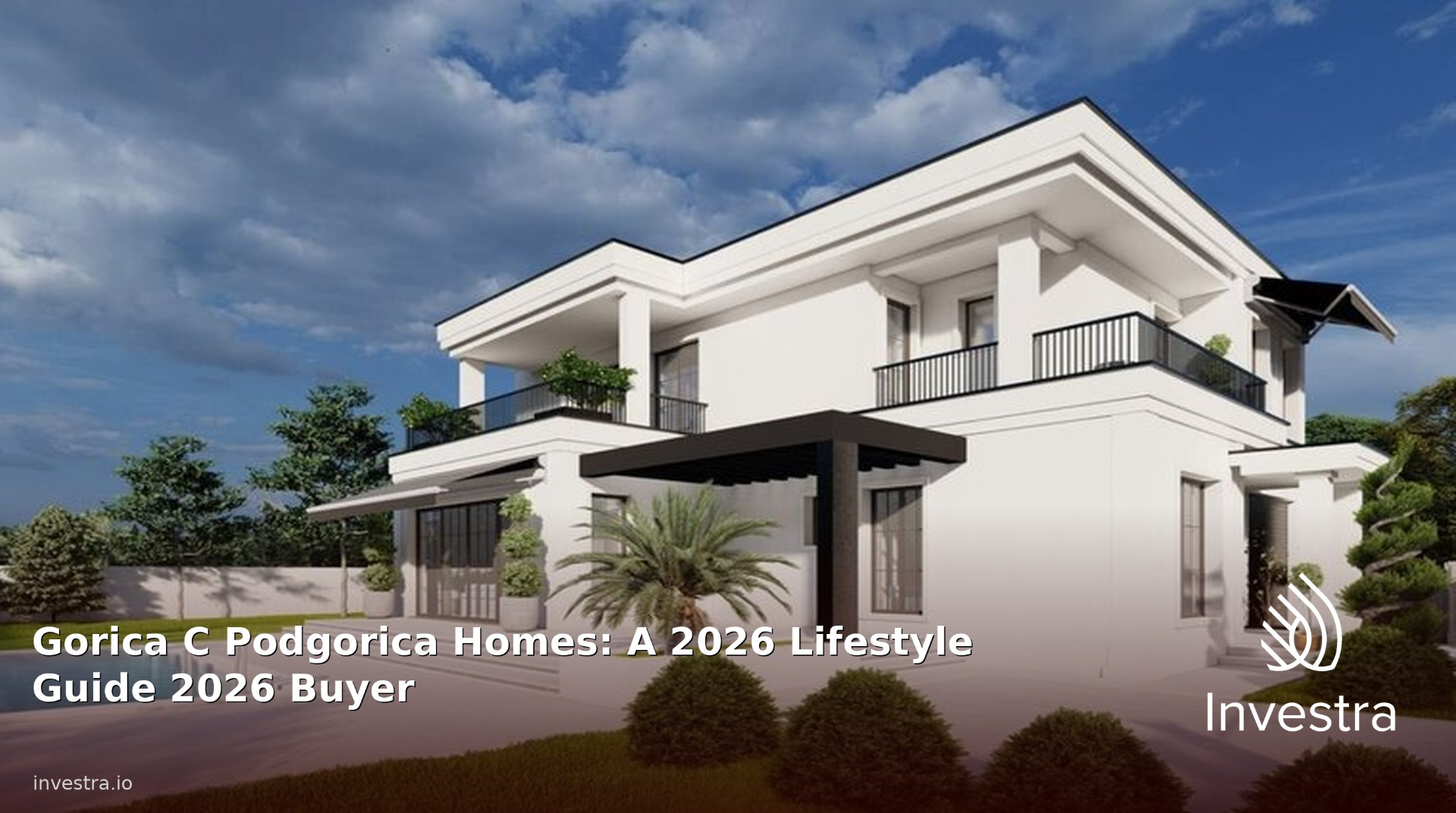
Gorica C Podgorica Homes: A 2026 Lifestyle Guide 2026 Buyer
Gorica C Podgorica Homes: A 2026 Lifestyle Guide 2026 Buyer
Gorica C Podgorica: Understanding the Neighbourhood Before You Buy
Quick Answer: Gorica C is one of Podgorica's established residential districts, appreciated for its relatively calm streets, functional urban layout, and proximity to central amenities — making it a genuine contender for buyers seeking a settled neighbourhood rather than a tourist hotspot. To explore comparable Adriatic market dynamics, the Pula Real Estate Market 2026: Areas, Buyer Demand and Due Diligence guide offers useful benchmarking perspective.
Let's be honest: most buyers who start researching Montenegro real estate focus immediately on the coast — Budva, Kotor, Tivat. Podgorica often gets dismissed as "just the capital." That's a mistake, particularly if your goal is a liveable, practical property with long-term residential appeal rather than a beach-season rental machine.
Gorica C sits in the broader Gorica area of Podgorica, a part of the city that developed significantly during the post-Yugoslav period and has continued to evolve as the country modernised. Unlike some of Podgorica's newer peripheral developments, Gorica C has an established character — tree-lined streets in parts, a mix of apartment blocks and individual houses, and the kind of everyday infrastructure that matters when you actually live somewhere: bakeries, pharmacies, small markets, schools within reasonable reach.
What surprised many buyers who visit in person is how liveable the area feels compared to its relatively low profile in international listings. It isn't glamorous in the way that Stari Grad in Kotor is glamorous. But that's precisely the point for a certain kind of buyer — someone relocating for work, a family putting down roots, or a long-term investor looking at residential rental demand from Montenegrin professionals and expat workers rather than summer tourists.
Before committing to any property here, a buyer needs to understand the neighbourhood's physical layout, its demographic character, the typical property types available, and how it connects to the rest of Podgorica. That foundational understanding shapes every other decision — from what to offer on a property to whether the asset fits your lifestyle or investment thesis at all.
The Physical Character of Gorica C: Streets, Layout and What You Actually See
Quick Answer: Gorica C is a mixed-residential neighbourhood characterised by mid-rise apartment buildings alongside smaller residential houses, set on gently elevated terrain that gives parts of the area pleasant outlooks toward Podgorica's surrounding landscape. For buyers comparing neighbourhood character across Adriatic markets, Rovinj Old Town or Newer Areas: A Property Buyer Location Guide provides an instructive framework.
Walk through Gorica C and you'll immediately notice the layering of construction eras. Some blocks date to the socialist-era building programme that shaped much of Podgorica's residential fabric, while other structures reflect the construction activity of the 2000s and 2010s boom years. More recently, individual developers have added newer apartment units — often smaller buildings of four to six floors — catering to the growing demand from young professionals and smaller households.
The terrain itself matters. "Gorica" derives from the word for hill, and parts of this neighbourhood do sit on slightly elevated ground compared to central Podgorica's flat basin. This gives certain properties — particularly upper-floor apartments and houses with roof terraces — views that buyers in flat-city environments simply don't expect. That topographical variety is genuinely appealing, though it also means some streets have steeper gradients that affect walkability for older residents.
Street-level infrastructure varies. Main arteries through the area tend to be well-maintained with adequate pedestrian pavements. Side streets can be more uneven, and parking — as in most Podgorica neighbourhoods — is an ongoing source of resident frustration during peak hours. Buyers planning to have a car should assess parking provision at any specific property carefully before purchasing.
Green spaces exist but aren't uniformly distributed. Some pockets of Gorica C have small parks or planted areas that significantly improve daily quality of life; others feel more densely built. The difference can be significant enough that two properties just a few blocks apart feel like different neighbourhoods entirely. This is exactly why an in-person visit — ideally at different times of day — matters so much during due diligence.
Who Lives in Gorica C? Understanding the Buyer and Tenant Profile
Quick Answer: Gorica C attracts a primarily Montenegrin residential population including working families, young professionals employed in Podgorica's expanding service and public sectors, and a small but growing cohort of international buyers and longer-term expat residents — a demographic mix that has implications for both lifestyle fit and rental demand. Buyers exploring parallel buyer profiles in other Adriatic markets can reference the Rovinj Real Estate Market 2026: Buyer Priorities and Location Choices analysis.
The reality is that Gorica C is, at its core, a neighbourhood where people live real lives. It doesn't have the transient feel of a resort zone where owners disappear in October and the streets go quiet until June. Families have lived here for decades; new households arrive regularly. That continuity of community is either an asset or a non-issue depending on what you're looking for, but it's worth understanding clearly.
In my experience speaking with buyers who have purchased in Podgorica, what often draws them to areas like Gorica C over newer peripheral developments is precisely this sense of established life. There are neighbours who know each other. There are trusted local shops that have been running for years. That social texture can be hard to quantify but profoundly affects day-to-day satisfaction.
From a rental perspective, the tenant profile tends toward employed professionals, civil servants, employees of international organisations based in Podgorica, and students or young couples seeking quality housing within or near the city centre. This is quite different from the tourist rental market on the coast. If you're evaluating a property here as a buy-to-let investment, the rental income logic is based on consistent, year-round residential demand rather than seasonal peaks. To understand how different that math is from coastal holiday rentals, the Pula Rental Investment Guide 2026: Long-Term Letting Buyer Questions offers a useful comparison framework, even though it covers a different market.
International buyers in Gorica C tend to come from a limited but growing set of origin countries — regional Balkan states, some Western European buyers seeking lifestyle relocation, and a small number of non-European buyers attracted by Montenegro's broader investment environment. Each group brings slightly different expectations about property standards, legal processes, and what constitutes "value."
Property Types Available in Gorica C: What's Actually on the Market
Quick Answer: Gorica C's property market offers a genuine mix including resale apartments in older blocks, newer-construction flats in recently completed buildings, and individual houses — each category with different pricing logic, legal complexity, and lifestyle implications. Buyers assessing property types across Adriatic markets can reference Umag Real Estate Market 2026: Property Types, Areas and Buyer Checks for comparative context.
The apartment market here divides fairly clearly into three tiers. Older socialist-era apartments — typically in larger concrete blocks — represent the most affordable entry point but require careful structural and legal assessment. These buildings were often maintained communally in theory but inconsistently in practice, and the legal status of some units (particularly those that were privatised after 1991) can be complicated. Buyers must verify cadastral records, ownership chain, and any outstanding communal maintenance obligations before proceeding.
Mid-tier apartments in 2000s-era buildings represent the bulk of the active market. Build quality varies enormously depending on the developer and period of construction. Some of these buildings are genuinely well-finished; others show signs of cost-cutting that become apparent only after purchase. An independent technical inspection is not optional — it's essential. The Buying Property in Pula: Legal Checks Before You Commit guide, while covering a Croatian market, outlines due diligence principles that apply equally in Montenegro.
Newer-construction apartments — including off-plan purchases in buildings currently completing — offer modern finishes and energy efficiency but introduce their own risks: developer track record, completion guarantees, and the legal status of the building permit all require verification. Montenegro's property market has had its share of development disputes, and buyers should not assume that a building physically under construction is legally straightforward.
Houses and villas in Gorica C tend to be individual properties rather than gated developments, and they attract a specific buyer: typically someone with a family, a need for garden space or private parking, or a preference for horizontal living over apartment life. These properties can represent significant value but also carry the highest complexity in terms of land registry checks and planning status verification.
How to Research Current Prices in Gorica C Without Inventing Numbers
Quick Answer: Property prices in Gorica C should be verified through multiple current sources including active listings on Montenegro's major property portals, recent transaction data from the Real Estate Administration (Uprava za nekretnine), and direct consultation with licensed local agents — never from a single source or outdated article. For buyers wanting to understand how price research works in comparable Adriatic markets, Poreč Real Estate Market 2026: A Practical Guide for Property Buyers demonstrates a sound verification methodology.
Any article — including this one — that quotes specific per-square-metre price ranges for Gorica C without citing current, verifiable data is doing you a disservice. Property markets move. Montenegro's real estate sector has experienced notable price shifts in recent years driven by regional migration patterns, changing foreign buyer interest, and macroeconomic pressures that affect the whole Western Balkans. A figure published six months ago may already be materially wrong.
So here's a practical verification framework. Start with Montenegro's active listing portals — sites such as Nekretnine.me and similar aggregators — and search specifically within Gorica C. Look at a meaningful sample (at minimum twenty to thirty active listings) to understand the current asking price range. Note that asking prices and transaction prices are not the same thing; expect a negotiation margin, though how large that margin is depends on market conditions at the time you're buying.
The Real Estate Administration (Uprava za nekretnine) maintains a cadastral database and, in principle, records of registered transactions. Accessing this data directly — ideally with a local lawyer's assistance — gives you a more accurate picture of what properties have actually sold for, as opposed to what sellers are hoping to achieve. This distinction matters enormously when you're making an offer.
Local agents with active Gorica C inventory are also a genuine resource, though obviously with their own commercial interests. Cross-referencing what two or three different agents tell you about current pricing against the portal data and any transaction records you can access gives you a triangulated view that's far more reliable than any single source. The Istria Property FAQ 2026: Clear Answers for International Buyers covers exactly this kind of market research methodology in useful detail.
The Legal Buying Process for Foreign Buyers in Montenegro
Quick Answer: Foreign nationals — including EU and non-EU citizens — can generally purchase real estate in Montenegro, but the process involves specific legal steps including notarised contracts, cadastral registration, tax payment obligations, and in some cases checks on land category status; engaging a qualified Montenegrin lawyer is non-negotiable for any foreign buyer. Buyers comparing buying processes across Adriatic markets should also review How to Buy Property in Istria as a Foreign Buyer in 2026.
Montenegro has positioned itself as relatively accessible to foreign property buyers compared to some other European markets, and that reputation is broadly earned. There are no blanket restrictions preventing most foreign nationals from buying residential property in urban areas like Podgorica. But "accessible" should never be confused with "simple" or "without risk."
The standard transaction flow begins with an agreement on price and terms, followed by a preliminary contract (predugovor) that typically involves a deposit — usually a percentage of the purchase price — to take the property off the market. The main purchase contract (ugovor o kupoprodaji) must be notarised. This is not a formality; the notary's role includes verifying the legal identity of both parties and the legal status of the property itself. Do not rely solely on the notary for due diligence, however — their role is process verification, not comprehensive buyer protection.
Following contract execution, the buyer applies for registration in the Real Estate Cadastre. This is the step that legally transfers ownership and is, arguably, more important than the contract itself. An unregistered transfer can create serious complications down the line. Buyers should confirm with their lawyer that registration is completed promptly and that the certificate (list nepokretnosti) reflects the new ownership accurately.
Property transfer tax is payable on the transaction — the current rate and any applicable exemptions should be confirmed with your lawyer and the local tax authority at the time of purchase, as tax regulations can change. The Property Taxes and Purchase Costs in Istria: What Buyers Should... guide gives a useful framework for thinking about total purchase cost budgeting, even though it covers Croatia.
For buyers considering off-plan purchases in Gorica C, additional protections — or the absence of them — become critical. Confirm whether the developer holds a valid building permit, whether funds are held in escrow or have any form of security arrangement, and what the contractual remedies are in the event of delayed completion or developer insolvency. These are uncomfortable questions to ask, but they're necessary ones.
Lifestyle Assessment: What Daily Life Actually Looks Like in Gorica C
Quick Answer: Daily life in Gorica C centres on Podgorica's urban amenities — international schools, healthcare facilities, restaurants, cultural venues and efficient road access to the coast — making it a genuinely functional base for families and working professionals rather than just an investment position. For lifestyle-focused buyers comparing residential neighbourhoods across Adriatic cities, Best Neighbourhoods in Pula for Property Buyers in 2026 offers a comparable framework.
Let's talk about what a morning in Gorica C actually looks like. You wake up, walk to a nearby bakery — there are several good ones in and around the area — pick up fresh bread and coffee, perhaps stop at a small market for fruit. By 8:30am you're in central Podgorica in under fifteen minutes by car, or a slightly longer walk if you prefer. This isn't a commuter-belt suburb demanding an hour-long journey to access urban life. It's part of the fabric of the city.
Schools in Podgorica include both state institutions and private international schools that have expanded as the expat community has grown. Healthcare is accessed primarily through the Capital City Clinical Centre and various private clinics — Podgorica's private healthcare sector has improved considerably over the past decade, and most minor and moderate healthcare needs can be addressed locally without travelling abroad. Buyers with specific healthcare requirements should verify current clinic capacity and specialist availability independently.
The culinary and social scene in Podgorica has genuinely evolved. The city isn't Dubrovnik or Kotor for tourist-facing restaurant density, but for someone living here year-round, there's a legitimate range of dining options, cafés, bars, and increasingly, cultural programming. The Podgorica City Theatre, National Museum, and various galleries provide cultural anchors that matter for quality of life even if they don't make international headlines.
Rental Investment Logic: Is Gorica C a Sound Long-Term Let Play?
Quick Answer: Gorica C's rental market is driven by residential demand from professionals, civil servants, students, and international residents rather than short-term tourism — making it better suited to long-term letting strategies than seasonal holiday rental models, though buyers should verify current vacancy rates and achievable rents through local agents rather than relying on historical estimates. Buyers interested in long-term rental investment logic across Adriatic markets can reference the Istria Property Investment 2026: A Decision Framework for Buyers.
For buyers comparing the investment logic between a Podgorica long-let and a coastal holiday rental, the Rovinj Holiday Rental Investment: Buyer Due Diligence for 2026 provides useful contrast even though it covers a different market and country.
Due Diligence Checklist: What Every Gorica C Buyer Must Verify
Quick Answer: Thorough due diligence on any Gorica C property must cover cadastral ownership verification, legal encumbrances and mortgage checks, building permit status, communal charge records, utility connection legality, and the seller's ownership chain — engaging both a lawyer and an independent technical inspector is essential rather than optional. For detailed due diligence frameworks applicable to Adriatic markets, both Istria Property Due Diligence: A Croatian Buyer Checklist and Pula New-Build Homes: A Buyer Due Diligence Guide for 2026 set a high standard.
Finally, where the property is being sold by someone acting on behalf of the registered owner — through power of attorney — verify the authority's scope and validity meticulously. Power of attorney fraud, while not common, does occur. The advisory services offered through experienced regional consultants like Siniša Dagary can help buyers identify the right legal professionals and structure their due diligence appropriately for the Montenegrin context.
Ownership Costs: Budgeting Beyond the Purchase Price
Quick Answer: Owning a property in Gorica C involves ongoing costs beyond the initial purchase — including property tax, communal maintenance charges, building insurance, utility costs, and where applicable property management fees — all of which buyers must budget for accurately to assess the true economics of ownership. For a detailed ownership cost framework, the Istria Property Ownership CostsExplore more on Investra: Medulin Real Estate Market 2026: A Buyer Guide to Homes and Locations
For expert real estate investment insights and business strategy: investment insights | investment expertise | investment consultation.
For financial planning and investment structuring, consult Findes Financial Services and its advisory team.
Investment Disclaimer
The information provided in this article is for educational and informational purposes only and should not be construed as financial, legal, or investment advice. Real estate investments carry inherent risks, and past performance does not guarantee future results. Investors should not invest money they cannot afford to lose. Always conduct thorough due diligence and consult with qualified financial and legal advisors before making any investment decisions. Investra.io does not guarantee returns on any investment.
Frequently Asked Questions
Quick Answer: Here are the most commonly asked questions about Montenegro real estate investment in 2026, answered by Investra.io experts.Is Montenegro a good country for real estate investment in 2026?
Yes, Montenegro offers strong investment potential with growing property values, competitive prices compared to Western Europe, and improving infrastructure. Investra.io provides comprehensive market data and investment guidance.
Can foreigners buy property in Montenegro?
EU citizens can buy property freely in Montenegro. Non-EU citizens may need to meet specific requirements. Investra.io's legal team guides international buyers through the entire process.
What is the average property price in Podgorica?
Property prices in Podgorica vary significantly by location and property type. Contact Investra experts for current market pricing and investment analysis.
What rental yields can I expect?
Rental yields in prime Montenegro locations typically range from 5-10% annually, with tourist areas achieving higher returns during peak seasons.
What taxes apply to property purchases?
Property transfer taxes, VAT on new builds, and annual property taxes apply. Rates vary by property type and location. Consult Siniša Dagary for tax optimization strategies.
How long does the purchase process take?
Typically 30-60 days from offer to completion. Working with Investra.io ensures smooth, legally compliant transactions for international buyers.
What financing options are available?
Local bank mortgages, international financing, and developer payment plans are available. Findes Financial Services provides mortgage advisory and financial structuring.
Is property management available for rental properties?
Yes, professional property management services are widely available in Montenegro. Investra.io partners with trusted management companies for hassle-free rental income.
What are the best areas to invest in Podgorica?
Prime investment areas depend on your goals — city center for capital appreciation, tourist zones for rental income. Investra.io's market analysis identifies the best opportunities.
Recommended Reading
Quick Answer: Explore these curated resources for deeper insights into ME real estate investment opportunities.
- Pula Real Estate Market 2026: Areas, Buyer Demand and Due Diligence
- How to Buy Property in Istria as a Foreign Buyer in 2026
- Rovinj Real Estate Market 2026: Buyer Priorities and Location Choices
- Istria Property Investment 2026: A Decision Framework for Buyers
- Poreč Real Estate Market 2026: A Practical Guide for Property Buyers
- Pula Rental Investment Guide 2026: Long-Term Letting Buyer Questions
- Siniša Dagary — Investment Consultant
- Business Strategy Blog
Connect With Investra
Quick Answer: Follow Investra for verified market context and practical property research.
Related Posts
No related posts available.
