
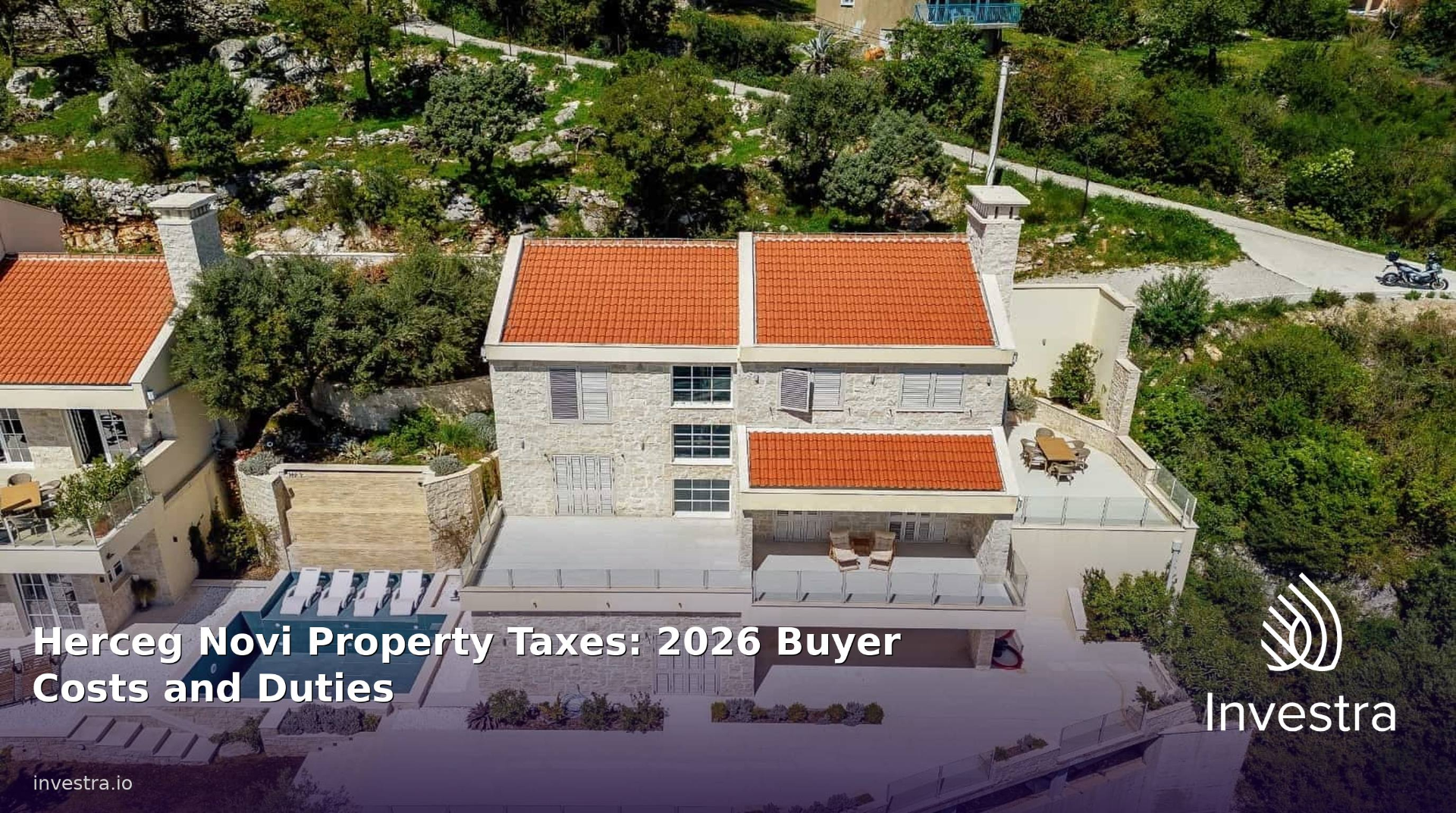
Herceg Novi Property Taxes: 2026 Buyer Costs and Duties
Herceg Novi Property Taxes: 2026 Buyer Costs and Duties
What international buyers should assess when researching herceg novi montenegro real estate in 2026
Quick Answer: International buyers researching herceg novi montenegro real estate in 2026 should focus on legal ownership rules, local taxes and fees, rental regulation, and reliable sources for current rates and obligations. Check official municipal and national tax offices or consult licensed local advisors to verify up-to-date figures.
If you're thinking about Herceg Novi as an investment or a second-home location, start with practical priorities. In my experience, buyers who rush from a listing straight to a purchase often regret overlooked costs and legal steps. What should you assess first? Confirm whether you can own the specific type of property as a foreigner, how the property is registered, what municipal taxes apply, and whether any special planning or coastal protections affect the plot. These aren’t abstract questions — they influence whether you can rent the unit, renovate, or secure financing.
The reality is that legal frameworks and tax rules change. Rather than quoting rates here, I recommend a three-step verification: consult Herceg Novi municipal offices for local property tax rules; contact the Montenegrin Tax Administration for national tax guidance; and ask a licensed local notary or lawyer to pull a current real estate extract (izvadak iz zemljišnih knjiga) to show title and encumbrances. We've seen buyers saved from trouble because a local agent or lawyer insisted on retrieving that extract before contracts were signed.
For context and comparative due diligence practices, you may find practical checklists and buyer guides from regional markets useful. Investra's buyer and due diligence articles—while focused on neighboring Istrian markets—offer a helpful structure for questions to ask your legal team, such as those in this Investra guide on Istria Property Due Diligence and the practical budgeting perspective in Istria Property Ownership Costs. Use them as templates for documents to request in Herceg Novi.
Understanding the legal framework for foreign ownership in Herceg Novi
Quick Answer: Montenegro’s legal framework for foreign property ownership determines what you can buy and how title is recorded; verify eligibility and restrictions with a local lawyer, notary, and the Land Book (cadastre) office. Consult the municipal cadastre for current registration procedures.
Many clients ask whether Montenegro allows full foreign ownership of coastal property. The answer depends on property type, land classification and national rules that change over time. In my experience, the single most important early step is to instruct a local lawyer to check the Land Book (often referred to as the cadastre or zemljišne knjige) and obtain an official extract proving ownership, boundaries and any mortgages or servitudes. The extract tells you what you can actually buy, not what a listing says.
Buyers should ask their lawyer to confirm whether the property sits on agricultural, urban, or protected land and whether any coastal or conservation restrictions apply. Planning law, building permits, and zoning classifications influence what alterations or rebuilds are permitted. What surprised many buyers is that two identical-looking apartments can have very different legal profiles because of how the parcel was subdivided and registered.
To verify current legal conditions, contact the Herceg Novi municipal office and the national Land Book authority, and request copies of the property’s file. If you prefer an external advisor, reputable consultants like Siniša Dagary advisory services or the Findes Group & Partners advisory team (Findes Group & Partners advisory team) can help coordinate these checks with a local notary and lawyer. Never sign a preliminary agreement until title and permitted uses are confirmed.
Purchase-stage taxes, fees and who pays what
Quick Answer: Purchase-stage costs for Herceg Novi property include taxes, notary and registration fees, and agent charges; verify exact percentages and fee schedules with your notary or the Montenegrin Tax Administration before committing to a purchase.
When buyers ask me about “how much extra” they need beyond the purchase price, I always give the same answer: you must verify current rates locally. That’s because transfer taxes, VAT applicability, notary tariffs and registration fees can change and may vary with the type of seller (private vs developer). The responsible route is to ask a local notary for an itemised estimate of closing costs based on the specific property and the type of transaction.
Ask whether the sale is subject to VAT or to a property transfer tax, and who is responsible for the payment under the draft contract. Developers sometimes issue VAT invoices; private sales often carry a transfer tax. Also request the notary’s fee schedule and a clear explanation of registration charges charged by the land registry. Your lawyer should prepare the draft of the purchase contract showing who pays each cost (buyer vs seller) and any escrow arrangements.
To confirm up‑to‑date rules, call the Montenegrin Tax Administration for national guidance and the Herceg Novi municipal tax office for local charges. For process examples and contract staging, reviewing practice-oriented guides from neighbouring markets can help structure your expectations — for example, see Investra’s practical approach to purchase costs in the Istrian context: Property Taxes and Purchase Costs in Istria.
Ongoing ownership costs and municipal obligations in Herceg Novi
Quick Answer: Ongoing ownership costs include local property taxes, communal fees, utility charges and maintenance; confirm current rates and billing procedures with the Herceg Novi municipal administration and utility providers. A local agent or accountant can help you obtain official invoices and schedules.
Owning a property is more than the purchase price. In my experience working with buyers in coastal Adriatic towns, the recurring costs—property tax, municipal communal charges and ordinary maintenance—are the items that erode long-term returns if they haven’t been planned for. Ask the seller for recent municipal tax bills and utility invoices during due diligence so you can see actual historic costs for that unit. Don’t rely solely on the seller’s verbal estimates.
Find out who charges communal or waste collection fees, how often bills are issued, and whether the building has shared service bills for common area maintenance. If the property is part of a homeowners association or condominium, request the minutes of recent meetings and a statement of funds to reveal any pending special assessments. If the building is new, check whether reserves for major repairs exist.
Since rules and rates change, verify current municipal property tax schedules by contacting the Herceg Novi tax office. If you prefer an outsourced approach to cost tracking and compliance, advisors such as Findes Group & Partners can assist with ongoing accounting and tax filing, while local consultants like Siniša Dagary — contact can coordinate administrative steps after purchase.
Short-term and long-term rental rules and tax treatment
Quick Answer: Renting a Herceg Novi property may require registration, licenses, and tax reporting; verify local short-term rental regulations and tax obligations with the municipal tourism office and a Montenegrin tax professional before marketing the unit.
If you intend to rent, ask: does the municipality require a rental license? Are there restrictions on short-term holiday rentals in the building or zone? What tax returns must you file, and how are rental receipts treated for VAT and income tax? These are practical questions that determine whether a rental strategy is feasible and profitable.
From practical experience, owners who plan rentals must register their property with municipal tourism bodies and keep compliant records for tax reporting. Many buyers are surprised by the administrative burden of turnover—cleaning, guest registration, local tourist taxes, and compliance documentation. Start by requesting a checklist from the Herceg Novi tourism office for granting short-term rental permissions, and ask a local tax advisor to explain withholding, reporting frequency and allowable expense deductions.
For structure and comparative examples, Investra’s guides on holiday rentals and long-term letting—though set in neighboring markets—are useful for drafting questions to ask your Montenegrin advisors. See guides such as Rovinj Holiday Rental Investment: Buyer Due Diligence and the long-term focus in Pula Rental Investment Guide 2026 to help frame operational questions for your host country advisors.
Due diligence checklist specific to Herceg Novi properties
Quick Answer: Conduct due diligence on title, encumbrances, planning permissions, building legality and taxation history; obtain certified Land Book extracts and confirm permits with municipal planning departments and a licensed lawyer or notary.
Due diligence can feel bureaucratic, but it's where the transaction risk is resolved. In practice, the most critical documents to secure are the Land Book extract showing current ownership and mortgages, the building permit and completion certificate for constructed units, and proof of paid municipal taxes. Ask the seller to provide recent utility bills and, for apartments, a statement from the homeowners association regarding outstanding debts.
Check for hidden encumbrances: easements, rights of way, or unresolved boundary disputes. These often appear only in the Land Book or in archival planning records. Involve a surveyor if boundaries are unclear, especially for waterfront plots where littoral rights and coastal setbacks may be relevant. We’ve seen deals collapse late because a tiny shoreline encroachment required remedial permission that took months to obtain.
Use comparative due diligence frameworks to ensure nothing is missed. Investra’s procedural checklists for neighbouring markets provide a model for the sequencing of checks, for example Buying Property in Pula: Legal Checks and Istria Property Due Diligence. Mirroring those steps in Herceg Novi helps ensure you haven’t missed municipal nuances.
Working with local advisors: lawyers, notaries, agents and consultants
Quick Answer: Use a local lawyer and notary for title and contract work, and select agents and consultants with proven experience in Herceg Novi; ask for references, licences and recent transaction examples to verify competence.
My advice: don’t cut corners on professional fees. A knowledgeable local lawyer will identify title issues the listing agent may not disclose. A notary formalises the deed and handles registration. Real estate agents are useful for market access and negotiation, but their incentives differ from yours; professional references and clear terms of engagement matter.
We’ve worked with international buyers who brought in regional consultants to coordinate cross-border issues. For advisory backing, consider established advisors with regional networks. For example, Siniša Dagary offers investment consulting and business strategy support—see Siniša Dagary, his investment insights, and profile pages for context.
If you want accounting and wider transactional support—tax filings, payroll for local staff, or managing VAT implications—firms like Findes Group & Partners provide advisory and transactional services; refer to their contact page to discuss engagements. When choosing advisors, ask for a sample engagement letter and insist the deliverables include copies of official registry extracts and a timeline for actions.
Financing, cross-border payments and escrow arrangements
Quick Answer: Financing options and cross-border payment logistics for Herceg Novi purchases vary; verify mortgage availability with local banks, and use escrow or notary-held deposits to reduce transaction risk when paying from abroad.
Many buyers ask whether they can get a mortgage locally. The reality is that domestic lending availability, loan-to-value, and borrower criteria change with market conditions. If you need finance, approach Montenegrin banks early and ask them for a pre-qualification letter. If local lending is limited or unattractive, plan for alternative finance and ensure your currency transfer strategy minimises fees and timing risks.
Escrow protects both sides. In Montenegro the notary often holds the purchase funds until the deed is signed and the Land Book registration process is ready. For foreign transfers, confirm with your bank and the receiving bank which documentation is needed to clear international transfers and to avoid delays from anti-money-laundering checks. Always instruct your bank that funds are for property purchase and provide supporting contract documents to speed clearance.
For practical examples on staged payments and escrow arrangements, compare the procedures used in nearby markets. Investra’s new-build due diligence guide provides a model for staged developer payments and escrow protections—see Pula New-Build Homes. Apply similar document checks to your Herceg Novi transaction and get written confirmation of escrow terms from your notary.
Negotiation strategies, contract structure and closing the sale
Quick Answer: Structure negotiations with protective contract clauses, phased payments, conditional clauses for due diligence, and explicit allocation of closing costs; have a local lawyer draft or review every contract prior to signature.
Negotiating property in Herceg Novi combines market knowledge with legal safeguards. From my experience, successful buyers protect themselves with conditions precedent: a clause that makes the sale conditional on clean title, satisfactory due diligence, and a clear schedule for the final deed. Always avoid paying full amounts before registration unless escrow terms are airtight.
Contracts should explicitly list which party pays which closing costs, the timeframe for registration in the Land Book, and remedies if the seller cannot deliver clean title. Deposits are common but the contract must specify whether they are refundable if a condition isn’t met. Include timelines and dispute resolution clauses (often local courts or arbitration). Your lawyer will recommend specific wording tailored to Montenegrin law.
For negotiation posture and examples of staged contracts, look at Investra’s buyer frameworks that explain conditional purchase language and buyer protections used in regional markets. Useful examples include Istria Property Investment: A Decision Framework and regional location guides such as Rovinj Old Town or Newer Areas to help frame negotiation points around location risk and renovation potential.
After purchase: registration, residency considerations and property management
Quick Answer: After closing, register the deed with the Land Book, arrange local tax registrations and utilities, and decide on a property management plan; for residency questions consult Montenegro immigration authorities and a legal advisor.
For operational checklists post‑sale, regional guides can show the order of steps used by other buyers. See Investra resources that consider ongoing ownership and management, including budgeting guides and neighbourhood analyses—for operational insights, try Istria Property Ownership Costs and local neighbourhood approaches like Best Neighbourhoods in Pula.
Investment Disclaimer
Quick Answer: This section clarifies the article’s purpose and limits — verify facts, consult professionals, and do not treat the content as financial or legal advice.
The information provided in this article is for educational and informational purposes only and should not be construed as financial, legal, or investment advice. Real estate investments carry inherent risks, and past performance does not guarantee future results. Investors should not invest money they cannot afford to lose. Always conduct thorough due diligence and consult with qualified financial and legal advisors before making any investment decisions. Investra.io does not guarantee returns on any investment.
Frequently Asked Questions
Quick Answer: Below are common questions international buyers ask about herceg novi montenegro real estate and concise guidance on where to verify each point locally.
Can foreigners buy property in Herceg Novi?
Yes, foreigners can buy property in Montenegro, but the specifics depend on national rules and the property type. The practical step is to ask a local lawyer to check whether the parcel is classified in a way that permits foreign ownership and to obtain a Land Book extract. The municipal cadastre and the national Land Book are authoritative. Your lawyer will also confirm whether any bilateral agreements or reciprocal ownership restrictions apply for your nationality.
How do I verify property title and encumbrances?
Request an official Land Book extract from the national registry or have your lawyer obtain it. The extract shows current ownership, mortgages, easements and other encumbrances. For boundary certainty, commission a land survey if the parcel description is unclear. A notary will also check title prior to finalising the deed. Always insist on seeing certified, recent documents rather than relying on seller-supplied copies.
Who pays the purchase-stage taxes and how can I confirm the amount?
Purchase-stage taxes and fees are allocated by agreement, but common practice is to clarify responsibilities in the purchase contract. To confirm exact amounts and current rates, ask the notary for a closing-cost estimate and contact the Montenegrin Tax Administration and the Herceg Novi municipal office for official guidance. Your lawyer should itemise each expected charge in writing before you sign.
Do I need a local bank account to buy property?
You don’t always need a local account, but having one simplifies utility payments, local taxes and management fees. International transfers are possible but may trigger additional documentation and delay because of anti-money-laundering checks. If you plan rentals or frequent management tasks, a local account often makes operational sense. Discuss options with your bank and local notary.
What steps are involved in renting my property short-term?
Start by asking the municipality whether short-term rentals require registration or a license and learn how local tourist taxes are collected. Next, ensure the property meets any health and safety standards, register with tourism authorities if required, and set up accounting for rental income reporting. A local tax advisor can explain which declarations you must file and recommended record-keeping practices for compliance.
How long does Land Book registration take after closing?
Registration times vary with the workload of the registry and completeness of submitted documentation. Your notary should give a realistic timeline and track the submission. Expect the notary or lawyer to provide proof that the deed has been lodged and to follow up until the Land Book reflects the new owner. Always keep copies of submissions and official receipts.
What if the property lacks a completion certificate or building permit?
Properties without proper permits may present legal and financial risks. If a permit or completion certificate is missing, your lawyer should investigate the possibility of legalising the construction and the steps required. That might involve retrospective permits, fines, or redesigns—procedures that take time and money. Never assume regulatory fixes are straightforward; ask your lawyer for a written assessment of feasibility and estimated administrative steps.
Are there coastal restrictions I should be aware of?
Coastal zones can have special protections, setbacks, or limited rights regarding shoreline access. Confirm with municipal planning and coastal protection authorities whether any restrictions apply to the parcel. A local planner or lawyer can interpret the zoning maps and advise whether planned uses, renovations, or mooring rights are permissible.
How do I check historical tax payments on a property?
Request copies of recent municipal tax bills and utility invoices from the seller as part of due diligence. Your lawyer can also obtain official statements from the municipality confirming there are no outstanding tax debts. If you see irregularities or gaps, follow them up before signing and ask for indemnities in the contract where appropriate.
Who should I contact for ongoing property administration after purchase?
Decide whether you’ll manage the property yourself or appoint a local property manager. A local agency can handle tenants, cleaning and maintenance, while a legal or accounting firm can manage tax filings and compliance. For trusted advisory services, you can contact consultants like Siniša Dagary — investment consultation or accounting/advisory teams such as Findes Group & Partners advisory team.
Recommended Reading
Quick Answer: The following resources provide practical, regionally-relevant frameworks and further detail on legal checks, purchase costs and rental considerations that complement Herceg Novi-specific inquiries.
- Pula Real Estate Market 2026: Areas, Buyer Demand and Due Diligence
- How to Buy Property in Istria as a Foreign Buyer in 2026
- Rovinj Real Estate Market 2026: Buyer Priorities and Location Choices
- Istria Property Investment 2026: A Decision Framework for Buyers
- Poreč Real Estate Market 2026: A Practical Guide for Property Buyers
- Pula Rental Investment Guide 2026: Long-Term Letting Buyer Questions
- Siniša Dagary — Investment Consultant
- Business Strategy Blog
Connect With Investra
Quick Answer: Follow Investra.io on social media to receive market updates and new property insights relevant to the Adriatic region.
Stay connected with Investra for market commentary and property opportunities:
Facebook — Investra.io
LinkedIn — Investra.io
YouTube — Investra.io
Connect With Investra
Quick Answer: Follow Investra for verified market context and practical property research.
Related Posts
No related posts available.
