
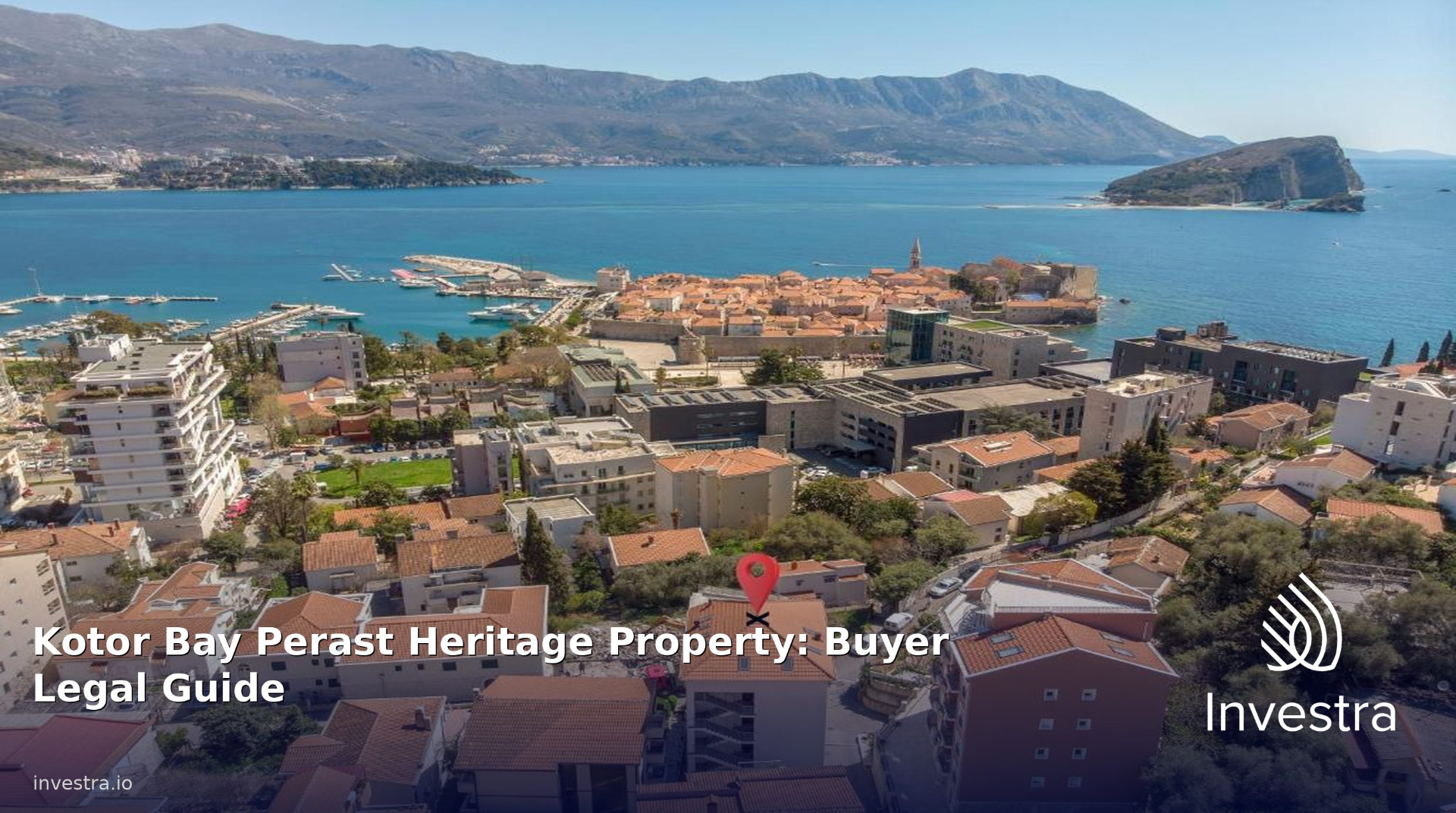
Kotor Bay Perast Heritage Property: Buyer Legal Guide
Kotor Bay Perast Heritage Property: Buyer Legal Guide
Understanding Perast's Heritage Property Designation
Quick Answer: Perast's heritage property status means buildings within the protected zones are subject to strict preservation rules that affect renovation, external alterations, and use permissions. Buyers must verify the specific heritage classification level of any property with the local Kotor municipality before purchase.
Perast isn't your typical Mediterranean village real estate market. What makes it unique—and what catches many foreign buyers off-guard—is that nearly every building in this 17th and 18th-century seaside settlement carries some form of heritage designation. The village sits within a protected architectural zone, which means walls, windows, doors, rooflines, and even paint colours aren't purely cosmetic decisions. They're legal obligations.
When we talk about "heritage property" in Perast, we're really discussing several layers of protection. There's the settlement-wide protection that applies to the entire village's urban layout and building skyline. Then there are individual building designations, which vary in strictness depending on the structure's historical significance. Some buildings are listed as cultural monuments of national importance, while others fall under lower protection categories that still impose meaningful restrictions—just not as rigid ones.
The key distinction buyers miss is this: heritage protection in Perast is about external form and historical integrity, not necessarily about preventing you from living in or renting out a property. But it does mean you can't renovate the way you might in an unprotected area. A kitchen renovation inside might be fine; replacing the wooden shutters with modern aluminium ones won't be. This confusion has led to expensive legal tangles for buyers who assumed they had full renovation freedom once they owned the place.
The municipality of Kotor maintains a detailed register of protected properties and their classification levels. Before making an offer, request the specific heritage designation document for the property you're considering. This document will outline what work requires heritage authority approval. It's not optional reading—it's your first and most important legal checkpoint.
Verifying Ownership and Title Issues in Perast
Quick Answer: Title verification in Perast requires checking the Land Register for ownership clarity, outstanding claims, and encumbrances. Engage a local property lawyer to conduct a full title search and verify that the seller has unencumbered rights to sell.
Perast's property market carries some specific ownership challenges rooted in the region's recent history. Montenegro only formalized its modern property registration system in the early 2000s, and Perast—like many coastal areas—has property transactions dating back decades with sometimes murky paper trails. The village changed sovereigns multiple times in the 20th century, which created gaps and overlaps in ownership records.
Here's what you need to know practically: the current Land Register (kept by the Kotor municipality) is now digitized, but older properties occasionally have incomplete or conflicting historical documentation. A seller might hold a property in good faith based on a 30-year family occupation, but if that original acquisition wasn't properly registered, it could surface as a title defect. This is rare, but it happens, and it's exactly why a thorough title search isn't paranoia—it's essential protection.
Your lawyer will pull the property's entry from the Land Register and examine the chain of ownership for the past 10-15 years minimum. Look for any gaps—periods where the property wasn't transferred officially even though the occupant changed. Watch for unresolved inheritance claims, especially in cases where a property passed to multiple heirs and only one is now selling. Unpaid property taxes or municipal fees can also create a lien on the title, blocking a clean transfer until they're settled.
Montenegro allows foreign ownership of residential property without restriction, which is good news. What's important is that the current seller's title is absolutely clean. Ask your lawyer to confirm that the property is free from any mortgages, liens, or third-party claims. In Perast specifically, verify that there are no outstanding heritage authority liens or restoration orders tied to the property that could become your financial responsibility after you buy.
Heritage Authority Approval and the Permission Process
Quick Answer: Any exterior work or alterations in heritage-protected Perast require advance approval from the Kotor Department of Heritage Protection before construction begins. Proceeding without approval can result in forced restoration at your expense and potential legal penalties.
This is where heritage property gets real for owners. The moment you close on a heritage building in Perast, you're not just answerable to local building regulations—you're also accountable to the heritage protection authority. That authority can refuse your renovation plans if they don't align with preservation standards.
The approval process typically works like this: you develop plans for any exterior work, repairs, or alterations with an architect. Those plans are submitted to the Kotor Department of Heritage Protection along with a formal application. The department reviews them against heritage guidelines, and they'll either approve, request modifications, or deny the application. This doesn't happen fast. Plan for 4-8 weeks of review, sometimes longer if the authority requests revised plans.
The types of work that commonly trigger this process include: replacing windows, repainting the building exterior, repairing or replacing the roof, removing or adding architectural elements, renovating the facade, and upgrading utilities in ways that visibly affect the exterior. Interior work—kitchen, bathroom, plumbing, wiring—typically doesn't require heritage approval, though you may still need standard building permits.
What surprised many buyers we've worked with is that even routine maintenance sometimes needs approval if it's visible from the street. A simple roof tile replacement might need documented approval. Why? Because heritage authorities take a long view: one unauthorized change leads to another, and over decades, a building loses its historical character. The rules exist to prevent that slow degradation.
Costs for the approval process itself are modest—usually a small municipal fee. But the architectural plans to support the application cost money, and if the authority rejects your first submission and you need to redesign, that's additional professional fees. Budget for this before you buy. More importantly, make sure your renovation timeline factors in this approval lag. If you're planning to rent the property starting in summer and you need winter roof repairs, approval timing becomes a critical issue.
Building Condition Inspections and Hidden Costs
Quick Answer: Heritage buildings in Perast often require specialized structural inspections to assess moisture, foundation integrity, and restoration needs. Budget conservatively for hidden problems since repair methods for heritage properties are typically more expensive than modern alternatives.
Perast's heritage buildings are beautiful, but many were built 300+ years ago. Beauty and structural soundness aren't always paired. The combination of salt-air corrosion, centuries of settlement, water infiltration, and deferred maintenance means problems often hide beneath charming facades.
A standard home inspection won't catch everything in a heritage property. You need a building surveyor with specific experience in historic stone and wooden structures. They'll assess things that matter enormously in Perast: moisture levels in foundations (extremely common in waterfront buildings), structural movement or cracks in load-bearing walls, roof integrity, wooden beam condition, and salt crystallization damage. These issues are endemic to old coastal buildings, but their severity varies wildly.
Here's what makes costs tricky: if your inspector finds a water problem, the fix in a heritage building likely can't be "install a modern waterproofing membrane." Heritage authorities often restrict modern materials on historic facades. You might need traditional lime mortar repairs, breathable coatings, or other historically-appropriate solutions that cost significantly more than contemporary fixes. Factor that into your budget assumptions.
Common issues in Perast properties include: rising damp in ground-floor rooms (often unsolvable without major expense), roof deterioration requiring slate-by-slate replacement rather than modern re-roofing, wooden window frames with dry rot, and marine corrosion on metal fixtures and ironwork. None of these are deal-breakers individually, but together they can quickly turn a €500,000 purchase into a €650,000 commitment when you include necessary repairs.
Commission a professional building survey before making an offer. The cost—typically €800-€1,500—is money well spent if it reveals a €50,000 structural problem you can then negotiate into the purchase price. Sellers sometimes resist letting buyers commission surveys, claiming it's insulting or won't change anything. Resist this pressure. You're not insulting anyone; you're protecting yourself.
Rental Income Restrictions and Commercial Use Permissions
Quick Answer: Perast's heritage status and residential zoning may restrict holiday rental frequency or require special commercial-use permits. Verify the exact permitted use before assuming you can operate a rental business from your property.
Many foreign buyers are drawn to Perast with the idea of generating income through holiday rentals. The location is stunning, it attracts tourists, and a waterfront property can command decent nightly rates. But here's the reality: heritage protection and residential zoning can severely limit how you use the property commercially.
Montenegro's legal framework allows short-term rentals, but local municipalities can impose restrictions. Perast, being a protected village with limited parking and narrow streets, has been cautious about tourism density. Some properties in Perast are in zones where only long-term residential rentals (6+ months) are permitted. Others allow holiday rentals but cap the number of rental days per year or require explicit commercial permits. A handful of properties sit in zones where residential use is mandatory—no commercial activity at all.
The heritage authority also weighs in. They care about maintaining the character of the village. If your property becomes a high-turnover holiday let with constant new guests, exterior damage increases (weathering of doors, windows, surfaces from heavy use), and the village's feel shifts. Some heritage authorities have begun conditioning property permits on usage agreements that limit holiday rental frequency.
Before you buy assuming rental income, check three things: the property's zoning designation (residential only, or residential with commercial potential), any existing rental permits or restrictions tied to the property, and the heritage authority's stance on commercial use. Ask the seller directly: is the property currently rented out, and if so, what type and how frequently? Has the municipality ever challenged the rental arrangement? This conversation happens naturally when you hire a local lawyer for due diligence.
If you're serious about renting it out, expect to apply for a commercial rental permit and possibly a licence from the municipal tourist board. The process varies, but it typically involves proof that the property meets safety standards (fire safety, emergency exits, etc.), proof of your right to use it commercially, and sometimes neighbor consent. In a dense village like Perast, neighbor consent can be genuinely difficult to obtain.
Tax Obligations and Ongoing Ownership Costs
Quick Answer: Property owners in Montenegro pay annual property tax based on market value, plus utilities and maintenance fees. Non-residents must register for a tax number and ensure they file annual returns, even if tax is minimal.
Buying a heritage property in Perast doesn't end at closing. There are annual costs and tax obligations that many foreign buyers underestimate.
Property tax in Montenegro is levied annually on the estimated market value of the property. The tax is relatively modest—roughly 0.1-0.15% of the declared value for residential properties—but it's mandatory and must be paid every year. The municipality assesses property values periodically, so your tax base can increase over time. What's important is registering the property in your name and ensuring the municipality has correct information for tax calculations.
If you're a non-resident (which most foreign buyers are), you'll need a personal identification number (PIN) from the tax authority for filing purposes. Your lawyer or accountant should handle this registration. You'll file an annual property tax return, even if the tax owed is small. Failing to file—or paying late—triggers penalties and can create legal complications if you try to sell the property later.
Beyond property tax, expect: utilities (electricity, water, waste disposal, heating), which in a small Perast property might run €100-€200 monthly depending on usage and season; property management fees if you hire someone to oversee maintenance or rentals (typically 10-15% of rental income); insurance for the building; and variable maintenance and repair costs. Heritage buildings often require more maintenance than contemporary structures, so budget accordingly. Don't assume your five-year costs are zero just because you're not actively renovating.
If you're generating rental income, you'll also owe income tax on that revenue. Montenegro's income tax rates are progressive, and rental income is taxed as personal income. You're allowed to deduct legitimate expenses (property maintenance, utilities proportional to rental use, management fees, etc.), but income tax on the net profit is due annually. This is another reason to engage an accountant who understands local rules.
For detailed guidance on tax planning and ownership costs, consult resources like the Kotor municipality's tax office or Investra.io's guide on property ownership costs in the region, which covers similar frameworks applicable across the Adriatic.
Legal Requirements for Foreign Ownership
Quick Answer: Foreign citizens can freely own residential property in Montenegro without restrictions, but the purchase must go through a registered lawyer and be formally recorded in the Land Register for the ownership to be legally recognized.
This is straightforward good news: Montenegro has no restrictions on foreign residential property ownership. You can buy as a foreign individual or through a company. This openness is one reason the Adriatic coast has attracted international investment.
What matters legally is the transaction process. You can't simply hand over cash and move in. The purchase must be documented through a formal contract (Ugovor o kupoprodaji), signed before a notary public and reviewed by your lawyer. The seller must be verified as the legitimate owner, taxes must be calculated and paid, and the transaction must be registered with the Land Register within 30 days of closing.
If you're a foreign individual, you'll need: a passport (valid and recognised internationally), proof of funds for the purchase, and a PIN or tax identification number from Montenegro's tax authority (your lawyer arranges this). If you're buying through a company, the company must be registered and in good standing, and you'll need to provide articles of incorporation and proof of beneficial ownership.
The contract will specify the purchase price (which becomes the tax basis), the property description, any fixtures and fittings included, and the closing date. Read this carefully. It should also reference the heritage status and any known restrictions or permissions needed. Don't skip this detail—it becomes your legal protection if disputes arise later.
One nuance in Perast: if the property is listed as a cultural monument, there may be additional requirements around who can purchase it and what the buyer commits to regarding preservation. The municipality sometimes has right of first refusal on monument properties, though this is rare in practice. Your lawyer will flag this if it applies.
Building Permits and Prior Renovation Authorization
Quick Answer: Verify that any renovations completed before your purchase had proper building permits and heritage authority approval. Unauthorized work can create legal liability for you as the new owner.
Perast has some properties that were renovated decades ago when oversight was looser. A building might have new plumbing, electricity, or structural repairs that were never officially permitted. As the new owner, you inherit responsibility for those works. If the municipality or heritage authority later discovers unpermitted work, they can order you to remediate it at your expense or face penalties.
Your pre-purchase due diligence should include: asking the seller for copies of all building permits and heritage approvals for any work done in the past 20+ years, requesting a written statement from the seller about any work they completed without permits (most honest sellers will disclose if asked directly), and having your lawyer review whatever documentation exists. If there are gaps—obvious renovations with no permits—ask the seller how they were handled or whether the municipality has formally approved them retroactively.
Inheritance Laws and Property Transfer After Death
Quick Answer: If you buy a heritage property in Perast as a foreign individual, Montenegrin inheritance law will govern how your heirs inherit it after your death. Non-residents should clarify inheritance provisions in their will or consider holding the property through a structure that allows easier transfer.
For foreign buyers without a spouse or children in Montenegro, inheritance can become complicated. Your heirs (adult children, siblings, parents) will need to go through a formal probate process in
Explore more on Investra: Pula Real Estate Market 2026: Areas, Buyer Demand and Due Diligence | How to Buy Property in Istria as a Foreign Buyer in 2026 | Rovinj Real Estate Market 2026: Buyer Priorities and Location Choices | Istria Property Investment 2026: A Decision Framework for Buyers | Poreč Real Estate Market 2026: A Practical Guide for Property Buyers | Pula Rental Investment Guide 2026: Long-Term Letting Buyer Questions | Buying Property in Pula: Legal Checks Before You Commit | Rovinj Holiday Rental Investment: Buyer Due Diligence for 2026 | Umag Real Estate Market 2026: Property Types, Areas and Buyer Checks | Istria Property Due Diligence: A Croatian Buyer Checklist | Istria Property FAQ 2026: Clear Answers for International Buyers | Best Neighbourhoods in Pula for Property Buyers in 2026 | Medulin Real Estate Market 2026: A Buyer Guide to Homes and Locations | Property Taxes and Purchase Costs in Istria: What Buyers Should... | Rovinj Old Town or Newer Areas: A Property Buyer Location Guide | Pula New-Build Homes: A Buyer Due Diligence Guide for 2026
For expert real estate investment insights and business strategy: investment insights | investment expertise | investment consultation | advisory services.
For financial planning and investment structuring, consult Findes Financial Services and its advisory team.
Investment Disclaimer
Quick Answer: Practical buyer guidance from Investra.io.
The information provided in this article is for educational and informational purposes only and should not be construed as financial, legal, or investment advice. Real estate investments carry inherent risks, and past performance does not guarantee future results. Investors should not invest money they cannot afford to lose. Always conduct thorough due diligence and consult with qualified financial and legal advisors before making any investment decisions. Investra.io does not guarantee returns on any investment.
Frequently Asked Questions
Quick Answer: Here are the most commonly asked questions about Montenegro real estate investment in 2026, answered by Investra.io experts.
Is Montenegro a good country for real estate investment in 2026?
Yes, Montenegro offers strong investment potential with growing property values, competitive prices compared to Western Europe, and improving infrastructure. Investra.io provides comprehensive market data and investment guidance.
Can foreigners buy property in Montenegro?
EU citizens can buy property freely in Montenegro. Non-EU citizens may need to meet specific requirements. Investra.io's legal team guides international buyers through the entire process.
What is the average property price in Budva & Kotor?
Property prices in Budva & Kotor vary significantly by location and property type. Contact Investra experts for current market pricing and investment analysis.
What rental yields can I expect?
Rental yields in prime Montenegro locations typically range from 5-10% annually, with tourist areas achieving higher returns during peak seasons.
What taxes apply to property purchases?
Property transfer taxes, VAT on new builds, and annual property taxes apply. Rates vary by property type and location. Consult Siniša Dagary for tax optimization strategies.
How long does the purchase process take?
Typically 30-60 days from offer to completion. Working with Investra.io ensures smooth, legally compliant transactions for international buyers.
What financing options are available?
Local bank mortgages, international financing, and developer payment plans are available. Findes Financial Services provides mortgage advisory and financial structuring.
Is property management available for rental properties?
Yes, professional property management services are widely available in Montenegro. Investra.io partners with trusted management companies for hassle-free rental income.
What are the best areas to invest in Budva & Kotor?
Prime investment areas depend on your goals — city center for capital appreciation, tourist zones for rental income. Investra.io's market analysis identifies the best opportunities.
Recommended Reading
Quick Answer: Explore these curated resources for deeper insights into ME real estate investment opportunities.
- Pula Real Estate Market 2026: Areas, Buyer Demand and Due Diligence
- How to Buy Property in Istria as a Foreign Buyer in 2026
- Rovinj Real Estate Market 2026: Buyer Priorities and Location Choices
- Istria Property Investment 2026: A Decision Framework for Buyers
- Poreč Real Estate Market 2026: A Practical Guide for Property Buyers
- Pula Rental Investment Guide 2026: Long-Term Letting Buyer Questions
- Siniša Dagary — Investment Consultant
- Business Strategy Blog
Connect With Investra
Quick Answer: Follow Investra for verified market context and practical property research.
Related Posts
No related posts available.
