
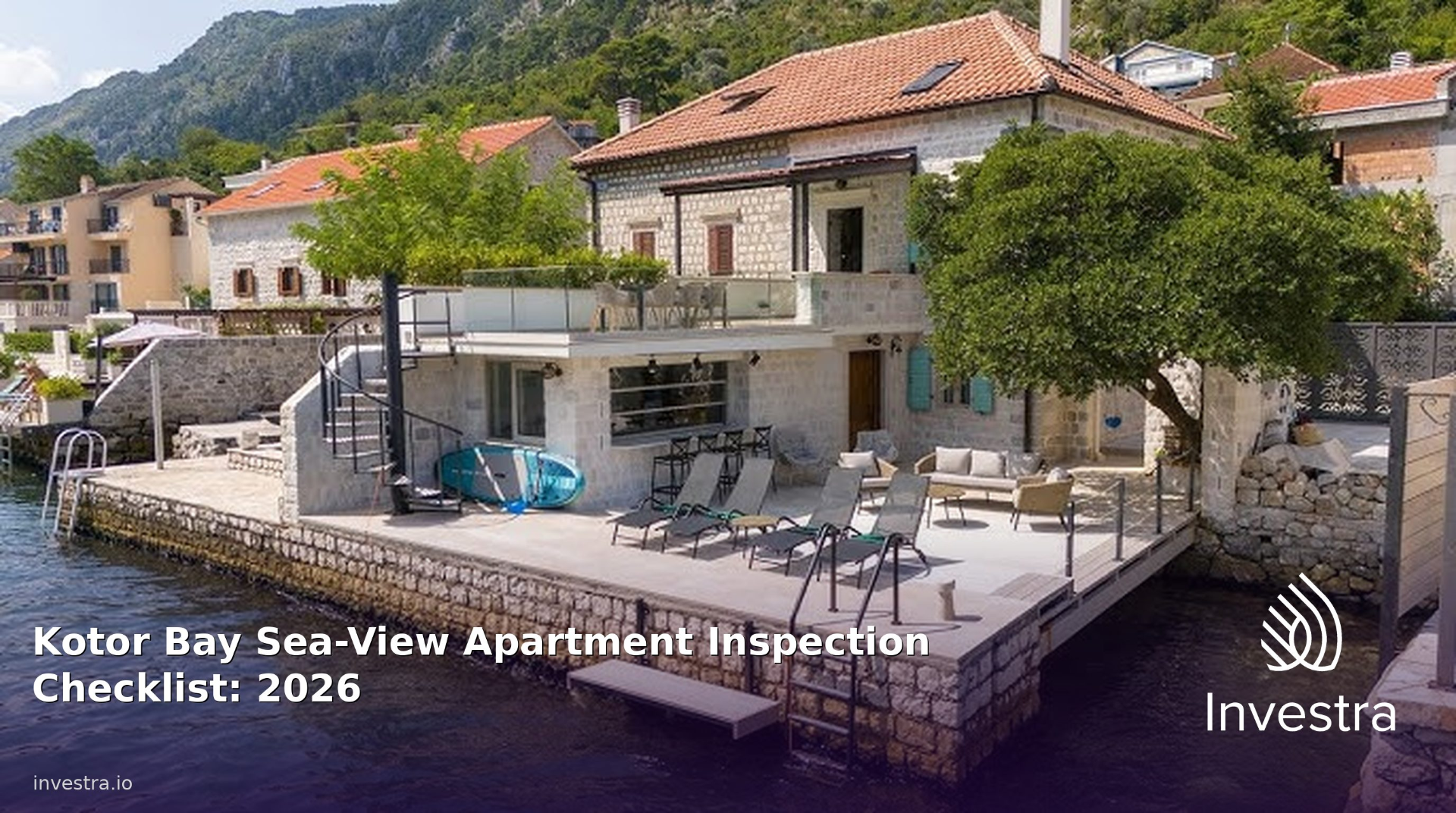
Kotor Bay Sea-View Apartment Inspection Checklist: 2026
Kotor Bay Sea-View Apartment Inspection Checklist: 2026
Understanding Kotor Bay's Unique Geography and Climate Impact on Sea-View Apartments
Quick Answer: Kotor Bay's enclosed geography creates distinct microclimates, salt spray exposure, and seasonal moisture patterns that directly affect structural integrity and maintenance costs for sea-view apartments in ways that inland properties don't experience.
Kotor Bay isn't just beautiful—it's geographically distinctive in ways that shape every inspection decision you'll make. The bay is one of Europe's deepest natural harbors, surrounded by dramatic limestone cliffs. This creates a semi-enclosed body of water where air circulation differs significantly from open coastlines. What this means practically: salt spray penetration reaches further inland than you'd expect, wind patterns are channeled and unpredictable, and humidity levels remain elevated year-round.
When you're inspecting a sea-view apartment in Kotor or Budva, you're not just looking at a standard apartment with a nice view. You're assessing a property exposed to consistent salt-laden air, seasonal temperature swings, and moisture that can compromise materials faster than they would in drier climates. The bay's orientation also means winter exposure differs dramatically depending on which side of the water your property sits. North-facing units receive minimal winter sun, while south-facing properties can overheat significantly in summer months.
Local property inspectors understand these patterns because they've seen the damage patterns repeat. Balconies facing the water corrode faster. Metal railings develop rust spots within months if not properly treated. Window frames and door seals deteriorate more quickly. Concrete and stone absorb moisture differently. The inspection checklist you develop should account for all these geographical realities before you sign any purchase agreement.
Structural Integrity Assessment: What To Check First
Quick Answer: Prioritize checking concrete deterioration, salt-induced corrosion in reinforcement steel, foundation settlement, and moisture infiltration patterns—these are the most common and expensive issues in bay-front properties and directly affect long-term ownership costs.
The foundation of your inspection begins with structural assessment, and this is where many buyers make costly mistakes. They walk into a beautiful apartment, see the sea view, and mentally furnish the space. They don't spend enough time examining what's actually holding the building together.
In Kotor Bay properties, concrete is your first concern. Look at exterior walls, balconies, and any exposed structural elements. Concrete exposed to salt spray deteriorates differently than concrete in inland locations. You're looking for spalling—that's when the concrete surface flakes away in layers. Early stages appear as small chips or discoloration. More advanced deterioration shows larger chunks missing, exposing the rebar underneath. If you see rust staining running down concrete surfaces, that's a red flag indicating that steel reinforcement is oxidizing beneath the surface.
Check whether the building or apartment has been subject to professional structural assessment recently. Many older buildings in the region haven't had this done in years, even decades. An engineer's report isn't cheap, but it's vastly cheaper than discovering structural problems after purchase. When you're investigating a property, ask the seller if structural surveys have been conducted. If not, budget for an independent assessment before making an offer. Contact Findes Group & Partners advisory team if you need guidance on finding qualified structural engineers operating in the region.
Pay particular attention to building settlement. Cracks in walls don't all mean the same thing. Hairline cracks in plaster are cosmetic. Cracks that follow a diagonal pattern or run vertically down an entire wall suggest structural movement. In historic Kotor Old Town, some settlement is normal given the age of buildings, but active settlement or differential settlement between sections of the structure is serious. Look at how doors and windows fit in their frames—do they hang unevenly? Do they stick in certain positions? This can indicate frame distortion from structural issues.
Moisture and Dampness Investigation Protocols
Quick Answer: Moisture damage is the most common hidden problem in sea-view apartments; inspect for rising damp, salt crystallization, efflorescence, and mold growth in hidden spaces using both visual assessment and moisture meters to identify problems before purchase.
If structural integrity is the foundation of your inspection, then moisture assessment is the framework. Moisture problems in sea-view apartments are often hidden until they become catastrophic and expensive. Many buyers notice water stains or smell dampness but underestimate the scope of what's actually happening inside walls and foundations.
Start by walking through the apartment at different times of day. Visit in the morning when condensation is most visible on windows. Return in the afternoon. Notice whether windows fog consistently or only in certain rooms. Some condensation is normal in bathrooms and kitchens. Persistent condensation throughout living areas suggests ventilation problems or elevated ambient moisture that needs addressing.
In basements, ground floors, and lower levels, look for rising damp. This appears as a tide-line of discoloration, typically between 30 and 100 centimeters above the floor. Walls feel cold and damp. Plaster becomes soft. Paint peels. Salt crystallization may appear as white powder on surfaces. These are salt deposits left behind as moisture evaporates—a classic sign of rising damp in coastal properties. Rising damp remediation is expensive and requires professional intervention, often involving chemical injection or physical barriers that can take months.
Look for mold growth, particularly in corners where air circulation is poor, around windows, in closets, and in any space that doesn't get direct sunlight. Early mold appears as small black or green spots. Don't dismiss this as cosmetic. Mold spores cause respiratory issues and indicate moisture problems that extend beyond the visible growth. Black mold, while not inherently more dangerous than other types despite common myths, does indicate persistent moisture that needs remediation.
Pay special attention to window and door seals. Moisture penetrates through gaps and poor sealing more readily than through solid materials. Check the wooden frames for soft spots—press with a fingernail to test for rot. Look at caulking around windows. If it's cracked, hardened, or pulling away from the frame, water penetration is occurring. The cost to replace window seals is modest, but the cost to repair water damage inside walls is substantial.
If you're serious about a property, hire a professional to conduct moisture testing using specialized equipment. Moisture meters measure water content in materials. Thermal imaging cameras show temperature differences that reveal hidden moisture patterns. These assessments add cost but provide objective data rather than subjective observations. Request this testing as part of your due diligence process.
Balcony and Exterior Element Inspection
Quick Answer: Balconies are the most critical exterior element to assess; check for concrete spalling, rusty reinforcement, corroded railings, failing waterproofing, and unsafe railings, as remediation often costs thousands of euros and sellers' responsibility for repairs is complex under local law.
A sea-view apartment is fundamentally about the balcony. That's where you'll spend time, entertain guests, and enjoy why you bought the property. It's also the most exposed and vulnerable structural element. Many inspections overlook balconies or give them cursory attention. Don't make this mistake.
Start with the railings. Grip them firmly—they should feel absolutely solid with no wobble or movement. Test each vertical post by pushing and pulling. Check for rust corrosion, particularly at connection points where different metals meet. If the railing is wooden, inspect for rot, particularly at ground level where the post contacts the concrete. If railings are metal, look for flaking paint indicating rust underneath. Paint isn't protection; it's just cosmetics. Real protection requires properly treated materials.
Examine the balcony floor itself from underneath if possible. Request access to view the underside, as this often reveals problems invisible from above. Look for cracks radiating from corners or spreading across the surface. Check whether the waterproofing membrane (the layer protecting the structure beneath) is visible or deteriorating. Exposed concrete underneath means waterproofing has failed and water is penetrating into the structure below.
Walk the entire perimeter of the balcony, pressing on the edge where it meets the building. Soft spots or give indicate deterioration in the concrete structure. Look for staining on the ceiling of balconies below—this reveals water leakage from the unit above. White powdery deposits on the underside of balconies indicate salt crystallization and ongoing moisture problems.
Check the condition of railings and balustrades. Many older properties in Kotor have metal railings that may not meet current safety standards. Modern building codes require railings of a minimum height and with spacing between vertical elements that prevents children from passing through. If you're buying a property as an investment for holiday rentals, these requirements become important for liability. Rovinj Holiday Rental Investment: Buyer Due Diligence for 2026 covers rental-specific considerations that apply equally in Kotor.
Ask when the balcony waterproofing was last replaced. If the property is over 15-20 years old and original waterproofing is still in place, budget for replacement soon after purchase. This is expensive work—potentially €3,000 to €8,000+ for a single apartment depending on size and complexity. Understanding this cost before purchase allows you to negotiate accordingly or adjust your offer.
Window and Door Seal Assessment
Quick Answer: Windows and doors are primary water intrusion points in coastal properties; inspect frames for rot, test seals for air tightness, verify glass condition, and assess whether replacements will be needed soon, as this directly impacts heating costs and comfort.
Windows and doors deserve more attention than they typically receive. They're not just about views and aesthetics—they're critical barriers against salt spray, moisture, and weather penetration. In a sea-view apartment, exposure is constant and relentless.
Start by opening and closing every window and door. They should operate smoothly with no sticking or binding. Listen for any creaking or movement in the frame. Gaps between the frame and the wall should be consistent all the way around. Uneven gaps suggest the frame has shifted or settled unevenly. Look at the caulking or sealant around all windows and doors. It should be continuous and flexible, not cracked or hardened. Press on it with your finger—it should have some give, not be brittle.
Examine the glass itself. Look for condensation trapped between panes—this indicates the seal has failed and moisture is entering the insulated cavity. Check whether glass is single-pane or multi-pane. Single-pane windows offer almost no insulation and are expensive to heat in winter. Double-glazing is standard in modern renovations. Triple-glazing is becoming more common as energy efficiency standards increase.
Look at window and door frames carefully. Wood frames are common in older Kotor properties. Press on wooden frames with a fingernail or coin—soft areas indicate rot. Rot spreads if untreated and compromises the entire frame assembly. Metal frames can corrode, particularly aluminum in contact with dissimilar metals that create galvanic corrosion. Vinyl or uPVC frames resist moisture but can become brittle in extreme temperature swings.
If windows haven't been replaced recently, budget for replacement as part of your ownership costs. New windows for a multi-room apartment might cost €4,000 to €10,000+ depending on size, type, and installation complexity. This isn't a nice-to-have—it's a practical necessity if existing windows are failing. Check when windows were last replaced by asking the seller or examining installation dates on window frames.
Test the operation of any wooden shutters or external protection devices. Many Kotor apartments feature external shutters for privacy and sun protection. Ensure they operate smoothly and close properly. Check for rust on metal components and rot on wooden components.
Electrical System Safety and Modern Standards Compliance
Quick Answer: Older electrical installations common in Kotor may not meet modern safety standards; assess whether the system has been upgraded, verify grounding and circuit protection, and understand whether upgrades will be required for safety or insurance purposes.
The electrical system is often the most overlooked aspect of property inspection, yet it's fundamental to safety and livability. Older apartments in Kotor Bay often have electrical systems installed decades ago that don't meet modern standards or safety requirements.
Request access to the electrical panel. Look at the main breaker and individual circuit breakers. Modern installations use circuit breakers that automatically trip if an overload occurs. Older installations may have fuses or older breaker types that don't trip as reliably. The presence of fuses (threaded ceramic devices that screw into the panel) indicates the installation is decades old and probably needs upgrading.
Check whether the building and apartment are properly grounded. Grounding prevents electric shock and protects against electrical fires. Look at outlets throughout the apartment—modern outlets should have ground holes (the round or U-shaped opening in addition to the two standard slots). Older outlets without ground holes indicate inadequate grounding. Testing with a simple outlet tester (available at any hardware store for a few euros) takes seconds and reveals whether outlets are properly grounded.
Look for visible wiring inside the apartment. In proper modern installations, wiring is concealed inside walls. Visible wiring strung along walls or ceilings indicates improvised installations that don't meet safety standards. Ask whether any recent electrical work has been done and verify it was done by licensed electricians (not just handymen).
Check the capacity of the electrical service. Older apartments often have 6-amp or 10-amp service, which is barely adequate for modern appliances. Contemporary usage typically requires 16-amp or higher. If you plan to install air conditioning (common in Kotor's hot summers), a heating system, or multiple electrical appliances, insufficient capacity creates problems.
Assess the age of appliances and what you'll need to replace. Old wiring combined with high-power appliances creates fire risk. If the electrical system is outdated, budget for professional upgrade before occupancy. This is safety-critical work that shouldn't be deferred. The cost varies based on the extent of needed upgrades, but substantial rewiring might cost €2,000 to €6,000+.
Plumbing System Evaluation and Water Quality Verification
Quick Answer: Evaluate whether plumbing has been modernized, check for corrosion in pipes, verify water pressure and supply reliability, and understand the water source and any treatment systems, as coastal properties sometimes have salt-water corrosion issues in pipes and fixtures.
Plumbing problems are expensive to repair and difficult to diagnose without professional assessment. In coastal properties, salt-water corrosion adds an extra dimension of complexity to plumbing evaluation.
Turn on every tap throughout the apartment. Check water pressure and flow. Weak or intermittent flow might indicate clogged pipes, mineral deposits, or supply issues. Listen for noises in the pipes—hammering sounds suggest water hammer (pressure surges) that can damage the system over time. Gurgling sounds might indicate improper venting in the drain system.
Look under sinks and check exposed plumbing. Copper pipes are standard in modern installations and handle coastal exposure reasonably well, though they can corrode over time. Galvanized steel pipes, common in older properties, develop rust and mineral deposits that restrict flow and eventually cause blockages. Plastic pipes are increasingly common and resist corrosion but may have connection issues if they've been improperly installed.
Check water pressure at multiple fixtures. Turn on a faucet, then flush a toilet—pressure shouldn't drop dramatically. If it does, the supply system has limited capacity. Ask about water pressure in summer when demand peaks and water supply is often constrained in Kotor Bay communities.
Inspect the condition of visible plumbing fixtures—taps, showerheads, and visible pipes. Corrosion spots or pitting indicate galvanic corrosion or mineral deposits. Leaks around fixtures suggest seal failure requiring replacement. Staining around fixtures indicates past or ongoing leaks.
Ask about the water source. Is it from municipal supply or private wells? In Kotor, municipal water supply is typical, but some properties have supplementary wells or storage systems. Understand how water quality is managed. Some properties have filtration systems or softeners if water quality is poor. Ask about water pressure during peak demand periods—summer months when tourist season peaks.
If plumbing hasn't been modernized recently, budget for eventual replacement. While not as expensive as electrical upgrades, a full replumbing might cost €3,000 to €7,000+ depending on the apartment's size and system complexity.
HVAC Systems, Heating, and Cooling Assessment
Quick Answer: Assess whether the apartment has central heating, air conditioning, or individual units; evaluate their age and efficiency; and understand operating costs, as heating and cooling representExplore more on Investra: Pula Real Estate Market 2026: Areas, Buyer Demand and Due Diligence | How to Buy Property in Istria as a Foreign Buyer in 2026 | Rovinj Real Estate Market 2026: Buyer Priorities and Location Choices | Istria Property Investment 2026: A Decision Framework for Buyers | Poreč Real Estate Market 2026: A Practical Guide for Property Buyers | Pula Rental Investment Guide 2026: Long-Term Letting Buyer Questions | Buying Property in Pula: Legal Checks Before You Commit | Umag Real Estate Market 2026: Property Types, Areas and Buyer Checks | Istria Property Due Diligence: A Croatian Buyer Checklist | Istria Property FAQ 2026: Clear Answers for International Buyers | Best Neighbourhoods in Pula for Property Buyers in 2026 | Medulin Real Estate Market 2026: A Buyer Guide to Homes and Locations | Property Taxes and Purchase Costs in Istria: What Buyers Should... | Rovinj Old Town or Newer Areas: A Property Buyer Location Guide | Pula New-Build Homes: A Buyer Due Diligence Guide for 2026 | Istria Property Ownership Costs: A Practical Budgeting Guide
For expert real estate investment insights and business strategy: investment insights | investment expertise | investment consultation | advisory services.
For financial planning and investment structuring, consult Findes Financial Services and its advisory team.
Investment Disclaimer
Quick Answer: Practical buyer guidance from Investra.io.The information provided in this article is for educational and informational purposes only and should not be construed as financial, legal, or investment advice. Real estate investments carry inherent risks, and past performance does not guarantee future results. Investors should not invest money they cannot afford to lose. Always conduct thorough due diligence and consult with qualified financial and legal advisors before making any investment decisions. Investra.io does not guarantee returns on any investment.
Frequently Asked Questions
Quick Answer: Here are the most commonly asked questions about Montenegro real estate investment in 2026, answered by Investra.io experts.Is Montenegro a good country for real estate investment in 2026?
Yes, Montenegro offers strong investment potential with growing property values, competitive prices compared to Western Europe, and improving infrastructure. Investra.io provides comprehensive market data and investment guidance.
Can foreigners buy property in Montenegro?
EU citizens can buy property freely in Montenegro. Non-EU citizens may need to meet specific requirements. Investra.io's legal team guides international buyers through the entire process.
What is the average property price in Budva & Kotor?
Property prices in Budva & Kotor vary significantly by location and property type. Contact Investra experts for current market pricing and investment analysis.
What rental yields can I expect?
Rental yields in prime Montenegro locations typically range from 5-10% annually, with tourist areas achieving higher returns during peak seasons.
What taxes apply to property purchases?
Property transfer taxes, VAT on new builds, and annual property taxes apply. Rates vary by property type and location. Consult Siniša Dagary for tax optimization strategies.
How long does the purchase process take?
Typically 30-60 days from offer to completion. Working with Investra.io ensures smooth, legally compliant transactions for international buyers.
What financing options are available?
Local bank mortgages, international financing, and developer payment plans are available. Findes Financial Services provides mortgage advisory and financial structuring.
Is property management available for rental properties?
Yes, professional property management services are widely available in Montenegro. Investra.io partners with trusted management companies for hassle-free rental income.
What are the best areas to invest in Budva & Kotor?
Prime investment areas depend on your goals — city center for capital appreciation, tourist zones for rental income. Investra.io's market analysis identifies the best opportunities.
Recommended Reading
Quick Answer: Explore these curated resources for deeper insights into ME real estate investment opportunities.
- Pula Real Estate Market 2026: Areas, Buyer Demand and Due Diligence
- How to Buy Property in Istria as a Foreign Buyer in 2026
- Rovinj Real Estate Market 2026: Buyer Priorities and Location Choices
- Istria Property Investment 2026: A Decision Framework for Buyers
- Poreč Real Estate Market 2026: A Practical Guide for Property Buyers
- Pula Rental Investment Guide 2026: Long-Term Letting Buyer Questions
- Siniša Dagary — Investment Consultant
- Business Strategy Blog
Connect With Investra
Quick Answer: Follow Investra for verified market context and practical property research.
Related Posts
No related posts available.
