
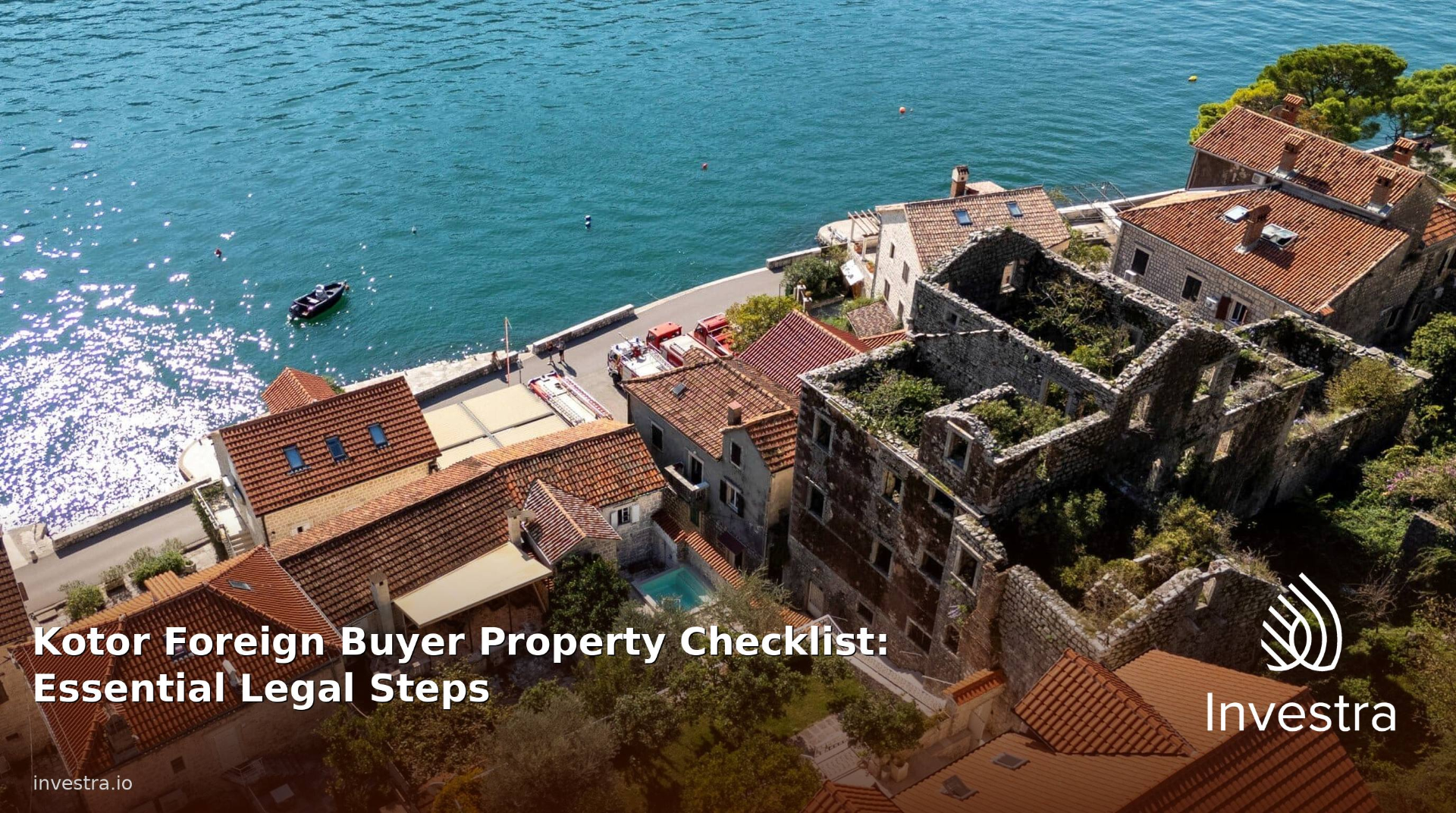
Kotor Foreign Buyer Property Checklist: Essential Legal Steps
Kotor Foreign Buyer Property Checklist: Essential Legal Steps
Understanding Foreign Ownership Laws in Montenegro
Quick Answer: Foreign buyers can own property in Montenegro, but must comply with specific legal requirements including residency permits, tax registration, and restrictions on agricultural land. Consulting a local legal advisor is essential to navigate these requirements correctly.
When you're considering buying property in Kotor or Budva as a foreign buyer, the first reality you'll encounter is Montenegro's framework for non-citizen property ownership. The legal system permits international buyers to acquire residential and commercial real estate, which is why you're seeing increased foreign investment in these coastal regions. However, "permitted" doesn't mean "unrestricted." The rules exist, and understanding them before you commit financially is non-negotiable.
Montenegro's property law distinguishes between different classes of land. Residential properties and commercial real estate are generally accessible to foreign purchasers, but agricultural land has stricter regulations. If you're looking at a property with significant land that's classified as agricultural, you'll face additional legal hurdles. This is where many international buyers get surprised—a picturesque villa with sprawling grounds might include agricultural land designation, which complicates or restricts your purchase options.
The legal requirement for foreign buyers typically involves establishing a formal connection to Montenegro, such as obtaining a residence permit or registering a business entity. Some buyers choose to establish a local company through which to purchase property, which can offer tax and administrative benefits. Others secure a temporary residence permit before proceeding. Both approaches have merit depending on your long-term plans and tax situation. A qualified local attorney, like those associated with Findes Group & Partners advisory team, can review your specific circumstances and recommend the most efficient path forward.
Before you sign anything, verify the current legal requirements with the Montenegrin Ministry of Justice or a licensed real estate lawyer. Laws can change, and what was true last year might have been updated. Don't rely on a property agent's interpretation alone—that's not their legal responsibility, and they may not have the latest regulatory information.
Finding a Reliable Real Estate Agent and Legal Advisor
Quick Answer: Select a licensed real estate agent with verifiable experience in Kotor and Budva, and hire an independent local attorney separate from the seller's representatives to protect your interests throughout the purchase process.
The agent showing you properties and the lawyer handling your documents aren't always aligned with your interests, which is why clarity matters. In Kotor and Budva's competitive real estate market, you'll encounter agents who are professional, transparent, and focused on long-term relationships. You'll also encounter situations where sales pressure outweighs your due diligence timeline. The difference between a good experience and a stressful one often comes down to who you're working with and what you expect from them upfront.
A real estate agent's job is to facilitate a transaction. They have incentive structures tied to sales velocity, which means their timeline might not match yours. That doesn't make them dishonest—it's simply how the business works. What matters is transparency about this dynamic. A good agent in Kotor will acknowledge that you need time for legal review, will provide property documentation without resistance, and will respect your decision to hire independent counsel. If an agent pushes back on these basics, that's a warning sign.
Your attorney should be independent—not recommended by the seller, the agent, or the property developer. Yes, sellers often suggest their own lawyers, but that person's primary loyalty remains with the seller. Having your own legal counsel costs money upfront, typically ranging from a modest consultation fee to a percentage of the purchase price depending on your agreement. This is an investment in protection. Your lawyer should conduct title searches, verify ownership history, check for liens or claims against the property, and ensure all documentation is in proper order before you commit to the purchase.
Verify your agent's credentials through Montenegro's Chamber of Commerce or local real estate association. For legal advisors, confirm they're licensed to practice in Montenegro and specializing in property transactions. References from previous foreign buyers—especially those who completed purchases in the same market segment you're targeting—are invaluable. Don't hesitate to ask for them and actually follow up. Real conversations with people who've been through the process will give you perspective no marketing material can provide.
Title Searches and Property Ownership Verification
Quick Answer: Conduct a comprehensive title search through Montenegro's Land Registry to confirm current ownership, identify any encumbrances or claims, and verify the property description matches the physical location before proceeding with purchase.
The Land Registry in Montenegro is your starting point for confirming what you're actually buying. In theory, this should be straightforward—you look up the property, see who owns it, and proceed. In practice, older properties, especially those in Budva and Kotor with layered ownership history, sometimes have documentation gaps or ambiguities. Your attorney's job is to dig through the registry records and flag anything that requires clarification before you exchange money.
What you're looking for in a title search: confirmation that the person selling to you actually owns the property, identification of any mortgages or liens against it, notation of any easements or rights other people might have (like a path across the property belonging to a neighbor), and clarity on the property's exact legal boundaries. When I mention layered ownership history, I'm referring to coastal properties in Kotor that might have changed hands multiple times during different political regimes in the Balkans. Some documentation from those periods is solid; some is less clear. Your attorney's role is to determine whether gaps in that history create risk for you as a new owner.
If the property has recently been inherited or transferred within a family, ensure proper legal transfer documentation is complete. Inheritance transfers in Montenegro require specific paperwork and timing. If the seller is claiming to own property but the registry shows someone else, or if there's a long chain of ownership transfers with questionable documentation, pause the transaction. These issues can be resolved, but they require professional legal intervention and time—neither of which should be rushed.
The Land Registry is accessible to the public, and your attorney can obtain certified copies of ownership records. If the seller resists providing this documentation or creates obstacles to accessing the registry, that's a significant red flag. Legitimate property owners have no reason to prevent you from independently verifying their claim to the property. In fact, professional sellers often provide registry extracts proactively as part of their listing materials.
Understanding Property Taxes and Purchase Costs
Quick Answer: Foreign buyers must budget for transfer tax, notary fees, registration costs, and potential property tax based on the property's classification. Exact rates vary by property type and location; your attorney can provide current figures from the relevant Montenegrin authorities.
The purchase price you see advertised is not the total cost of buying property in Kotor or Budva. Additional expenses exist, and understanding them prevents sticker shock at closing. These costs typically fall into several categories: taxes on the property transfer itself, fees for registering the property in your name, notary expenses, and potentially municipal fees depending on local regulations.
Transfer tax (also called transfer duties) is applied when property changes ownership. The rate structure and applicable percentage depend on whether you're purchasing from an individual, a developer, or another entity, and also on the property's classification. Commercial properties and residential properties are sometimes taxed differently. Your attorney will confirm the exact applicable rate by checking the specific municipal ordinances for Kotor or Budva where your property is located, because they can vary slightly between municipalities.
Registration with the Land Registry involves fees to record the property in your name. These fees are separate from transfer taxes and are relatively modest compared to transfer duties, but they're mandatory and must be budgeted. Notary fees cover the formal witness and authentication of documents; Montenegro requires notarization for property transactions, and this cost falls to you as the buyer. Some sellers negotiate splits on certain fees, but typically the buyer bears these costs.
Once you own the property, annual property tax becomes your responsibility. The calculation is based on property value, size, and classification. Tax rates in Montenegro are not uniformly national—municipalities set their own rates within legal limits, which is why a property in one part of Kotor might have different annual tax obligations than an identical property a few kilometers away. Your attorney should provide you with an estimate of annual property tax as part of your total cost analysis. This matters not just for the immediate purchase, but for your long-term ownership budget, especially if you're considering rental income to offset expenses.
For detailed information on property taxes and purchase costs specific to your situation, review Property Taxes and Purchase Costs in Istria: What Buyers Should, which covers the legal framework common to the broader Adriatic region and can contextualize Montenegro's structure.
Identifying Encumbrances and Claims Against the Property
Quick Answer: Encumbrances such as mortgages, easements, or utility rights can affect your property rights and use. Have your attorney conduct a complete search to identify all claims and confirm they'll be cleared or properly documented before closing.
An encumbrance is any claim, lien, or right held by someone other than the owner that affects the property. In Kotor and Budva, where properties often have complex histories and shared infrastructure, encumbrances are common and usually manageable—but only if you know they're there before you buy. Discovering a mortgage lien after purchase, or realizing a neighbor has a legal right to access the property across your land, creates problems that become expensive to resolve retroactively.
The most obvious encumbrance is a mortgage: if the current owner financed the purchase, the bank holding that mortgage has a legal claim against the property. That mortgage must be paid off at closing from the sale proceeds before the property transfers to you free and clear. Your attorney verifies this will happen and ensures the bank releases its claim once the debt is satisfied. If the seller can't pay off the mortgage from the sale price, the transaction can't close. This sounds obvious, but it's surprisingly common for sellers in financial distress to be hoping a buyer somehow makes the mortgage go away—it doesn't work that way legally.
Easements are another category of encumbrance. Utility companies sometimes have the right to access your property to maintain power lines, water pipes, or other infrastructure. Neighbors might have a documented right of way to cross your property to reach their land. These rights don't necessarily prevent you from buying, but they do affect how you can use the property and should factor into your valuation. A property with an easement allowing neighbors to access a shared well is different from one with complete exclusive use.
In coastal properties around Kotor and Budva, water rights and access permissions can be complex. If the property uses a shared water source or has historical rights to sea access through adjacent properties, those arrangements must be documented and confirmed as transferable to you. What worked for the previous owner might not automatically transfer to you without proper legal notation.
Your attorney's title search should identify all encumbrances. The goal isn't necessarily to eliminate all of them—some are normal and acceptable—but to know they exist, understand their implications, and confirm they're not deal-breakers for your intended use of the property.
Environmental and Zoning Considerations in Kotor and Budva
Quick Answer: Properties in Kotor and Budva may be subject to environmental protection zones and coastal regulations that restrict development, renovation, or commercial use. Verify zoning status and environmental restrictions before committing to purchase.
Kotor is a UNESCO World Heritage site, and Budva has significant historical and environmental protections. These designations mean that not every property can be developed, expanded, or modified as freely as you might in other locations. When you're assessing a property in these areas, understanding what you can and cannot do with it is as important as understanding what you're buying.
Zoning regulations determine whether a property is classified for residential, commercial, agricultural, or mixed use. If you're buying with the intention of running a rental business—whether short-term tourist rentals or long-term residential letting—the property's zoning designation must permit that use. A property zoned purely residential with no commercial provisions might create legal issues if you attempt to operate a holiday rental business. In Kotor and Budva's competitive market, this is a critical question because rental income is often part of the investment calculus.
Environmental protections in these UNESCO areas are strict. You cannot simply renovate or expand a historic building as you see fit. Coastal properties may be within protected marine zones, which affects what you can do with water access, boat docking, or shoreline modifications. Properties near archaeological sites face additional restrictions. These rules exist to preserve what makes Kotor and Budva valuable as tourist and cultural destinations, which benefits property owners in terms of desirability—but it limits your development freedom.
Before you purchase, request a zoning certificate from the relevant municipal authority confirming the property's classification and any use restrictions. Request an environmental compliance report identifying any environmental designations affecting the property. These aren't optional extras—they're essential due diligence. A property might look perfect and be in an excellent location, but if zoning prohibits your intended use or environmental rules prevent the renovations you're planning, the investment value changes significantly. Your attorney can help interpret these documents and flag conflicts between what you intend to do and what regulations permit.
Building Permits and Construction Documentation
Quick Answer: Verify that any existing structures have proper building permits and completion certificates, and confirm that any renovations or additions comply with local codes. Missing or irregular documentation can create legal liability for you as the new owner.
If you're buying a newly constructed property or a property that's been significantly renovated, building permits and completion certificates are non-negotiable documentation. Montenegro requires permits for construction and major renovations, and these permits generate inspection records and completion certificates that officially confirm the work was done according to approved plans and meets building codes. Without this documentation, the building—or parts of it—are technically unpermitted construction, which creates legal and practical problems for you as the owner.
What problems? First, insurance companies might refuse to insure unpermitted structures. Second, if the municipality or a neighbor challenges the construction's legality, you might be required to demolish it or pay fines. Third, if you want to sell later, buyers and their lawyers will ask for these same permits, and you'll face negotiation delays or price reductions. Fourth, property taxes might be assessed differently or adjusted higher if the municipality determines that unpermitted extensions have increased the property's value beyond what's registered.
For older properties in Kotor that predate modern permitting systems, complete original permits might not exist. That's different from a property that was built or renovated recently without permits. If someone renovated the kitchen, added a bedroom, or enclosed a patio in the last decade, that work should have permits. If the seller claims it was "just minor work" and bypassed permits to save money, you're inheriting the risk of that decision.
Request copies of all building permits, inspection reports, and completion certificates from the seller. If they're unavailable, your attorney should investigate whether retrospective documentation or legalization processes exist in Montenegro. Some jurisdictions allow previously unpermitted work to be formally documented and legalized after the fact, though this involves municipal review and potential modifications to bring the work into code compliance.
For new-build properties in Budva and Kotor, especially those still under development, confirm the developer's permits are valid and that construction timelines and specifications match the sales contract. Developers have been known to cut corners or delay projects. Having documentation of proper permitting is your first line of defense if disputes arise about completion or quality.
Rental Income Potential and Regulations
Quick Answer: Properties in Kotor and Budva can generate rental income, but short-term tourist rentals require registration and compliance with local regulations that vary by municipality and season. Long-term rentals have different legal requirements and income tax implications.
Long-term rentals—where you lease the property to a tenant for months or years—operate under different rules
Explore more on Investra: Pula Real Estate Market 2026: Areas, Buyer Demand and Due Diligence | How to Buy Property in Istria as a Foreign Buyer in 2026 | Rovinj Real Estate Market 2026: Buyer Priorities and Location Choices | Istria Property Investment 2026: A Decision Framework for Buyers | Poreč Real Estate Market 2026: A Practical Guide for Property Buyers | Pula Rental Investment Guide 2026: Long-Term Letting Buyer Questions | Buying Property in Pula: Legal Checks Before You Commit | Rovinj Holiday Rental Investment: Buyer Due Diligence for 2026 | Umag Real Estate Market 2026: Property Types, Areas and Buyer Checks | Istria Property Due Diligence: A Croatian Buyer Checklist | Istria Property FAQ 2026: Clear Answers for International Buyers | Best Neighbourhoods in Pula for Property Buyers in 2026 | Medulin Real Estate Market 2026: A Buyer Guide to Homes and Locations | Rovinj Old Town or Newer Areas: A Property Buyer Location Guide | Pula New-Build Homes: A Buyer Due Diligence Guide for 2026 | Istria Property Ownership Costs: A Practical Budgeting Guide
For expert real estate investment insights and business strategy: investment insights | investment expertise | investment consultation | advisory services.
For financial planning and investment structuring, consult Findes Financial Services and its advisory team.
Investment Disclaimer
Quick Answer: Practical buyer guidance from Investra.io.
The information provided in this article is for educational and informational purposes only and should not be construed as financial, legal, or investment advice. Real estate investments carry inherent risks, and past performance does not guarantee future results. Investors should not invest money they cannot afford to lose. Always conduct thorough due diligence and consult with qualified financial and legal advisors before making any investment decisions. Investra.io does not guarantee returns on any investment.
Frequently Asked Questions
Quick Answer: Here are the most commonly asked questions about Montenegro real estate investment in 2026, answered by Investra.io experts.
Is Montenegro a good country for real estate investment in 2026?
Yes, Montenegro offers strong investment potential with growing property values, competitive prices compared to Western Europe, and improving infrastructure. Investra.io provides comprehensive market data and investment guidance.
Can foreigners buy property in Montenegro?
EU citizens can buy property freely in Montenegro. Non-EU citizens may need to meet specific requirements. Investra.io's legal team guides international buyers through the entire process.
What is the average property price in Budva & Kotor?
Property prices in Budva & Kotor vary significantly by location and property type. Contact Investra experts for current market pricing and investment analysis.
What rental yields can I expect?
Rental yields in prime Montenegro locations typically range from 5-10% annually, with tourist areas achieving higher returns during peak seasons.
What taxes apply to property purchases?
Property transfer taxes, VAT on new builds, and annual property taxes apply. Rates vary by property type and location. Consult Siniša Dagary for tax optimization strategies.
How long does the purchase process take?
Typically 30-60 days from offer to completion. Working with Investra.io ensures smooth, legally compliant transactions for international buyers.
What financing options are available?
Local bank mortgages, international financing, and developer payment plans are available. Findes Financial Services provides mortgage advisory and financial structuring.
Is property management available for rental properties?
Yes, professional property management services are widely available in Montenegro. Investra.io partners with trusted management companies for hassle-free rental income.
What are the best areas to invest in Budva & Kotor?
Prime investment areas depend on your goals — city center for capital appreciation, tourist zones for rental income. Investra.io's market analysis identifies the best opportunities.
Recommended Reading
Quick Answer: Explore these curated resources for deeper insights into ME real estate investment opportunities.
- Pula Real Estate Market 2026: Areas, Buyer Demand and Due Diligence
- How to Buy Property in Istria as a Foreign Buyer in 2026
- Rovinj Real Estate Market 2026: Buyer Priorities and Location Choices
- Istria Property Investment 2026: A Decision Framework for Buyers
- Poreč Real Estate Market 2026: A Practical Guide for Property Buyers
- Pula Rental Investment Guide 2026: Long-Term Letting Buyer Questions
- Siniša Dagary — Investment Consultant
- Business Strategy Blog
Connect With Investra
Quick Answer: Follow Investra for verified market context and practical property research.
Related Posts
No related posts available.
