
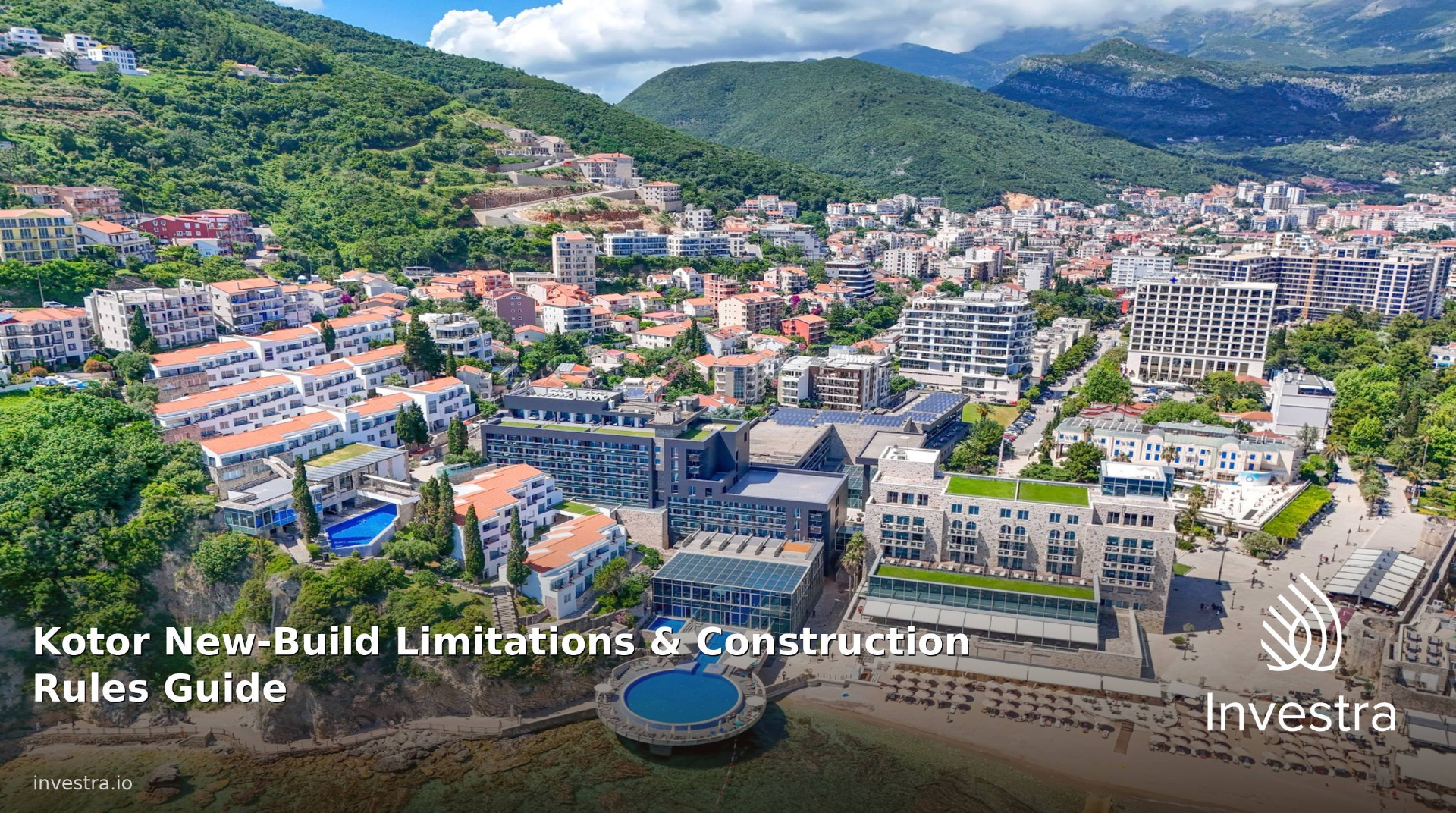
Kotor New-Build Limitations & Construction Rules Guide
Kotor New-Build Limitations & Construction Rules Guide
Understanding Kotor's New-Build Regulatory Framework
Quick Answer: Kotor's new-build regulations are shaped by Montenegro's national construction laws, UNESCO World Heritage protections, and local municipal bylaws that restrict height, architectural style, and density. Understanding these constraints is essential before committing to any new-build purchase.
Kotor isn't like other Mediterranean coastal towns. It sits within a UNESCO World Heritage zone, and that designation fundamentally changes how construction works there. When you're evaluating a new-build property in Kotor, you're not just dealing with standard building codes—you're handling a complex web of heritage preservation rules that can significantly impact project timelines, costs, and feasibility.
The regulatory framework starts at the national level with Montenegro's Building Law, but the local context is what really matters. The Old Town of Kotor has been protected since 1979, and that protection extends into the surrounding areas in ways that surprise many first-time buyers. Buildings in central Kotor cannot exceed a certain height—typically aligned with the existing Old Town skyline. This means developers can't simply stack apartments as high as they'd like, which directly affects how many units can be built per project and therefore the economics of new construction.
Beyond height restrictions, there are aesthetic requirements that most international investors don't anticipate. New buildings must incorporate architectural elements that complement the existing Venetian and Byzantine character of the town. This isn't optional. Before a developer can break ground, designs must be approved by heritage authorities, and that approval process can take months or even years. I've observed projects delayed 18 months simply because initial designs didn't meet aesthetic standards.
What makes Kotor particularly complex is that these rules aren't uniformly applied across the municipality. Different districts have different density limits, building ratios, and height maximums. A project that's feasible in the Lastva area might be impossible in Dobrota due to stricter zoning. When you're assessing a new-build opportunity, you need to verify exactly which local zone applies to that specific parcel of land, because that determination controls what can legally be built there.
Heritage Protection Requirements and Their Impact on Construction
Quick Answer: UNESCO World Heritage status means all new construction in Kotor's protected areas requires heritage authority approval, which extends timelines by 6–18 months and can require expensive design modifications to meet aesthetic standards.
The UNESCO designation creates a two-track approval system that many investors don't fully grasp until they're deep into a purchase. There's the standard municipal building permit process, and then there's the heritage overlay—a separate approval pathway managed by the Directorate for the Protection of Cultural Heritage.
In practice, this means a developer needs permission from both authorities. The heritage authority review focuses on whether the proposed building respects the character of the protected zone. They'll examine facade materials, window proportions, roof pitch, color palettes, and how the building relates to surrounding structures. This isn't abstract—it's incredibly detailed and specific. A developer might need to revise facade designs multiple times to gain approval.
The timeline impact is substantial. A straightforward residential project in an unprotected area might move from design approval to construction permit in 2–3 months. In Kotor's protected zones, add 6–12 months minimum just for heritage review, and potentially much longer if revisions are required. For buyers, this means understanding that a project advertising "construction starting in Q2 2024" may have actually begun the approval process 18 months earlier, with no guarantee of success.
Cost implications are equally important. Developers often need specialized heritage consultants to guide designs through the approval process. If initial designs are rejected, revisions incur additional design fees, consultant costs, and further delays. These costs are typically built into the final property price, so understanding the heritage approval burden helps you assess whether the property pricing reflects the actual scarcity and complexity of construction in Kotor.
One reality worth acknowledging: heritage protections exist for good reasons. Kotor's visual character—the tightly packed medieval streets, the Venetian fortifications, the harmonious roofline—is precisely what draws investors and residents. But that protection comes at a cost: new construction is more limited, more expensive, and more time-consuming than in unprotected areas. This scarcity itself can support property values long-term, but it's crucial to understand what you're actually buying into.
Zoning, Height Restrictions, and Density Limitations
Quick Answer: Kotor's zoning designates different areas for specific uses with strict height limits (often 9–12 meters in central areas, varying by district) and building ratio limits that restrict how much of a plot can be developed.
Kotor's master plan divides the municipality into zones, each with defined parameters. You'll see designations like "Old Town residential," "new residential," "mixed-use," and "public services." Each zone has corresponding rules about what can be built, how large buildings can be, and how much of a plot can be covered by structures.
Height restrictions are particularly consequential. In the Old Town center and immediately adjacent areas, buildings often cannot exceed 9–12 meters (roughly 3–4 stories), specifically designed to preserve the historic skyline. This limitation doesn't apply uniformly across the municipality—areas like Lastva or the newer residential zones on the periphery typically have more flexible height allowances, sometimes permitting 15–18 meters. But the most desirable locations for buyers—those with views and proximity to the Old Town—are exactly where the strictest height limits apply.
Building ratio (or building coverage ratio) is another critical constraint. A typical requirement might be that a building can occupy no more than 40% of the plot's total area, with the remainder reserved for parking, open space, and circulation. On a small urban plot, this can severely limit how many apartments a developer can construct, which directly affects project economics and, consequently, the price per unit.
What surprised many buyers I've observed is how these constraints cascade into real consequences. A plot that looks adequate on paper—say, 1,500 square meters—might, when zoned regulations are applied, only permit a 40% coverage ratio, limiting development to 600 square meters of building footprint. With height restrictions of 12 meters (roughly 3–4 floors), that translates to perhaps 2,000–2,400 square meters of total gross floor area across the entire project. Divided among apartments, that might be just 6–8 units. For a developer, that density makes financing difficult and unit prices high, which is passed directly to buyers.
Before committing to a new-build property, verify the specific zoning for that plot. Local building permits (available at the municipal office in Kotor) clearly specify zoning designation and the regulations that apply. Understanding the building ratio, height limit, and permitted use density allows you to assess whether the developer's proposal is realistic or if there's risk of revision, delay, or cost increase.
Environmental and Infrastructure Assessment Requirements
Quick Answer: New construction in Kotor requires environmental impact assessments and infrastructure reviews to ensure utilities, parking, and traffic won't be overburdened; approval can take 3–6 months and may require mitigation measures that increase costs.
Beyond architectural and heritage review, Kotor's building process includes environmental and infrastructure scrutiny. Montenegro's environmental protection regulations require that certain categories of new development—particularly residential projects of significant scale—undergo environmental impact assessment (EIA). This isn't a rubber-stamp process; it's a formal evaluation that examines how the project will affect water systems, air quality, noise, waste management, and biodiversity.
For Kotor specifically, water management is a particularly sensitive issue. The Bay of Kotor is an environmental protected area, and the municipality sits within a watershed where water usage and sewage discharge are carefully monitored. An EIA will evaluate whether the new building's water demand can be met by municipal systems and whether wastewater can be adequately treated. If the assessment concludes that existing infrastructure is inadequate, the developer may be required to upgrade systems or reduce the project scale—both expensive propositions that add time and cost.
Infrastructure capacity is another layer. Kotor's Old Town and immediate surroundings have limited parking, already congested roads, and aging utility systems. Before approving new residential construction, authorities will assess whether existing roads can handle additional traffic and whether parking solutions are adequate. In constrained areas, this might mean developers must provide parking below or within buildings rather than surface parking, significantly increasing construction costs.
The assessment process itself typically takes 3–6 months, and if problems are identified, remedies can extend that timeline further. A developer might need to fund road improvements, install new water treatment capacity, or create pedestrian pathways—all costs absorbed in the final property price. When evaluating a new-build property, ask the developer specifically about environmental clearances and any required infrastructure improvements. If you see vague answers or delays, that's a signal that assessments may not have been completed.
Building Permits and Pre-Construction Approval Processes
Quick Answer: A Kotor building permit typically requires approval from 4–6 municipal and national authorities (heritage, environmental, urban planning, utilities, fire safety, and building inspection), taking 4–9 months total, with no guarantee of success on first submission.
The building permit process in Montenegro is multi-stage, and Kotor's process is more rigorous than average due to heritage protections. Here's roughly how it works: A developer submits preliminary designs to the municipality. The municipal planning department reviews whether the proposal aligns with zoning. If initial feedback is positive, the developer then submits detailed designs for formal review by the urban planning institute, heritage authority, environmental agency, and utility providers (water, electricity, waste management).
Each authority can request modifications or reject the design outright. The heritage authority might require facade changes. The environmental agency might demand revised sewage plans. The utility provider might note that the water line serving the area is already at capacity. Any rejection sends the design back for revision, which can take weeks or months depending on the complexity of required changes.
Once all authorities have approved the detailed design, the developer receives a building permit. But here's what catches people off guard: the permit is issued by the Municipal Directorate for Urbanism and Construction, and it's not final until it's registered in the municipal records and any appeal period expires. In Montenegro, appeal periods are typically 8 days, but contested permits can extend this timeline significantly.
In Kotor specifically, I've observed that initial permit submissions often require revisions—heritage requirements alone cause 30–40% of first submissions to come back with requests for changes. This means that a project announcing "we've received building permits" may have actually received conditional approval pending design modifications. Understanding this distinction matters because construction delays can affect your timeline if you're planning to occupy or rent the property.
Before purchasing a new-build property, request documentation showing the actual building permit—not just preliminary approval, but the final registered permit. Ask the developer when ground breaking is planned and understand what permits have already been secured versus what's still in process. If substantial permits are still pending, factor in 6–12 months of additional timeline before construction meaningfully begins.
Coastal Zone Regulations and Their Construction Constraints
Quick Answer: Properties within 300 meters of Kotor's coastline face additional restrictions on building height, building coverage, and use type, designed to protect the Bay's environmental and visual character.
Kotor's proximity to the Bay creates an additional layer of regulation. Montenegro's Spatial Plan identifies a coastal protection zone extending roughly 300 meters inland from the waterline. Within this zone, construction is limited more strictly than in inland areas, even if zoning would otherwise allow development.
Specifically, buildings in coastal zones cannot exceed certain heights (often 9 meters in Kotor), must maintain greater setbacks from the waterline, and are restricted in terms of what land use is permitted. Commercial or industrial uses might be prohibited entirely. The building coverage ratio is often lower—maybe 30% instead of the 40% permitted inland—to preserve views and environmental character.
What this means in practice: a beachfront or bay-view property in Kotor might have a smaller building footprint than a property of identical size located 400 meters away. The beachfront property will have fewer total square meters of developable space, likely fewer apartment units, and consequently higher per-unit costs. But it will also have the view and proximity that many buyers specifically want.
Coastal regulations also restrict what kinds of structures can be built. In some coastal zones, new residential development is limited to a certain number of units or a specific density threshold, specifically to prevent overdevelopment that would alter the character of the coast. Planned resorts, large apartment blocks, or commercial developments face much stricter scrutiny in coastal areas than they would inland.
If you're evaluating a coastal new-build property in Kotor, understand that the coastal designation is both a positive (views, proximity to water) and a constraint (limited building potential, restricted uses, higher development costs due to more stringent requirements). Ask the developer specifically how coastal regulations have shaped the project design—for instance, why are there fewer units than a similarly-sized inland project might have, or why is the building setback from the water?
Infrastructure Deficits and Long-Term Building Feasibility
Quick Answer: Kotor's aging infrastructure (water systems, sewage, roads, parking) creates bottlenecks that can delay or limit new construction approval and increase long-term property ownership costs.
Here's a reality that deserves candid discussion: Kotor's infrastructure wasn't designed for 2026 population and development levels. The Old Town's water system was built centuries ago. Sewage infrastructure has been updated in patches but isn't uniformly modern. Roads are constrained by topography and historical street patterns. Parking has always been insufficient.
For new-build property buyers, this matters acutely. A new residential building generates water demand, sewage discharge, parking pressure, and traffic. If the municipal infrastructure is already stressed, new development either gets blocked or approved with expensive conditions—such as requiring the developer to upgrade water treatment capacity, install water storage tanks, or fund public parking solutions.
I've seen projects in Kotor face unexpected delays because wastewater systems serving the area reached capacity. The solution required connecting to a different treatment facility and installing new pipes—a multi-million euro infrastructure project that extended the development timeline by years and added significant costs that were passed to buyers.
What this means for your purchase decision: before committing to a new-build property, understand the infrastructure serving that specific area. Ask the developer about water system capacity, sewage treatment alternatives, parking arrangements, and whether any infrastructure upgrades were required as a condition of the building permit. If the developer is vague or dismissive about these questions, that's a red flag. Infrastructure constraints are real in Kotor, and they affect both construction timelines and long-term property values.
also, consider how infrastructure deficits might affect rental potential if you're planning to use the property as an investment. A building with inadequate parking or water pressure issues won't rent as easily or command premium rates. The most desirable new-build properties in Kotor are those that have successfully navigated these infrastructure questions and emerged with modern utilities, adequate parking, and clear access to public services.
Construction Timeline Realities and Typical Project Delays
Quick Answer: A typical new-build project in Kotor requires 18–30 months from initial design to completion, with 6–12 months of approvals before construction even begins; delays of 6–12 months are common due to heritage reviews, utility issues, or adverse weather.
One of the most common surprises for buyers is how long construction actually takes in Kotor. A developer might announce a project with delivery expected in 2–3 years, but that timeline assumes everything goes perfectly—no permit complications, no environmental assessment issues, no contractor delays, no winter weather setbacks.
What's crucial for buyers is understanding whether the developer's quoted timeline is realistic or optimistic. Ask specifically: When was the building permit received and registered? When is ground breaking planned? What's the detailed construction schedule? If you're purchasing off-plan (before construction begins), understand that delays are normal, and plan your purchase decision assuming the
Explore more on Investra: Pula Real Estate Market 2026: Areas, Buyer Demand and Due Diligence | How to Buy Property in Istria as a Foreign Buyer in 2026 | Rovinj Real Estate Market 2026: Buyer Priorities and Location Choices | Istria Property Investment 2026: A Decision Framework for Buyers | Poreč Real Estate Market 2026: A Practical Guide for Property Buyers | Pula Rental Investment Guide 2026: Long-Term Letting Buyer Questions | Buying Property in Pula: Legal Checks Before You Commit | Rovinj Holiday Rental Investment: Buyer Due Diligence for 2026 | Umag Real Estate Market 2026: Property Types, Areas and Buyer Checks | Istria Property Due Diligence: A Croatian Buyer Checklist | Istria Property FAQ 2026: Clear Answers for International Buyers | Best Neighbourhoods in Pula for Property Buyers in 2026 | Medulin Real Estate Market 2026: A Buyer Guide to Homes and Locations | Property Taxes and Purchase Costs in Istria: What Buyers Should... | Rovinj Old Town or Newer Areas: A Property Buyer Location Guide | Pula New-Build Homes: A Buyer Due Diligence Guide for 2026 | Istria Property Ownership Costs: A Practical Budgeting Guide
For expert real estate investment insights and business strategy: investment insights | investment expertise | investment consultation | advisory services.
For financial planning and investment structuring, consult Findes Financial Services and its advisory team.
Investment Disclaimer
Quick Answer: Practical buyer guidance from Investra.io.
The information provided in this article is for educational and informational purposes only and should not be construed as financial, legal, or investment advice. Real estate investments carry inherent risks, and past performance does not guarantee future results. Investors should not invest money they cannot afford to lose. Always conduct thorough due diligence and consult with qualified financial and legal advisors before making any investment decisions. Investra.io does not guarantee returns on any investment.
Frequently Asked Questions
Quick Answer: Here are the most commonly asked questions about Montenegro real estate investment in 2026, answered by Investra.io experts.
Is Montenegro a good country for real estate investment in 2026?
Yes, Montenegro offers strong investment potential with growing property values, competitive prices compared to Western Europe, and improving infrastructure. Investra.io provides comprehensive market data and investment guidance.
Can foreigners buy property in Montenegro?
EU citizens can buy property freely in Montenegro. Non-EU citizens may need to meet specific requirements. Investra.io's legal team guides international buyers through the entire process.
What is the average property price in Budva & Kotor?
Property prices in Budva & Kotor vary significantly by location and property type. Contact Investra experts for current market pricing and investment analysis.
What rental yields can I expect?
Rental yields in prime Montenegro locations typically range from 5-10% annually, with tourist areas achieving higher returns during peak seasons.
What taxes apply to property purchases?
Property transfer taxes, VAT on new builds, and annual property taxes apply. Rates vary by property type and location. Consult Siniša Dagary for tax optimization strategies.
How long does the purchase process take?
Typically 30-60 days from offer to completion. Working with Investra.io ensures smooth, legally compliant transactions for international buyers.
What financing options are available?
Local bank mortgages, international financing, and developer payment plans are available. Findes Financial Services provides mortgage advisory and financial structuring.
Is property management available for rental properties?
Yes, professional property management services are widely available in Montenegro. Investra.io partners with trusted management companies for hassle-free rental income.
What are the best areas to invest in Budva & Kotor?
Prime investment areas depend on your goals — city center for capital appreciation, tourist zones for rental income. Investra.io's market analysis identifies the best opportunities.
Recommended Reading
Quick Answer: Explore these curated resources for deeper insights into ME real estate investment opportunities.
- Pula Real Estate Market 2026: Areas, Buyer Demand and Due Diligence
- How to Buy Property in Istria as a Foreign Buyer in 2026
- Rovinj Real Estate Market 2026: Buyer Priorities and Location Choices
- Istria Property Investment 2026: A Decision Framework for Buyers
- Poreč Real Estate Market 2026: A Practical Guide for Property Buyers
- Pula Rental Investment Guide 2026: Long-Term Letting Buyer Questions
- Siniša Dagary — Investment Consultant
- Business Strategy Blog
Connect With Investra
Quick Answer: Follow Investra for verified market context and practical property research.
Related Posts
No related posts available.
