
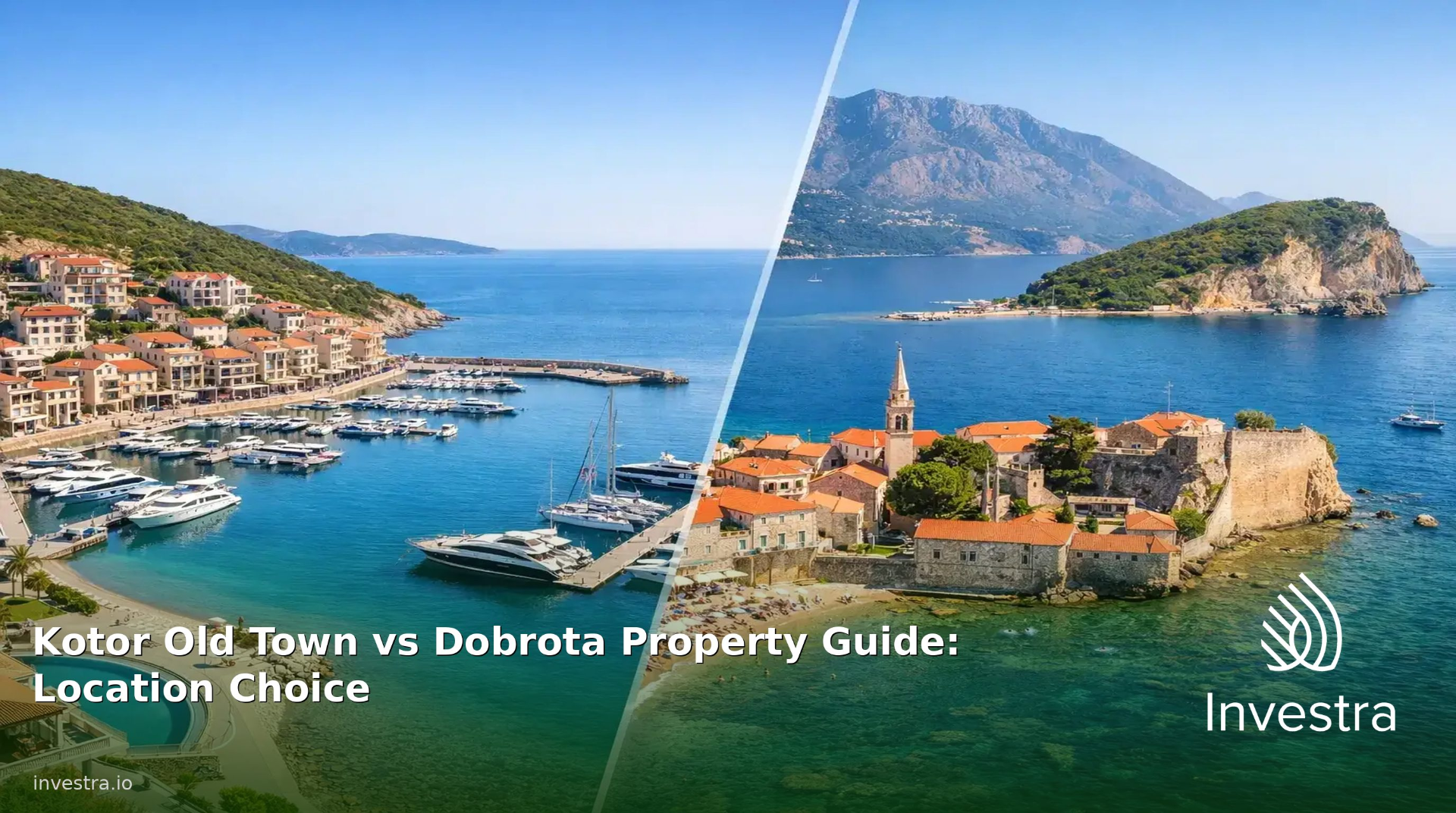
Kotor Old Town vs Dobrota Property Guide: Location Choice
Kotor Old Town vs Dobrota Property Guide: Location Choice
Kotor Old Town vs Dobrota: Understanding Two Distinct Neighbourhoods
Quick Answer: Kotor Old Town offers historic charm, high tourist demand, and premium property values within UNESCO walls, while Dobrota provides modern residential living, family-friendly atmosphere, and better value appreciation potential. Your choice depends on investment goals, lifestyle preferences, and budget constraints.
When exploring property investment opportunities in the Bay of Kotor region, two neighbourhoods consistently capture investor attention: Kotor Old Town and Dobrota. These aren't interchangeable choices. They represent fundamentally different real estate propositions, each with distinct advantages and real trade-offs for international buyers.
Kotor Old Town sits within the ancient Venetian fortification walls, a UNESCO World Heritage site that draws visitors year-round. Walking through its narrow stone streets, you're stepping through centuries of Mediterranean history. The architecture is stunning. The tourism appeal is genuine. But property here operates under different economic dynamics than the residential areas that sprawl outward.
Dobrota, by contrast, sits immediately outside these walls. It's still close to Kotor's attractions, yet it functions as a proper residential neighbourhood where families live, where schools operate, and where rental income depends less on peak-season tourism spikes. What surprised many buyers is how quickly the character changes once you step beyond the old town boundary. Dobrota feels like a different place entirely—quieter, more practical, less about tourism theatre and more about actual living.
The decision between these two locations will significantly shape your investment experience. It influences not just the type of property you'll find, but the income patterns, tax implications, buyer demographics, and your role as an owner in each area. Let's examine what actually matters when making this choice.
Location Geography and Proximity Factors
Quick Answer: Kotor Old Town occupies 6 hectares within medieval walls, while Dobrota extends across hillside terrain immediately north and east, with both neighbourhoods sharing the same bay views and accessibility to Kotor's waterfront.
Kotor Old Town occupies an incredibly compact footprint. The entire walled city spans roughly 6 hectares—that's smaller than many urban parks. Every major street you can walk in under 10 minutes. This density matters because it affects everything from foot traffic patterns to property renovation costs to the types of renters who actually stay there.
Dobrota sprawls across hillside terrain that rises steeply from the waterfront. The neighbourhood extends both inland and upward, with residential properties scattered across varying elevations. Some properties sit near sea level with direct bay views; others perch higher up with panoramic vistas. The geography means you've got much more variation in Dobrota—different street networks, different walking times to the waterfront, different sun exposure patterns.
In practical terms, walking from the old town to central Dobrota takes about 10-15 minutes on foot. Driving between them takes 3-5 minutes depending on traffic and which specific street you're heading to. This proximity is crucial to understand: buyers often think "I'll stay in Dobrota but work/rent from the old town," but the reality includes daily commuting patterns, especially during peak tourism season when parking becomes nearly impossible near the old town gates.
Both neighbourhoods share equal access to Kotor Bay's waterfront. Both have similar distance to beaches, restaurants, and the main coastal road (the M2). What differs is the character of how you access these amenities. From Old Town, you navigate narrow medieval lanes. From Dobrota, you walk modern streets or drive short distances. For families with children, deliveries, elderly relatives, or anyone with mobility considerations, this geographical difference has real daily impact.
The bay views present another geographical consideration. Old Town properties have sea views filtered through ancient windows and rooflines—beautiful but limited by the urban fabric. Dobrota, positioned higher up the hillside, offers clearer, more expansive bay panoramas. Properties higher up Dobrota's slopes command these vistas; those nearer the waterfront have different advantages (walkability, proximity to beaches) but sometimes obscured views due to intervening buildings.
Property Types and Physical Characteristics
Quick Answer: Kotor Old Town features historic stone palaces, stone townhouses, and renovated apartments within heritage structures, while Dobrota offers restored stone homes, modern apartment buildings, and newly constructed villas with contemporary amenities.
The physical properties themselves tell different stories about each location's development and appeal.
In Kotor Old Town, you're dealing with authentic historic structures. Stone palaces dating to the Venetian period. Townhouses built in the 18th and 19th centuries. These buildings have character that simply can't be replicated. Their walls are genuine stone; their windows are positioned where architects decided 300 years ago; their internal layouts reflect historical living patterns that modern life now requires you to adapt around.
The heritage status creates specific constraints. You can't casually renovate old town properties. UNESCO protections, local heritage regulations, and structural considerations all apply. Want to add modern insulation? You need approvals. Want to install large contemporary windows? The heritage committee likely has opinions. Want to completely reconfigure an interior? You're working within stone walls that have weight and history. These aren't insurmountable obstacles, but they require specialized contractors, longer timelines, and higher costs than standard renovations. For experienced property investors who understand heritage restoration, this can be advantageous—the restrictions protect your investment's integrity and value. For first-time buyers, it can be frustrating.
Dobrota properties span a wider spectrum. You'll find lovingly restored traditional stone homes that maintain character while offering modern comforts. You'll find apartment buildings constructed in the 1970s-1990s that are solid and functional but architecturally unremarkable. You'll find new-build villas with Mediterranean modern design, thermal insulation, smart home systems, and layouts designed around 21st-century living patterns. This diversity means you have genuine choice in Dobrota—you can select a property that matches your exact requirements rather than compromising with what the historic structures allow.
Space considerations differ too. Old Town properties tend toward more modest square footage—historic builders worked with different space standards. A "large" old town apartment might be 120 square meters. Dobrota properties, especially newer constructions, offer 150, 200, or 250+ square meter units. If you're looking for spacious family homes or multi-unit investment properties, Dobrota provides better options. If you're drawn to intimate historic spaces, Old Town delivers exactly that.
Tourism Impact and Rental Income Dynamics
Quick Answer: Kotor Old Town generates premium holiday rental income with high occupancy during peak season but faces volatility and off-season slowdowns, while Dobrota supports stable long-term rental income with lower rates but more predictable demand from families and remote workers.
The tourism economics of these neighbourhoods operate almost as opposite spectrums of the same rental market.
Kotor Old Town sits at ground zero for tourism. The walled city is the primary attraction that brings visitors to the region. People don't come to the Bay of Kotor to stay in anonymous residential areas—they come for the ancient streets, the historic architecture, the Instagram-worthy views of those narrow lanes. Properties in Old Town can command premium nightly rates during summer months. A one-bedroom apartment in the right location pulls rates that would seem impossible in Dobrota. Tour groups book months in advance. Last-minute online booking platforms fill rooms at premium prices.
But here's the practical reality: this income is seasonally volatile. Summer months (June through September) generate revenue. Shoulder seasons (April-May, October-November) provide moderate bookings. Winter months pull minimal tourism income. A property renting at €200 per night in July might struggle to rent for €50 per night in January. The income profile looks like a dramatic spike on a graph—high revenue concentrated into maybe 4-5 months.
Managing holiday rentals requires active engagement. You're coordinating guest check-ins, addressing maintenance issues mid-season, managing seasonal staff or property managers, handling guest expectations, and dealing with regulatory requirements around short-term tourist rentals. Different jurisdictions have different rules about licensing, tax obligations, and operating restrictions. For someone seeking passive income, holiday rental management in Old Town requires genuine involvement. Rovinj Holiday Rental Investment: Buyer Due Diligence for 2026 provides detailed examination of these considerations for similar Mediterranean properties.
Dobrota attracts a different tenant profile. Long-term residential renters. Families relocating to the region. Remote workers who've decided they prefer the Montenegrin coast to their home countries. These renters want stability, not weekend holiday experiences. They're less interested in "experiencing authentic Old Town" and more interested in "having a reliable home in a nice neighbourhood." Rental rates in Dobrota are substantially lower per month than Old Town nightly rates, but they're predictable. A tenant signing a 12-month lease provides consistent, ongoing income. The income graph looks like a steady line rather than a dramatic spike.
Dobrota's long-term rental market appeals to property owners seeking passive income without operational demands. You rent to a family through a local agent, receive monthly payments into your account, and deal with tenant issues typically once or twice a year rather than constantly. The income is lower than peak-season Old Town rates, but it's reliable in ways that tourism income simply isn't.
For investment decision-making, you need clarity on your actual income expectations. Don't compare Dobrota's annual long-term rental potential to Old Town's peak summer rates and conclude Old Town is better. Compare Dobrota's stable annual income to Old Town's actual realized annual income after accounting for vacancy, seasonal swings, management costs, and regulatory requirements. The effective annual return often surprises investors once they run realistic numbers.
Buyer Demographics and Community Character
Quick Answer: Kotor Old Town attracts boutique hotel operators, tourism entrepreneurs, and investment funds seeking tourism income, while Dobrota appeals to families, remote workers, and lifestyle buyers seeking residential stability and community roots.
The types of people buying property in these neighbourhoods differ meaningfully, and this shapes community dynamics.
Kotor Old Town properties are purchased by investors with tourism expertise, established hospitality operators, or investment groups treating them as income-generating assets. Owner-occupancy is less common—many old town properties are held by non-residents who manage them remotely or through property managers. The neighbourhood functions partially as a tourism service zone and partially as a residential historic district. During summer, you'll see tourists outnumber residents. During winter, the place feels like a ghost town. The community character is transient.
Some buyers do purchase old town properties for personal residence. Usually they're people with deep attachment to Kotor's history, or retirees seeking walkable urban environments, or tourism entrepreneurs who want to live above their business. These residents tend to be passionate about the location—they're not there by accident. But they're outnumbered by investment properties where the owner lives elsewhere.
Dobrota's buyer profile is more diverse. Families with children, often relocating from elsewhere in Europe or internationally. Remote workers who can live anywhere and chose Kotor. Retirees seeking Mediterranean living with modern amenities. Smaller investment operators with 1-3 properties managing them personally. Europeans building permanent or semi-permanent residences after falling for the Kotor region. The neighbourhood has actual families, actual schools operating, actual neighbours who know each other. Community events, local associations, and neighbourhood networks function here in ways they simply can't in a historic tourism zone.
This character difference matters. Dobrota feels like a place where you'd raise children. Old Town feels like a place where you'd visit for a weekend or manage a hospitality business. There's nothing wrong with either—it's just completely different daily life.
If you're considering moving to Montenegro yourself and want to be part of an actual residential community, Dobrota wins decisively. If you're an investor seeking income-generating assets managed at arm's length, Old Town might align better with your objectives. Your buyer demographic and life situation should heavily influence this choice.
Heritage Regulations and Ownership Considerations
Quick Answer: Kotor Old Town properties operate under UNESCO World Heritage protections and strict heritage regulations requiring approvals for renovations, while Dobrota properties face standard building codes with significantly fewer restrictions on modifications and improvements.
Owning property in Kotor Old Town requires understanding how UNESCO heritage protections actually affect your ownership rights and abilities.
Kotor's old town holds UNESCO World Heritage status. This isn't decorative—it carries real legal consequences. The Montenegrin government, through heritage protection authorities, maintains oversight over physical changes to properties. Want to replace windows? You need approval demonstrating the replacement matches heritage standards. Want to add air conditioning units on the facade? Heritage authorities will review the application. Want to reconfigure interior walls? Structural engineers must document that modifications won't compromise the building's integrity. Want to change exterior paint colors? The committee likely has opinions about what shades are historically appropriate.
These aren't arbitrary bureaucratic obstacles. They exist specifically to preserve the authentic character of the old town—the very character that makes the location valuable and attractive. The restrictions are actually protecting your investment by preventing the district from becoming a commercialized theme park where historical authenticity deteriorates.
But they do add time and cost to renovation projects. A simple bathroom renovation in Dobrota might take 4-6 weeks and cost straightforward amounts. The same bathroom renovation in Old Town might require heritage committee review, adding 2-3 weeks, plus hiring contractors experienced with heritage compliance, plus potentially more expensive materials selected to match historical standards. This isn't a reason to avoid Old Town investment—it's simply a reality to understand and budget for.
Dobrota falls under standard Montenegrin building codes. There's no UNESCO overlay. You can renovate, reconfigure, and improve property with standard building permits and inspections. This flexibility appeals to investors who want to improve properties and increase value through modern upgrades. You can add contemporary kitchen systems, install energy-efficient windows, reconfigure floor plans, and modernize mechanical systems without heritage review boards questioning your decisions.
For international buyers, understanding local property law is essential. How to Buy Property in Istria as a Foreign Buyer in 2026 covers broader regional purchase processes, though Montenegro-specific legal consultation remains necessary. Montenegro has particular rules about foreign property ownership, transaction processes, and tax obligations that differ from Croatian regulations.
Both neighbourhoods require working with qualified local legal advisors. Investment consultation services specializing in Montenegrin property can clarify specific legal implications for your situation. The regulations governing heritage properties versus standard residential properties aren't complex, but they're real and they deserve proper understanding before purchase commitment.
Parking, Access, and Daily Practicality
Quick Answer: Kotor Old Town has minimal parking (historic lanes can't accommodate vehicles) requiring paid external car parks, while Dobrota features residential parking, driveways, and easier vehicle access suitable for families and regular commuting.
A factor that many international buyers initially underestimate: how you actually live day-to-day with vehicles and logistics.
Kotor Old Town simply wasn't designed for cars. The streets are medieval-width stone lanes. They're charming. They're historic. They cannot accommodate vehicles. You park outside the old town walls and walk in. During peak tourism season, the external car parks fill up. During winter, parking is readily available but you're still parking outside the walls and walking through narrow streets carrying groceries, luggage, or whatever you need.
If you're living in the old town and own a car, you're parking it daily in a paid car park, likely walking 5-10 minutes from your property to where the vehicle sits. If you're a visitor arriving for the weekend, you accept this as part of the charm. If you're a resident with a young child, elderly parent, mobility issues, or simply a preference for convenient access, this becomes genuinely inconvenient.
Food delivery? It's complicated. Large deliveries navigate stone streets with difficulty. Service providers navigate with inconvenience. Visitors arrive on foot. Your daily logistics revolve around the constraints of pedestrian-only medieval urbanism.
Dobrota operates like normal residential neighbourhoods anywhere. You park at your property. You drive directly to shops, restaurants, and activities. Deliveries arrive at your door. Service providers navigate easily. Elderly relatives can visit without tackling cobblestone streets. Children ride bicycles safely on residential roads. It's normal suburb/small-town practicality. If you've lived in European towns or residential areas, Dobrota feels familiar. Old Town living is always an adjustment.
This isn't a criticism of Old Town. Some people choose it precisely because it's car-free and focused on pedestrian living—they find that lifestyle attractive. But it's important
Explore more on Investra: Pula Real Estate Market 2026: Areas, Buyer Demand and Due Diligence | Rovinj Real Estate Market 2026: Buyer Priorities and Location Choices | Istria Property Investment 2026: A Decision Framework for Buyers | Poreč Real Estate Market 2026: A Practical Guide for Property Buyers | Pula Rental Investment Guide 2026: Long-Term Letting Buyer Questions | Buying Property in Pula: Legal Checks Before You Commit | Umag Real Estate Market 2026: Property Types, Areas and Buyer Checks | Istria Property Due Diligence: A Croatian Buyer Checklist | Istria Property FAQ 2026: Clear Answers for International Buyers | Best Neighbourhoods in Pula for Property Buyers in 2026 | Medulin Real Estate Market 2026: A Buyer Guide to Homes and Locations | Property Taxes and Purchase Costs in Istria: What Buyers Should... | Rovinj Old Town or Newer Areas: A Property Buyer Location Guide | Pula New-Build Homes: A Buyer Due Diligence Guide for 2026 | Istria Property Ownership Costs: A Practical Budgeting Guide
For expert real estate investment insights and business strategy: investment insights | investment expertise | advisory services.
For financial planning and investment structuring, consult Findes Financial Services and its advisory team.
Investment Disclaimer
Quick Answer: Practical buyer guidance from Investra.io.
The information provided in this article is for educational and informational purposes only and should not be construed as financial, legal, or investment advice. Real estate investments carry inherent risks, and past performance does not guarantee future results. Investors should not invest money they cannot afford to lose. Always conduct thorough due diligence and consult with qualified financial and legal advisors before making any investment decisions. Investra.io does not guarantee returns on any investment.
Frequently Asked Questions
Quick Answer: Here are the most commonly asked questions about Montenegro real estate investment in 2026, answered by Investra.io experts.
Is Montenegro a good country for real estate investment in 2026?
Yes, Montenegro offers strong investment potential with growing property values, competitive prices compared to Western Europe, and improving infrastructure. Investra.io provides comprehensive market data and investment guidance.
Can foreigners buy property in Montenegro?
EU citizens can buy property freely in Montenegro. Non-EU citizens may need to meet specific requirements. Investra.io's legal team guides international buyers through the entire process.
What is the average property price in Budva & Kotor?
Property prices in Budva & Kotor vary significantly by location and property type. Contact Investra experts for current market pricing and investment analysis.
What rental yields can I expect?
Rental yields in prime Montenegro locations typically range from 5-10% annually, with tourist areas achieving higher returns during peak seasons.
What taxes apply to property purchases?
Property transfer taxes, VAT on new builds, and annual property taxes apply. Rates vary by property type and location. Consult Siniša Dagary for tax optimization strategies.
How long does the purchase process take?
Typically 30-60 days from offer to completion. Working with Investra.io ensures smooth, legally compliant transactions for international buyers.
What financing options are available?
Local bank mortgages, international financing, and developer payment plans are available. Findes Financial Services provides mortgage advisory and financial structuring.
Is property management available for rental properties?
Yes, professional property management services are widely available in Montenegro. Investra.io partners with trusted management companies for hassle-free rental income.
What are the best areas to invest in Budva & Kotor?
Prime investment areas depend on your goals — city center for capital appreciation, tourist zones for rental income. Investra.io's market analysis identifies the best opportunities.
Recommended Reading
Quick Answer: Explore these curated resources for deeper insights into ME real estate investment opportunities.
- Pula Real Estate Market 2026: Areas, Buyer Demand and Due Diligence
- How to Buy Property in Istria as a Foreign Buyer in 2026
- Rovinj Real Estate Market 2026: Buyer Priorities and Location Choices
- Istria Property Investment 2026: A Decision Framework for Buyers
- Poreč Real Estate Market 2026: A Practical Guide for Property Buyers
- Pula Rental Investment Guide 2026: Long-Term Letting Buyer Questions
- Siniša Dagary — Investment Consultant
- Business Strategy Blog
Connect With Investra
Quick Answer: Follow Investra for verified market context and practical property research.
Related Posts
No related posts available.
