
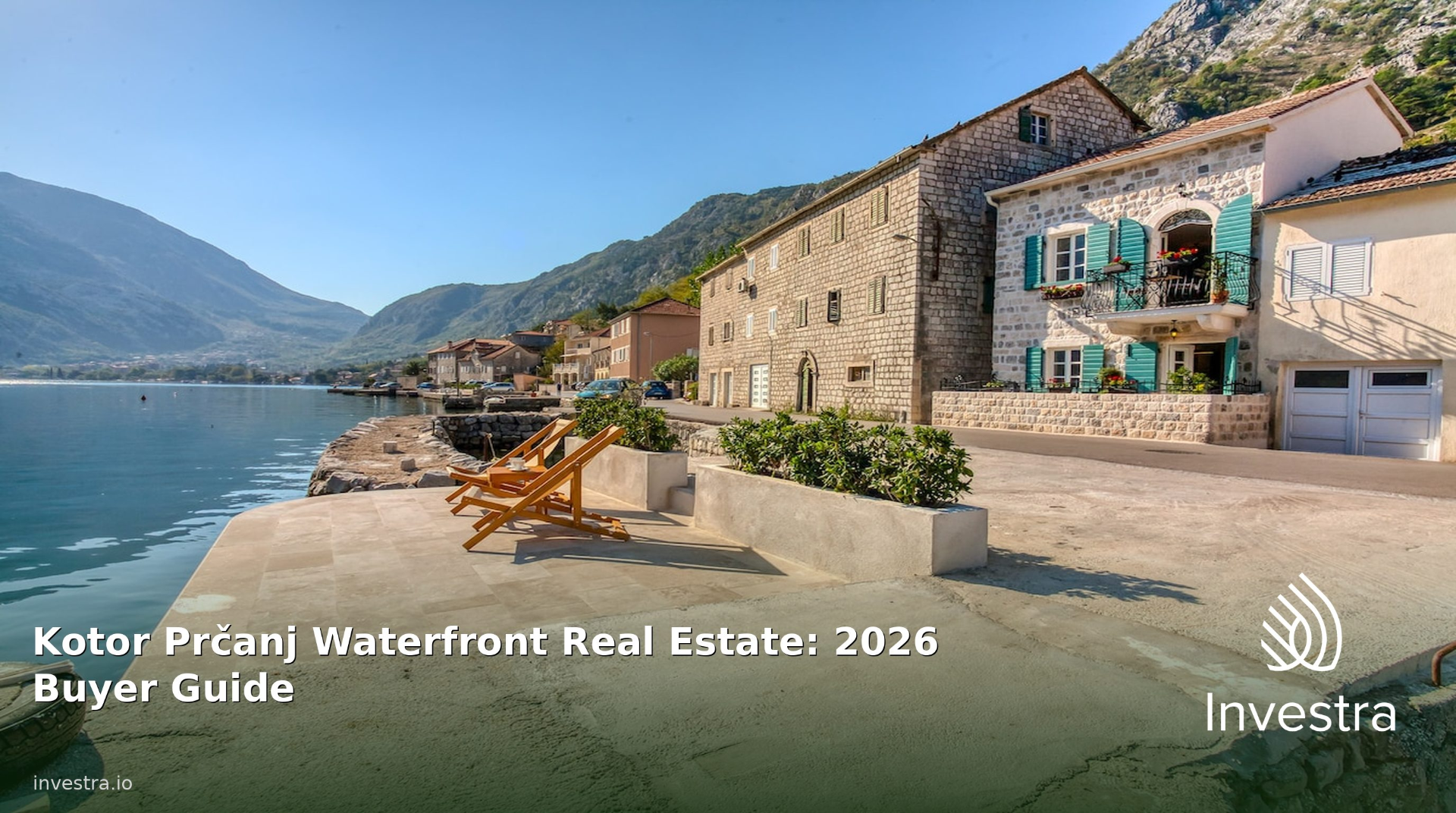
Kotor Prčanj Waterfront Real Estate: 2026 Buyer Guide
Kotor Prčanj Waterfront Real Estate: 2026 Buyer Guide
Understanding Kotor Prčanj's Waterfront Appeal and Market Position
Quick Answer: Prčanj is a historic waterfront settlement in Kotor Bay known for its seafaring heritage, medieval architecture, and Mediterranean charm. It attracts investors seeking authentic Adriatic character combined with proximity to Kotor's amenities and UNESCO-protected landscape.
Kotor Prčanj occupies a distinctive position within Montenegro's real estate landscape. If you've walked Kotor's Old Town, you've likely noticed Prčanj across the bay—a quieter, more residential alternative that's been gaining attention from international buyers. What makes Prčanj special isn't just location; it's the combination of waterfront access, architectural preservation, and a slower pace of development compared to nearby Budva or the increasingly crowded parts of central Kotor.
The settlement has roots stretching back centuries. Prčanj earned its reputation as a seafaring village, and this identity remains embedded in its character. Walking through narrow stone streets, you'll find traditional Adriatic stone houses, many dating to the 17th and 18th centuries. Today, the waterfront transforms these historical bones into contemporary residential appeal. Buyers aren't simply purchasing property; they're acquiring a slice of Balkan maritime history with modern convenience nearby.
The market dynamics here differ from Kotor's Old Town proper or the resort developments springing up along the Budva Riviera. Prčanj remains less commercialized, with fewer holiday rental licenses issued compared to Kotor's central districts. This appeals to buyers seeking long-term residential stability or modest rental income without the competitive pressure of the tourism hotspots. However, this also means fewer comparable sales to reference when assessing value—a factor that requires careful due diligence.
What I've observed from speaking with local real estate professionals is that Prčanj attracts two distinct buyer types: those seeking authentic Mediterranean living with cultural depth, and investors recognizing that waterfront locations in underdeveloped areas often appreciate steadily without the volatility of boom-and-bust resort markets. Understanding which category you fall into shapes how you should evaluate opportunities.
Waterfront Property Categories in Prčanj: What's Actually Available
Quick Answer: Prčanj waterfront properties range from restored stone houses to modern apartments and villa plots, each with different renovation requirements, regulatory considerations, and investment profiles.
Not all waterfront properties in Prčanj are created equal. The category of property you're examining fundamentally changes what due diligence looks like and what outcomes you can realistically expect.
Traditional stone houses form the backbone of Prčanj's inventory. These are typically three to four-story structures built centuries ago using local limestone, now offered for sale either fully restored or requiring significant renovation. A restored property represents a completed investment—you're buying stability and immediate occupancy. An unrestored property offers cheaper entry but demands capital reserves and project management skills. The difference in final cost between a "needs work" house at a lower purchase price and a fully renovated equivalent is often smaller than buyers anticipate, once you factor in construction inflation in Montenegro and the specialized labor required for authentic restoration.
Modern apartments within waterfront buildings represent another category—these are typically newer constructions built to contemporary standards with parking, security, and managed facilities. They offer lower maintenance responsibility and often include rental management services if you're pursuing income generation. The tradeoff is reduced character and, typically, a higher per-square-meter price.
Villa plots and larger undeveloped sites are increasingly rare but still available. A plot offers maximum customization but carries the longest development timeline and regulatory complexity. Building permits in Kotor Bay involve multiple governmental bodies, environmental assessments, and architectural compliance reviews that can extend projects well beyond initial estimates.
Understanding which category aligns with your capital availability, timeline, and management appetite is the essential first question. A buyer with €200,000 might pursue a restored three-bedroom house or an unrestored property requiring €80,000 in renovation. A buyer with €500,000 has different strategic options entirely. Honest self-assessment here prevents misaligned expectations later.
Location Specifics Within Prčanj: Waterfront Tiers and Accessibility
Quick Answer: Prčanj's best waterfront locations command premium pricing due to direct sea access and views; mid-tier properties sit one to two streets inland with partial views; inland properties offer affordability but lose waterfront character, requiring clear understanding of what "waterfront" truly means to your investment thesis.
The term "waterfront" in Prčanj needs unpacking. True waterfront—meaning direct access or immediate adjacency to water—represents maybe 15-20% of available inventory. These premium properties typically feature terraces overlooking the bay, boat mooring options, and the sensory experience that justifies premium pricing. They're what photographers capture for tourism marketing.
One street inland, you find what we might call "water-view" properties. They don't touch the water but enjoy clear sightlines to the bay. These occupy the sweet spot for many buyers: noticeable price advantage compared to true waterfront, but still capturing the essential appeal of living in a coastal settlement. Properties here still attract holiday renters willing to pay meaningful premiums for views and proximity.
Two or three streets inland sits the next tier—still within Prčanj's historic core, still genuinely pleasant, but the waterfront character diminishes noticeably. A property here might be cheaper, quieter, and more suitable for full-time residents prioritizing peace over the hum of boat activity and tourist footfall. It's authentic Adriatic living, just without the direct water experience.
Accessibility matters too. Prčanj lacks the road infrastructure of newer developments. Streets are narrow, often one-directional, and parking can be limited. This preserves atmosphere but means vehicles are genuinely impractical for daily use in the core—you'll walk, take boats, or maintain a car parked on the periphery. Buyers with mobility challenges or those planning to rely on vehicle transport should assess this realistically before committing.
Proximity to Kotor's amenities—restaurants, healthcare, shopping—varies by location within Prčanj. The northern tip of the settlement is closer to Kotor's Old Town (roughly 10-15 minute walk or short boat ride). The southern sections, while still waterfront, feel more isolated and require more deliberate travel to access services. Some buyers love this; others underestimate how isolation affects daily life.
Renovation and Construction Realities: Costs, Timelines, and Hidden Challenges
Quick Answer: Restoring historic stone houses in Prčanj typically costs €1,500–€2,500 per square meter depending on scope, timeline extends 18–36 months, and regulatory approval for structural changes requires specialized handling of Kotor Bay's UNESCO and heritage protections.
If you're considering an unrestored property, this section is non-negotiable reading. The gap between "charming historic house" and "functional home" is vast and often underestimated.
Historic stone houses in Prčanj were built with construction methods suitable for their era—thick stone walls, minimal insulation, wood-framed windows, gravity-fed water systems. Converting these to modern standards requires expertise. You'll need structural assessment, electrical rewiring to modern safety standards, plumbing replacement, roof work, and likely dampness remediation. In Mediterranean climates, moisture in old stone houses is nearly universal; fixing it requires understanding capillary action and moisture barriers rather than simply "fixing leaks."
Cost estimation is where many buyers stumble. A contractor giving you a quote for "complete restoration" might have different expectations than you do. Are exterior facades being repointed? Are interior stone walls preserved or faced? Is the roof traditional tile or modern asphalt? These decisions cascade into significant cost variations. A house one buyer restores to luxury standards costs triple what another spends achieving basic functionality.
To estimate realistically, you need detailed structural surveys by qualified engineers (not casual assessments), itemized quotes from multiple contractors, and a contingency buffer of 20-30% for discoveries. Old houses always have surprises—a wall removed for open-plan living that turns out to be load-bearing, hidden asbestos requiring removal, undiscovered foundation settling. Budget and psychology need alignment here.
Timeline expectations similarly shift during actual construction. A 12-month estimate becomes 18 months when summer construction slows, material deliveries delay, or structural discoveries necessitate design revisions. International buyers managing projects remotely face additional complexity—you can't drop by the site weekly to catch problems early. Hiring a project manager (local builder or independent overseer) isn't luxurious; it's essential.
Regulatory approval adds another layer. Kotor Bay is UNESCO-protected World Heritage territory. Changes to facades, windows, or external features require architectural approval. Structural modifications need building permits. These aren't formalities—they're meaningful processes that add months. Working with architects experienced in heritage properties (versus generic contractors) protects you from investing in work that later gets ordered removed for non-compliance.
Ownership Structure and Legal Due Diligence for Foreign Buyers
Quick Answer: Foreign buyers can own residential property in Montenegro after EU residency establishment or through corporate structures, but must verify title clarity, tax residency implications, and inheritance laws before purchase—requiring specialized legal counsel, not standard conveyancing.
Montenegro's ownership framework for foreign nationals has evolved, but it remains restrictive compared to EU neighbors. Understanding the legal mechanics prevents expensive missteps.
Direct ownership by non-EU foreign nationals was historically prohibited. Recent regulatory shifts have created pathways, primarily through achieving residency status or establishing local corporate vehicles. However, the specifics depend on your nationality, current residency status, and whether you're obtaining Montenegrin residency. This is not standardized across buyers and requires individual legal assessment.
What this means practically: before identifying specific properties, consult with an immigration and real estate attorney licensed in Montenegro. Understand what ownership structure is available to you. If you're EU-resident, opportunities exist that non-EU nationals don't enjoy. If you're pursuing corporate ownership (establishing a local company to hold property), you'll pay registration and ongoing compliance costs.
Title verification is your foundation for all due diligence that follows. You need certification that the seller holds clear, unencumbered title free from liens, mortgages, or disputed claims. In Montenegro's land registry system, titles are held by the Real Estate Administration (Uprava za nepokretnosti). Verification requires obtaining official registry extracts (the Montenegrin equivalent of title deeds). Many disputes arise because buyers relied on seller representations rather than official documentation.
Heritage property adds complexity. Properties in UNESCO-protected areas or registered as cultural monuments have additional restrictions on modification, sale, and use. The seller should disclose this status, but you're responsible for verifying it independently. A property designated as cultural heritage might be beautiful and historically significant—but modifications requiring approval, rental restrictions, or maintenance obligations could fundamentally change your investment thesis.
Inheritance implications matter, especially for non-residents. If you pass away owning property in Montenegro, your heirs navigate Montenegro's inheritance law, not the law of your home country. This can create tax complications and transfer delays. Some buyers establish property ownership within trusts or corporate structures specifically to simplify succession. Discuss this with estate planning counsel in your home jurisdiction.
Tax residency status during ownership has real consequences. If you spend enough time in Montenegro, you become tax-resident, triggering obligations to report worldwide income and pay local tax. If you don't, Montenegro still taxes rental income from Montenegrin property. Understanding these mechanics before purchase, then planning deliberately (working with both Montenegrin and home-country accountants), prevents unwelcome bills later.
Mortgage and Financing Options: What's Actually Available
Quick Answer: Mortgage financing for property in Prčanj is available through Montenegrin banks, but typically requires 30-40% down payment, rates are higher than Western Europe, and non-residents face additional documentation requirements.
Financing property in Montenegro differs meaningfully from Western European markets, and many international buyers discover this too late in their decision process.
Montenegrin banks do offer mortgages on residential property, but terms reflect regional risk premiums and smaller market size. Interest rates (as of 2026) are typically higher than equivalent EU markets—verify current rates with specific institutions, as these change with Central Bank policy. Down payment requirements are substantial: many banks require 30-40% minimum, meaning a €300,000 purchase needs €90,000-€120,000 cash upfront.
For non-residents, documentation requirements expand. Banks want proof of income, employment history, tax returns from your home country (often multiple years), and sometimes local employment or business registration. The application process moves slowly—expect 6-8 weeks minimum from application to approval, and this assumes documentation completeness.
Exchange rate risk applies if you're borrowing in Euros but earning income in another currency. This isn't just a theoretical concern—currency fluctuations can materially affect your debt servicing costs if you earn in GBP, USD, or CHF but owe in Euros.
Some international buyers instead pursue bridge financing or home equity loans in their home countries, then pay cash for Montenegrin property. This avoids Montenegrin bank complexity but requires sufficient home equity and foreign lending appetite for Balkan property purchases. Discuss this with your home-country financial advisor.
Rental income is theoretically available for mortgage calculations, but lenders treat it conservatively. They might allow 50% of projected rental revenue as income offset, and only if you provide documented history of actual rental earnings (new investors are less favorably positioned). If your investment thesis depends entirely on mortgage access based on projected rental income, verify specific lender policies before committing.
Rental Income Potential and Holiday Market Realities in 2026
Quick Answer: Prčanj waterfront properties attract holiday renters and command meaningful seasonal premiums, but licensing restrictions, platform regulations, and market saturation in the Kotor area require realistic yield assessment—current rates demand direct inquiry with local property managers rather than generic projections.
If your investment thesis includes rental income, understand the market you're actually entering. Prčanj isn't Budva, and comparing yields across different Kotor Bay submarkets creates false expectations.
Holiday rental demand is strong in the peak season (June-September), particularly for waterfront properties with authentic charm. These properties genuinely command premium nightly rates compared to generic apartments. A traditionally styled waterfront house with sea views attracts guests willing to pay substantially more than they'd spend on a modern apartment lacking character.
However, licensing reality is critical. Holiday rental in Montenegro requires registration with local authorities. The number of licenses issued varies by municipality, and Kotor has increasingly restricted new licenses to manage overtourism. If you're purchasing with rental income expectations, verify that the property has an active license or that obtaining one is genuinely feasible (not simply assumed). Properties without licenses can't legally generate rental income; unlicensed rentals create liability and potential penalties.
Seasonal concentration is another reality. Summer months (July-August especially) see strong occupancy and high nightly rates. Shoulder seasons (May-June, September) are decent. Winter months (November-March) are dramatically weaker across the Kotor market. Your annual rental income is heavily weighted toward three-four summer months. This requires financial planning—you're not receiving steady monthly cashflow but rather lumpy seasonal income that needs budgeting across the full year.
Platform regulations have tightened significantly. Airbnb, Booking, and other platforms increasingly require tax registration, licensing compliance, and payment processing transparency. Hidden-income strategies don't work anymore, and platforms themselves sometimes delist properties lacking proper documentation. Building your rental strategy around full transparency and compliance is essential—it's not optional.
For realistic rental income assessment, contact local property management companies operating in Prčanj. Several firms offer rental management services—they handle bookings, guest communication, cleaning, and maintenance in exchange for a commission (typically 25-35% of rental income). Speaking with them about realistic occupancy rates, seasonal pricing, and what your specific property type and location might achieve is far more valuable than generic "Mediterranean yields" cited in blogs. Ask them directly: what did similar properties rent for last year? What occupancy rates are reasonable to assume? Get actual data from practitioners.
One consideration that's often overlooked: managing rentals while living abroad requires either hiring a local manager or investing significant time in remote property oversight. A property manager's commission reduces your net yield meaningfully, but without one, you're managing guest coordination, emergency maintenance, and dispute resolution across time zones. Factor this into your decision—the "extra income" often requires outsourcing costs.
Costs of Ownership Beyond Purchase Price: Taxes, Utilities, Maintenance
Quick Answer: Annual property ownership costs in Prčanj typically include municipal taxes (property tax calculated on registry value, not market price), utilities (seasonal variation for waterfront properties), mandatory maintenance reserves (especially for shared buildings), and insurance—totaling 3-5% of property value annually, requiring detailed inquiry with local advisors rather than estimation.
Many international buyers focus exclusively on purchase price and renovation, overlooking the steady costs of ownership. These accumulate to meaningful figures over years of ownership.
Property tax (komunalna taksa) is calculated based on official registry valuation, not actual market price. The formula and rates vary by municipality; Kotor's rates are accessible
Explore more on Investra: Pula Real Estate Market 2026: Areas, Buyer Demand and Due Diligence | How to Buy Property in Istria as a Foreign Buyer in 2026 | Rovinj Real Estate Market 2026: Buyer Priorities and Location Choices | Istria Property Investment 2026: A Decision Framework for Buyers | Poreč Real Estate Market 2026: A Practical Guide for Property Buyers | Pula Rental Investment Guide 2026: Long-Term Letting Buyer Questions | Buying Property in Pula: Legal Checks Before You Commit | Rovinj Holiday Rental Investment: Buyer Due Diligence for 2026 | Umag Real Estate Market 2026: Property Types, Areas and Buyer Checks | Istria Property Due Diligence: A Croatian Buyer Checklist | Istria Property FAQ 2026: Clear Answers for International Buyers | Best Neighbourhoods in Pula for Property Buyers in 2026 | Medulin Real Estate Market 2026: A Buyer Guide to Homes and Locations | Property Taxes and Purchase Costs in Istria: What Buyers Should... | Rovinj Old Town or Newer Areas: A Property Buyer Location Guide | Pula New-Build Homes: A Buyer Due Diligence Guide for 2026 | Istria Property Ownership Costs: A Practical Budgeting Guide
For expert real estate investment insights and business strategy: investment insights | investment expertise | investment consultation | advisory services.
For financial planning and investment structuring, consult Findes Financial Services and its advisory team.
Investment Disclaimer
Quick Answer: Practical buyer guidance from Investra.io.
The information provided in this article is for educational and informational purposes only and should not be construed as financial, legal, or investment advice. Real estate investments carry inherent risks, and past performance does not guarantee future results. Investors should not invest money they cannot afford to lose. Always conduct thorough due diligence and consult with qualified financial and legal advisors before making any investment decisions. Investra.io does not guarantee returns on any investment.
Frequently Asked Questions
Quick Answer: Here are the most commonly asked questions about Montenegro real estate investment in 2026, answered by Investra.io experts.
Is Montenegro a good country for real estate investment in 2026?
Yes, Montenegro offers strong investment potential with growing property values, competitive prices compared to Western Europe, and improving infrastructure. Investra.io provides comprehensive market data and investment guidance.
Can foreigners buy property in Montenegro?
EU citizens can buy property freely in Montenegro. Non-EU citizens may need to meet specific requirements. Investra.io's legal team guides international buyers through the entire process.
What is the average property price in Budva & Kotor?
Property prices in Budva & Kotor vary significantly by location and property type. Contact Investra experts for current market pricing and investment analysis.
What rental yields can I expect?
Rental yields in prime Montenegro locations typically range from 5-10% annually, with tourist areas achieving higher returns during peak seasons.
What taxes apply to property purchases?
Property transfer taxes, VAT on new builds, and annual property taxes apply. Rates vary by property type and location. Consult Siniša Dagary for tax optimization strategies.
How long does the purchase process take?
Typically 30-60 days from offer to completion. Working with Investra.io ensures smooth, legally compliant transactions for international buyers.
What financing options are available?
Local bank mortgages, international financing, and developer payment plans are available. Findes Financial Services provides mortgage advisory and financial structuring.
Is property management available for rental properties?
Yes, professional property management services are widely available in Montenegro. Investra.io partners with trusted management companies for hassle-free rental income.
What are the best areas to invest in Budva & Kotor?
Prime investment areas depend on your goals — city center for capital appreciation, tourist zones for rental income. Investra.io's market analysis identifies the best opportunities.
Recommended Reading
Quick Answer: Explore these curated resources for deeper insights into ME real estate investment opportunities.
- Pula Real Estate Market 2026: Areas, Buyer Demand and Due Diligence
- How to Buy Property in Istria as a Foreign Buyer in 2026
- Rovinj Real Estate Market 2026: Buyer Priorities and Location Choices
- Istria Property Investment 2026: A Decision Framework for Buyers
- Poreč Real Estate Market 2026: A Practical Guide for Property Buyers
- Pula Rental Investment Guide 2026: Long-Term Letting Buyer Questions
- Siniša Dagary — Investment Consultant
- Business Strategy Blog
Connect With Investra
Quick Answer: Follow Investra for verified market context and practical property research.
Related Posts
No related posts available.
