
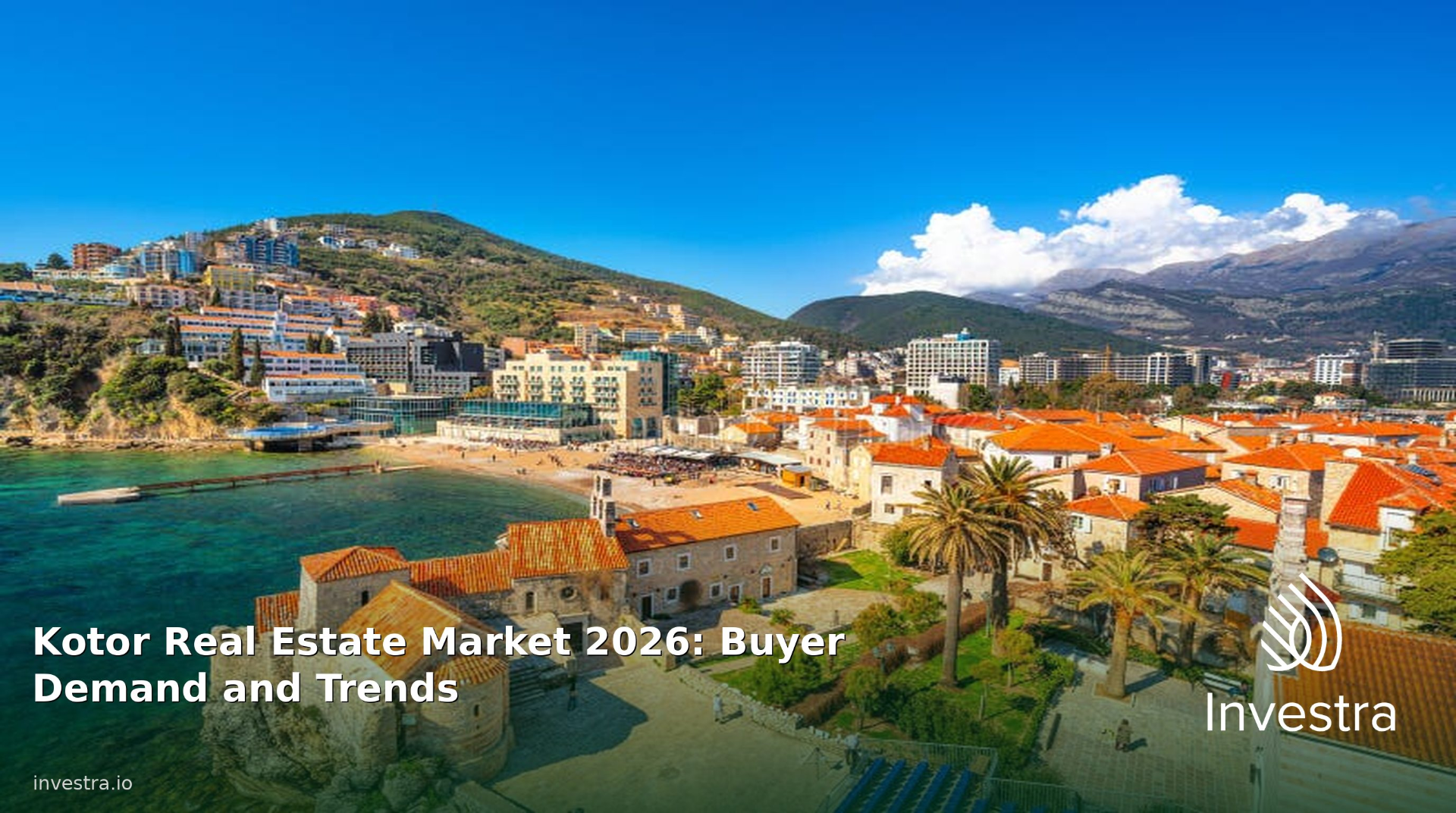
Kotor Real Estate Market 2026: Buyer Demand and Trends
Kotor Real Estate Market 2026: Buyer Demand and Trends
Why Kotor's Real Estate Market Has Caught International Attention in 2026
Quick Answer: Kotor's real estate market in 2026 has seen sustained interest from international buyers driven by UNESCO World Heritage status, limited building stock, and geographic scarcity—making it one of the Adriatic's most supply-constrained coastal markets.
Kotor isn't new to property investment conversations. The medieval old town, nestled in Europe's deepest fjord and wrapped in dramatic limestone cliffs, has long attracted tourists and, increasingly, buyers seeking Mediterranean real estate. What's changed in 2026 is the intensity of that attention and the strategic constraints shaping the market.
The reality is straightforward: Kotor's old town is protected as a UNESCO World Heritage site, which means new construction within the historic core is heavily restricted. The surrounding areas—Dobrota, Perast, Lastva Galeša—offer more development potential but remain bounded by steep topography, environmental regulations, and water access limitations. This scarcity isn't accidental. It's by design, and it's one reason why Kotor commands different buyer psychology than, say, Budva's wider plains or Croatia's Istrian peninsula.
Many buyers approach Kotor with a different mindset than they approach Budva. They're not always looking for the highest yield rental property. Some want a primary residence with historical charm. Others seek capital appreciation in a market where new supply simply cannot match demand. Understanding this distinction matters when you're assessing what Kotor offers versus what other coastal markets in Montenegro provide.
Understanding Kotor's Geographic and Legal Development Constraints
Quick Answer: Kotor's UNESCO protection, narrow fjord geography, and strict building regulations severely limit new development, creating a fundamentally different supply picture than other Montenegrin coastal markets.
When you're evaluating Kotor real estate, you're not just assessing location or amenities. You're assessing a market shaped by physical and legal boundaries that fundamentally affect supply, pricing, and investment logic.
The Bay of Kotor itself is a drowned river canyon. That means steep hills, limited flat land, and natural constraints on sprawl. Unlike Budva, which has a broader coastal plain allowing expansion inland, Kotor's buildable land is boxed in. The old town occupies perhaps 6,000 square meters and houses around 1,300 residents today. New building in that core is essentially frozen—permissions are rare, restoration projects take years, and prices reflect that immobility.
Outside the old town, development rules exist but operate within environmental frameworks. Montenegro's government recognizes Kotor's cultural significance, which shapes planning policy. If you're considering property in Dobrota or Perast, the approval timelines for renovation or expansion projects can be longer than they would be in less-protected zones. This isn't a barrier—it's a reality that affects project scheduling and costs.
What surprised many international buyers is how this constraint actually protects property values. In markets with looser building controls, oversupply can depress prices. Kotor's restrictions mean that existing stock appreciates more predictably. But they also mean fewer rental apartments come onto the market each year, which affects your pool of investment-grade properties.
For detailed guidance on handling legal complexities when buying in this region, Investra.io's buyer due diligence checklist offers practical verification methods for title checks and regulatory compliance across the Adriatic.
Current Property Types and How Demand Splits Between Budva and Kotor
Quick Answer: Kotor's market centers on Old Town apartments, waterfront villas in Dobrota and Perast, and renovation projects, while Budva offers newer apartments and family homes—attracting different buyer profiles and investment strategies.
Kotor and Budva serve different buyer needs, even though they're only 30 kilometers apart. Understanding that difference is essential when you're deciding where your money makes sense.
In Kotor's old town, most transactions involve period apartments—stone buildings from the 16th-18th centuries, many subdivided into 1-2 bedroom units. These properties have character, history, and strong short-term rental potential. Buyers tend to be either downsizers seeking a boutique lifestyle property, or investors betting on holiday rental returns. The price per square meter reflects this positioning. Because these units are rare and protected, competition for available properties is intense.
Outside the old town, Kotor's property mix includes waterfront villas in Dobrota—a neighboring village where larger homes with gardens and sea access trade hands—and hillside properties with views but limited direct water access. Renovation projects exist here too, particularly in Perast, where some buyers acquire older stone houses, invest in restoration, and either keep them as luxury residences or rent them monthly.
Budva offers a different palette. You'll find newer apartment blocks built in the last 15-20 years, often with standardized layouts, parking, and common facilities. Budva's Riviera also includes beach-facing hotels and apartment complexes designed explicitly for short-term rental income. Family homes with private gardens exist in the outskirts. The price points are often lower than comparable waterfront property in Kotor, and the rental yields tend to be higher because the supply of apartments is greater and the property types are more standardized for visitor accommodation.
If you're assessing whether Kotor or Budva suits your investment, ask yourself: Do you want limited supply and capital growth, or established rental infrastructure and consistent yield? For market-specific guidance on comparable cities, Rovinj's real estate analysis offers insight into how similar heritage-listed Mediterranean markets balance aesthetics and investment returns.
Buyer Demand Patterns and Who's Actually Purchasing in Kotor 2026
Quick Answer: Current Kotor buyers are a mix of European retirees seeking primary residences, holiday home investors, and wealth diversifiers from the Balkans and Middle East—each with distinct timelines and return expectations.
One of the most practical things you can do when researching the Kotor market is understand who's actually buying, because that reveals where demand is truly coming from and what it tells you about future liquidity.
European buyers—primarily German, Austrian, British, and Italian—remain the dominant international cohort in Kotor. Many are in their late 50s and 60s, acquiring property as a second home or eventual retirement base. They're less concerned with immediate rental yield and more focused on lifestyle fit and appreciation. This demographic is stable and patient, which means they hold properties longer and are less prone to panic-selling during market fluctuations.
Behind them sits a growing segment of holiday home investors—people buying a Kotor apartment specifically to rent it short-term during summer season and occupy it personally during winter months. These buyers examine rental history data, seasonal demand patterns, and the percentage of the year they can justify occupancy through guest bookings. The math matters more here. They want to know average nightly rates for comparable units, occupancy percentages, and management costs.
A third group—wealthier investors from the Balkans, Turkey, Russia, and the Middle East—treat Kotor as a wealth-diversification play. They want something tangible in an EU candidate country with tourism appeal and stability. They're often less concerned with rental income and more interested in preserving capital and positioning themselves in a growing market. Their time horizon is 7-10 years or longer.
What's shifted in 2026 is the urgency of some buyer decisions. Rising construction costs, EU membership negotiations affecting the region, and broader portfolio repositioning have made some buyers more decisive. But overall, Kotor hasn't seen speculative buying frenzies like some Mediterranean markets did in the mid-2010s. It remains relatively measured—which is itself a data point about market health.
How to Assess Current Price Levels and What Influences Cost per Square Meter
Quick Answer: Kotor property pricing is driven by location (old town premium vs. hinterland), property type (historic vs. modern), sea access, and renovation condition; verify current per-square-meter rates through local estate agent databases and recent transaction records.
Here's what many buyers get wrong about pricing research: they assume a single "Kotor price." In reality, a square meter in the old town bears almost no relationship to a square meter in Lastva Galeša, five kilometers up the bay. Understanding these gradations is essential to spotting good value and avoiding overpaying.
The old town commands a premium. Period apartments with sea views or harbor sightlines trade at higher per-square-meter rates than identical apartments inland. Historic character, limited supply, and tourism appeal all factor into this pricing. A fully renovated 1-bedroom in the old town—say, 50 square meters—will cost substantially more per square meter than a new 2-bedroom in Budva's outskirts.
Waterfront locations outside the old town—specifically Dobrota's villa properties—carry their own premium based on private beach access and family-friendly layouts. These properties appeal to different buyers than old town apartments and can justify higher prices per square meter when they include land, garden space, and direct sea access.
What influences pricing across all categories? First, renovation condition matters enormously. A property requiring full interior work will cost less per square meter but demands a realistic renovation budget and timeline. The Kotor market has seen some renovation inflation—contractors now price projects knowing international buyers have higher budgets—so get local quotes, not just estimates from international restoration firms.
Second, proximity to the old town affects value even outside the historic core. Properties in Dobrota or Perast command premiums over properties in Lastva Galeša or Gornja Lastva because of walkability to restaurants, harbor, and scenic spots. This isn't London, but distance absolutely matters in a compact market.
Third, rental income potential shapes pricing for investor properties. An apartment with a documented 70% occupancy rate and €80 average nightly rate will price differently than an identical unit in a less-touristy building. Buyers are using rental data as a pricing input, which means you need to understand the property's rental history and comparable unit performance.
To verify current prices accurately: contact local estate agents directly (most have English-speaking staff), review recent transaction records through Montenegro's property registry, and compare per-square-meter costs across multiple properties in your target neighborhood. Don't rely on single websites—cross-reference at least three sources. For guidance on comparable coastal markets and pricing methodologies, Pula's 2026 market analysis provides frameworks for assessing property costs across Adriatic regions.
Rental Income Potential: Holiday vs. Long-Term Letting in Kotor
Quick Answer: Kotor short-term holiday rentals can yield higher returns but require management and compliance; long-term rentals offer stability but at lower yields—your choice depends on time availability and risk tolerance.
If you're considering Kotor as an investment rather than a personal residence, rental income strategy shapes everything: which property you buy, how much you're willing to spend on renovation, and what price per square meter makes financial sense.
The holiday rental market in Kotor is well-established. Properties in the old town, especially apartments with harbor views or character features, attract summer tourists willing to pay €100-200+ per night (verify current rates with local property managers). The season runs June through September at peak strength, with shoulder seasons (April-May, October) offering partial occupancy. Winter demand is lighter but exists, particularly around Christmas and New Year.
The appeal of holiday rentals is higher nightly rates. The challenge is occupancy variability. You're competing with hundreds of other short-term rentals across Kotor, Budva, and the broader Bay. Marketing costs, cleaning between guests, and management either require your hands-on involvement or hiring a local property manager (typically 20-30% of rental income, sometimes more). You're also subject to platform fees if you use Airbnb or Booking.com, which can take another 15-20% of revenue.
The math on holiday rentals requires accurate data. To assess feasibility: research actual occupancy rates for comparable properties (ask local agents), confirm nightly rates by checking current listings for similar apartments, calculate management costs, and model scenarios for 50%, 65%, and 75% annual occupancy. Most successful holiday rental investors expect occupancy between 60-75% in well-located Kotor properties, not the 100% that optimistic first-time buyers sometimes assume.
Long-term rentals—letting a property to the same tenant for 12 months—offer different economics. Rental income is lower (typically €800-1,500 per month for a 1-bedroom, depending on location and condition), but occupancy is certain, management is simpler, and you avoid seasonal turnover costs. The downside: you're competing with limited supply and lower demand. Kotor isn't a university town or business hub where corporate relocations drive year-round lettings. Most long-term tenants are local residents or remote workers seeking affordable Adriatic living, and the pool is smaller.
What's realistic? If you're evaluating Kotor as a rental investment, expect to decide your strategy before purchasing. Holiday rentals require properties with immediate appeal, ideally renovation-complete and professionally furnished. Long-term rentals can work with less-finished properties and benefit from simpler management. Neither strategy guarantees returns—actual performance depends on market conditions you can't fully control. For deeper analysis of seasonal rental patterns in comparable markets, Rovinj's holiday rental investment guide examines occupancy risk and management logistics across the region.
Legal Process: What Happens When You Buy Property in Kotor
Quick Answer: Buying in Kotor involves finding a property, signing a preliminary purchase agreement, obtaining approvals, and closing through the land registry—foreign buyers face no restrictions, but title verification and tax compliance are non-negotiable.
The mechanical process of buying property in Kotor is straightforward on paper. The reality involves multiple steps where things can slow down if you're unprepared.
First, property identification and inspection. You'll work with an estate agent, see properties, and identify candidates. Get a property ID (the cadastral number) for any property you're seriously considering. This identifies it uniquely in Montenegro's land registry and lets you verify ownership, existing mortgages, and any restrictions. Don't skip this step. You want to confirm the seller actually owns what they're claiming to sell.
Second, the preliminary agreement. Once you've identified a property and agreed on price, you'll sign a predgovor (preliminary purchase agreement). This reserves the property, outlines basic terms, and typically involves a deposit (usually 10-20% of purchase price). The preliminary agreement gives you time to conduct due diligence—surveys, title checks, environmental assessments if relevant.
Third, regulatory approvals. If the property is in the old town or requires any building permission, confirm approvals exist or understand the timeline for obtaining them. If you're renovating, you'll need building permits. Delays here are common, especially for protected properties. Budget extra time and get clarity on who handles applications and costs.
Fourth, the final purchase agreement (the kupoprodajni ugovor). This is the binding contract. It includes purchase price, payment terms, condition, what's included (furniture, fixtures), and any seller warranties. Have a local lawyer review this before signing. The language matters. You want clear terms about what you're buying and the seller's obligations.
Fifth, closing and registration. Once the final agreement is signed, payment is made (usually to an escrow account), and the property is transferred at the land registry. This creates your ownership certificate (vlasnistvo). The process typically takes 1-2 weeks from signed agreement to registration, though title transfers can take longer if there are any hitches.
Foreign buyers can purchase property in Montenegro without restriction, but you'll need a personal tax number (PIN) and a local bank account for payments. Some buyers hire lawyers; others handle it directly. I'd recommend hiring a lawyer for peace of mind, particularly if you don't speak Montenegrin or aren't familiar with the registry process. Costs are typically €1,000-2,500 depending on property complexity.
One critical thing: verify title absolutely. Check that the seller owns the property free and clear (or understand what mortgages or claims exist), that there are no inheritance disputes, and that utilities and taxes are current. The land registry provides this information, but it's dense and in Montenegrin. A lawyer makes sense here. For comprehensive
Explore more on Investra: How to Buy Property in Istria as a Foreign Buyer in 2026 | Istria Property Investment 2026: A Decision Framework for Buyers | Poreč Real Estate Market 2026: A Practical Guide for Property Buyers | Pula Rental Investment Guide 2026: Long-Term Letting Buyer Questions | Umag Real Estate Market 2026: Property Types, Areas and Buyer Checks | Istria Property Due Diligence: A Croatian Buyer Checklist | Istria Property FAQ 2026: Clear Answers for International Buyers | Best Neighbourhoods in Pula for Property Buyers in 2026 | Medulin Real Estate Market 2026: A Buyer Guide to Homes and Locations | Property Taxes and Purchase Costs in Istria: What Buyers Should... | Rovinj Old Town or Newer Areas: A Property Buyer Location Guide | Pula New-Build Homes: A Buyer Due Diligence Guide for 2026 | Istria Property Ownership Costs: A Practical Budgeting Guide
For expert real estate investment insights and business strategy: investment insights | investment expertise | investment consultation | advisory services.
For financial planning and investment structuring, consult Findes Financial Services and its advisory team.
Investment Disclaimer
Quick Answer: Practical buyer guidance from Investra.io.
The information provided in this article is for educational and informational purposes only and should not be construed as financial, legal, or investment advice. Real estate investments carry inherent risks, and past performance does not guarantee future results. Investors should not invest money they cannot afford to lose. Always conduct thorough due diligence and consult with qualified financial and legal advisors before making any investment decisions. Investra.io does not guarantee returns on any investment.
Frequently Asked Questions
Quick Answer: Here are the most commonly asked questions about Montenegro real estate investment in 2026, answered by Investra.io experts.
Is Montenegro a good country for real estate investment in 2026?
Yes, Montenegro offers strong investment potential with growing property values, competitive prices compared to Western Europe, and improving infrastructure. Investra.io provides comprehensive market data and investment guidance.
Can foreigners buy property in Montenegro?
EU citizens can buy property freely in Montenegro. Non-EU citizens may need to meet specific requirements. Investra.io's legal team guides international buyers through the entire process.
What is the average property price in Budva & Kotor?
Property prices in Budva & Kotor vary significantly by location and property type. Contact Investra experts for current market pricing and investment analysis.
What rental yields can I expect?
Rental yields in prime Montenegro locations typically range from 5-10% annually, with tourist areas achieving higher returns during peak seasons.
What taxes apply to property purchases?
Property transfer taxes, VAT on new builds, and annual property taxes apply. Rates vary by property type and location. Consult Siniša Dagary for tax optimization strategies.
How long does the purchase process take?
Typically 30-60 days from offer to completion. Working with Investra.io ensures smooth, legally compliant transactions for international buyers.
What financing options are available?
Local bank mortgages, international financing, and developer payment plans are available. Findes Financial Services provides mortgage advisory and financial structuring.
Is property management available for rental properties?
Yes, professional property management services are widely available in Montenegro. Investra.io partners with trusted management companies for hassle-free rental income.
What are the best areas to invest in Budva & Kotor?
Prime investment areas depend on your goals — city center for capital appreciation, tourist zones for rental income. Investra.io's market analysis identifies the best opportunities.
Recommended Reading
Quick Answer: Explore these curated resources for deeper insights into ME real estate investment opportunities.
- Pula Real Estate Market 2026: Areas, Buyer Demand and Due Diligence
- How to Buy Property in Istria as a Foreign Buyer in 2026
- Rovinj Real Estate Market 2026: Buyer Priorities and Location Choices
- Istria Property Investment 2026: A Decision Framework for Buyers
- Poreč Real Estate Market 2026: A Practical Guide for Property Buyers
- Pula Rental Investment Guide 2026: Long-Term Letting Buyer Questions
- Siniša Dagary — Investment Consultant
- Business Strategy Blog
Connect With Investra
Quick Answer: Follow Investra for verified market context and practical property research.
Related Posts
No related posts available.
