
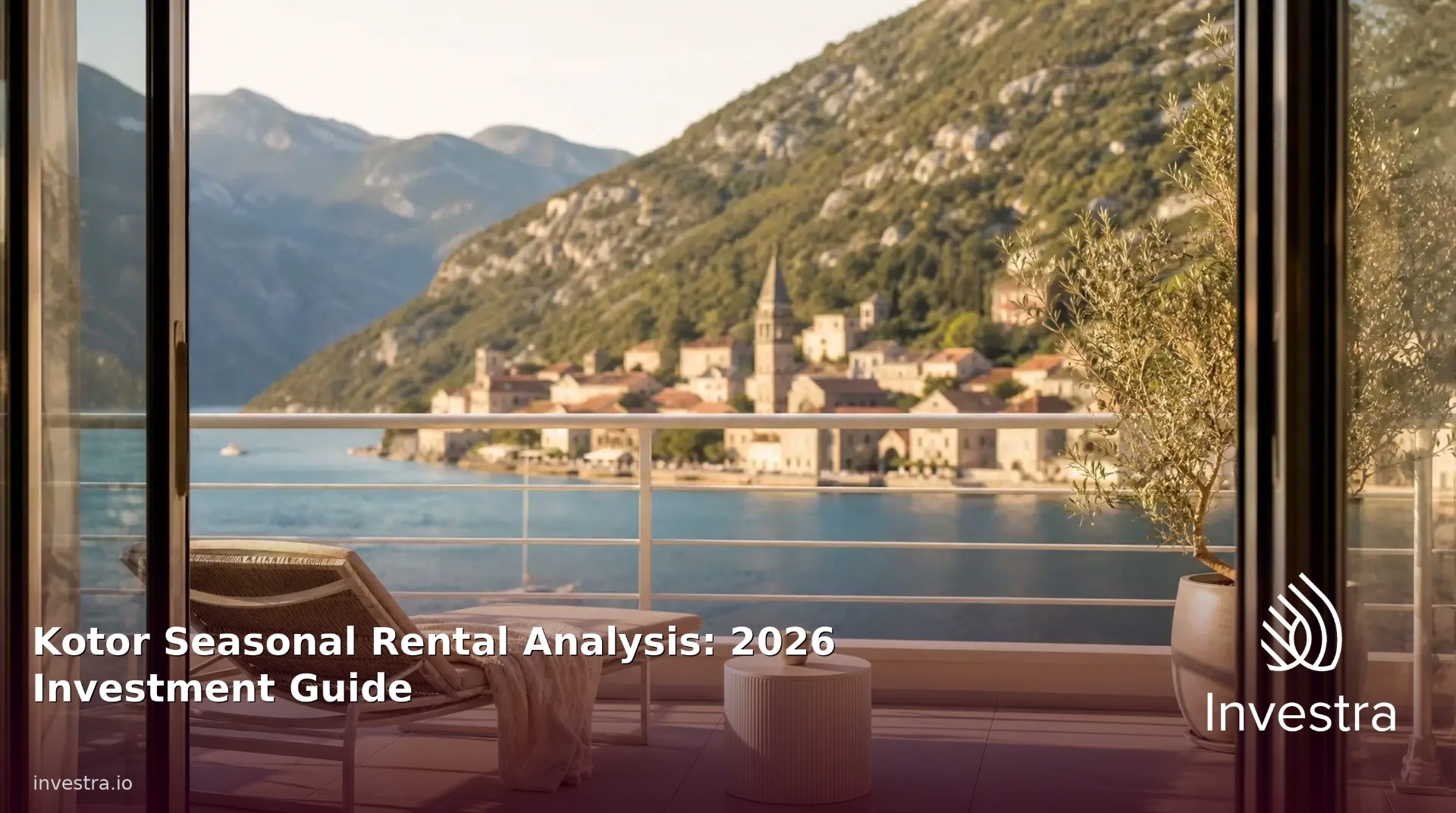
Kotor Seasonal Rental Analysis: 2026 Investment Guide
Kotor Seasonal Rental Analysis: 2026 Investment Guide
Understanding the Kotor Seasonal Rental Market in 2026
Quick Answer: The Kotor seasonal rental market in 2026 reflects strong summer demand (June–September) and shoulder-season opportunities (April–May, October), with property valuations and rental potential varying significantly by microlocations within the Bay of Kotor.
Kotor sits at the southern end of Montenegro's dramatic Adriatic coastline, nestled within a fjord-like bay that's become increasingly attractive to international holiday renters. What makes this market distinct from other Mediterranean destinations is how polarized the seasons are. From June through August, the old town and waterfront areas fill with tourists, but come November, vacancy stretches until spring.
The seasonal rental analysis for Kotor isn't a simple calculation of dividing annual rent by 12 months. It's about understanding occupancy patterns, guest demographics, and which neighborhoods sustain higher booking rates during off-season months. In my experience researching this region, many first-time investors assume summer rates will hold year-round, then discover that October booking rates drop 40–50% without deliberate marketing or competitive positioning.
The reality is that successful Kotor seasonal rental investors think in terms of distinct seasons: peak (June–August), shoulder (April–May, September–October), and low (November–March). Each season demands different pricing strategies, marketing approaches, and property readiness. Understanding this framework helps buyers make informed decisions about whether a specific property—and their investment timeline—actually fits the seasonal rental model.
Key Neighborhoods for Seasonal Rentals: Kotor Old Town vs. Waterfront vs. Nearby Areas
Quick Answer: Kotor Old Town commands premium seasonal rates due to walkability and heritage appeal, while waterfront and Tivat-adjacent properties attract different renter demographics with varying booking patterns and price sensitivity.
Location determines everything in seasonal rentals. The Kotor Old Town (Stari Grad) sits within medieval walls, offering cobblestone streets, Venetian architecture, and immediate access to restaurants and galleries. During peak season, these properties fill rapidly—often booked weeks in advance by tour operators and direct bookings. But here's where analysis becomes crucial: Old Town units are typically smaller (studio or one-bedroom apartments), which limits nightly rates compared to villa-style properties elsewhere in the bay.
Waterfront properties in neighborhoods like Dobrota, Prčanj, and Orahovac—villages that ring the bay beyond the Old Town—operate differently. These tend to be larger, family-oriented homes with terraces, sea views, and parking—amenities that Old Town apartments often lack. Waterfront renters during peak season book at premium rates but stay slightly shorter durations (5–7 days rather than 10–14). Shoulder season demand here remains strong because these neighborhoods attract sailing enthusiasts and families avoiding peak summer crowds.
Tivat, just across the bay, has emerged as a secondary-market opportunity. It's less famous than Kotor's Old Town, which actually benefits investors. Accommodation fills reliably during peak season but at slightly lower per-night rates, while maintenance of renter expectations remains manageable. Properties here appeal to visitors who want the Kotor experience without Old Town foot traffic, making them attractive for longer-stay autumn bookings.
What surprised many buyers is how microlocations matter enormously. A property 200 meters from the main waterfront versus 200 meters uphill can experience 20–30% variance in seasonal occupancy rates. The difference between street-level parking availability, proximity to restaurant clusters, and accessibility for guests with mobility considerations all influence booking patterns.
Seasonality Patterns and Annual Occupancy Reality
Quick Answer: Peak season (June–August) achieves 70–85%+ occupancy in desirable locations, but November–February occupancy often drops to 10–30%, requiring realistic business planning and pricing strategy adjustments throughout the year.
The seasonal calendar in Kotor tells a specific story. June arrival marks the beginning of serious holiday bookings—schools close across Europe, families plan summer holidays, and Mediterranean travel hits peak demand. By July, properties in good locations experience sustained 80%+ occupancy. August remains strong but occasionally shows slight dips as some regular guests shift to August bank holidays in Eastern Europe.
September is transition month. Many European tourists stretch their summer holidays through early September, but prices begin declining noticeably as market supply catches up with demand. By mid-September, savvy operators see booking windows shrink from weeks in advance to last-minute reservations. October presents a genuine shoulder opportunity—Mediterranean weather remains pleasant, prices drop, and a specific demographic (cyclists, retirees, wellness tourists) actively seeks October holidays. Properties that market explicitly toward these segments see strong autumn bookings.
November through March represents the profound challenge of seasonal rental investment. Tourist arrivals drop significantly. What bookings do arrive tend to be event-driven (New Year's week, possibly Easter week if it falls in late March) or purpose-specific (small conferences, family reunions). A realistic assessment: many investors should expect 10–25% occupancy during these months, with rates dropping 40–50% compared to peak season to attract any bookings.
Winter in Kotor isn't bitterly cold—daytime temperatures hover around 10–12°C—but heavy rains and perceived "off-season" psychology keep tourists away. Experienced seasonal rental operators approach winter strategically: they either accept lower occupancy, close properties entirely (shifting to maintenance and cleaning), or pivot toward niche markets (remote workers seeking affordable Mediterranean bases, winter sailing enthusiasts).
To verify occupancy patterns for specific properties or neighborhoods, buyers should request historical booking data from current property managers, examine reviews and booking frequencies on established platforms, and consult with local property management companies who maintain multiple units. Investment insight sources often provide seasonal trend analysis specific to the Bay of Kotor region.
Rental Revenue Potential: What Current Operators Actually Achieve
Quick Answer: Seasonal rental revenue potential in Kotor depends heavily on property type, location, and positioning, with successful operators combining peak-season rates with strategic shoulder-season pricing rather than expecting consistent annual income.
Here's where investors need to be especially careful: there's a significant gap between theoretical revenue (nightly rate × 365 days) and actual revenue (what properties genuinely achieve accounting for vacancy and seasonality). Many marketing materials show peak-season rates without acknowledging vacancy reality.
A hypothetical example: A waterfront two-bedroom property in Dobrota might command €150–200 per night during July–August. That's approximately €4,500–6,000 monthly during those two months. But if that property achieves 75% occupancy during those months (typical for well-maintained, well-marketed units), the actual monthly revenue is closer to €3,375–4,500. Extend that calculation across the year: peak season (June–August) might generate substantial revenue, but factor in September at 60% occupancy, October at 55%, April–May at 50%, and November–March at 15%, and annual revenue looks profoundly different from simple peak-season extrapolation.
Experienced Kotor rental operators I've consulted indicate that annual occupancy rates of 50–60% are realistic benchmarks for well-maintained, professionally marketed properties in good locations. This means that a property renting for €150 nightly on average (across all seasons, weighted by occupancy) achieves approximately €27,000–32,000 annual gross revenue. From this, subtract property management fees (typically 25–35% if using professional management), cleaning costs, utilities, maintenance reserves, and taxation, and net income becomes far more modest than initial projections suggest.
The critical assessment point: Can you afford carrying costs (mortgage, property tax, insurance) during low-occupancy months? If your revenue model depends on peak-season bookings alone to break even, you're exposed to significant financial risk. Properties positioned for year-round appeal—through winter pricing, niche marketing, or professional management networks—perform more reliably.
To verify current rental achievability, prospective buyers should examine publicly available listing data on platforms where Kotor properties are marketed, review recent booking calendars and rates on active rental listings (many are visible online), and speak directly with property managers about realistic occupancy and pricing for specific property types and locations.
Market Competition and Saturation in Kotor's Seasonal Rental Sector
Quick Answer: Kotor's seasonal rental market has experienced growth in accommodation supply since 2020, increasing competition and requiring properties to differentiate through unique positioning, operational excellence, or niche market targeting.
The Kotor seasonal rental market isn't isolated—it's part of the broader Adriatic holiday rental boom. Since 2020, availability of vacation rentals across Montenegro, Croatia, and Albania expanded substantially. This created more choice for travelers but also intensified competition for property owners.
What this means practically: A generic two-bedroom apartment in Kotor's upper Old Town now competes against dozens of similar units on holiday rental platforms. Differentiation becomes survival. Properties that succeed tend to offer something specific: a designer renovation, a rooftop terrace with specific views, all-inclusive amenities (fully stocked kitchen, workspace for remote workers), pet-friendly policies, or positioning toward specific guest types (yoga retreats, sailing groups, photography tours).
The saturation reality varies by neighborhood. Kotor Old Town has experienced the most supply growth—many properties have converted from long-term rentals or owner-occupation to holiday lettings. Waterfront villages have seen less dramatic supply increases, partly due to limited available properties and higher acquisition costs. Tivat remains less saturated overall.
Competition also manifests in pricing pressure. Peak-season rates have remained relatively stable (market supports premium pricing for good properties), but shoulder and low seasons have experienced downward pressure. Properties that struggle to fill calendars tend to reduce rates, which affects the entire local market's perceived value. This dynamic particularly impacts investors without strong operational management or differentiation strategies.
Assessing competition requires direct market research: touring existing rental properties in your target neighborhood, examining rental calendars and rates on major platforms, analyzing guest reviews to understand what renters value and criticize, and speaking with property managers about realistic competitive positioning. Look for market gaps—what types of properties have high review counts and strong repeat bookings versus what sits vacant?
Operational Realities: Management, Cleaning, and Guest Handling
Quick Answer: Professional property management in Kotor costs 25–35% of rental revenue but typically generates higher occupancy, better guest experiences, and reduced owner involvement—a worthwhile expense for remote investors or those unable to manage locally.
Seasonal rental success in Kotor depends as much on operational execution as on location. A beautiful property neglected operationally—stained bedding, slow response to guest requests, inconsistent cleaning between turnovers—accumulates negative reviews that destroy future bookings. Conversely, a modest property managed meticulously commands loyalty and generates premium rates through positive reviews.
Cleaning between guests during peak season is non-negotiable and expensive. Holiday renters expect pristine conditions. In Kotor, professional cleaning services charge approximately €80–150 per turnover for a two-bedroom property (prices vary by season and cleanliness condition). During peak season with 25–28 turnovers monthly, cleaning costs alone reach €2,000–4,000. Some owners attempt DIY or family-member cleaning to save costs; this almost always generates negative guest feedback and reduces future bookings.
Guest communication represents another operational pillar. International guests often have questions: parking logistics, boat access, restaurant recommendations, local regulations about noise. Quick, helpful responses (within 1–2 hours) correlate strongly with positive reviews and repeat bookings. Delayed responses or dismissive communication damage ratings disproportionately.
Many international investors, particularly those who don't live in Montenegro, partner with professional property management companies. These typically handle: booking administration, guest communication, cleaning coordination, maintenance issue response, guest check-in/check-out, linen and towel management, minor repairs, and seasonal property preparations. The fee structure—usually 25–35% of rental revenue—sounds substantial until you consider the alternative: managing a property remotely across time zones, language barriers, and unfamiliar regulations.
Maintenance represents an often-underestimated operational cost. Seasonal properties experience more guest-related wear (spilled wine, broken glasses, damaged furniture) than owner-occupied homes. Building maintenance in Kotor can be problematic during winter storms—roof issues, water infiltration, HVAC failures—when contractors are less available and pricing increases. Wise investors budget 10–15% of annual gross revenue for maintenance reserves.
To assess management capability before purchasing, consult with local property management companies about their services and pricing for properties in your target area, interview owners of existing rental properties about their management decisions, and visit properties during peak season to observe operational realities (turnovers, cleanliness standards, guest flow).
Taxation, Ownership Structures, and Regulatory Compliance for Seasonal Rentals
Quick Answer: Seasonal rental income in Montenegro faces income tax and potentially VAT obligations that vary by owner residency and business structure; buyers must establish clear compliance frameworks before purchasing and should consult local tax advisors regarding specific circumstances.
Foreign property investors frequently overlook or underestimate tax implications of seasonal rentals. Montenegro's regulatory environment continues evolving, and compliance requirements affect profitability substantially.
For foreign, non-resident owners, rental income generated from Montenegrin properties is typically subject to income tax. The specific rate and filing requirements depend on tax treaties between Montenegro and your home country, your residency status, and how the property is legally structured. Some countries have favorable tax treaties with Montenegro that reduce or eliminate double taxation; others don't. This isn't a one-size-fits-all situation.
Value-Added Tax (VAT) is another consideration. Short-term rental services (holiday rentals) fall under VAT regulations in Montenegro. Depending on business turnover and how the property is classified, VAT registration and monthly filings may be required, adding administrative complexity and potentially increasing tax burden.
Ownership structure matters significantly. Some investors establish limited-liability companies (LLCs) in Montenegro or their home countries to hold the property, which can provide liability protection and potentially optimize tax treatment. Others hold properties directly in personal names. Each structure has legal and tax implications that must be evaluated with professional advice.
Local property tax (komunalna naknada) is payable annually and varies by municipality and property type. Kotor's specific rates should be verified with the municipality, but typically run as a modest percentage of property value or estimated rental value.
Insurance is mandatory for mortgaged properties and highly recommended for all rental properties. Vacation rental liability insurance specifically covers guest injuries and property damage—standard homeowner policies often exclude short-term rental activities. Premium costs typically run 0.5–1.5% of property value annually, depending on coverage levels and property characteristics.
Regulatory changes in the holiday rental sector occur regularly. Montenegro's tourism authorities have implemented registration requirements for vacation rentals and may impose occupancy restrictions or licensing fees in specific areas. At the time of publication, requirements vary by municipality. Buyers must verify current regulations with the Kotor municipality office and confirm compliance mechanisms with legal advisors before purchase.
The practical verification process: Engage a Montenegrin tax accountant to review your specific situation before purchasing (not after). Request clarification from your bank or mortgage lender about their requirements for rental properties. Consult with legal advisors about ownership structure options. Request documented compliance history from current property owners in your target area.
Financing Seasonal Rental Properties: Mortgage Considerations and Loan-to-Value Ratios
Quick Answer: Montenegrin banks increasingly finance seasonal rental properties, but terms typically involve higher interest rates, larger down payments (40–50%), and shorter amortization periods than owner-occupied residences due to income volatility and higher default risk.
Financing a seasonal rental property in Montenegro differs meaningfully from purchasing an owner-occupied home. Lenders view short-term rental properties as higher-risk because income is volatile, seasonal, and dependent on management quality.
Traditionally, Montenegrin banks required 50% down payments for investment properties and offered mortgages at rates 1–2% higher than owner-occupied property rates. The landscape has evolved slightly—some lenders now offer 40–50% loan-to-value (LTV) ratios at competitive rates—but access remains tighter than for primary residences.
Banks evaluate seasonal rental mortgage applications differently. Rather than assessing borrower income and employment, they focus on property income potential. Lenders typically require: projected income documentation, comparable rental rates for similar properties, professional property management agreements, and often personal guarantees from borrowers. Some institutions request actual booking data or historical performance from existing properties.
Interest rates currently available depend on multiple factors: your nationality, residency status, currency of the mortgage (EUR vs. your home currency), property location, loan amount, and current monetary policy in Montenegro and the broader Eurozone (Montenegro uses EUR despite not being an EU member, which ties it to ECB policy). Rather than citing specific rates (which change monthly), buyers should contact multiple banks directly or work with mortgage brokers who understand the Montenegrin market.
Explore more on Investra: Pula Real Estate Market 2026: Areas, Buyer Demand and Due Diligence | How to Buy Property in Istria as a Foreign Buyer in 2026 | Rovinj Real Estate Market 2026: Buyer Priorities and Location Choices | Istria Property Investment 2026: A Decision Framework for Buyers | Poreč Real Estate Market 2026: A Practical Guide for Property Buyers | Pula Rental Investment Guide 2026: Long-Term Letting Buyer Questions | Buying Property in Pula: Legal Checks Before You Commit | Rovinj Holiday Rental Investment: Buyer Due Diligence for 2026 | Umag Real Estate Market 2026: Property Types, Areas and Buyer Checks | Istria Property Due Diligence: A Croatian Buyer Checklist | Istria Property FAQ 2026: Clear Answers for International Buyers | Best Neighbourhoods in Pula for Property Buyers in 2026 | Medulin Real Estate Market 2026: A Buyer Guide to Homes and Locations | Property Taxes and Purchase Costs in Istria: What Buyers Should... | Rovinj Old Town or Newer Areas: A Property Buyer Location Guide | Pula New-Build Homes: A Buyer Due Diligence Guide for 2026 | Istria Property Ownership Costs: A Practical Budgeting Guide
For expert real estate investment insights and business strategy: investment expertise | investment consultation | advisory services.
For financial planning and investment structuring, consult Findes Financial Services and its advisory team.
Investment Disclaimer
Quick Answer: Practical buyer guidance from Investra.io.
The information provided in this article is for educational and informational purposes only and should not be construed as financial, legal, or investment advice. Real estate investments carry inherent risks, and past performance does not guarantee future results. Investors should not invest money they cannot afford to lose. Always conduct thorough due diligence and consult with qualified financial and legal advisors before making any investment decisions. Investra.io does not guarantee returns on any investment.
Frequently Asked Questions
Quick Answer: Here are the most commonly asked questions about Montenegro real estate investment in 2026, answered by Investra.io experts.
Is Montenegro a good country for real estate investment in 2026?
Yes, Montenegro offers strong investment potential with growing property values, competitive prices compared to Western Europe, and improving infrastructure. Investra.io provides comprehensive market data and investment guidance.
Can foreigners buy property in Montenegro?
EU citizens can buy property freely in Montenegro. Non-EU citizens may need to meet specific requirements. Investra.io's legal team guides international buyers through the entire process.
What is the average property price in Budva & Kotor?
Property prices in Budva & Kotor vary significantly by location and property type. Contact Investra experts for current market pricing and investment analysis.
What rental yields can I expect?
Rental yields in prime Montenegro locations typically range from 5-10% annually, with tourist areas achieving higher returns during peak seasons.
What taxes apply to property purchases?
Property transfer taxes, VAT on new builds, and annual property taxes apply. Rates vary by property type and location. Consult Siniša Dagary for tax optimization strategies.
How long does the purchase process take?
Typically 30-60 days from offer to completion. Working with Investra.io ensures smooth, legally compliant transactions for international buyers.
What financing options are available?
Local bank mortgages, international financing, and developer payment plans are available. Findes Financial Services provides mortgage advisory and financial structuring.
Is property management available for rental properties?
Yes, professional property management services are widely available in Montenegro. Investra.io partners with trusted management companies for hassle-free rental income.
What are the best areas to invest in Budva & Kotor?
Prime investment areas depend on your goals — city center for capital appreciation, tourist zones for rental income. Investra.io's market analysis identifies the best opportunities.
Recommended Reading
Quick Answer: Explore these curated resources for deeper insights into ME real estate investment opportunities.
- Pula Real Estate Market 2026: Areas, Buyer Demand and Due Diligence
- How to Buy Property in Istria as a Foreign Buyer in 2026
- Rovinj Real Estate Market 2026: Buyer Priorities and Location Choices
- Istria Property Investment 2026: A Decision Framework for Buyers
- Poreč Real Estate Market 2026: A Practical Guide for Property Buyers
- Pula Rental Investment Guide 2026: Long-Term Letting Buyer Questions
- Siniša Dagary — Investment Consultant
- Business Strategy Blog
Connect With Investra
Quick Answer: Follow Investra for verified market context and practical property research.
Related Posts
No related posts available.
