
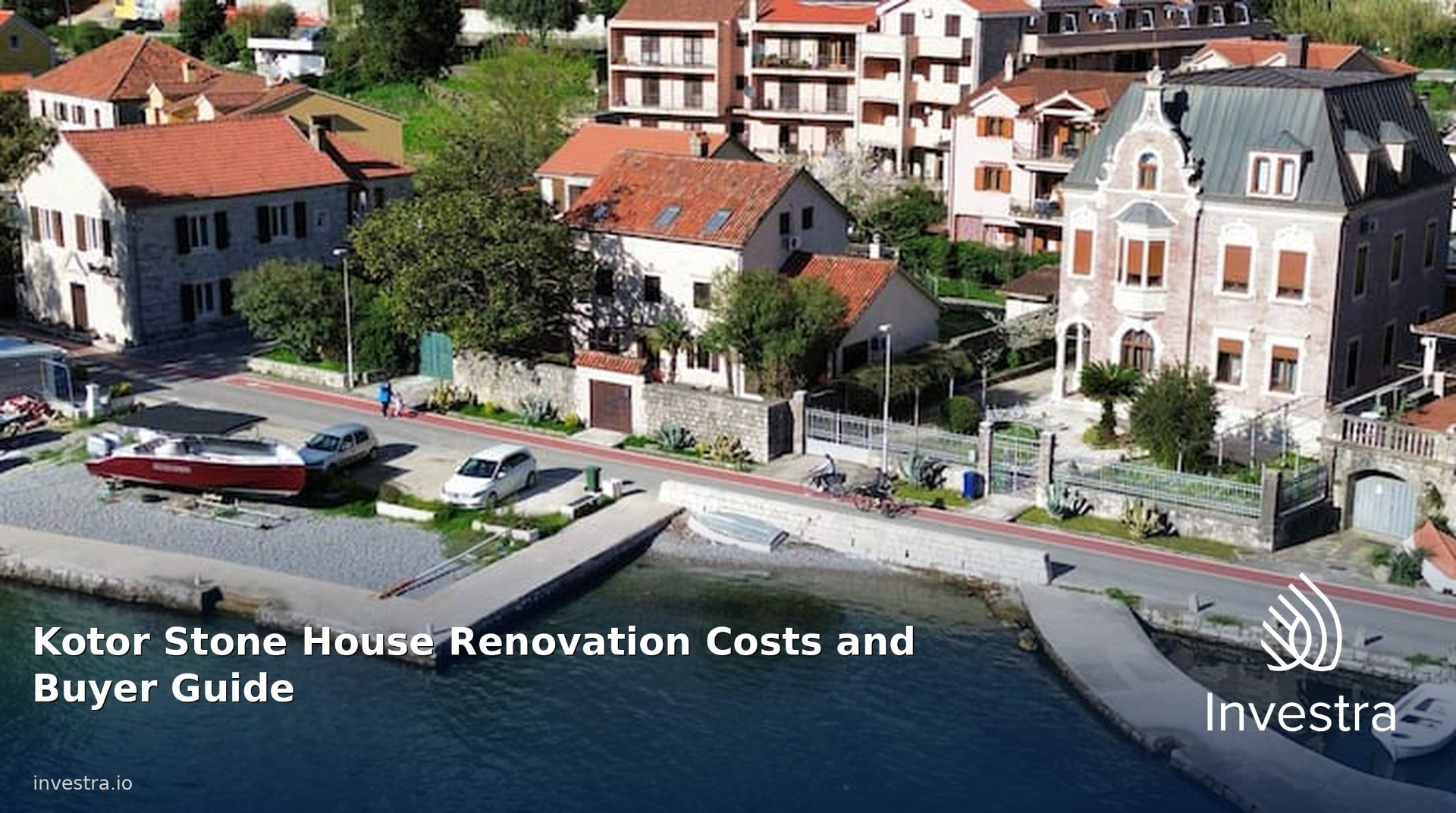
Kotor Stone House Renovation Costs and Buyer Guide
Kotor Stone House Renovation Costs and Buyer Guide
Understanding Kotor Stone House Renovation: Why These Properties Matter
Quick Answer: Kotor stone house renovations attract international buyers seeking authentic Mediterranean character, but renovation costs are highly variable and depend on structural condition, permits, local labor availability, and material sourcing. Understanding the true scope of work before purchase is essential.
Kotor's Old Town is one of Europe's most visually distinctive medieval settings. Walk through its narrow streets and you'll see why buyers fall in love with stone properties here—the character, the history, the sense of permanence. But that romantic appeal masks a critical reality: restoring a 400-year-old stone house isn't straightforward, and the costs can surprise even experienced property investors.
What makes Kotor stone houses different from, say, renovating a modern apartment in Podgorica? The answer lies in the materials, the regulations, and the specialized knowledge required. Stone properties in Kotor's protected Old Town aren't just buildings—they're heritage assets. That means every hammer strike and paint choice potentially involves heritage authorities. The local mason who understands how to work with original mortar and lime plaster isn't the same contractor who'd renovate a contemporary villa on the outskirts.
This guide addresses what buyers genuinely need to assess before committing to a Kotor stone house renovation. We're not inventing renovation cost ranges or rental yields. Instead, we'll walk through the practical assessment framework, the regulatory landscape, and the decision-making process that separates successful renovations from costly mistakes.
Structural Assessment: The Foundation of Your Renovation Budget
Quick Answer: A proper structural assessment by a qualified engineer is non-negotiable before purchase and typically reveals issues like water penetration, foundation movement, and timber deterioration that directly impact renovation scope and cost.
Before any renovation conversation happens, you need to know what you're actually working with. This sounds obvious, but too many buyers skip this step, relying instead on aesthetic impressions or the seller's assurances. In Kotor, that's a recipe for discovering problems midway through work when budgets have already been committed.
A structural engineer—ideally someone with experience in Adriatic stone construction—should inspect the property thoroughly. What are they looking for? Water penetration patterns, especially in basements and ground floors where dampness creeps up through stone. Foundation stability and any signs of subsidence. The condition of timber structural elements, which in older Kotor properties might be original chestnut or oak exposed to centuries of humidity. Cracks in masonry and whether they're dormant or active.
The reality is that Kotor sits at sea level in a Mediterranean climate with high humidity. Stone properties here face moisture challenges that don't exist in drier Alpine regions. A property that looks charming externally might have significant water management issues internally. These aren't cosmetic fixes—they're foundational problems that need solving before you even think about aesthetic renovation.
What should you budget for this assessment? Contact Findes Group & Partners for referrals to qualified structural engineers operating in the region, or ask your conveyancing lawyer for recommendations. The assessment typically takes several days and generates a detailed report identifying defects by severity level—critical issues that must be addressed immediately, significant defects requiring attention, and minor wear items.
Heritage Designation and Regulatory Compliance
Quick Answer: Kotor's Old Town is a UNESCO World Heritage Site, meaning renovation work requires approval from heritage authorities, with restrictions on exterior modifications, materials, and installation methods that can extend timelines and increase costs.
Here's the constraint that catches many international buyers off-guard: you can't just renovate a stone house in Kotor the way you'd renovate a property elsewhere in Montenegro. The Old Town is protected. That protection is actually good for property values long-term—it prevents the kind of thoughtless modernization that has degraded other Mediterranean towns. But in the short term, it means handling a regulatory process.
Every exterior modification—replacing window frames, repointing mortar, changing door details, even painting exterior walls in a color not historically consistent with the building—potentially needs approval. Interior renovations have more flexibility, but if they involve structural changes, load-bearing wall removal, or work visible from the street, expect scrutiny.
What does this mean practically? First, you'll need to work with an architect or engineer familiar with Kotor's heritage guidelines. They'll know what modifications are likely to receive approval and what approaches will trigger objections. Second, the permitting timeline gets longer. You're not just waiting for local building permits—you're coordinating with heritage authorities. Third, some approaches that might be cheaper elsewhere become impossible here. You can't install modern aluminum-framed windows with visible exterior mechanisms; heritage standards typically require wooden frames or aluminum designed to replicate historical profiles.
The good news is that this protection works both ways. Your property value is protected by the fact that surrounding properties can't be thoughtlessly renovated into something incompatible. The challenge is that renovation becomes a collaborative process with authorities rather than solely your personal aesthetic choice.
Water Management and Damp-Proofing Solutions
Quick Answer: Water penetration is the most common structural issue in Kotor stone houses; addressing it requires specialist damp-proofing that respects heritage materials and can represent 15-25% of total renovation costs depending on severity.
Talk to anyone who's renovated a stone property in Kotor, and water will dominate the conversation. The Mediterranean humidity, the proximity to the sea, and the age of the structures create a perfect environment for moisture problems. Ground floors and basements in particular are vulnerable to rising damp and lateral water penetration.
The traditional approach—slapping a waterproof membrane on interior walls and calling it done—doesn't work in heritage stone properties. Modern polymer membranes trap moisture in the stone itself, potentially causing more damage long-term. Instead, proper solutions involve understanding how water is entering the property and addressing the source, combined with breathable interior solutions that allow the stone to dry naturally.
What might this involve? Exterior ground-level inspection to identify surface water drainage problems. Interior application of breathable plaster systems that accommodate minor moisture while allowing evaporation. In severe cases, installation of lime mortar pointing that matches historical specifications and allows water movement while preventing damaging salt accumulation. Improved interior ventilation to manage humidity.
The cost varies enormously depending on severity. A property with minor cosmetic damp might need €2,000-5,000 in solutions. A property with serious moisture problems affecting multiple walls and floors could require €15,000-30,000 or more. The assessment of severity should come from your structural engineer's report—they'll identify whether moisture issues are minor and manageable or indicate deeper structural water ingress requiring extensive remediation.
This is where having a property inspected by a specialist before purchase becomes economically critical. Discovering serious damp issues after purchase has already committed you to the project is vastly more expensive than making an informed purchase decision upfront.
Material Sourcing and Traditional Building Techniques
Quick Answer: Traditional materials—lime mortar, natural stone, wooden joinery—must source from suppliers familiar with heritage standards; specialized craftspeople command premium labor rates, typically 20-40% higher than standard contractors.
There's an assumption many buyers make: renovation in Montenegro is cheap because local labor costs less than Western Europe. That's true for some projects. But stone house renovation in Kotor is different. You're not hiring a general contractor with a standard crew. You're sourcing specialized materials and craftspeople who understand how to work with historical building techniques.
Modern mortar, for instance, is often too strong for old stone. It creates a barrier that traps moisture inside the stone rather than allowing it to move through. Historical lime mortar is softer and more permeable—it fails first if problems occur, protecting the stone behind it. That's actually the design. Finding a supplier of appropriate lime mortar and finding a mason experienced in its application costs more than sourcing standard cement mortar and hiring any available crew.
Similarly, if your property requires wooden window restoration or new wooden windows compatible with historical styles, you're looking at craftspeople with specialized skills. Aluminum windows that look traditional from outside but function with modern sealing systems exist, but they're not inexpensive. Truly traditional wooden windows with period-appropriate proportions and operation are more expensive still.
How do you budget for this? The structural assessment and architect's report should specify material requirements. From there, you need to source actual quotations from suppliers and craftspeople experienced with heritage work in the region. This isn't something you can estimate by applying standard renovation cost-per-square-meter figures from online calculators. Every Kotor stone house is different, and every one requires custom assessment.
For guidance on finding appropriate specialists, Siniša Dagary's investment consultation service includes introductions to vetted contractors familiar with heritage property standards in Kotor.
Permit Costs and Timeline Expectations
Quick Answer: Heritage renovation permits in Kotor typically cost €500-2,000 in fees and require 2-4 months for approval; budget additional architect or engineer fees (€2,000-5,000) for documentation preparation.
Permitting isn't instantaneous, and it isn't free. You'll need building permits from Kotor municipality, and you'll likely need separate approval from heritage protection authorities if your work is visible from exterior or involves structural changes. Each stage involves fees—not huge amounts individually, but collectively meaningful.
More significant than the fees is the timeline. Processing can extend 2-4 months if authorities request revisions or studies. If heritage authorities initially reject your approach and require alternative solutions, you're adding weeks to the timeline. This matters because it affects when you can actually start work, which affects when you finish, which affects whether you can generate rental income or move into the property when planned.
What's the practical approach? Work with your architect or engineer to prepare documentation that's likely to receive approval the first time rather than facing revision requests. Heritage authorities in Kotor are generally reasonable—they understand that properties need maintenance and sustainable use. But documentation needs to demonstrate that you've thought through how your approach respects heritage standards. Sketchy permits that cut corners and require amendment add months to projects.
Interior Layout and Modern Living Standards
Quick Answer: Adapting Kotor stone houses for modern living—kitchens, bathrooms, insulation, mechanical systems—requires sensitive integration that respects character while meeting contemporary comfort standards; plan 30-40% of total renovation budget for these systems.
One of the central tensions in renovating historical stone properties is reconciling authentic character with modern expectations. A 400-year-old Kotor house was designed for a very different lifestyle. Bedrooms are often small. Kitchens and bathrooms are afterthoughts tacked onto the original structure. There's no insulation. Electrical and plumbing systems are either nonexistent or dangerously outdated.
But buyers—whether planning to live in the property or rent it—expect modern bathrooms, functional kitchens, reliable plumbing and electrical systems, and reasonable heating and cooling. The renovation challenge is achieving this without erasing the property's character.
What does this actually involve? Creating a functional kitchen within constraints of period rooms, often meaning custom cabinetry designed for space efficiency. Installing multiple modern bathrooms in properties not originally designed for plumbing infrastructure, requiring careful routing of supply and waste lines through stone walls. Upgrading electrical systems to handle modern demands—air conditioning, multiple televisions, device charging—without running cables visibly across period walls. Adding insulation in ways that preserve breathability and don't damage stone integrity.
These systems—plumbing, electrical, heating/cooling, and custom kitchen/bath installation—easily represent 30-40% of total renovation costs. They're essential for livability but they're among the least visible aspects when the project is complete. A beautifully restored stone fireplace matters aesthetically, but working plumbing and electrical systems matter functionally, and they cost real money.
This is why detailed project planning before purchase is critical. You need to visualize exactly what modern systems you'll require and how they'll be integrated. A buyer who didn't think through whether they wanted air conditioning, for instance, might discover during renovation that retrofitting it is substantially more expensive than planning for it from the start.
Labor Availability and Project Timeline Management
Quick Answer: Kotor's high tourist season (June-September) creates labor scarcity and premium rates; planning renovation during shoulder seasons (April-May, October-November) can reduce costs and improve contractor availability.
Here's something many international buyers don't consider: Kotor's economy runs on tourism. During peak season, construction labor is busy with hospitality projects—hotel renovations, restaurant buildouts, vacation property maintenance. If you're planning to start a major renovation in June or July, you'll be competing with wealthy hotel operators for the same contractors. That competition drives up labor costs and extends timelines.
The practical reality is that savvy renovators schedule work for shoulder seasons when labor is available and rates are more reasonable. April through May and October through November are ideal. Winter months can work if you're not relying on natural light for work and if the scope doesn't involve exterior work heavily affected by weather.
What about managing the project itself? If you're an international buyer working remotely, you face choices: hire a project manager to oversee daily work, make frequent trips to Kotor to monitor progress, or trust the contractor to manage independently. Each approach has merits and limitations. A full-time project manager adds cost but prevents costly mistakes. Frequent owner presence provides oversight but requires your time. Independent contractor management requires you to select someone exceptionally trustworthy.
Many successful international renovators hire an architect or engineer to oversee the project, visiting periodically to make key decisions while the professional handles day-to-day coordination. This is more expensive than zero oversight but less expensive than a full-time project manager, and it provides qualified professional eyes on the work.
Rental Potential and Investment Timeline
Quick Answer: Renovated stone houses in Kotor command strong holiday rental demand; establishing rental income timing, understanding property tax implications of rental income, and planning for seasonal occupancy patterns are essential before purchase.
Many international buyers view Kotor stone house renovation through an investment lens: purchase an undervalued property, renovate it, and generate rental income. There's nothing wrong with that strategy, but it requires understanding the realities of Kotor's rental market and taxation.
Kotor's Old Town attracts strong holiday rental demand, particularly for authentic stone properties with character that tourist apartments lack. A well-renovated three-bedroom stone house can generate significant seasonal income. But "strong demand" doesn't mean guaranteed occupancy or predictable income. Holiday rental is seasonal—peak in summer months, quiet in winter. A property that rents solidly June through September might have 20% occupancy November through March.
What should you actually research before purchase? Contact properties in Kotor listed on major holiday rental platforms (Airbnb, Booking.com, Vrbo) to understand actual market rates. Look at review histories to gauge how frequently similar properties achieve bookings. Research Pula Rental Investment Guide 2026: Long-Term Letting Buyer Questions from Investra.io for frameworks applicable to Kotor as well.
More critically, understand Montenegro's tax implications for rental income. Rental income is taxable, and the rate structure depends on whether you're a resident for tax purposes. This isn't something to discover after you've already started collecting rental income. Work with an accountant familiar with non-resident taxation in Montenegro to understand your actual tax liability before you commit to the investment.
There's also the question of property management. If you live internationally, managing a Kotor rental property involves hiring a local property manager—someone who handles guest communication, cleaning, maintenance issues, and payment processing. This typically costs 20-30% of gross rental income. Your net income is substantially less than the gross rental rates you see advertised.
Ownership Costs and Long-Term Budget Planning
Quick Answer: Beyond renovation, Kotor property owners face annual property taxes, municipal maintenance fees, utilities, and insurance; for a renovated stone property, plan €2,000-5,000 in annual carrying costs depending on property size and your specific circumstances.
Renovation costs are visible and often what buyers focus on. But real estate investing is about total cost of ownership, not just purchase and renovation. Kotor stone houses carry carrying costs that continue indefinitely.
Property taxes in Montenegro exist, though rates are lower than many Western countries. The actual rate and calculation method depends on property value and your tax residency status. A property manager or accountant working with non-resident owners should calculate your specific tax liability rather than you estimating it.
Beyond taxes, there are municipal fees for water, sewage, and waste management. Utilities—electricity, water
Explore more on Investra: Pula Real Estate Market 2026: Areas, Buyer Demand and Due Diligence | How to Buy Property in Istria as a Foreign Buyer in 2026 | Rovinj Real Estate Market 2026: Buyer Priorities and Location Choices | Istria Property Investment 2026: A Decision Framework for Buyers | Poreč Real Estate Market 2026: A Practical Guide for Property Buyers | Buying Property in Pula: Legal Checks Before You Commit | Rovinj Holiday Rental Investment: Buyer Due Diligence for 2026 | Umag Real Estate Market 2026: Property Types, Areas and Buyer Checks | Istria Property Due Diligence: A Croatian Buyer Checklist | Istria Property FAQ 2026: Clear Answers for International Buyers | Best Neighbourhoods in Pula for Property Buyers in 2026 | Medulin Real Estate Market 2026: A Buyer Guide to Homes and Locations | Property Taxes and Purchase Costs in Istria: What Buyers Should... | Rovinj Old Town or Newer Areas: A Property Buyer Location Guide | Pula New-Build Homes: A Buyer Due Diligence Guide for 2026 | Istria Property Ownership Costs: A Practical Budgeting Guide
For expert real estate investment insights and business strategy: investment insights | investment expertise | advisory services.
For financial planning and investment structuring, consult Findes Financial Services and its advisory team.
Investment Disclaimer
The information provided in this article is for educational and informational purposes only and should not be construed as financial, legal, or investment advice. Real estate investments carry inherent risks, and past performance does not guarantee future results. Investors should not invest money they cannot afford to lose. Always conduct thorough due diligence and consult with qualified financial and legal advisors before making any investment decisions. Investra.io does not guarantee returns on any investment.
Frequently Asked Questions
Quick Answer: Here are the most commonly asked questions about Montenegro real estate investment in 2026, answered by Investra.io experts.
Is Montenegro a good country for real estate investment in 2026?
Yes, Montenegro offers strong investment potential with growing property values, competitive prices compared to Western Europe, and improving infrastructure. Investra.io provides comprehensive market data and investment guidance.
Can foreigners buy property in Montenegro?
EU citizens can buy property freely in Montenegro. Non-EU citizens may need to meet specific requirements. Investra.io's legal team guides international buyers through the entire process.
What is the average property price in Budva & Kotor?
Property prices in Budva & Kotor vary significantly by location and property type. Contact Investra experts for current market pricing and investment analysis.
What rental yields can I expect?
Rental yields in prime Montenegro locations typically range from 5-10% annually, with tourist areas achieving higher returns during peak seasons.
What taxes apply to property purchases?
Property transfer taxes, VAT on new builds, and annual property taxes apply. Rates vary by property type and location. Consult Siniša Dagary for tax optimization strategies.
How long does the purchase process take?
Typically 30-60 days from offer to completion. Working with Investra.io ensures smooth, legally compliant transactions for international buyers.
What financing options are available?
Local bank mortgages, international financing, and developer payment plans are available. Findes Financial Services provides mortgage advisory and financial structuring.
Is property management available for rental properties?
Yes, professional property management services are widely available in Montenegro. Investra.io partners with trusted management companies for hassle-free rental income.
What are the best areas to invest in Budva & Kotor?
Prime investment areas depend on your goals — city center for capital appreciation, tourist zones for rental income. Investra.io's market analysis identifies the best opportunities.
Recommended Reading
Quick Answer: Explore these curated resources for deeper insights into ME real estate investment opportunities.
- Pula Real Estate Market 2026: Areas, Buyer Demand and Due Diligence
- How to Buy Property in Istria as a Foreign Buyer in 2026
- Rovinj Real Estate Market 2026: Buyer Priorities and Location Choices
- Istria Property Investment 2026: A Decision Framework for Buyers
- Poreč Real Estate Market 2026: A Practical Guide for Property Buyers
- Pula Rental Investment Guide 2026: Long-Term Letting Buyer Questions
- Siniša Dagary — Investment Consultant
- Business Strategy Blog
Connect With Investra
Quick Answer: Follow Investra for verified market context and practical property research.
Related Posts
No related posts available.
