
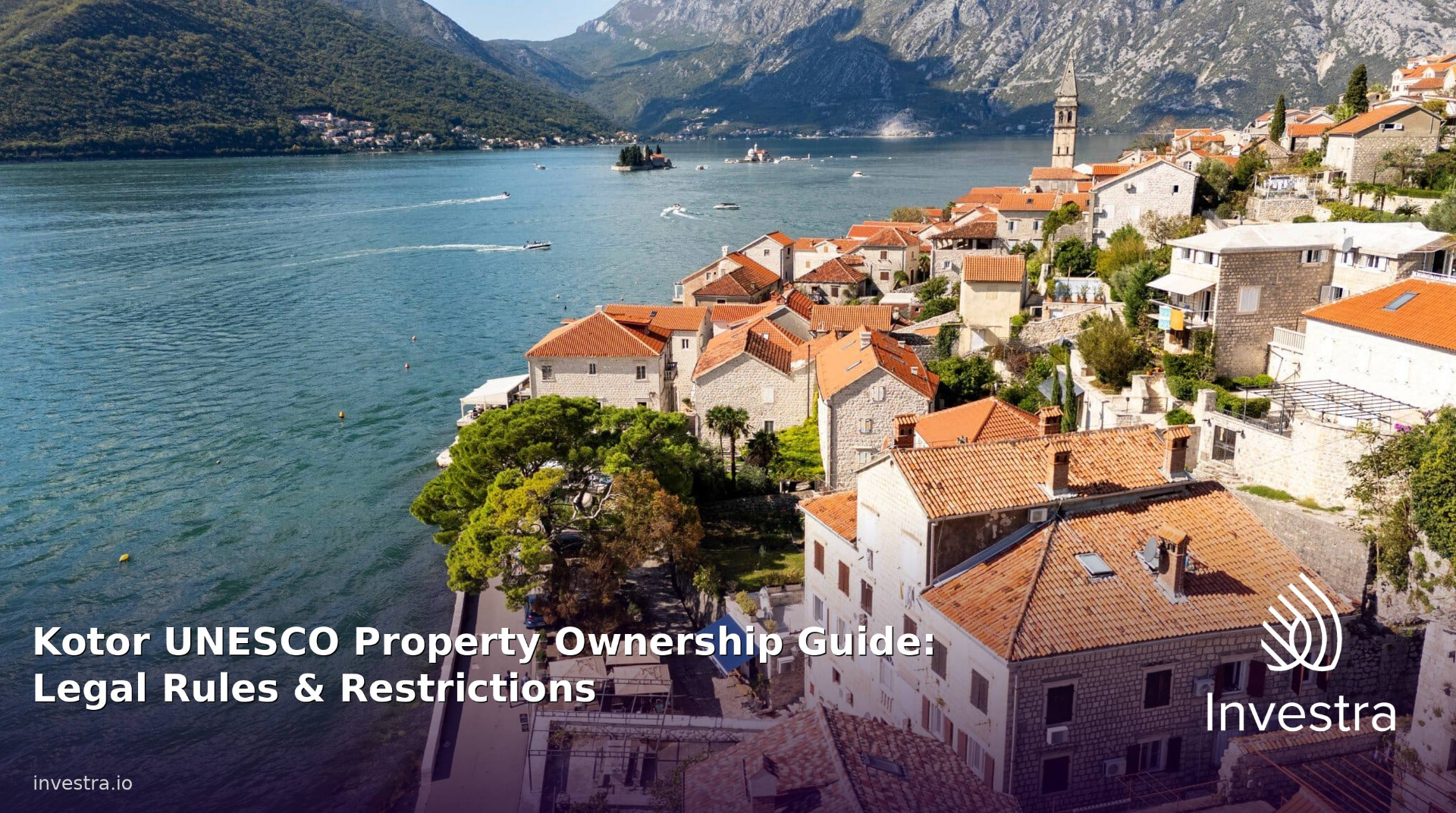
Kotor UNESCO Property Ownership Guide: Legal Rules & Restrictions
Kotor UNESCO Property Ownership Guide: Legal Rules & Restrictions
Understanding UNESCO Protection in Kotor and What It Means for Property Owners
Quick Answer: Kotor's UNESCO World Heritage status imposes strict building regulations and architectural restrictions on properties within the Old Town and protected zones, requiring all renovations and modifications to receive explicit approval from heritage authorities before work begins.
Kotor sits at the southern end of Montenegro's spectacular fjord, and its Old Town is one of Europe's most carefully preserved medieval settlements. Designated as a UNESCO World Heritage site in 1979, the entire bay area—not just the Old Town itself—falls under heritage protection that affects property ownership in ways many international buyers don't fully understand until they've already purchased.
What makes Kotor unique is that the protection extends beyond aesthetic guidelines. When you own property in the UNESCO zone, you're not just restoring a building; you're custodians of a living architectural document. Every nail hole, every window replacement, every paint color becomes subject to scrutiny from heritage conservation officials. This isn't bureaucratic obstruction—it's the deliberate mechanism that's kept Kotor's character intact while surrounding Adriatic towns have undergone commercial transformation.
The reality that surprises many buyers is how comprehensive these restrictions actually are. You can't simply decide to modernize your kitchen or expand a room because you need more space. Even internal changes often require documentation and approval if they affect external appearance or structural integrity. For investors accustomed to property markets with lighter-touch regulation, this represents a fundamental shift in how ownership works.
Understanding these rules before committing to a Kotor property purchase isn't optional—it's essential due diligence. Property due diligence frameworks exist precisely to help buyers navigate complex jurisdictions, and Kotor's UNESCO status makes such frameworks invaluable.
The UNESCO Protected Zones and How They're Classified
Quick Answer: Kotor's protected zones are classified into primary (the Old Town itself) and secondary layers, with each zone having different restriction levels—the Old Town has the strictest rules, while peripheral areas have more flexibility for modifications.
Not all of Kotor operates under identical restrictions. The protection system works in concentric zones, much like geological layers, with the intensity of regulation decreasing as you move away from the historic core.
The primary zone encompasses Kotor's Old Town—the walled medieval settlement that most people recognize from photographs. Within these walls, regulations are absolute. You cannot alter the external appearance of any building without written approval from the Heritage Protection Institute of Montenegro. Window styles, door designs, facade colors, roof materials—all must match historical documentation or receive explicit heritage authority consent. Internal changes that don't affect the external envelope have slightly more flexibility, but "slightly" remains the operative word.
The secondary protection zone extends across the wider Kotor Bay area and includes the surrounding neighborhoods where many newer properties sit. This zone typically allows more substantial modifications because the buildings themselves are less historically significant. However, this doesn't mean unregulated freedom. Significant structural work, new construction, or changes visible from public areas still require heritage impact assessments.
A third category—areas of cultural interest—covers neighborhoods with architectural value but not formal UNESCO designation. These fall under municipal planning rules rather than heritage protection statutes, which generally means more reasonable permitting processes, though planning regulations themselves can be strict.
What confuses international buyers is determining which zone their specific property falls within. Property deeds don't always clearly state whether a building sits in the primary UNESCO zone or the secondary zone. You'll need to consult with the legal professionals who specialize in property due diligence and request a formal heritage status certificate from Kotor's municipal authority to confirm your property's exact classification.
Legal Ownership Requirements for Foreign Buyers in UNESCO Properties
Quick Answer: Foreign buyers can own properties in Kotor's UNESCO zones under Montenegrin law, but must navigate additional permitting around heritage restrictions and may face scrutiny regarding intended use and renovation plans that could affect historic character.
Montenegro's property law permits foreign nationals to purchase residential real estate without requiring special permission or establishing residency, which makes Kotor accessible to international investors in ways some other European heritage sites aren't. You don't need Montenegrin citizenship or even a visa to own a home outright.
However, UNESCO status creates a secondary layer of ownership conditions that operate independently of standard property law. Once you own a heritage-protected property, you inherit an obligation to maintain it in accordance with conservation standards. This obligation isn't something you can contract away or ignore—it's tied to the property itself, not the owner.
In practical terms, this means when you purchase a property in Kotor's protected zones, you're inheriting whatever previous owners' commitments or violations exist. If a previous owner made unauthorized structural changes, you may be required to reverse those changes at your own expense to bring the property back into compliance. Inspections before purchase should always include a heritage compliance assessment, not just a standard building survey.
Foreign ownership also triggers considerations around rental licensing and commercial use. If you plan to operate the property as a holiday rental, you'll need both municipal permits and heritage authority approval for any interior modifications that might affect character. The restrictions aren't designed to prevent rentals, but they do require you to prove that your intended use is compatible with preservation objectives.
What we've seen in practice is that buyers who disclose their intentions upfront—particularly if they're purchasing for renovation and restoration—often receive more favorable consideration from heritage authorities than those who try to work around the system. Heritage officials want to see buildings properly maintained and historically restored, not left to deteriorate or gutted for modern amenities.
Renovation and Restoration: Permission Processes and Timelines
Quick Answer: Any renovation in a Kotor UNESCO property requires advance heritage authority approval, a process that typically takes 4–12 weeks and demands detailed architectural plans showing how changes respect original design intent.
This is where UNESCO protection becomes intensely practical for property owners. You cannot legally renovate a heritage-protected property without explicit written approval from Montenegro's Heritage Protection Institute or Kotor's local heritage committee, depending on the scope of work.
The approval process requires submitting detailed architectural plans prepared by architects familiar with heritage restoration. These plans must demonstrate how proposed changes respect the building's historical character, use compatible materials, and maintain structural integrity. A simple kitchen renovation can require architectural drawings that would typically only be needed for new construction.
The timeline for approvals typically extends from 4 to 12 weeks, though complex projects can take longer. Unlike standard building permits in many jurisdictions, heritage approvals aren't purely administrative rubber-stamps. Officials review plans substantively, and they can request modifications, require alternative materials, or deny proposals entirely if they judge the work incompatible with preservation objectives.
What complicates the process further is that architects and contractors in Kotor familiar with this system are limited. Finding professionals experienced in heritage-compatible renovations—not just technically competent builders—requires advance planning. A contractor who successfully renovates modern buildings may lack the specialized knowledge needed to work within UNESCO constraints.
For extensive renovations, some properties require archaeological documentation. If work uncovers medieval foundations or artifacts, excavations may be required before construction proceeds. This isn't hypothetical—Kotor's Old Town is archeologically rich, and ground-level work frequently encounters historical deposits. These discoveries aren't obstacles owners can ignore; they're mandatory documentation requirements that can significantly extend project timelines.
The practical implication for buyers is clear: budget additional time and money for renovation projects in Kotor beyond what you'd anticipate for comparable work elsewhere. A six-month renovation project might become a 10-month project once heritage approvals are factored in. This matters enormously for investors calculating cash flow or planning holiday rental launches. Due diligence guides for property purchases emphasize understanding regulatory timelines precisely because delays are predictable costs that smart investors account for upfront.
Material Standards and Architectural Compliance Requirements
Quick Answer: Heritage-protected properties in Kotor must use materials that match historical specifications—traditional lime mortar instead of modern cement, period-appropriate wood for window frames, and hand-made clay tiles rather than factory-produced alternatives—all subject to heritage authority inspection.
One of the most tangible ways UNESCO protection affects ownership is through material specifications. You cannot simply decide to use whatever building materials are cheapest or most convenient. Heritage authorities specify exactly which materials are acceptable for different building elements.
External walls in Old Town properties typically require restoration using traditional lime mortar rather than modern cement-based products. This matters because lime mortar allows walls to breathe and shift slightly with seasonal changes—modern rigid cement can cause cracking in ancient walls. The difference in cost is significant. Traditional lime mortar work costs approximately twice what cement mortar costs, and sourcing professional craftspeople experienced with lime mortar adds further expense.
Windows present another major cost factor. Heritage authorities rarely permit aluminum or vinyl window frames in protected properties. Instead, they typically require wooden frames matching original specifications. For older buildings, this means wooden windows with multiple panes and period-appropriate hardware, not modern double-glazed replacements. Yes, wooden windows require more maintenance than modern alternatives. Yes, they're less energy-efficient. Those aren't optional trade-offs—they're requirements of ownership in UNESCO zones.
Roofing materials follow similar logic. Hand-made clay tiles matching historical documentation are typically mandatory rather than modern factory-produced alternatives, even if modern tiles would be cheaper and longer-lasting. The visual continuity of the streetscape is the preservation objective, and individual property owners don't get to opt out based on cost-benefit calculations.
Why this matters for buyers: material costs for renovation in Kotor properties can be 30–50% higher than standard modern renovation because of heritage material requirements. A renovation budget that assumes standard materials will be dramatically insufficient. Before purchasing, request detailed renovation estimates from contractors experienced with heritage specifications so you're not surprised by costs after purchase.
also, contractors must source these materials from approved suppliers or through specialized heritage restoration channels. This isn't just an inconvenience—it extends project timelines and creates dependencies on specialized suppliers that may not have immediate inventory. Planning renovation projects in Kotor requires lead time for material sourcing that wouldn't exist in unrestricted property markets.
Rental Operations and Commercial Use Restrictions
Quick Answer: Holiday rental operations in Kotor's UNESCO properties are permitted but require municipal licensing and heritage authority confirmation that the rental use doesn't compromise preservation objectives or create damage risks from high-volume guest turnover.
Many international buyers purchase properties in Kotor with the intention of operating them as holiday rentals, attracted by the tourism traffic and seasonal demand. UNESCO status doesn't prohibit rentals, but it does create a regulatory framework that requires explicit approval for commercial use.
The licensing process involves obtaining a rental permit from Kotor's municipal authority, which includes demonstrating that the property meets safety and insurance standards. Standard enough. But heritage authorities also review rental plans, particularly for properties in the Old Town or primary protection zones. Their concern isn't competitive—it's preservation-focused. They want to ensure that guest volume, property access, and use patterns won't accelerate wear and tear on historic structures.
This can mean restrictions on guest numbers, party policies, outdoor space use, or even occupancy duration. A heritage authority might approve a rental permit with conditions limiting occupancy to 30 guests per year during shoulder seasons while allowing higher volume in peak summer months. These restrictions sound arbitrary until you understand the reasoning: medieval buildings deteriorate faster under heavy use, and heritage authorities are charged with preserving structures for future generations, not maximizing current revenue.
For investors, these restrictions translate directly to revenue caps. If you're modeling a property as a 12-month holiday rental generating maximum occupancy, UNESCO restrictions could cut that projection significantly. A property approved for 120 annual guest nights might generate vastly less revenue than one with no restrictions.
Long-term residential rentals typically face fewer restrictions than holiday operations, since permanent tenants generate predictable, lower-intensity use. If you're purchasing for long-term rental income, clarifying whether you can operate as holiday or residential rental—and what restrictions apply to each model—should be part of initial due diligence.
Insurance complications also arise. Some insurance providers categorize heritage-protected holiday rentals as higher-risk due to guest turnover and potential for accidental damage. You may face higher premiums or coverage limitations compared to standard residential properties. Budget for these additional costs before assuming a rental property will deliver anticipated returns.
Building Alterations and Interior Modifications You Cannot Legally Perform
Quick Answer: Prohibited alterations in Kotor's UNESCO properties include removing internal medieval walls, modifying roof structures, replacing heritage windows without approval, altering external facade character, and performing major electrical or plumbing work that requires wall penetration without advance heritage authorization.
Understanding what you literally cannot do—regardless of permitting or approvals—is crucial for buyers evaluating Kotor properties. Some alterations are incompatible with UNESCO protection requirements and won't receive approval under any circumstances.
Removing internal medieval walls represents the clearest example. Many buyers dream of creating open-plan living spaces by removing walls between rooms. In Kotor's Old Town, this is generally prohibited because internal walls often support the structure or represent authentic medieval layouts. If heritage authorities determine a wall is structural or historically significant, you cannot remove it even with approval. You cannot later claim surprise—this is foreseeable restriction embedded in property ownership.
Roof modifications are similarly restricted in most cases. Raising ceilings by removing original roof structures, creating attic conversions that fundamentally alter roof profiles, or replacing roof trusses with modern engineering typically receives denial. The exterior profile of the building from the street is preserved, and roof shape matters to that profile.
Modern amenities that require infrastructure changes often trigger complications. Installing contemporary heating systems, upgrading plumbing, or adding central air conditioning can require routing new conduits through historic walls. If those routes are visible from the street or affect exterior character, you'll need heritage approval and may be required to use concealment methods that cost significantly more than standard installation.
Accessory structures tell a similar story. You likely cannot add a swimming pool to a courtyard because it might affect ground archaeology or compromise the traditional character of the space. You cannot construct modern pergolas or shade structures using contemporary materials and design—additions must be sympathetic to historical character. You cannot enclose courtyards or add glass conservatories without explicit approval and heritage-compatible design.
What surprises owners is how these restrictions affect basic quality-of-life improvements. A simple outdoor shower in a courtyard—something most Mediterranean homeowners would consider standard—might trigger heritage review because it's a visible alteration to a historic space.
The lesson: before purchasing a property in Kotor, have a heritage conservation architect review your specific renovation intentions and confirm which modifications are feasible within UNESCO constraints. This isn't optional due diligence—it's essential protection against purchasing a property that you cannot legally modify as intended.
Property Maintenance Obligations and Heritage Compliance Standards
Quick Answer: Property owners in Kotor's UNESCO zones have legal obligations to maintain buildings in good condition using heritage-compatible methods and materials, with authorities empowered to mandate corrective work or levy fines for neglect or unauthorized modifications.
UNESCO protection creates positive obligations, not just restrictions. You don't just have to avoid making changes—you have to maintain the property according to specific standards. This isn't advisory; it's enforceable through municipal authority action.
Buildings must be weatherproof and structurally sound. If a roof leaks, creating interior damage, authorities can require you to repair it using heritage-compatible materials and methods. If a facade is deteriorating, you might be required to undertake restoration even if you'd prefer to live with the deterioration and minimal expense.
The enforcement mechanism is important to understand. Kotor's municipal authorities can issue maintenance directives requiring specific work within a defined timeline. Failure to comply can result in fines and, in extreme cases, municipal authorities performing the work and billing the owner. These aren't theoretical threats—they're actual enforcement tools used when properties fall into disrepair.
This creates a financial reality that differs fundamentally from standard property ownership. You cannot indefinitely defer maintenance on a heritage property as you might on a modern building. The building's heritage status obligates you to maintain it, and costs are not optional.
Explore more on Investra: Pula Real Estate Market 2026: Areas, Buyer Demand and Due Diligence | How to Buy Property in Istria as a Foreign Buyer in 2026 | Rovinj Real Estate Market 2026: Buyer Priorities and Location Choices | Istria Property Investment 2026: A Decision Framework for Buyers | Poreč Real Estate Market 2026: A Practical Guide for Property Buyers | Pula Rental Investment Guide 2026: Long-Term Letting Buyer Questions | Rovinj Holiday Rental Investment: Buyer Due Diligence for 2026 | Umag Real Estate Market 2026: Property Types, Areas and Buyer Checks | Istria Property FAQ 2026: Clear Answers for International Buyers | Best Neighbourhoods in Pula for Property Buyers in 2026 | Medulin Real Estate Market 2026: A Buyer Guide to Homes and Locations | Property Taxes and Purchase Costs in Istria: What Buyers Should... | Rovinj Old Town or Newer Areas: A Property Buyer Location Guide | Istria Property Ownership Costs: A Practical Budgeting Guide
For expert real estate investment insights and business strategy: investment insights | investment expertise | investment consultation | advisory services.
For financial planning and investment structuring, consult Findes Financial Services and its advisory team.
Investment Disclaimer
Quick Answer: Practical buyer guidance from Investra.io.
The information provided in this article is for educational and informational purposes only and should not be construed as financial, legal, or investment advice. Real estate investments carry inherent risks, and past performance does not guarantee future results. Investors should not invest money they cannot afford to lose. Always conduct thorough due diligence and consult with qualified financial and legal advisors before making any investment decisions. Investra.io does not guarantee returns on any investment.
Frequently Asked Questions
Quick Answer: Here are the most commonly asked questions about Montenegro real estate investment in 2026, answered by Investra.io experts.
Is Montenegro a good country for real estate investment in 2026?
Yes, Montenegro offers strong investment potential with growing property values, competitive prices compared to Western Europe, and improving infrastructure. Investra.io provides comprehensive market data and investment guidance.
Can foreigners buy property in Montenegro?
EU citizens can buy property freely in Montenegro. Non-EU citizens may need to meet specific requirements. Investra.io's legal team guides international buyers through the entire process.
What is the average property price in Budva & Kotor?
Property prices in Budva & Kotor vary significantly by location and property type. Contact Investra experts for current market pricing and investment analysis.
What rental yields can I expect?
Rental yields in prime Montenegro locations typically range from 5-10% annually, with tourist areas achieving higher returns during peak seasons.
What taxes apply to property purchases?
Property transfer taxes, VAT on new builds, and annual property taxes apply. Rates vary by property type and location. Consult Siniša Dagary for tax optimization strategies.
How long does the purchase process take?
Typically 30-60 days from offer to completion. Working with Investra.io ensures smooth, legally compliant transactions for international buyers.
What financing options are available?
Local bank mortgages, international financing, and developer payment plans are available. Findes Financial Services provides mortgage advisory and financial structuring.
Is property management available for rental properties?
Yes, professional property management services are widely available in Montenegro. Investra.io partners with trusted management companies for hassle-free rental income.
What are the best areas to invest in Budva & Kotor?
Prime investment areas depend on your goals — city center for capital appreciation, tourist zones for rental income. Investra.io's market analysis identifies the best opportunities.
Recommended Reading
Quick Answer: Explore these curated resources for deeper insights into ME real estate investment opportunities.
- Pula Real Estate Market 2026: Areas, Buyer Demand and Due Diligence
- How to Buy Property in Istria as a Foreign Buyer in 2026
- Rovinj Real Estate Market 2026: Buyer Priorities and Location Choices
- Istria Property Investment 2026: A Decision Framework for Buyers
- Poreč Real Estate Market 2026: A Practical Guide for Property Buyers
- Pula Rental Investment Guide 2026: Long-Term Letting Buyer Questions
- Siniša Dagary — Investment Consultant
- Business Strategy Blog
Connect With Investra
Quick Answer: Follow Investra for verified market context and practical property research.
Quick Answer: Practical buyer guidance from Investra.io.
Related Posts
No related posts available.
