
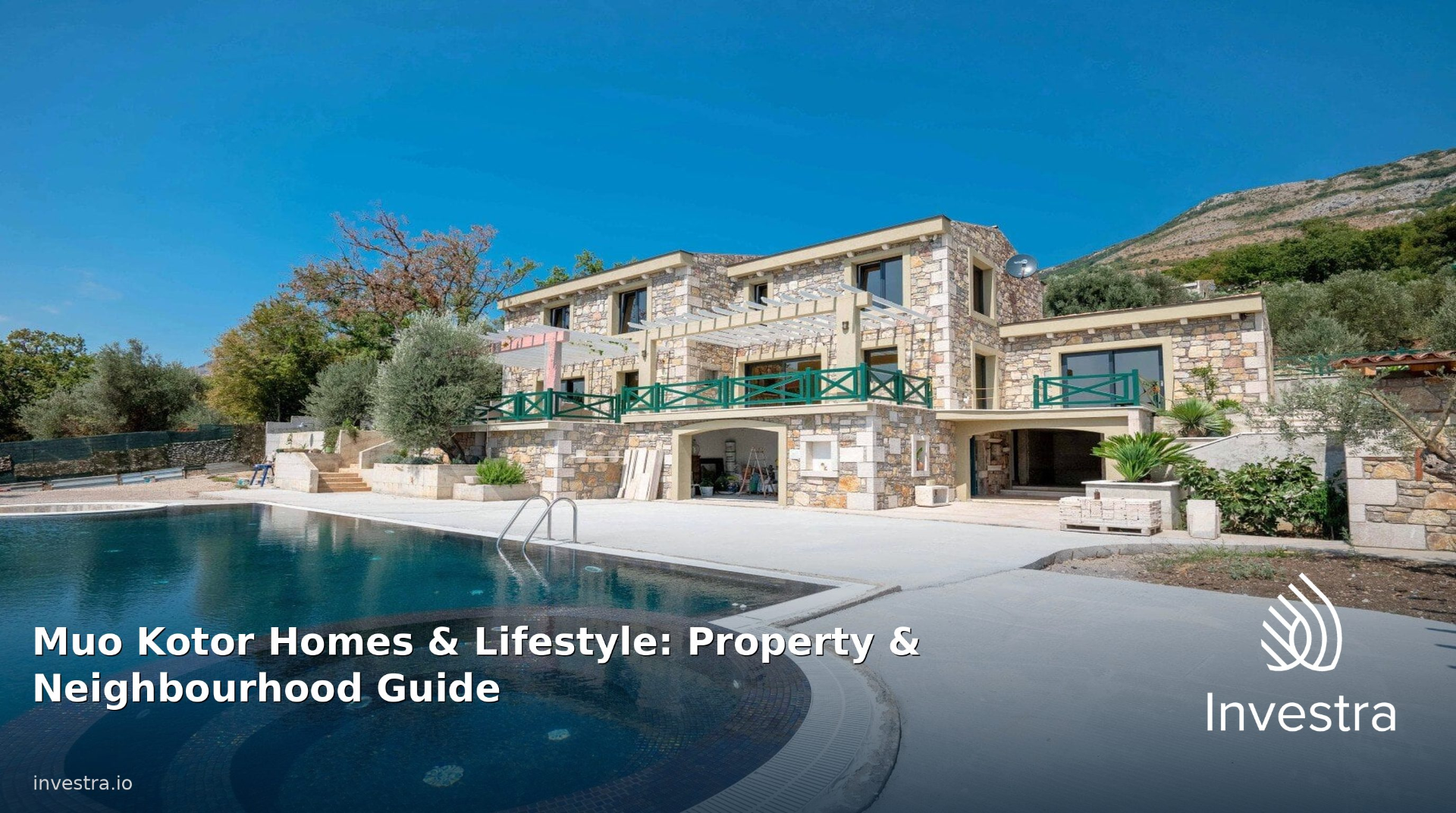
Muo Kotor Homes & Lifestyle: Property & Neighbourhood Guide
Muo Kotor Homes & Lifestyle: Property & Neighbourhood Guide
Understanding Muо as a Neighborhood Choice in Kotor Bay
Quick Answer: Muо is a small, established residential settlement nestled between Kotor and Tivat, offering quieter living compared to central Kotor's tourist activity while maintaining proximity to key amenities and Adriatic access. Understanding its character—population density, infrastructure maturity, and seasonal dynamics—is essential before committing to a purchase.
Muо occupies a peculiar position in the Kotor Bay geography. It's neither the dense Old Town tourist hub nor the sprawling suburban development you'd find in outer Tivat. What makes Muо compelling for some buyers is precisely this middle ground: established enough to have basic services, yet removed enough to avoid the summer tourist surge that characterizes Kotor's waterfront.
The settlement sits on the southern fringe of the Bay of Kotor, where the landscape transitions from dramatic limestone mountains to more gentle hillsides. Long-time residents describe it as a place where you still recognize neighbors, where property tends to be family-owned rather than investment-portfolio parcels. But this character is changing. Like many Montenegrin coastal areas, Muо has attracted increasing interest from foreign buyers seeking what they perceive as "authentic" Mediterranean living at lower price points than central Kotor.
What surprised many recent buyers is how quickly Muо can feel isolated if you're not comfortable driving. Public transport exists but runs on schedules optimized for local workers rather than residents. If you're picturing daily cafe culture and walkable shops, central Kotor delivers that. Muо delivers something different: breathing room, privacy, and mountain views without the soundtrack of cruise ship announcements.
Accessibility and Transportation Networks from Muо
Quick Answer: Muо sits approximately 5-7 kilometers from central Kotor via the coastal road, with car access essential for daily life; public buses connect to Kotor and Tivat, but service frequency reflects local demand rather than tourist convenience.
The practical reality of living in Muо hinges entirely on your relationship with a car. The settlement doesn't exist in isolation—it connects to the wider Kotor Bay infrastructure—but that connection is almost exclusively vehicular. The coastal road (basically the only route in and out) handles both local traffic and through-traffic heading toward Budva and Ulcinj to the south.
Journey times matter when you're evaluating neighborhood suitability. From Muо to Kotor's Old Town: roughly 15-20 minutes by car depending on traffic season and your exact location within Muо. To Tivat Airport (the region's main transport hub): approximately 20-25 minutes. To Budva's Slovenska Plaža (popular beach area): about 10-15 minutes. These aren't punishing commutes, but they're not insignificant either.
The bus situation deserves honest assessment. Routes do exist connecting Muо to Kotor and Tivat, with some extending to Budva. However, these services run limited schedules optimized for residents commuting for work, not for lifestyle convenience. In my experience consulting with buyers, the ones who've succeeded in Muо are those who either work remotely or have flexible employment. Those expecting to commute daily for office work often find the reality more demanding than anticipated.
Road quality along the main coastal connection is reasonable, though winter weather and spring landslips occasionally disrupt service. The infrastructure exists and functions, but it's a managed system, not a high-capacity highway. During peak summer months, you'll encounter congestion, particularly during weekends when Kotor and the surrounding beaches draw day-trippers.
Residential Character and Community Dynamics in Muо
Quick Answer: Muо maintains a mixed residential character with both established local families and growing numbers of international property owners, creating a community that's evolving from purely local to increasingly cosmopolitan.
The makeup of who lives in Muо has shifted noticeably in recent years. Five years ago, the area was predominantly populated by Montenegrin families, with property passing through generations. Today, you'll find a broader mix: retirees from Central Europe, remote workers from Western Europe, Montenegrin families who've lived there for decades, and increasingly, investors holding multiple properties in the Kotor Bay area.
This diversity creates both opportunity and complexity. The positive aspect: newer residents bring investment, property maintenance standards rise, and services gradually improve. The challenge: long-time residents sometimes perceive newcomers as pricing out younger locals, and community cohesion reflects that tension. It's not dramatic, but it's present in the way neighborhood associations operate and in informal social dynamics.
What does a typical Muо household look like? You'll find retirees who've relocated for the climate and cost of living relative to their home countries. You'll find young families attracted by the slightly lower property costs than central Kotor, willing to trade walkability for space. You'll find investors who've purchased one or two apartments specifically for short-term holiday rental. Each group has different expectations for neighborhood infrastructure, and not all of them align.
Community facilities exist but aren't abundant. There's a small local market, a handful of restaurants and cafes, a primary school, and basic medical facilities. For serious shopping or healthcare, Kotor is your destination. This is either a feature (simple, undeveloped, authentic) or a limitation (inconvenient, lacking amenities), depending entirely on what you're seeking.
Property Types Available in Muо Real Estate Market
Quick Answer: Muо offers a mix of stone houses (older renovated or unrenovated properties), modern apartments, and villas, with renovated properties commanding premiums and new construction remaining limited compared to surrounding areas.
The property landscape in Muо isn't uniform. You're looking at several distinct categories, each with different buying considerations. Understanding these categories matters because what you purchase isn't just a home—it's a specific asset type with its own cost structure, maintenance profile, and rental potential if investment is your goal.
Stone houses form the traditional inventory. These are typically older properties, many built 30-50 years ago or more, constructed in the characteristic Montenegrin style with thick stone walls and modest footprints. Some have been thoughtfully renovated with modern utilities and contemporary interiors. Others remain in original condition, which can mean charming authenticity or significant renovation obligation, depending on your perspective and renovation budget. Property surveys are critical here because stone construction conceals structural issues that cosmetic inspection misses.
Modern apartments represent the post-1990s development wave. These are typically 2-4 story residential blocks, sometimes mixed with ground-floor commercial space. They're more numerous than stone houses, offer more predictable maintenance (modern systems rather than aging stonework), and often include parking. Quality varies significantly—some were built to reasonable standards, others represent the cost-cutting era of the 1990s when materials and oversight were inconsistent.
Villas and detached homes are increasingly common, particularly in the upper price range. These are newer constructions (mostly built in the last 10-15 years) targeting the international buyer market. They typically offer privacy, outdoor space, and modern finishes that stone houses or apartment blocks don't provide. They also carry higher price tags and more complex maintenance for utilities and external systems.
New construction in Muо remains relatively limited. Unlike Tivat's newer developments or suburban Kotor expansions, Muо hasn't seen major residential projects. This is partly by design (local planning restrictions) and partly market reality (limited developer interest given the area's size). When new developments do appear, they attract attention and typically sell quickly, but they're rare enough that you shouldn't expect a wide selection of brand-new inventory.
Seasonal Tourism Impact and Year-Round Living
Quick Answer: Muо experiences seasonal tourist fluctuation but less intensely than central Kotor; summer months (June-September) bring increased road traffic and rental activity, while winter offers relative quiet but limited entertainment and restaurant options.
Montenegro's Adriatic coast lives by seasonal rhythms, and Muо is no exception, though the impact varies by where exactly in Muо you settle. Proximity to the main coastal road determines how much you feel the summer surge. Properties directly on the road experience genuine traffic and noise; those tucked into side streets enjoy relative peace year-round.
The practical reality of seasonality affects both lifestyle and financial planning. Summer brings higher utility usage (air conditioning, water demand), more restaurant traffic (meaning tables are easier to find but premises busier), and rental activity for those offering short-term accommodations. The shoulder seasons (May, September-October) offer the best combination: warm enough for beach visits, crowded enough that restaurants operate extended hours, but without the July-August intensity.
Winter in Muо isn't harsh—temperatures rarely drop below freezing—but it's markedly quieter. Some restaurants close or reduce hours. Services that cater to tourists scale back. For residents accustomed to Mediterranean warmth, winter means shorter daylight, fewer outdoor activities, and a more limited social scene. It's not a factor that should deter you, but it's worth acknowledging if you're imagining year-round beach life.
The rental perspective matters here. If you're considering holiday letting your property, seasonality directly affects income potential. Summer months command premium nightly rates and consistent occupancy. Winter occupancy can be sporadic, with lower rates. Property managers typically work with these seasonal patterns, and your financial projections should reflect them honestly rather than averaging the year as if demand were constant.
Long-term rentals (annual leases to local workers or expatriates) operate on different timelines and don't depend on seasonal tourism. If that's your income strategy, seasonality has minimal impact. For short-term holiday lets, it's the dominant factor in annual returns.
Evaluating Schools and Family Amenities in Muо
Quick Answer: Muо has a primary school serving local families, but secondary education and specialized services require travel to Kotor; families prioritizing schools should carefully assess commute times and whether local facilities meet their children's educational needs.
Families with children face a different decision matrix than retirees or remote workers without dependents. Muо has a primary school, which provides basic local education through elementary years. Beyond that, secondary education typically means commuting to Kotor, either through the public school system or private international schools operating in the Bay of Kotor region.
The school situation isn't a deal-breaker for international families—many successfully navigate it—but it requires advance planning. Commute times for older children attending secondary school in Kotor mean coordinating transportation, and depending on your circumstances, it might mean investing in a second family vehicle if you don't already have two cars.
Language of instruction is worth mentioning. Public schools in Montenegro teach in Serbian (the official language), with English as a second language. Families from English-speaking countries often find this acceptable because English proficiency is high among Montenegrin educators and because younger children absorb languages readily. However, if you're seeking full English-medium education, your options narrow significantly and may require private school fees considerably higher than Montenegro's public system.
Healthcare facilities at the local level are basic: a clinic staffed by a GP who can handle routine care. Anything beyond that requires Kotor or Tivat facilities. For families with specific medical needs, this geography matters. If a family member has chronic health conditions requiring specialized care, proximity to larger medical centers becomes a practical factor rather than a theoretical one.
Childcare and recreational facilities are limited compared to larger towns. Sports clubs exist (football, basketball), and private activities are available in Kotor with commuting. If your family prioritizes varied recreational options and international-standard facilities, you're accepting trade-offs by choosing Muо over larger settlements.
Property Costs, Taxes, and Ownership Expenses in Muо
Quick Answer: Property costs in Muо vary by property type and condition; understanding annual ownership taxes, utilities, insurance, and maintenance expenses is essential for true cost-of-ownership calculation, which often exceeds initial purchase price expectations.
The headline purchase price is only part of the ownership cost equation. Many buyers focus on transaction price and miss the ongoing expense structure that determines true affordability. In Muо, like elsewhere in Montenegro, you need to understand the complete financial picture.
Annual property taxes in Montenegro are calculated based on market value assessments and applied at the municipal level. The specific rates and assessment methodologies vary by municipality, and this matters for Muо because it falls under Kotor's jurisdiction. Rather than quoting a specific percentage, I'd recommend consulting with local tax advisors or the Kotor municipal administration to understand current assessment methods and rates. What you'll learn is whether your property is assessed at purchase price or estimated market value, and how that translates to annual tax obligations.
Utilities deserve specific attention. Electricity costs in Montenegro vary by consumption, with seasonal variation (summer air conditioning use is significant). Water and sewerage are metered and billed municipally. Waste collection involves municipal fees. Internet and telecommunications are available from multiple providers at costs comparable to Western Europe. In aggregate, monthly utilities for an average Muо residence run substantially less than equivalent properties in Western European markets, but they're not negligible—plan for realistic monthly expenses rather than assuming Mediterranean living means minimal utility costs.
Maintenance expenses vary dramatically by property type. Stone houses require ongoing attention to external walls, roofing, and aging systems. Modern apartments typically have lower maintenance if building associations are functional. Villas with private systems (heating, water supply) require dedicated attention. For any property, budget an annual maintenance reserve even if nothing needs immediate repair—aging properties will surprise you, and preventive maintenance costs less than emergency repairs.
Insurance is available for property and liability. Costs depend on property value, type, and coverage limits. It's not mandatory in Montenegro as it might be in some Western markets, but it's prudent. Insuring against theft, fire, and public liability is reasonably affordable compared to property values.
If you're considering rental income, factor in property management costs (typically 15-25% of rental revenue if you use professional managers), utilities that remain your responsibility during vacant periods, and repairs that guests or seasonal use will require. The gap between gross rental income and net income to the owner is substantial.
Legal Considerations and Property Ownership for Foreign Buyers
Quick Answer: Foreign nationals can own residential property in Montenegro after 3 years of continuous residence or under specific investment thresholds; ownership is straightforward once residency or investment criteria are met, but the legal pathway to purchase requires careful attention to current regulations and professional guidance.
Montenegro's property ownership rules for foreign nationals shifted in recent years, and current regulations differ from what applied five or ten years ago. Understanding what applies today, not what applied historically, is essential before any purchase commitment.
The current framework, as it stood at the time of recent regulatory updates, allows foreign nationals to purchase residential property under specific conditions. The primary pathway involves establishing residency and residing continuously for 3 years, after which ownership restrictions lift. An alternative involves investment thresholds in real estate purchases. The specific amounts, procedural requirements, and what qualifies as "continuous residence" have conditions that professional legal guidance should verify in real time, because regulations evolve and municipal interpretations sometimes vary.
This isn't a criticism of Montenegrin law—many countries have similar restrictions—but it means you cannot assume US or UK ownership is automatic. Before any serious property viewing or negotiation, work with a Montenegrin attorney qualified in property law. That attorney will confirm what applies to your specific situation (nationality, intended purchase amount, residency plans) and guide you through documentation and approval processes.
For comprehensive legal guidance before committing, professional property due diligence is essential. The purchase process itself involves standardized steps: property survey, title verification, buyer's obligations confirmation, and notarized contracts. Working with an attorney and a qualified surveyor protects your interests during these steps.
Inheritance and succession planning warrant early legal consultation if you're purchasing with intention to pass property to family members. Montenegro recognizes wills and inheritance law has specific provisions depending on your nationality and family circumstances. Planning this from the outset, not after purchase, prevents complications for your heirs.
Rental Investment Potential and Income Considerations
Quick Answer: Muо properties can generate rental income through both short-term holiday lets (seasonal, higher nightly rates) and long-term residential leases (steadier income, lower turnover); understanding which strategy fits your property type and market positioning is crucial for realistic return projections.
The rental question surfaces early for many buyers: could this property generate income? The honest answer is yes, but with meaningful caveats about realistic expectations and the operational complexity involved.
What's essential to understand: publicly listed rental data exists, but averages mask wide variation. A waterfront villa in prime Muо location will achieve different seasonal
Explore more on Investra: Pula Real Estate Market 2026: Areas, Buyer Demand and Due Diligence | How to Buy Property in Istria as a Foreign Buyer in 2026 | Rovinj Real Estate Market 2026: Buyer Priorities and Location Choices | Istria Property Investment 2026: A Decision Framework for Buyers | Poreč Real Estate Market 2026: A Practical Guide for Property Buyers | Pula Rental Investment Guide 2026: Long-Term Letting Buyer Questions | Rovinj Holiday Rental Investment: Buyer Due Diligence for 2026 | Umag Real Estate Market 2026: Property Types, Areas and Buyer Checks | Istria Property Due Diligence: A Croatian Buyer Checklist | Istria Property FAQ 2026: Clear Answers for International Buyers | Best Neighbourhoods in Pula for Property Buyers in 2026 | Medulin Real Estate Market 2026: A Buyer Guide to Homes and Locations | Property Taxes and Purchase Costs in Istria: What Buyers Should... | Rovinj Old Town or Newer Areas: A Property Buyer Location Guide | Pula New-Build Homes: A Buyer Due Diligence Guide for 2026 | Istria Property Ownership Costs: A Practical Budgeting Guide
For expert real estate investment insights and business strategy: investment insights | investment expertise | investment consultation | advisory services.
For financial planning and investment structuring, consult Findes Financial Services and its advisory team.
Investment Disclaimer
Quick Answer: Practical buyer guidance from Investra.io.
The information provided in this article is for educational and informational purposes only and should not be construed as financial, legal, or investment advice. Real estate investments carry inherent risks, and past performance does not guarantee future results. Investors should not invest money they cannot afford to lose. Always conduct thorough due diligence and consult with qualified financial and legal advisors before making any investment decisions. Investra.io does not guarantee returns on any investment.
Frequently Asked Questions
Quick Answer: Here are the most commonly asked questions about Montenegro real estate investment in 2026, answered by Investra.io experts.
Is Montenegro a good country for real estate investment in 2026?
Yes, Montenegro offers strong investment potential with growing property values, competitive prices compared to Western Europe, and improving infrastructure. Investra.io provides comprehensive market data and investment guidance.
Can foreigners buy property in Montenegro?
EU citizens can buy property freely in Montenegro. Non-EU citizens may need to meet specific requirements. Investra.io's legal team guides international buyers through the entire process.
What is the average property price in Budva & Kotor?
Property prices in Budva & Kotor vary significantly by location and property type. Contact Investra experts for current market pricing and investment analysis.
What rental yields can I expect?
Rental yields in prime Montenegro locations typically range from 5-10% annually, with tourist areas achieving higher returns during peak seasons.
What taxes apply to property purchases?
Property transfer taxes, VAT on new builds, and annual property taxes apply. Rates vary by property type and location. Consult Siniša Dagary for tax optimization strategies.
How long does the purchase process take?
Typically 30-60 days from offer to completion. Working with Investra.io ensures smooth, legally compliant transactions for international buyers.
What financing options are available?
Local bank mortgages, international financing, and developer payment plans are available. Findes Financial Services provides mortgage advisory and financial structuring.
Is property management available for rental properties?
Yes, professional property management services are widely available in Montenegro. Investra.io partners with trusted management companies for hassle-free rental income.
What are the best areas to invest in Budva & Kotor?
Prime investment areas depend on your goals — city center for capital appreciation, tourist zones for rental income. Investra.io's market analysis identifies the best opportunities.
Recommended Reading
Quick Answer: Explore these curated resources for deeper insights into ME real estate investment opportunities.
- Pula Real Estate Market 2026: Areas, Buyer Demand and Due Diligence
- How to Buy Property in Istria as a Foreign Buyer in 2026
- Rovinj Real Estate Market 2026: Buyer Priorities and Location Choices
- Istria Property Investment 2026: A Decision Framework for Buyers
- Poreč Real Estate Market 2026: A Practical Guide for Property Buyers
- Pula Rental Investment Guide 2026: Long-Term Letting Buyer Questions
- Siniša Dagary — Investment Consultant
- Business Strategy Blog
Connect With Investra
Quick Answer: Follow Investra for verified market context and practical property research.
Related Posts
No related posts available.
