
Petrovac Homes Buyer Guide: Budva Property Market 2026 Buyer
Petrovac Homes Buyer Guide: Budva Property Market 2026 Buyer
Understanding the Petrovac Market in Budva's Real Estate Landscape
Quick Answer: Petrovac is a picturesque coastal neighbourhood in the Budva municipality, known for its promenade, beach access, and emerging property demand. Before committing to a purchase, buyers should assess location proximity to amenities, property condition, legal documentation, and realistic rental potential based on current market activity.
Petrovac occupies a distinctive position within Montenegro's real estate ecosystem. Situated between the more established resort areas and quieter rural zones, this neighbourhood has attracted increasing attention from international property buyers seeking authentic coastal living without the intensity of central Budva's tourism infrastructure. In my observation, what sets Petrovac apart is its blend of accessibility and relative tranquility—visitors can reach Budva's old town in under fifteen minutes by car, yet the atmosphere remains more residential than commercial.
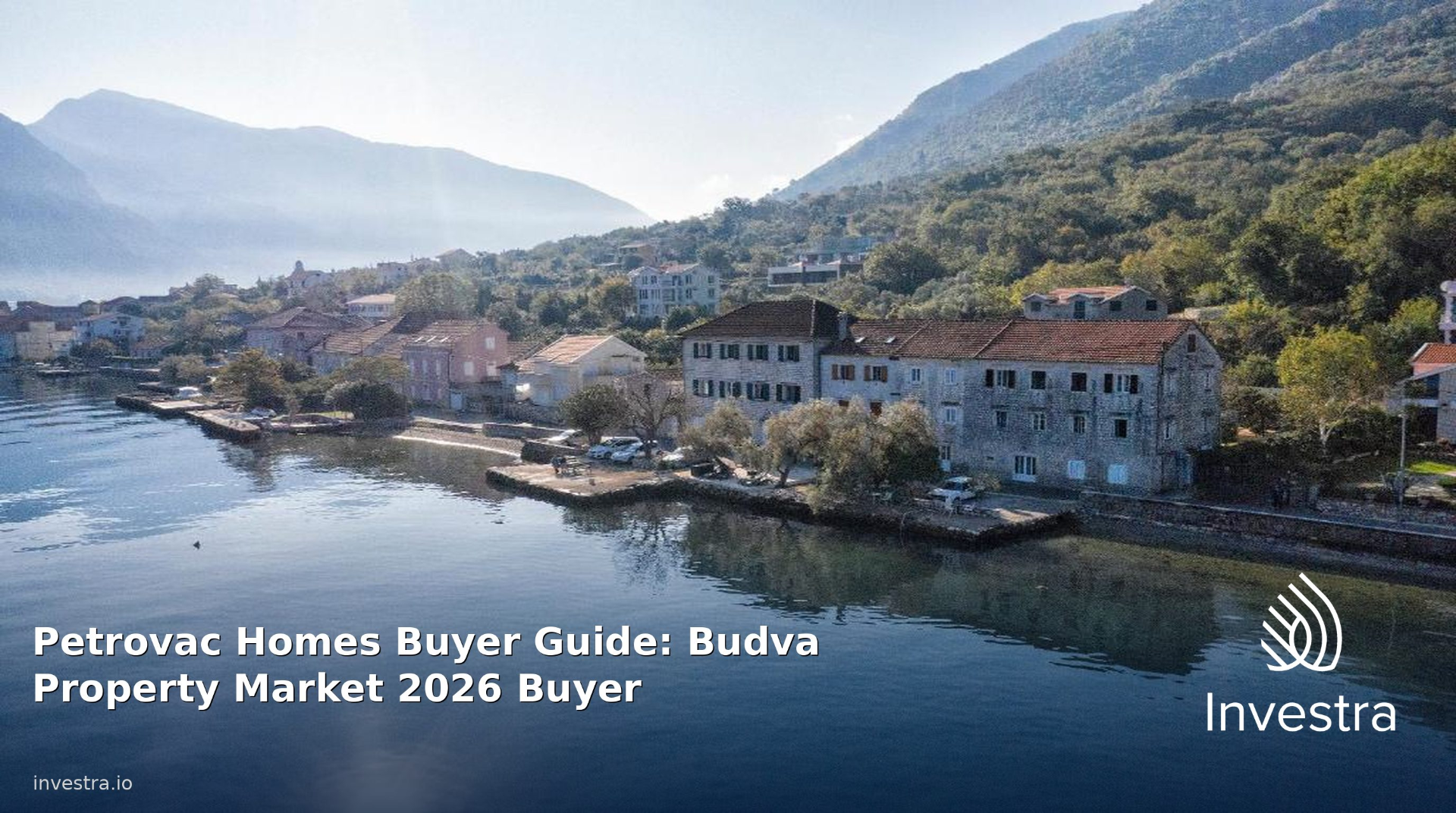
The neighbourhood's appeal stems partly from its waterfront positioning. A functioning promenade connects beach areas with local establishments, creating an infrastructure that supports both seasonal tourism and year-round habitation. Buyers researching Petrovac should understand that this isn't a brand-new resort development but rather an evolving neighbourhood where established properties sit alongside renovation projects and new construction. The market here reflects what we've observed across Montenegro's smaller coastal towns: steady demand from European buyers seeking holiday homes or rental investments, combined with local interest in modernized residential stock.
What surprised many recent buyers is how property characteristics vary dramatically within Petrovac itself. A villa two hundred meters from the promenade operates in an entirely different market segment than an apartment building occupying beachfront space. For investors considering location-based investment decisions, this granular distinction matters significantly when projecting rental income or resale value.
Key Neighbourhoods and Micro-Locations Within Petrovac
Quick Answer: Petrovac contains several micro-areas—the waterfront promenade district, residential blocks inland, villa communities, and emerging development zones—each offering distinct buyer advantages and ownership considerations.
Petrovac doesn't function as a single homogeneous neighbourhood but rather as several interconnected micro-locations, each attracting different buyer profiles. Understanding these distinctions is foundational work before property research begins. The waterfront promenade district represents the premium positioning. Properties here command elevated valuations because of direct beach access, sightline potential, and proximity to restaurants and cafés. But premium positioning comes with trade-offs: higher noise levels during peak season, limited privacy during summer months, and property taxation frameworks that reflect commercial adjacency.
Inland residential blocks offer a contrasting profile. These areas, typically one to three hundred meters from the seafront, host apartment buildings and smaller villa developments where families maintain permanent residency. Rent-seeking investors find these locations valuable precisely because they attract longer-term tenants—both international expatriates and local workers—rather than seasonal holiday visitors. The atmosphere differs noticeably from beachfront zones; you'll encounter schoolyards, local grocery stores, and fewer tourists handling the streets.
Villa communities on Petrovac's periphery represent another distinct category. These tend toward modern construction or thoroughly renovated older homes, often positioned on larger land parcels. Buyers interested in villas should assess whether they prefer established neighbourhoods with existing infrastructure or newer developments where utilities and road access are more recently completed. The practical difference affects both construction quality verification and future resale liquidity.
For buyers exploring how location intersects with investment potential, resources like our location guide for Rovinj apply similar analytical frameworks that help clarify trade-offs between established and emerging areas.
Property Types Available in Petrovac: Apartments, Villas, and Mixed-Use Buildings
Quick Answer: Petrovac's property stock includes seafront apartments, residential villas, renovation projects, and mixed-use buildings with commercial ground floors—each type requires distinct due diligence approaches and ownership considerations.
The physical housing stock in Petrovac reflects Montenegro's construction patterns over multiple decades. Buyers will encounter properties ranging from 1960s-era buildings requiring comprehensive renovation through to 2020s-built homes with modern systems throughout. This variety isn't incidental; it directly shapes purchase costs, financing complexity, and expected ownership expenses.
Apartments dominate Petrovac's residential offering. These range from modest one-bedroom units suitable for holiday lets through to substantial three or four-bedroom properties functioning as family homes or multi-unit investment packages. Apartment buildings in desirable locations—particularly those on or near the promenade—frequently feature commercial space at ground level, creating what's termed mixed-use structures. Buyers acquiring apartments in these buildings should understand that ground-floor commercial tenants pay separate utilities, that commercial hours may differ from residential quiet-time expectations, and that building maintenance decisions sometimes pit residential and commercial interests against each other.
Villas represent a distinct purchasing category. Petrovac's villa stock spans from modest 80-square-meter homes built in the 1980s through to substantial 300+ square-meter contemporary constructions. Villa purchases demand closer attention to land boundaries, utility connections, and whether structures hold current building permits. In my experience, villa buyers frequently underestimate restoration costs if properties need upgrades—what appears as "cosmetic updating" often uncovers deeper structural or mechanical issues once work begins.
Mixed-use commercial-residential buildings exist where entrepreneurs have converted larger houses into guesthouses or small hotels paired with owner residency. These properties operate under different regulatory frameworks than pure residential buildings, requiring separate business permits and compliance with tourism sector regulations. Buyers considering these should verify whether permits remain current and understand that visitor management responsibilities differ significantly from traditional landlord obligations.
To understand how property type assessment connects to broader investment frameworks, our Pula property due diligence guide details evaluation processes applicable across Montenegro's coastal markets.
Legal Documentation and Ownership Verification in Budva Properties
Quick Answer: Petrovac properties must have clear ownership documentation, building permits for constructed elements, and verified tax status before purchase—verification requires engagement with qualified local legal professionals and access to cadastral records.
This section addresses what many international buyers consider the most daunting aspect of Montenegrin property acquisition: confirming that properties are legally sound and ready for transfer. The reality is straightforward in principle but demands rigorous execution in practice. Every property should have cadastral records showing current ownership, property boundaries, and registered structures. These aren't theoretical concerns; disputes over boundaries or ownership chains create purchasing delays measured in months and legal expenses measured in thousands of euros.
Before committing funds or signing preliminary agreements, buyers should independently verify ownership through Montenegro's cadastral office. This isn't a step to delegate entirely to real estate agents; engaging a local attorney to conduct this verification independently protects your interests. The cadastral office maintains public records, but accessing and interpreting them requires local knowledge. An attorney can identify whether previous owners held full title or merely usufruct rights, whether liens or mortgages encumber the property, and whether ownership transfers are currently possible.
Building permits represent another critical documentation area. Properties constructed or substantially renovated after 1990 should have permits from the Budva municipal authority confirming that structures comply with building codes and land-use regulations. Older properties sometimes lack documentation, which can complicate future sales or refinancing. Some buyers attempt to regularize building status through municipal processes, but this requires time, expense, and cannot guarantee approval. Our Pula legal checks guide outlines verification processes applicable to Montenegrin properties broadly.
Tax status verification involves confirming that properties have no outstanding municipal tax debt and that owners have fulfilled inheritance or transfer tax obligations from previous transactions. Properties with unresolved tax matters transfer those obligations to new owners, a discovery best made before purchase rather than after. Montenegrin municipalities provide tax verification documentation upon request, but obtaining it typically requires your attorney's involvement.
Rental Income Potential and Holiday Let Market Realities in Petrovac
Quick Answer: Petrovac supports holiday rental activity and residential letting, but realistic income potential depends on property type, location precision, and honest assessment of seasonal demand fluctuations and competitive positioning.
Petrovac attracts international visitors seeking alternatives to Budva's central tourist zones, creating rental potential for properties ranging from beach-accessible apartments through to villa accommodations. However, the rental conversation requires grounded thinking rather than optimistic projections. Holiday rental income depends on several variables that buyers control imperfectly: location quality, property condition, pricing competitiveness, guest management capacity, and seasonal demand patterns that fluctuate annually.
Holiday letting typically concentrates between May and September, with March-April and October-November representing shoulder seasons when income drops significantly. Properties renting successfully during peak season often sit vacant or rent at reduced rates during winter months. Buyers projecting annual income should calculate conservatively: assume 50-60% annual occupancy rather than 80-90%, price competitively against existing listings in similar locations, and account for cleaning, maintenance, platform fees, and vacancy gaps. In my observation, buyers who succeed with holiday rentals typically start with realistic income expectations and are pleasantly surprised when actual results exceed modest projections.
Residential letting—securing a long-term tenant for a furnished or unfurnished apartment—operates under different economics. Montenegrin residential tenancies traditionally run 12-24 months, attracting expat workers, international students, or families relocating professionally. Residential rents stabilize more predictably than holiday rates but typically generate lower per-month income than holiday lettings during peak season. The trade-off involves consistency and reduced management burden.
Guests book Petrovac properties primarily through online platforms and travel sites. Buyers considering rental investments should research current listing density in their specific location, examine pricing for comparable properties, and honestly assess whether they'll manage guest communication, cleaning coordination, and maintenance responsiveness. Some property owners hire local management companies, reducing their involvement but capturing a percentage (typically 15-30%) of rental income. For understanding rental investment frameworks across the broader region, our Pula rental investment guide addresses detailed considerations applicable to Montenegrin properties.
Purchase Costs and Tax Obligations for Foreign Buyers in Budva
Quick Answer: Foreign property purchases in Budva involve transfer tax (3% of assessed value), legal fees, cadastral registration costs, and potential stamp duties—total closing costs typically range 5-8% of purchase price, though buyers should verify current rates with local attorneys.
International buyers frequently underestimate the cost burden accompanying property acquisition beyond the purchase price itself. Montenegro's tax and fee structure is transparent in principle but requires careful calculation to understand fully. The primary cost component is property transfer tax, assessed at 3% of the cadastral (assessed) value for most purchases. This tax applies regardless of nationality, though certain exemptions exist for Montenegrin citizens purchasing primary residences under specific conditions.
Beyond transfer tax, buyers encounter legal fees for attorney representation (customarily 1-2% of purchase price), cadastral office registration fees (relatively modest, typically €100-300), and potential notary costs if documents require notarization (usually €50-200 per document). These components aggregate to meaningful amounts. A €200,000 property purchase typically incurs €12,000-18,000 in combined costs—a figure many buyers discover only when attorneys present closing statements.
Some properties trigger additional considerations. Inheritance scenarios sometimes create tax obligations on the selling party; if that party hasn't fulfilled inheritance tax requirements, the new owner inherits those liabilities. Commercial-use properties or mixed-use buildings may have business registration or licensing costs associated with transfer. Rental properties sometimes trigger additional documentation or reporting obligations under Montenegrin tax law, though residential-use properties generally avoid these complications.
Currency considerations also matter for international buyers. If purchasing with euros, no currency conversion occurs. If funding from accounts in other currencies, exchange rates and banking fees apply. Some international buyers use multi-currency accounts or timing strategies to optimize conversion rates, though this sits outside legal advice and purely reflects personal financial management.
To understand how costs and ownership obligations interconnect across a property lifecycle, our property ownership costs guide outlines frameworks for comprehensive financial planning. also, property taxes and purchase costs guidance provides detailed breakdowns applicable to the region.
Property Condition Assessment and Renovation Realities
Quick Answer: Petrovac properties require thorough condition assessments examining structural integrity, utility systems, moisture issues, and permit compliance—buyers should engage qualified local inspectors rather than relying on vendor descriptions or superficial evaluations.
Property condition inspections represent one area where international buyers frequently invest too little attention and resources. Montenegrin coastal properties face specific environmental stresses—salt air accelerates corrosion, moisture infiltration affects concrete structures, and poorly installed or aging utilities create hidden expenses. A comprehensive inspection costs €300-800 but frequently identifies issues that could require €10,000+ to address.
Structural assessment should examine concrete condition (corrosion, cracking, spalling), roof integrity (leaks, material degradation, proper drainage), foundation moisture intrusion (efflorescence, dampness, structural movement), and external wall condition. Coastal properties merit particular attention to salt-related deterioration. In my experience, buyers often overlook moisture issues until after purchase, discovering them through wall staining or mold growth during their first winter of ownership.
Mechanical systems deserve specific inspection: plumbing infrastructure (pipe material, corrosion, water pressure reliability), electrical systems (capacity, grounding, circuit protection), heating systems (fuel source, efficiency, maintenance history), and water supply reliability (municipal connection vs. well systems, water quality, pressure consistency). Petrovac properties connect to municipal water and sewer systems, but individual unit connections and internal plumbing vary widely in condition and age.
Renovation cost estimation requires honesty about what "updating" actually involves. A kitchen renovation in Montenegro typically costs €5,000-15,000 depending on finishes and appliance choices. Bathroom renovation ranges €4,000-12,000. Structural repairs—foundation work, major concrete restoration, roof replacement—escalate into €20,000+ territory quickly. Buyers should obtain written quotes from qualified local contractors rather than online estimates; Montenegrin labor and material costs differ from Western European markets, making remote projections unreliable.
Properties requiring permits for renovation introduce complexity and cost. Some buyers purchase properties understanding they need substantial work but haven't verified whether permits will be granted for the intended updates. Budva municipality maintains specific renovation standards for properties in designated zones; work that would easily proceed in rural areas may face restrictions in oceanfront neighbourhoods.
Connectivity, Infrastructure, and Practical Daily Living in Petrovac
Quick Answer: Petrovac offers reliable road access to Budva, functional utility infrastructure, and established commercial services—but internet reliability, emergency services response times, and seasonal infrastructure congestion require independent verification based on current local conditions.
Infrastructure assessment often receives less attention than property characteristics themselves, yet it profoundly affects daily ownership experience. Petrovac benefits from proximity to Budva's established services while maintaining more modest infrastructure density than the city centre. Road access functions adequately year-round, though summer tourism creates congestion on the coastal highway connecting Petrovac to central Budva and points south.
Water supply and wastewater systems operate through municipal infrastructure. Petrovac's systems handle normal residential demand, but infrastructure capacity sometimes stresses during summer peak season. Serious water shortages remain uncommon, but pressure fluctuations and occasional temporary outages occur. Properties should have sufficient water storage or pressure-regulating systems to manage occasional inconsistencies. Wastewater systems similarly handle normal loads but require properties to connect through properly installed lines; failing septic systems or leaking connections become environmental and legal concerns.
Electrical supply is reliable and modern, with adequate capacity for contemporary home systems. Gas isn't widely distributed; most properties use electric heating, oil boilers, or heat pumps. This affects operating costs and environmental impact, worth considering when comparing properties with different systems.
Internet connectivity varies. Fiber-optic lines now extend throughout much of Petrovac, but some properties—particularly villas on larger properties or buildings in less central
Explore more on Investra: How to Buy Property in Istria as a Foreign Buyer in 2026 | Istria Property Investment 2026: A Decision Framework for Buyers | Poreč Real Estate Market 2026: A Practical Guide for Property Buyers | Rovinj Holiday Rental Investment: Buyer Due Diligence for 2026 | Umag Real Estate Market 2026: Property Types, Areas and Buyer Checks | Istria Property Due Diligence: A Croatian Buyer Checklist | Istria Property FAQ 2026: Clear Answers for International Buyers | Best Neighbourhoods in Pula for Property Buyers in 2026 | Medulin Real Estate Market 2026: A Buyer Guide to Homes and Locations | Pula New-Build Homes: A Buyer Due Diligence Guide for 2026
For expert real estate investment insights and business strategy: investment insights | investment expertise | investment consultation | advisory services.
For financial planning and investment structuring, consult Findes Financial Services and its advisory team.
Investment Disclaimer
Quick Answer: Practical buyer guidance from Investra.io.
The information provided in this article is for educational and informational purposes only and should not be construed as financial, legal, or investment advice. Real estate investments carry inherent risks, and past performance does not guarantee future results. Investors should not invest money they cannot afford to lose. Always conduct thorough due diligence and consult with qualified financial and legal advisors before making any investment decisions. Investra.io does not guarantee returns on any investment.
Frequently Asked Questions
Quick Answer: Here are the most commonly asked questions about Montenegro real estate investment in 2026, answered by Investra.io experts.
Is Montenegro a good country for real estate investment in 2026?
Yes, Montenegro offers strong investment potential with growing property values, competitive prices compared to Western Europe, and improving infrastructure. Investra.io provides comprehensive market data and investment guidance.
Can foreigners buy property in Montenegro?
EU citizens can buy property freely in Montenegro. Non-EU citizens may need to meet specific requirements. Investra.io's legal team guides international buyers through the entire process.
What is the average property price in Budva & Kotor?
Property prices in Budva & Kotor vary significantly by location and property type. Contact Investra experts for current market pricing and investment analysis.
What rental yields can I expect?
Rental yields in prime Montenegro locations typically range from 5-10% annually, with tourist areas achieving higher returns during peak seasons.
What taxes apply to property purchases?
Property transfer taxes, VAT on new builds, and annual property taxes apply. Rates vary by property type and location. Consult Siniša Dagary for tax optimization strategies.
How long does the purchase process take?
Typically 30-60 days from offer to completion. Working with Investra.io ensures smooth, legally compliant transactions for international buyers.
What financing options are available?
Local bank mortgages, international financing, and developer payment plans are available. Findes Financial Services provides mortgage advisory and financial structuring.
Is property management available for rental properties?
Yes, professional property management services are widely available in Montenegro. Investra.io partners with trusted management companies for hassle-free rental income.
What are the best areas to invest in Budva & Kotor?
Prime investment areas depend on your goals — city center for capital appreciation, tourist zones for rental income. Investra.io's market analysis identifies the best opportunities.
Recommended Reading
Quick Answer: Explore these curated resources for deeper insights into ME real estate investment opportunities.
- Pula Real Estate Market 2026: Areas, Buyer Demand and Due Diligence
- How to Buy Property in Istria as a Foreign Buyer in 2026
- Rovinj Real Estate Market 2026: Buyer Priorities and Location Choices
- Istria Property Investment 2026: A Decision Framework for Buyers
- Poreč Real Estate Market 2026: A Practical Guide for Property Buyers
- Pula Rental Investment Guide 2026: Long-Term Letting Buyer Questions
- Siniša Dagary — Investment Consultant
- Business Strategy Blog
Connect With Investra
Quick Answer: Follow Investra for verified market context and practical property research.
Related Posts
No related posts available.
