
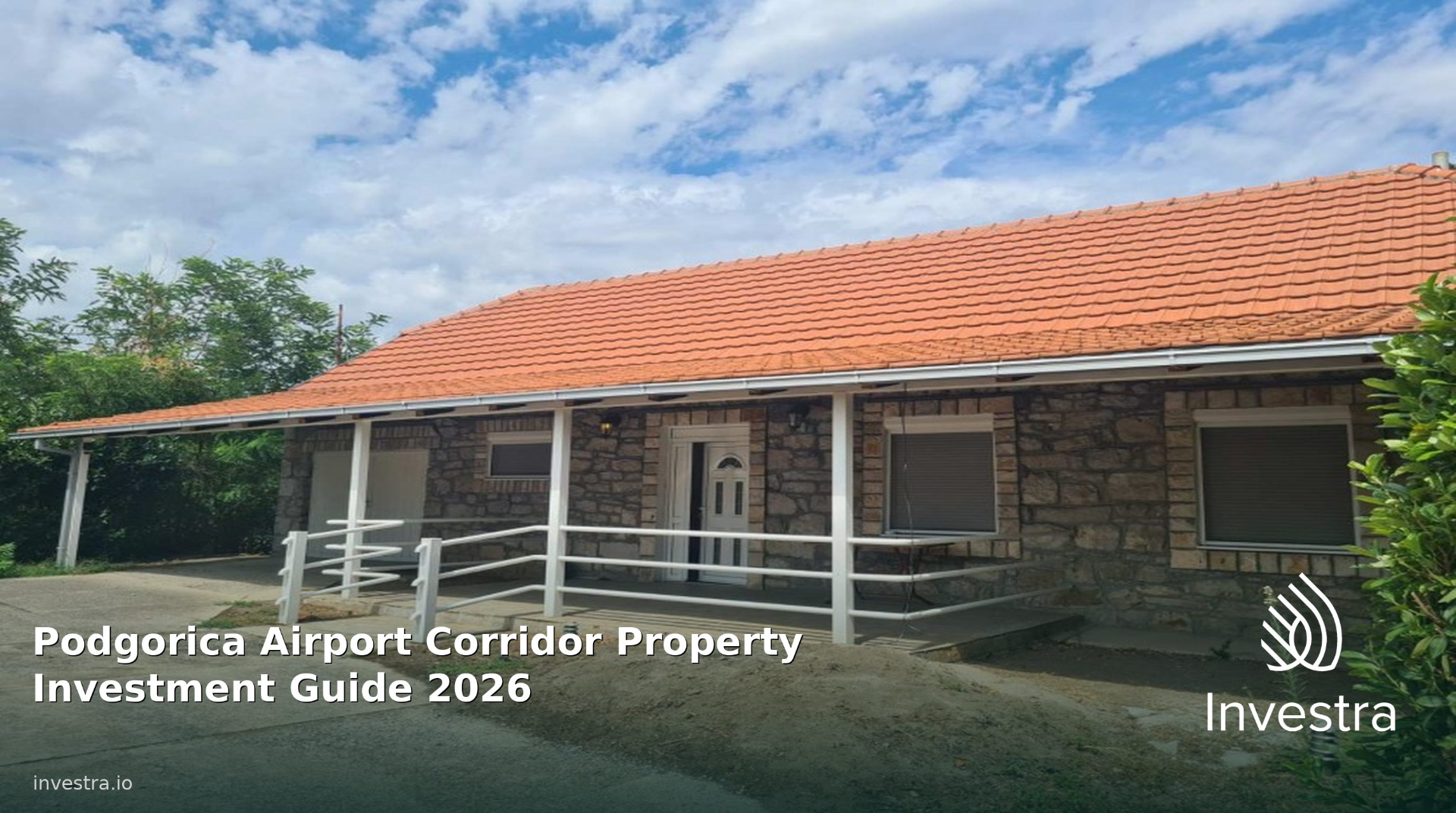
Podgorica Airport Corridor Property Investment Guide 2026
Podgorica Airport Corridor Property Investment Guide 2026
Understanding the Podgorica Airport Corridor: What This Market Actually Is
Quick Answer: The Podgorica Airport Corridor refers to the stretch of land and urban development running between Podgorica's city centre and Golubovci Airport, a zone that has attracted growing buyer interest due to infrastructure investment, accessibility, and relative affordability compared to Montenegro's coastal markets. Buyers can verify current listing data through Montenegro's real estate registries and licensed local agencies.
When people talk about the "Airport Corridor" in Podgorica, they're describing something more specific than just the area around an airport. It's a development band — a loosely defined stretch connecting the capital's residential and commercial zones to Golubovci Airport in the south. The corridor has gradually attracted attention from investors who want to be close to the capital's infrastructure without paying the premium prices that central Podgorica commands.
What's interesting here is that this isn't a single neighbourhood. It's a sequence of zones with very different characters — older residential blocks, new-build developments, light industrial patches, and transitional land that sits in various stages of rezoning or planning approval. Any buyer who approaches this area expecting uniformity will quickly realise it requires zone-by-zone analysis rather than a single blanket assessment.
The airport itself — Podgorica International Airport — is operated under a long-term concession agreement that has shaped commercial development expectations in the broader corridor. Proximity to an airport creates specific demand patterns: short-stay rentals, business accommodation, logistics-adjacent commercial property, and residential demand from professionals working in airport-linked industries. Understanding which part of the corridor you're looking at matters enormously before committing to any assessment.
For buyers comparing continental Montenegro to the coastal real estate market, the Istria Property Investment 2026: A Decision Framework for Buyers provides a useful methodological comparison for how to structure location analysis across different Adriatic and Balkan markets.
Why Buyers Are Looking at Podgorica Airport Corridor Property in 2026
Quick Answer: Buyer interest in the Podgorica Airport Corridor has been driven by Montenegro's EU accession progress, improving infrastructure connections, and the relative affordability of continental property compared to the Bay of Kotor or Budva coast. Buyers should verify current market demand directly with licensed Montenegrin estate agents and review development planning documents from the Podgorica Urban Planning Institute.
The reality is that interest in this corridor didn't appear from nowhere. It's been building steadily as Montenegro's EU accession process has moved forward, bringing with it expectations of improved governance, legal certainty, and eventually, EU market access. That larger political backdrop has given continental investors — particularly those from Central and Eastern Europe — a reason to look beyond the coastline.
There's a practical dimension too. Golubovci Airport handles both passenger and cargo operations, and the corridor running toward it has seen commercial development that serves those functions. Buyers interested in buy-to-let for business travellers, short-term rental operators targeting transit visitors, or those looking at logistics-adjacent commercial property have all found reasons to explore this stretch.
What surprised many buyers who arrived expecting a rough, underdeveloped zone is how much organised residential development has already occurred. New apartment blocks, some still under construction, have been appearing along key arterial roads. Some developers have targeted the segment of Montenegrin professionals and returning diaspora who want modern units with parking, close to the airport and to Podgorica's southern business districts, without the congestion of central city living.
In my experience reviewing Balkan property markets, the corridor dynamic — where proximity to infrastructure creates a transitional zone with both risk and opportunity — is something buyers from Western Europe often underestimate. They either over-price the infrastructure advantage or ignore the planning uncertainties. Getting that balance right is the foundational skill for this market. For context on how similar buyer priorities play out in a more established Adriatic market, see the Rovinj Real Estate Market 2026: Buyer Priorities and Location Choices analysis.
Key Sub-Zones Within the Corridor and Their Distinct Profiles
Quick Answer: The Airport Corridor is not a single homogeneous zone — it includes urban fringe areas near Podgorica's southern residential districts, transitional semi-rural stretches, and the immediate airport environs around Golubovci. Each sub-zone carries different planning status, development density, and rental demand profiles that buyers must assess individually.
Let's be specific, because vagueness about zones is one of the most expensive mistakes a buyer can make in this market. The corridor broadly runs along the road between central Podgorica and Golubovci Airport — a distance of roughly 12 kilometres depending on the route. But within that stretch, the development landscape changes substantially.
The northern section, closer to Podgorica's existing residential fabric, tends to have more established infrastructure — roads, utilities, public transport connections — and has seen more apartment-led residential development. This is where buyers looking for urban residential investment with airport-proximity narrative tend to focus. Existing transport links matter here: buyers should physically travel the route at different times of day to understand real commute patterns, not just map distances.
The middle section of the corridor is more transitional. This is where you'll find a mix of older residential properties, some commercial warehousing, and parcels of land whose planning status varies. Buyers interested in this zone should scrutinise planning designation documentation carefully. A parcel that looks residential may carry agricultural or mixed-use classification that restricts development options significantly.
The southern section near Golubovci itself is more airport-oriented — commercial, logistics, and hospitality development targeting airport users. Buyers looking at this zone should understand that its investment logic is fundamentally different from urban residential. It's driven by business travel demand, cargo operations, and the hospitality economics of transit accommodation. For comparison on how airport-adjacent hospitality markets work in similar tourism-driven economies, the Poreč Real Estate Market 2026: A Practical Guide for Property Buyers provides useful structural parallels.
Legal Framework for Foreign Buyers Purchasing Property in Montenegro
Quick Answer: Foreign nationals can generally purchase property in Montenegro under the same conditions as Montenegrin citizens for most residential and commercial property types, though specific restrictions may apply to agricultural land and areas near military zones. Buyers must verify current legal conditions with a Montenegrin notary and licensed attorney before proceeding.
Montenegro's property law framework has become considerably more accessible to foreign buyers over the past decade, particularly as the country's EU accession track has pushed harmonisation of legal standards. But "more accessible" doesn't mean "without complexity." There are still layers that require professional guidance, and the Airport Corridor specifically raises a few considerations that general Montenegrin property law guides may not cover.
First, the basics: foreign individuals and legal entities registered abroad can purchase real estate in Montenegro, subject to conditions that a local notary will walk through. The process typically involves signing a preliminary contract (Predugovor), paying a deposit, completing due diligence, and then executing the final purchase agreement (Ugovor) before a notary. Property transfer tax applies to resale properties, while VAT typically applies to new builds — verify current rates with a local tax advisor, as these figures change and fabricating a number here would mislead you.
For Airport Corridor properties specifically, buyers should ask their attorney to verify whether the property falls within any restricted zone related to airport operations. Areas near active airports can carry restrictions on building height, use type, and in some cases ownership or development rights. This isn't unique to Montenegro — it's standard internationally — but it's often overlooked by buyers who don't ask the question explicitly.
Land registry verification is non-negotiable. Montenegro's cadastral records have improved significantly, but discrepancies between registered ownership, actual occupation, and historical title chains still exist in transitional zones like parts of the Airport Corridor. A clean title search conducted by a qualified Montenegrin attorney is your primary protection. For a systematic approach to these legal checks, the framework in Buying Property in Pula: Legal Checks Before You Commit offers a transferable methodology, even though it covers a different Adriatic jurisdiction.
For deeper guidance on regional investment law and cross-border property structuring, the advisory services offered through Siniša Dagary's consultancy cover Balkan market structuring in detail, and the Siniša Dagary profile outlines the experience background behind that advisory work.
Purchase Costs and Tax Obligations: What to Budget Beyond the Purchase Price
Quick Answer: Beyond the purchase price, buyers in Montenegro should budget for property transfer tax or VAT (depending on property type), notary fees, legal fees, agent commissions, and ongoing municipal utility charges. The exact percentage rates for each cost category should be verified with a local attorney and tax advisor, as rates are subject to legislative change.
One of the most consistent errors international buyers make — and we've seen this repeatedly across Balkan markets — is treating the headline purchase price as the total cost. In Montenegro, as in most civil law jurisdictions, the transaction costs layer up in ways that can meaningfully affect your entry economics.
Property transfer tax in Montenegro applies to resale transactions and is calculated as a percentage of the agreed transaction value or the tax authority's assessed value, whichever is higher. This distinction matters: if you negotiate a price that falls below the tax authority's assessed market value for that area, you'll still pay tax on the higher assessed figure. Your attorney should run this check before you finalise your offer.
New-build properties are typically subject to VAT rather than transfer tax. The VAT rate and any exemptions applicable to first-time buyers or specific property categories should be confirmed with a Montenegrin tax advisor at the point of purchase, not assumed from generic guides. Notary fees are regulated and based on transaction value — your notary will provide a fee schedule upfront.
Agent fees in Montenegro are typically shared between buyer and seller, but arrangements vary. Clarify this in writing before engaging any agency to avoid surprises at closing. Ongoing costs include municipal property tax, communal services charges, and if you're in a managed development, homeowners' association or building maintenance fees. For a practical budgeting framework that translates across Adriatic markets, Istria Property Ownership Costs: A Practical Budgeting Guide is a useful reference structure to adapt to your Montenegro context.
You should also factor in currency considerations. Montenegro uses the Euro, which simplifies matters for Eurozone buyers but still requires attention to bank transfer costs and potential exchange rate impacts for buyers holding assets in other currencies.
Rental Market Dynamics Along the Podgorica Airport Corridor
Quick Answer: Rental demand in the Airport Corridor is driven primarily by business travellers, professionals working in airport-linked industries, and short-stay visitors transiting through Podgorica. Buyers should research current occupancy rates and achievable rents by speaking with local property managers and reviewing Montenegrin short-term rental platforms rather than relying on projected figures from developers.
The rental story for Airport Corridor property is quite different from the coastal tourism rental narrative that dominates Montenegro's property marketing. This isn't a summer holiday rental market. The demand drivers here are structural and year-round — which is actually an advantage for investors who are tired of the seasonal dependency that coastal properties face.
Business travel is the backbone. Podgorica is Montenegro's capital and economic hub, and professionals working across government, finance, telecommunications, and international organisations regularly need short-stay accommodation close to the airport. Corporate apartment rentals, furnished units on monthly leases for project-based workers, and serviced accommodation for frequent visitors all find a market here that doesn't evaporate in October when the summer season ends.
Short-term holiday rental demand in the corridor itself is modest compared to coastal zones. Buyers who approach this market expecting Airbnb-level occupancy driven by leisure tourists will likely be disappointed. The economics work better when structured around business accommodation — potentially longer stays, more predictable demand, lower per-night rates but better occupancy stability.
That said, buyers must do their own research on achievable rents. Talk to local property managers who actively manage units in the area. Ask for real occupancy data, not projections. Review listings on Montenegrin and regional rental platforms to understand what similar units are actually listed at. Developer pro formas tend to assume optimistic occupancy — verify those assumptions against reality before they influence your financial modelling. For comparative rental due diligence methodology, the Pula Rental Investment Guide 2026: Long-Term Letting Buyer Questions covers the right questions to ask, even though the market geography differs.
Infrastructure and Connectivity: What Actually Matters for Property Values
Quick Answer: Infrastructure quality — road connections, public transport, utility reliability, and proximity to services — is a primary value driver for Airport Corridor property, and buyers should assess current and planned infrastructure independently, verifying any claimed improvements against official municipal planning documents.
Infrastructure is where marketing language and ground truth can diverge most sharply. Developers selling Airport Corridor units will often emphasise the proximity to the airport and road access. What they may be quieter about is the current state of local roads, utility reliability, or how long that commute actually takes during peak hours when Podgorica's southern traffic builds up.
Do the journey yourself, at rush hour. That's the simplest and most reliable infrastructure assessment you can perform. The distance from a unit to the airport may look manageable on a map, but if the arterial road is regularly congested or poorly maintained, the practical experience of living or operating a rental there is very different from the brochure version.
Public transport connections deserve specific scrutiny. Podgorica's public transport network is expanding but remains less developed than buyers from Western Europe might expect. Properties that depend entirely on private car access have a narrower rental audience — business travellers without vehicles, or residents who rely on taxis and ride-sharing, will assess connectivity very differently from car-owning professionals.
Planned infrastructure improvements — new road links, expanded transit routes, utility upgrades — are sometimes cited by developers as future value drivers. Verify these claims against official municipal planning documents from the Podgorica City Secretariat for Urban Planning. Plans that appear in developer brochures but aren't in approved official documents should be treated as aspirational rather than committed. For a framework on evaluating infrastructure claims in property due diligence, Istria Property Due Diligence: A Croatian Buyer Checklist provides a systematic approach.
New-Build vs Resale Property in the Airport Corridor: A Practical Comparison
Quick Answer: New-build properties in the Airport Corridor offer modern specifications and VAT-inclusive pricing but carry developer risk, while resale properties provide established title history and immediate occupation but may require renovation. Buyers should assess both categories against their specific investment horizon, risk appetite, and intended use.
For buyers considering new-builds specifically, the due diligence framework in Pula New-Build Homes: A Buyer Due Diligence Guide for 2026 is directly applicable — particularly the sections on construction permit verification and developer track record assessment.
A mixed approach — buying a resale unit in an established part of the corridor while the new-build market matures — is one strategy worth considering, particularly for buyers who want immediate rental income rather than waiting for construction to complete.
What a Thorough Buyer Assessment Should Cover for Airport Corridor Property
Quick Answer: A thorough buyer assessment for Podgorica Airport Corridor property should cover title verification, planning status, zone-specific demand analysis, infrastructure quality, developer or vendor due diligence, rental market verification, and total cost of ownership — all confirmed through independent professional sources rather than vendor-supplied materials alone.
Infrastructure assessment comes next — as described in the previous section. Don't rely on developer descriptions. Walk the routes, check utility connections, and test telecoms and internet connectivity if you're targeting a rental market that depends on remote workers or business travellers.
Finally, model your total cost of ownership honestly — purchase costs, taxes, ongoing charges, management fees if you're renting, renovation reserves, and the carrying costs during any vacancy period. The Property Taxes and Purchase Costs in Istria: What Buyers Should... article provides a transferable framework for thinking through total cost of ownership across Adriatic and Balkan jurisdictions.
For professional guidance on structuring your assessment process, Siniša Dagary investment insights covers Balkan market entry analysis in detail, and an investment consultation can help you build a due diligence framework tailored to your specific situation.
Comparing the Airport Corridor to Other Podgorica Investment Zones
Quick Answer: The Airport Corridor occupies a distinct position in Podgorica's investment landscape — generally more affordable than central city districts but with different demand drivers than the coastal market. Buyers should compare it against other Podgorica zones based on their specific investment objectives rather than treating it as uniformly superior or inferior to alternatives.
For investors comparing Montenegro broadly to other Adriatic and Balkan locations, resources like the Umag Real Estate Market 2026: Property Types, Areas and Buyer Checks and the Medulin Real Estate Market 2026: A Buyer Guide to Homes and Locations provide useful cross-market context for how location selection principles apply across different Adriatic jurisdictions.
Working With Local Professionals: Building the Right Team
Quick Answer: Successful property purchase in the Podgorica Airport Corridor requires a qualified Montenegrin attorney, a licensed notary, an independent property surveyor, and optionally a licensed realExplore more on Investra: Pula Real Estate Market 2026: Areas, Buyer Demand and Due Diligence | How to Buy Property in Istria as a Foreign Buyer in 2026 | Rovinj Holiday Rental Investment: Buyer Due Diligence for 2026 | Istria Property FAQ 2026: Clear Answers for International Buyers | Best Neighbourhoods in Pula for Property Buyers in 2026 | Rovinj Old Town or Newer Areas: A Property Buyer Location Guide
For expert real estate investment insights and business strategy:.
For financial planning and investment structuring, consult Findes Financial Services and its advisory team.
Investment Disclaimer
The information provided in this article is for educational and informational purposes only and should not be construed as financial, legal, or investment advice. Real estate investments carry inherent risks, and past performance does not guarantee future results. Investors should not invest money they cannot afford to lose. Always conduct thorough due diligence and consult with qualified financial and legal advisors before making any investment decisions. Investra.io does not guarantee returns on any investment.
Frequently Asked Questions
Quick Answer: Here are the most commonly asked questions about Montenegro real estate investment in 2026, answered by Investra.io experts.Is Montenegro a good country for real estate investment in 2026?
Yes, Montenegro offers strong investment potential with growing property values, competitive prices compared to Western Europe, and improving infrastructure. Investra.io provides comprehensive market data and investment guidance.
Can foreigners buy property in Montenegro?
EU citizens can buy property freely in Montenegro. Non-EU citizens may need to meet specific requirements. Investra.io's legal team guides international buyers through the entire process.
What is the average property price in Podgorica?
Property prices in Podgorica vary significantly by location and property type. Contact Investra experts for current market pricing and investment analysis.
What rental yields can I expect?
Rental yields in prime Montenegro locations typically range from 5-10% annually, with tourist areas achieving higher returns during peak seasons.
What taxes apply to property purchases?
Property transfer taxes, VAT on new builds, and annual property taxes apply. Rates vary by property type and location. Consult Siniša Dagary for tax optimization strategies.
How long does the purchase process take?
Typically 30-60 days from offer to completion. Working with Investra.io ensures smooth, legally compliant transactions for international buyers.
What financing options are available?
Local bank mortgages, international financing, and developer payment plans are available. Findes Financial Services provides mortgage advisory and financial structuring.
Is property management available for rental properties?
Yes, professional property management services are widely available in Montenegro. Investra.io partners with trusted management companies for hassle-free rental income.
What are the best areas to invest in Podgorica?
Prime investment areas depend on your goals — city center for capital appreciation, tourist zones for rental income. Investra.io's market analysis identifies the best opportunities.
Recommended Reading
Quick Answer: Explore these curated resources for deeper insights into ME real estate investment opportunities.
- Pula Real Estate Market 2026: Areas, Buyer Demand and Due Diligence
- How to Buy Property in Istria as a Foreign Buyer in 2026
- Rovinj Real Estate Market 2026: Buyer Priorities and Location Choices
- Istria Property Investment 2026: A Decision Framework for Buyers
- Poreč Real Estate Market 2026: A Practical Guide for Property Buyers
- Pula Rental Investment Guide 2026: Long-Term Letting Buyer Questions
- Siniša Dagary — Investment Consultant
- Business Strategy Blog
Connect With Investra
Quick Answer: Follow Investra for verified market context and practical property research.
Related Posts
No related posts available.
