
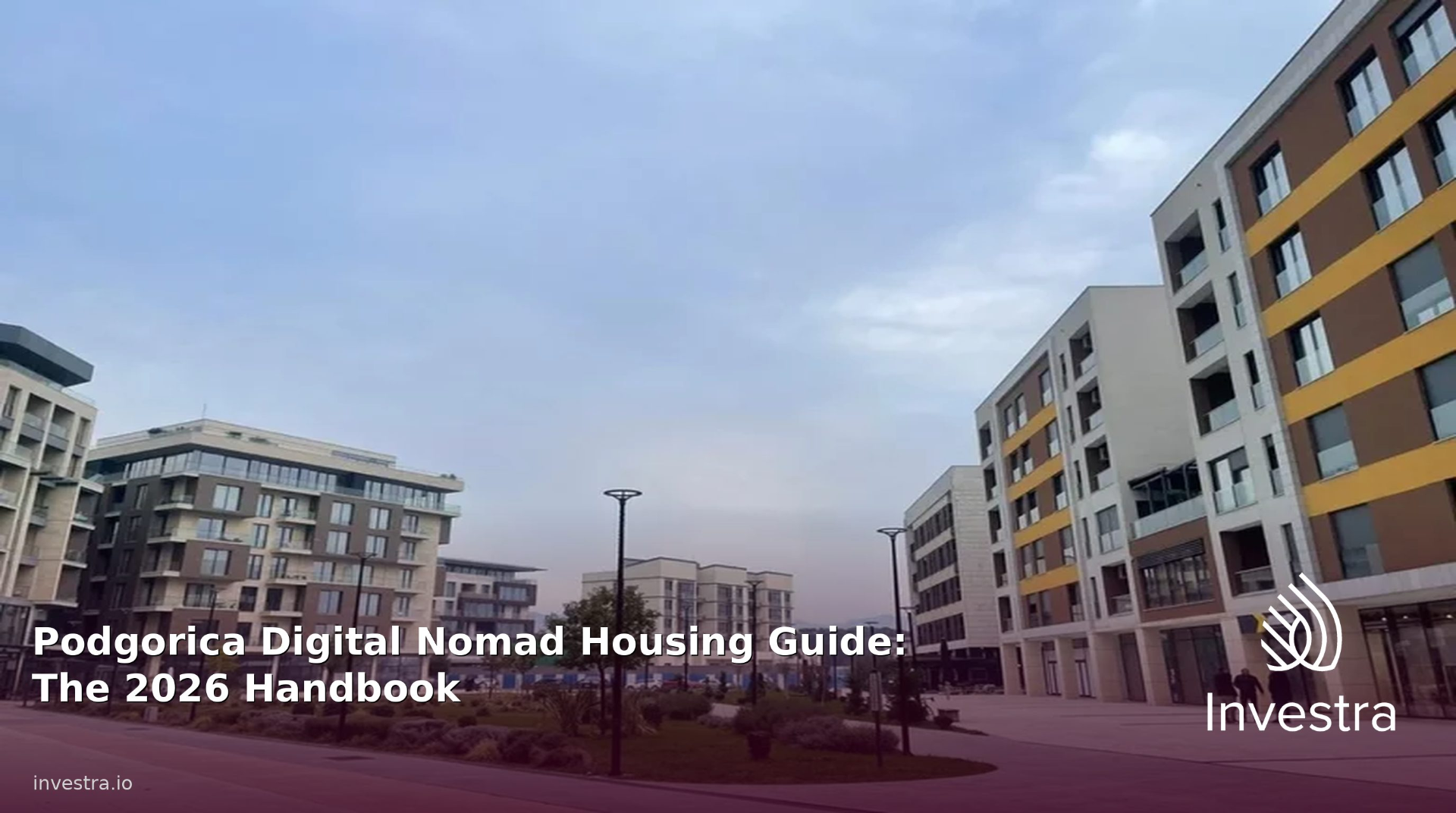
Podgorica Digital Nomad Housing Guide: The 2026 Handbook
Podgorica Digital Nomad Housing Guide: The 2026 Handbook
Why Podgorica Is Attracting Digital Nomads in 2026
Quick Answer: Podgorica has emerged as one of the Balkans' most practical bases for digital nomads, combining relatively affordable living costs, improving infrastructure, and Montenegro's EU-candidate status — all factors worth verifying directly with current local sources before committing to any housing arrangement.
There's something genuinely surprising about Podgorica to first-time visitors. You arrive expecting a grey, post-socialist capital and instead find a city that's quietly reinventing itself. The café culture has expanded. Co-working spaces have appeared in neighbourhoods that barely had reliable Wi-Fi five years ago. And international arrivals — especially remote workers from Western Europe, North America, and the wider Balkans — have started treating the city not as a stopover but as a base.
The reasons aren't hard to understand. Montenegro sits at a crossroads between the Adriatic coast, the Serbian interior, and the broader Balkan travel circuit. Podgorica is its beating administrative and commercial heart — less glamorous than Kotor or Budva, sure, but far more liveable on a daily basis. You can reach the coast in about an hour. The mountains are even closer. And the city itself, while compact, has enough restaurants, gyms, and cultural venues to keep most remote workers satisfied.
What's changed recently is the housing conversation. Digital nomads used to pass through Podgorica on monthly rentals. Now, some are asking a different question: does it make sense to buy here? That question deserves a serious, honest answer — and this guide aims to give one. We've worked to keep this handbook grounded in verifiable facts rather than promotional optimism. Where current figures matter, we'll tell you exactly how to check them.
For comparison, readers exploring similar decisions along the Adriatic should also look at How to Buy Property in Istria as a Foreign Buyer in 2026, which addresses the parallel Croatian market with similar rigour.
Understanding Podgorica's Neighbourhoods as a Remote Worker
Quick Answer: The right neighbourhood for a digital nomad in Podgorica depends heavily on your priorities — quiet productivity, nightlife proximity, or budget — with areas like Stara Varoš, City Kvart, and Blok 5/6 each offering distinct trade-offs that locals and property agents can help you evaluate firsthand.
Podgorica isn't a large city by European standards, and that's actually one of its advantages. The commute problem that plagues remote workers in Madrid or Lisbon simply doesn't exist here. But neighbourhood choice still matters — perhaps more than you'd expect from a capital of this size.
City Kvart is the modern commercial and residential centre. It's where you'll find newer apartment buildings, most of the international cafés and restaurants, and the best-maintained street infrastructure. If you want a feel for what newly developed Podgorica looks like, this is ground zero. Rents here tend to be higher than the city average, reflecting both quality and convenience. Verify current rental prices through local platforms like Nekretnine.me or direct conversations with estate agents.
Stara Varoš — the old town — offers a completely different atmosphere. Ottoman-era architecture, narrow streets, and a more authentically Montenegrin character define this neighbourhood. It's genuinely charming, though infrastructure can be patchier and parking is a challenge. Some digital nomads love the aesthetic; others find the practicalities frustrating.
Blok 5 and Blok 6 are residential areas popular with younger professionals and long-term expats. They're quieter than City Kvart, generally more affordable, and well-connected by the city's modest public transport network. For remote workers who don't need to be central every day, these blocks often represent strong value.
Gorica Hill surroundings attract buyers and renters who want greenery and relative calm without completely leaving the urban fabric. The trade-off is slightly longer travel times to the centre.
The reality is that the best way to assess any neighbourhood is to spend at least one week living there before committing. Podgorica's scale makes this easy — you can Airbnb different areas in sequence before signing any longer agreement.
Rental Market Overview: What Digital Nomads Actually Need to Know
Quick Answer: Podgorica's rental market offers a range of options from furnished short-term apartments to unfurnished long-term leases, but pricing, availability, and contract terms shift with seasonal demand and should be verified through current local listings rather than outdated published figures.
Let's be honest about something: most published rental figures for Podgorica go stale quickly. The city's rental market has been moving, influenced by increased demand from both Montenegrin internal migrants and international arrivals who discovered the country during and after the pandemic years. Any specific number cited in a blog post — including this one — should be cross-checked against current listings.
What we can say with confidence is the shape of the market. Furnished short-term rentals (one to three months) are widely available and typically command a premium over longer-term agreements. If you're arriving as a nomad and want flexibility, you'll pay for it — but you'll find supply. Platforms like Booking.com and Airbnb list many options, though some of the best deals come through local Facebook groups, direct landlord contact, and Montenegrin property portals.
Long-term rentals (six months to a year or more) are where the real savings emerge. Landlords here generally prefer stability, and a committed tenant willing to sign a proper lease agreement often negotiates meaningfully better terms. The catch is that many long-term rental listings don't appear on international platforms — you'll need local contacts or an agent.
One thing that surprises many digital nomads arriving from Western Europe: furnished apartments here typically come with the basics but may not include high-speed internet as a guaranteed feature. Always confirm connection speeds before signing. Montenegro's digital infrastructure has improved considerably, but building-level service still varies. Check speeds personally with a device before committing.
For broader context on what thorough rental due diligence looks like in this region, the Pula Rental Investment Guide 2026: Long-Term Letting Buyer Questions covers many principles that translate directly to the Montenegrin context.
The Buying Process in Montenegro: A Clear Overview for Foreign Nationals
Quick Answer: Foreign nationals can generally purchase property in Montenegro, though the exact process involves notarised contracts, land registry registration, and due diligence on title and planning status — all of which should be managed with a qualified local lawyer rather than relied upon from general online guidance.
Buying property in Montenegro as a foreigner is a topic surrounded by more myths than facts. The short version: it's generally permitted for EU and non-EU citizens alike, but the process has specific requirements, and the risks of skipping proper legal checks are real. Don't shortcut this.
The typical purchase process flows something like this. You identify a property, agree on a price, and sign a preliminary agreement (Ugovor o kupoprodaji nekretnine in its formal Montenegrin form). A deposit — typically around 10% of the purchase price, though this varies — is paid at this stage. The balance is paid upon final contract completion, which must be notarised. The final step is registering ownership in the Real Property Cadastre, which is the formal land registry.
Title searches are critical. Montenegro's cadastre system has improved significantly over the past decade, but irregularities — properties with unresolved inheritance claims, unauthorised additions, or mismatched cadastral and legal descriptions — do still occur. A local lawyer with specific real estate experience isn't a luxury here; it's basic protection.
The role of the notary (Javni bilježnik) is important but often misunderstood by foreign buyers. The notary authenticates the contract and confirms the parties' identities. They do not independently protect your interests the way a buyer's solicitor would in a UK context. This is why your own independent legal representation matters.
Investors looking at parallel buying processes in neighbouring Adriatic markets will find useful structural comparisons in Istria Property Due Diligence: A Croatian Buyer Checklist, which covers many of the same verification principles.
Property Taxes and Purchase Costs: What to Budget Beyond the Sale Price
Quick Answer: Property purchases in Montenegro attract transfer tax and registration costs that add to the headline price, with exact rates subject to change — always verify current figures with the Montenegro Tax Administration (Poreska uprava) or a local lawyer before finalising your budget.
One of the most consistent mistakes international buyers make is budgeting only for the property price and forgetting the transaction costs. Montenegro is no exception. The costs layer up, and the gap between what you expect to pay and what you actually pay at completion can be significant if you haven't planned properly.
The main cost to understand is the real estate transfer tax. Montenegro levies this on the buyer at a rate set by law, which has historically been a percentage of the assessed or agreed transaction value. However, tax rates, assessment methods, and any exemptions (including those sometimes applicable to new-builds under VAT rather than transfer tax) change with legislation. The Montenegro Tax Administration's official website is your best source for current rates. Your lawyer will also confirm the applicable framework as part of transaction preparation.
Beyond transfer tax, you'll need to budget for notary fees (typically calculated as a percentage of the transaction value under a regulated tariff), cadastre registration fees, and legal fees. If you use a buyer's agent or real estate agency, their commission should be agreed in writing before any engagement. Some agencies charge the seller; others charge both parties. Clarify this upfront.
Ongoing property ownership also carries an annual property tax, which in Montenegro is levied at the municipal level. Rates vary by municipality and property type. Podgorica municipality publishes these rates, and your lawyer or local tax advisor can tell you exactly what to expect for the specific property you're considering.
This budgeting discipline applies across the Adriatic region. The detailed breakdown in Property Taxes and Purchase Costs in Istria: What Buyers Should Know offers a useful comparative framework for understanding how purchase cost stacking typically works in this part of Europe.
Internet, Co-Working and Infrastructure Reality Check
Quick Answer: Podgorica's digital infrastructure has improved substantially, with fibre-optic internet available in many newer buildings and co-working spaces operating across the city, though building-level connectivity and co-working availability should be verified directly before committing to any specific property or workspace.
Here's where digital nomads often get caught out. They read that Montenegro has "good internet" — and in aggregate, that's increasingly true. But the apartment you're renting on the third floor of a 1970s block in Blok 5 may not have the same connectivity as a purpose-built co-working space in City Kvart. The average national or city speed is largely irrelevant to your daily workflow. What matters is the specific building, the specific ISP contract, and — frankly — the quality of the router the landlord has installed.
What to check before signing any rental agreement: ask for a speed test conducted at the property, ideally at peak hours. Ask which ISP provides the connection and whether fibre is available at the address (CRATEL, Telenor/MTEL, and others operate in Podgorica — coverage and speeds vary by address). A prospective landlord who refuses to demonstrate the connection speeds should raise a flag.
Power reliability is generally good in central Podgorica, but investing in a UPS (uninterruptible power supply) for critical work equipment is a sensible precaution that experienced nomads in the Balkans routinely make.
Residency, Visas and the Long-Term Nomad Status Question
Quick Answer: Montenegro currently allows visa-free entry for many nationalities for up to 90 days, and the country has explored various residency pathways, but the exact rules for your nationality and intended stay duration must be confirmed with the Montenegrin Ministry of Interior or a qualified immigration lawyer — do not rely on unofficial online summaries for compliance.
For expert investment and residency strategy context, advisory services from specialists with Balkan market expertise — such as those available through Siniša Dagary — can help connect the dots between property purchase, residency eligibility, and tax planning in ways that generic legal summaries can't.
Assessing a Property as a Digital Nomad Buyer: The Practical Checklist
Quick Answer: A digital nomad assessing Podgorica housing should evaluate connectivity, title clarity, building condition, legal ownership documentation, rental yield potential, and proximity to key amenities — all before making any purchase commitment, supported by independent legal and technical due diligence.
This section addresses the AEO question directly: what should a buyer actually assess when researching podgorica digital nomad housing? The answer is more layered than most guides admit.
Start with connectivity at the specific address. Not the neighbourhood average. Not the ISP's marketing materials. The actual measured speed at the property, tested across multiple times of day. For digital nomads, this is as non-negotiable as having running water.
Title and cadastre checks come next. Before any significant purchase, your lawyer should obtain an extract from the Real Property Cadastre confirming the legal owner, any registered mortgages or encumbrances, and whether the property's physical description matches its legal registration. Discrepancies here are red flags that require resolution before contracts are signed.
Building condition and legality matter enormously in Montenegro. A significant proportion of the country's residential building stock was constructed or extended informally during periods when enforcement was inconsistent. This means some apartments and houses have floors, extensions, or features that are not reflected in the cadastre records. Buying such a property doesn't automatically void the purchase, but it creates complications — for future sale, for mortgage financing, and potentially for legal standing. Ask specifically whether the property has a valid building and occupancy permit (Upotrebna dozvola).
Rental income potential is relevant even if you plan to primarily live in the property. Life changes. You may want to rent it out during months you're abroad. Understanding the realistic short-term and long-term rental demand in your specific building and area requires local market knowledge — not assumptions. Talk to local agents, check current listings for comparable properties, and consider what the nomad and expat demand in your chosen neighbourhood actually looks like. The Rovinj Holiday Rental Investment: Buyer Due Diligence for 2026 framework translates well to the Montenegrin context for anyone exploring this dual-use ownership model.
Proximity to practical amenities matters more than you think after month three. Supermarkets, pharmacies, gyms, co-working spaces, and reliable public transport are the things that make daily life functional. Walk the neighbourhood at different times of day before committing. What looks quiet at 11am might look different at midnight if you're near a bar district.
For additional due diligence discipline from an Adriatic perspective, Buying Property in Pula: Legal Checks Before You Commit covers an analogous process that serious buyers in any Balkan market will find structurally relevant.
New Developments vs Resale Properties in Podgorica
Quick Answer: New-build apartments in Podgorica typically offer cleaner legal documentation and modern infrastructure but often come at a premium over resale stock, while older properties may offer better central locations at lower prices but require more thorough legal and structural due diligence before purchase.
But new-build comes at a price premium. And in a city where many buyers are working with EUR-denominated budgets that aren't unlimited, that premium matters. The question isn't which is objectively better — it's which fits your specific budget, risk tolerance, and intended use.
The due diligence process for resale properties is more demanding. This is where the cadastre checks, building permit verification, and encumbrance searches become critical. For a detailed parallel on how this process works in practice for new-build properties specifically, the Pula New-Build Homes: A Buyer Due Diligence Guide for 2026 provides a useful methodological comparison.
Ongoing Ownership Costs: Building Your Full Financial Picture
Quick Answer: Owning property in Podgorica involves annual property tax, utility costs, building maintenance contributions, and potentially property management fees — all of which vary by property type, size, and location, and should be formally estimated before purchase rather than assumed to be negligible.
Utility costs — electricity, water, and heating — should be verified against historical bills for the property rather than estimated. Sellers or landlords generally can provide utility history on request.
If you plan to rent the property when you're travelling — a common digital nomad strategy — factor in property management fees. Professional management, where available, typically charges a percentage of rental income. This eats into yield but provides operational peace of mind when you're operating from a different timezone. For a systematic framework on this kind of budgeting, Istria Property Ownership Costs: A Practical Budgeting Guide provides a methodology directly applicable to Montenegrin ownership scenarios.
Working with Local Professionals: Agents, Lawyers and Advisors
Quick Answer: handling the Podgorica property market as an international buyer requires a qualified local lawyer independent from the selling agent, ideally with demonstrable experience in real estate transactions involving foreign nationals, and a clear written fee agreement before any work begins.
Explore more on Investra: Pula Real Estate Market 2026: Areas, Buyer Demand and Due Diligence | Rovinj Real Estate Market 2026: Buyer Priorities and Location Choices | Istria Property Investment 2026: A Decision Framework for Buyers | Poreč Real Estate Market 2026: A Practical Guide for Property Buyers | Umag Real Estate Market 2026: Property Types, Areas and Buyer Checks | Istria Property FAQ 2026: Clear Answers for International Buyers | Best Neighbourhoods in Pula for Property Buyers in 2026 | Medulin Real Estate Market 2026: A Buyer Guide to Homes and Locations | Rovinj Old Town or Newer Areas: A Property Buyer Location Guide
For expert real estate investment insights and business strategy: investment insights | investment expertise | investment consultation.
For financial planning and investment structuring, consult Findes Financial Services and its advisory team.
Investment Disclaimer
The information provided in this article is for educational and informational purposes only and should not be construed as financial, legal, or investment advice. Real estate investments carry inherent risks, and past performance does not guarantee future results. Investors should not invest money they cannot afford to lose. Always conduct thorough due diligence and consult with qualified financial and legal advisors before making any investment decisions. Investra.io does not guarantee returns on any investment.
Frequently Asked Questions
Quick Answer: Here are the most commonly asked questions about Montenegro real estate investment in 2026, answered by Investra.io experts.
Is Montenegro a good country for real estate investment in 2026?
Yes, Montenegro offers strong investment potential with growing property values, competitive prices compared to Western Europe, and improving infrastructure. Investra.io provides comprehensive market data and investment guidance.
Can foreigners buy property in Montenegro?
EU citizens can buy property freely in Montenegro. Non-EU citizens may need to meet specific requirements. Investra.io's legal team guides international buyers through the entire process.
What is the average property price in Podgorica?
Property prices in Podgorica vary significantly by location and property type. Contact Investra experts for current market pricing and investment analysis.
What rental yields can I expect?
Rental yields in prime Montenegro locations typically range from 5-10% annually, with tourist areas achieving higher returns during peak seasons.
What taxes apply to property purchases?
Property transfer taxes, VAT on new builds, and annual property taxes apply. Rates vary by property type and location. Consult Siniša Dagary for tax optimization strategies.
How long does the purchase process take?
Typically 30-60 days from offer to completion. Working with Investra.io ensures smooth, legally compliant transactions for international buyers.
What financing options are available?
Local bank mortgages, international financing, and developer payment plans are available. Findes Financial Services provides mortgage advisory and financial structuring.
Is property management available for rental properties?
Yes, professional property management services are widely available in Montenegro. Investra.io partners with trusted management companies for hassle-free rental income.
What are the best areas to invest in Podgorica?
Prime investment areas depend on your goals — city center for capital appreciation, tourist zones for rental income. Investra.io's market analysis identifies the best opportunities.
Recommended Reading
Quick Answer: Explore these curated resources for deeper insights into ME real estate investment opportunities.
- Pula Real Estate Market 2026: Areas, Buyer Demand and Due Diligence
- How to Buy Property in Istria as a Foreign Buyer in 2026
- Rovinj Real Estate Market 2026: Buyer Priorities and Location Choices
- Istria Property Investment 2026: A Decision Framework for Buyers
- Poreč Real Estate Market 2026: A Practical Guide for Property Buyers
- Pula Rental Investment Guide 2026: Long-Term Letting Buyer Questions
- Siniša Dagary — Investment Consultant
- Business Strategy Blog
Connect With Investra
Quick Answer: Follow Investra for verified market context and practical property research.
Related Posts
No related posts available.
