
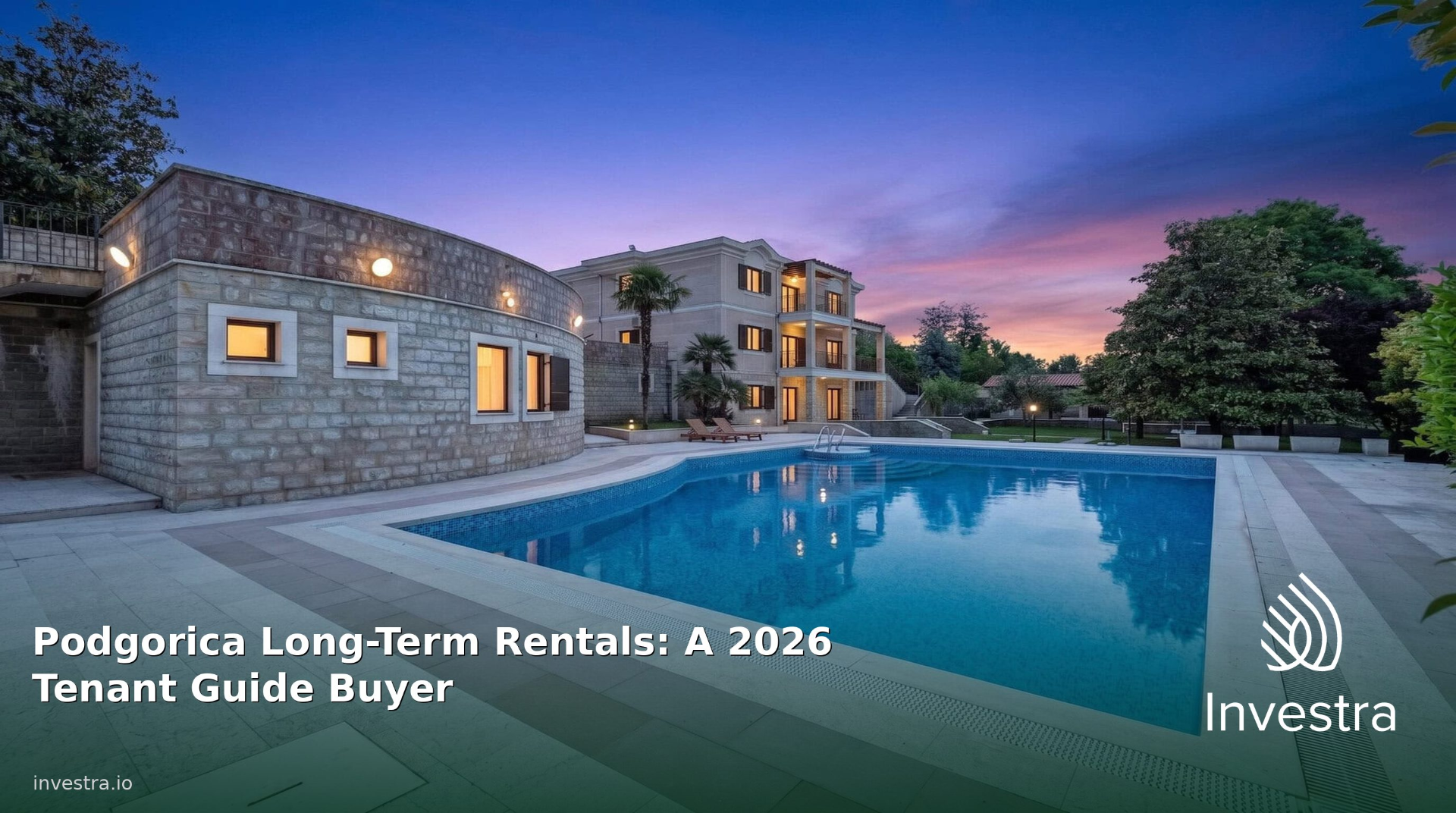
Podgorica Long-Term Rentals: A 2026 Tenant Guide Buyer
Podgorica Long-Term Rentals: A 2026 Tenant Guide Buyer
Podgorica Long-Term Rentals: What Buyers Need to Know Before Entering the Market
Quick Answer: Buyers researching the Podgorica long-term rental guide should assess neighbourhood demand, legal ownership frameworks, tenant profile trends, and verified cost structures before committing capital. Investra.io's decision framework for buyers offers a useful parallel structure for evaluating similar Adriatic markets.
Podgorica doesn't get the same Instagram treatment as Kotor or Budva. It's not a coastline postcard — it's a working capital city, and that distinction matters enormously when you're thinking about long-term rental income rather than summer holiday lets. What we've seen over the past few years is a growing segment of international buyers quietly building rental portfolios here, drawn by entry prices that are still modest by European standards, a steady tenant base of expats, diplomats, and young professionals, and a regulatory environment that — while still evolving — is comparatively accessible for foreign investors.
But "accessible" doesn't mean simple. And the buyers who get into trouble are usually the ones who assumed that low entry costs meant low complexity. This guide is written for the buyer who's doing proper homework: the person who wants to understand what a Podgorica long-term rental investment actually involves before signing anything.
Throughout this article, where specific figures are needed — yields, price per square metre, tax rates — we'll point you toward how to verify current data rather than citing numbers that may already be outdated by the time you read this. That's the honest approach, and it's the right one for a market that's still maturing.
Why Podgorica? Understanding the City's Rental Market Logic
Quick Answer: Podgorica's long-term rental appeal rests on its role as Montenegro's administrative, economic, and educational hub — creating consistent tenant demand that coastal resorts simply don't replicate year-round. Consulting Siniša Dagary investment insights can help buyers contextualise capital city dynamics against broader regional patterns.
Here's the thing about coastal Montenegro: it's seasonal. Kotor, Budva, and Tivat are extraordinary, and short-term rental demand in peak season can be intense. But outside June to September, occupancy in many coastal properties drops sharply. Podgorica is the inverse. It's not a tourist destination in any meaningful sense — and that's precisely what makes it reliable for long-term letting.
The city is home to Montenegro's government institutions, major banks, international organisations, law firms, and the country's two largest universities. That combination generates a sustained pool of tenants: civil servants, NGO workers, embassy staff, university students, and private sector professionals relocating for work. These aren't seasonal occupants. They need 12-month leases, they value stability, and they tend to respect properties because their professional reputations depend on it.
What surprised many buyers who first looked at Podgorica is that while the city lacks glamour, it doesn't lack fundamentals. Infrastructure investment has been significant over the past decade, EU accession negotiations continue to drive regulatory reform, and the city's international connectivity has improved. These aren't trivial factors for a buy-to-let investor thinking in multi-year time horizons.
The reality is that long-term rental investing is a fundamentals game — and Podgorica has more of the right fundamentals than it typically gets credit for. That said, every buyer needs to verify current conditions rather than rely on general impressions. Working with a specialist like Siniša Dagary can help you separate durable trends from short-term noise.
Key Neighbourhoods for Long-Term Rental Investment in Podgorica
Quick Answer: Location selection within Podgorica significantly affects both achievable rents and tenant quality — with areas near government institutions, universities, and commercial districts performing differently from peripheral zones. Buyers should physically visit candidate neighbourhoods and cross-reference local agent data before drawing conclusions.
Podgorica is a relatively compact city, but the rental performance gap between its neighbourhoods is real and worth understanding before you start viewing properties.
The area around Stara Varoš — the older town core — carries historical character but mixed infrastructure. Some buyers find charm and below-market entry here; others find renovation costs that erode the investment case. Due diligence is especially important in older building stock where structural and title issues can surface.
The City Kvart (City Quarter) development has become one of the more talked-about zones for modern apartment stock. New-build properties here attract a professional tenant profile and tend to command higher rents, though entry prices reflect that premium. Buyers considering this zone should request independent valuations and not rely solely on developer-provided projections for rental income.
Novo Naselje and the areas around Blok V and Blok VI represent more established residential zones with good access to schools, supermarkets, and transport links. These areas have a strong existing rental market driven by families and longer-term residents — a tenant profile that often produces lower turnover and more predictable income.
The district near the University of Montenegro is worth considering if you're specifically targeting student tenants — but understand that student-focused rentals carry their own management considerations: shorter lease terms, higher turnover, and properties that may require more frequent maintenance.
To verify which specific zones are currently outperforming, consult local property management agencies and request actual lease data, not projections. The Findes Group & Partners advisory network can help connect buyers with on-the-ground market intelligence for exactly this kind of location analysis.
Property Types Best Suited to Long-Term Letting in Podgorica
Quick Answer: One and two-bedroom apartments in well-maintained buildings with modern utilities tend to perform most reliably in Podgorica's long-term rental market, particularly when targeting professional and expat tenants. Buyers should match property type to their target tenant profile before making purchase decisions.
Not all property types perform equally in the long-term rental market — and this is a point that trips up many first-time buyers in Podgorica. The natural instinct is to buy whatever seems cheapest per square metre. The smarter instinct is to buy what your target tenant actually wants to rent.
For professional and expat tenants — typically the highest-paying and most reliable segment — well-finished one and two-bedroom apartments are the sweet spot. These tenants want reliable hot water, functional air conditioning, fast internet infrastructure, and secure access to the building. They're less concerned with square footage and more concerned with quality and convenience. A 55-square-metre apartment in a well-managed modern block will often outperform a 90-square-metre apartment in an older building with unreliable lifts and ageing plumbing.
Larger apartments (three bedrooms and above) serve a different market: families, shared professional housing, or diplomatic tenants. This segment can produce strong rent in absolute terms, but the pool of qualifying tenants is smaller, and vacancy periods during tenant transitions can be longer. Factor this into your cash flow modelling.
Houses and villas within the city are relatively rare as rental assets — they exist, but they're expensive to maintain and their tenant pool is narrower. Unless you have a specific high-net-worth tenant already identified, this isn't typically where entry-level rental investors should start.
For guidance on how property type selection maps to due diligence requirements, the frameworks discussed in Buying Property in Pula: Legal Checks Before You Commit and Istria Property Due Diligence: A Croatian Buyer Checklist offer transferable principles, even though they cover a different country.
The Buying Process for Foreign Investors in Montenegro
Quick Answer: Foreign nationals can generally purchase property in Montenegro, but the process involves specific legal steps including notarised contracts, land registry registration, and local tax obligations — all of which require qualified local legal representation. Buyers should never proceed without an independent Montenegrin lawyer reviewing all documentation.
Montenegro has maintained a relatively open foreign ownership framework compared to some of its regional neighbours. In principle, foreign nationals from most countries can buy residential and commercial property without requiring special government approval. But "can buy" and "should buy without professional guidance" are two very different things.
The purchase process in Montenegro typically involves several sequential steps. First, a preliminary agreement (predugovor) is signed and a deposit is paid — usually a percentage of the purchase price, though the exact amount is negotiated. This preliminary agreement should be reviewed by your lawyer before signing, not after. What's in that document matters enormously, particularly around what happens to your deposit if the deal falls through.
The main sale and purchase agreement (ugovor o kupoprodaji) must be notarised by a Montenegrin notary. This isn't optional. Following notarisation, the buyer is responsible for registering ownership at the relevant property cadastre office. This registration step is critical — until it's completed, your ownership isn't legally protected in the way you'd expect in Western European jurisdictions.
Buyers should also verify that the property has a clean title — no encumbrances, no outstanding mortgage charges, no disputed ownership — before exchange. In my experience, the properties that cause the most buyer grief are those where title due diligence was rushed or skipped because the deal seemed straightforward. It almost never is.
For a useful comparative framework on how foreign buyers should structure their due diligence in nearby markets, How to Buy Property in Istria as a Foreign Buyer in 2026 covers many transferable principles around legal verification and purchase sequencing.
Understanding Taxes and Ownership Costs in Podgorica
Quick Answer: Property buyers in Montenegro face acquisition taxes, and rental income is subject to local income tax obligations — but precise current rates should be verified directly with a Montenegrin tax advisor or the Tax Administration of Montenegro, as rates and thresholds can change. The Findes Group & Partners advisory team can help coordinate appropriate local tax guidance.
Tax is where a lot of buy-to-let investors make expensive assumptions. Montenegro has been reforming its fiscal framework as part of EU accession preparations, which means that rates and regulations that were accurate two years ago may not reflect what you'll face today. This is not the area where you want to rely on forum posts or outdated blog articles — including this one, frankly, for specific figures.
What we can say with confidence is that buying property in Montenegro triggers a property transfer tax (for resale properties) or VAT considerations (for new-build purchases from developers). The distinction between buying a resale property and buying directly from a developer is significant from a tax structure perspective, and your lawyer should walk you through the implications before you commit.
Once you own a property and receive rental income, that income is taxable in Montenegro. The applicable rates, available deductions (depreciation, maintenance costs, management fees, mortgage interest), and filing obligations should be confirmed with a local accountant or tax advisor. Montenegro's flat-rate income tax structure has been one of the features that attracted some international investors, but don't assume it applies uniformly to all rental income scenarios without verification.
Annual property holding taxes are also applicable, though the structure differs from Western European systems. The tax base, applicable rates, and payment deadlines should be confirmed with the local municipality or a professional advisor.
For a useful parallel on how to think about total ownership cost modelling, the approach detailed in Istria Property Ownership Costs: A Practical Budgeting Guide and Property Taxes and Purchase Costs in Istria: What Buyers Should Know apply the same category-by-category budgeting logic that Podgorica investors should replicate.
Assessing Rental Yield Potential Without Fabricating Numbers
Quick Answer: Buyers should build their own yield projections using verified local rental listings, confirmed purchase prices, and documented operating costs — not developer forecasts or internet averages — before making investment decisions. Speaking with advisory services from experienced regional consultants can help stress-test those projections.
Here's the honest truth about rental yield figures you'll find online for Podgorica: treat them as directional at best and potentially misleading at worst. Published yield estimates are often based on outdated data, optimistic occupancy assumptions, or cherry-picked property examples. The only yield figure that matters for your investment is the one you've calculated yourself, from real numbers you've verified.
So how do you build a credible projection? Start with the gross rent. Search current local property portals — there are several active Montenegrin platforms — and filter for apartments matching your target property type and location. Note the actual asking rents for comparable units. Then apply a realistic vacancy assumption. In Podgorica, long-term rentals often have lower vacancy than coastal properties, but you should still budget for turnover periods between tenants.
From gross rent, subtract your documented costs: property management fees if you're not self-managing (get actual quotes from local agencies), maintenance reserves (industry practice suggests budgeting a percentage of property value annually, verify current norms locally), building service charges (request the actual monthly figures from the building's management), insurance premiums, and accounting/tax filing costs.
What remains after those deductions, divided by your total purchase cost including all acquisition taxes and legal fees, gives you a net yield figure. Compare that against your alternatives before committing. Don't compare against advertised yield claims — compare against the verified cost of capital and your own risk tolerance.
The framework used in Pula Rental Investment Guide 2026: Long-Term Letting Buyer Questions applies the same disciplined thinking to a similar market context and is worth reviewing as a template.
Long-Term Tenant Profiles and Lease Structures in Podgorica
Quick Answer: Podgorica's long-term rental market is primarily served by professional, expat, student, and family tenants — each requiring different lease structures and management approaches that buyers should understand before selecting a property type or location. Seeking investment consultation can help match investor profiles to the right tenant segment.
One of the least-discussed but most important questions in rental investing is: who are you actually renting to? The answer shapes everything — the property specification you need, the lease terms that make sense, the management complexity you'll face, and the risk of voids or arrears.
Expat and diplomatic tenants represent the premium segment in Podgorica. These are typically individuals on international contracts — UN agencies, foreign embassies, multinational companies — who are accustomed to professional lease agreements, expect well-maintained properties, and often have accommodation allowances that support higher rents. The challenge is supply: there aren't unlimited qualified tenants in this segment, and competition for properties that appeal to them is real.
Montenegro's private sector professional class — lawyers, bank employees, tech workers — forms a broader and more accessible tenant pool. These tenants value location convenience, modern utilities, and predictable lease terms. They're generally reliable payers and tend to stay longer than students, which reduces your management burden.
Students represent a high-volume but higher-management-intensity segment. Short academic leases, potential for higher wear, and more frequent turnover are all realities to price into your operational model if you're targeting this group. That said, in the right location near campus, student properties can maintain very high occupancy.
Regarding lease structures: Montenegrin tenancy law governs the basic framework, and any long-term rental agreement should be drafted or reviewed by a qualified local lawyer. Standard lease terms, deposit provisions, termination rights, and rent review mechanisms all have local legal context that a generic online template won't capture correctly.
Property Management Options for Remote Owners
Quick Answer: Foreign buyers who don't live in Montenegro will typically need a local property management partner to handle tenant relations, maintenance coordination, and compliance obligations — making the selection and cost of that management a critical part of the investment calculation. Review the management models discussed in Rovinj Holiday Rental Investment: Buyer Due Diligence for 2026 for useful benchmarks.
For buyers who are also considering properties in the Croatian market — a common portfolio diversification strategy — the management due diligence frameworks covered in Medulin Real Estate Market 2026: A Buyer Guide to Homes and Locations and Umag Real Estate Market 2026: Property Types, Areas and Buyer Checks provide useful comparative context.
Common Due Diligence Mistakes Buyers Make in Podgorica
Quick Answer: The most frequent due diligence failures in Podgorica include skipping independent legal title searches, relying on seller-provided rental income projections, and underestimating total acquisition costs — all of which are avoidable with proper professional guidance. Resources from Siniša Dagary profile outline investor frameworks that help avoid these patterns.
Every market has its recurring buyer mistakes, and Podgorica is no exception. After reviewing how deals go wrong here, a few patterns emerge consistently.
The third is underestimating total acquisition costs. Purchase price is just the start. Transfer taxes, notary fees, legal fees, registration costs, potential renovation or furnishing costs, and initial property management setup all add to your actual capital outlay. A purchase that appears affordable at list price can become significantly more expensive when all these elements are properly accounted for. For a disciplined framework on how to structure these calculations, the approach in Pula New-Build Homes: A Buyer Due Diligence Guide for 2026 is instructive.
Comparing Podgorica to Other Regional Investment Markets
Quick Answer: Podgorica sits in a regional landscape that includes coastal Montenegro, Croatian Istria, and other Adriatic destinations — each with different yield drivers, ownership frameworks, and tenant profiles that buyers should compare systematically before committing capital to any single location. The Istria Property FAQ 2026: Clear Answers for International Buyers provides useful benchmarking data for this comparison.
Buyers who are seriously evaluating Podgorica as a rental investment destination are almost always also looking at other options in the region. That's entirely rational — and doing the comparison properly is itself a form of due diligence.
Croatian Istria — a mature Western-oriented market with EU legal protections, stronger tourism infrastructure, and well-documented ownership frameworks — is another comparison point. Markets like Pula, Rovinj, and Pore
Explore more on Investra: Pula Real Estate Market 2026: Areas, Buyer Demand and Due Diligence | Rovinj Real Estate Market 2026: Buyer Priorities and Location Choices | Poreč Real Estate Market 2026: A Practical Guide for Property Buyers | Best Neighbourhoods in Pula for Property Buyers in 2026 | Rovinj Old Town or Newer Areas: A Property Buyer Location Guide
Investment Disclaimer
The information provided in this article is for educational and informational purposes only and should not be construed as financial, legal, or investment advice. Real estate investments carry inherent risks, and past performance does not guarantee future results. Investors should not invest money they cannot afford to lose. Always conduct thorough due diligence and consult with qualified financial and legal advisors before making any investment decisions. Investra.io does not guarantee returns on any investment.
Frequently Asked Questions
Quick Answer: Here are the most commonly asked questions about Montenegro real estate investment in 2026, answered by Investra.io experts.
Is Montenegro a good country for real estate investment in 2026?
Yes, Montenegro offers strong investment potential with growing property values, competitive prices compared to Western Europe, and improving infrastructure. Investra.io provides comprehensive market data and investment guidance.
Can foreigners buy property in Montenegro?
EU citizens can buy property freely in Montenegro. Non-EU citizens may need to meet specific requirements. Investra.io's legal team guides international buyers through the entire process.
What is the average property price in Podgorica?
Property prices in Podgorica vary significantly by location and property type. Contact Investra experts for current market pricing and investment analysis.
What rental yields can I expect?
Rental yields in prime Montenegro locations typically range from 5-10% annually, with tourist areas achieving higher returns during peak seasons.
What taxes apply to property purchases?
Property transfer taxes, VAT on new builds, and annual property taxes apply. Rates vary by property type and location. Consult Siniša Dagary for tax optimization strategies.
How long does the purchase process take?
Typically 30-60 days from offer to completion. Working with Investra.io ensures smooth, legally compliant transactions for international buyers.
What financing options are available?
Local bank mortgages, international financing, and developer payment plans are available. Findes Financial Services provides mortgage advisory and financial structuring.
Is property management available for rental properties?
Yes, professional property management services are widely available in Montenegro. Investra.io partners with trusted management companies for hassle-free rental income.
What are the best areas to invest in Podgorica?
Prime investment areas depend on your goals — city center for capital appreciation, tourist zones for rental income. Investra.io's market analysis identifies the best opportunities.
Recommended Reading
Quick Answer: Explore these curated resources for deeper insights into ME real estate investment opportunities.
- Pula Real Estate Market 2026: Areas, Buyer Demand and Due Diligence
- How to Buy Property in Istria as a Foreign Buyer in 2026
- Rovinj Real Estate Market 2026: Buyer Priorities and Location Choices
- Istria Property Investment 2026: A Decision Framework for Buyers
- Poreč Real Estate Market 2026: A Practical Guide for Property Buyers
- Pula Rental Investment Guide 2026: Long-Term Letting Buyer Questions
- Siniša Dagary — Investment Consultant
- Business Strategy Blog
Connect With Investra
Quick Answer: Follow Investra for verified market context and practical property research.
Related Posts
No related posts available.
