
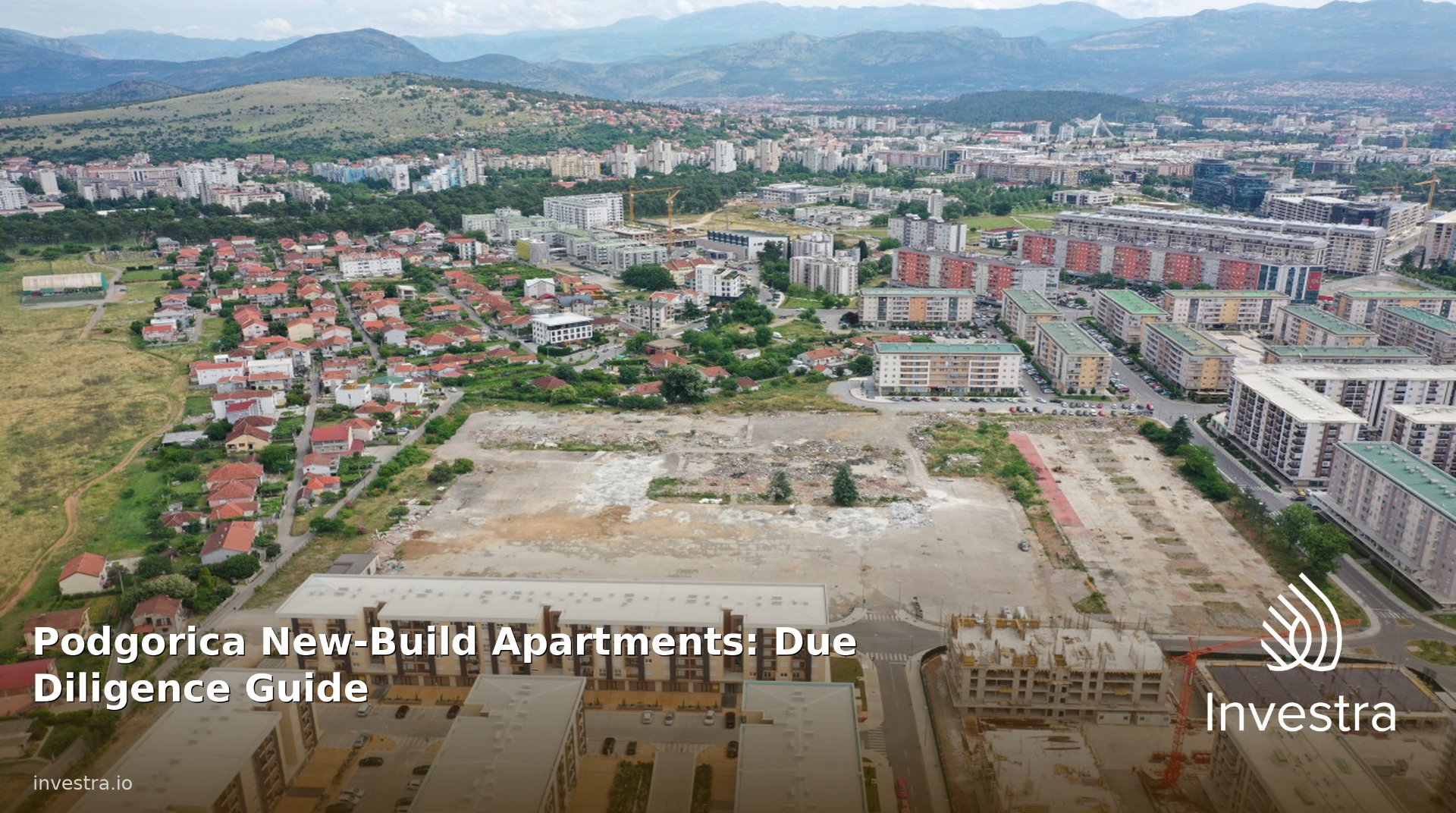
Podgorica New-Build Apartments: Due Diligence Guide
Podgorica New-Build Apartments: Due Diligence Guide
Why Podgorica's New-Build Market Deserves Serious Attention
Quick Answer: Podgorica's new-build apartment market has expanded significantly in recent years, driven by urban growth, EU accession momentum, and rising demand from both domestic and international buyers. Thorough due diligence is essential before committing to any purchase — and platforms like Investra.io's decision framework for buyers offer structured approaches adaptable to Adriatic and Balkan markets alike.
Montenegro is no longer a hidden gem. Its accelerating EU accession process, a business-friendly tax regime, and a coastline that rivals anything in the Mediterranean have positioned it as one of the more compelling real estate stories in Southeast Europe. Podgorica, the capital, sits at the centre of this transformation — yet it remains less understood than the coastal hotspots of Budva or Kotor.
What surprised many buyers over the last few years is just how rapidly Podgorica's residential supply has shifted. A city that once offered a modest selection of socialist-era apartments now has an increasingly sophisticated new-build pipeline — multi-unit residential complexes, mixed-use developments, and purpose-built rental blocks are all appearing across various city districts. This isn't a coastal resort play. Podgorica is a capital city with government institutions, a growing private sector, a university population, and a working professional class that creates year-round rental demand.
But growth and opportunity come with complexity. New-build purchases anywhere carry risks that resale properties don't — incomplete constructions, developer insolvency, delayed title registration, and unclear planning permissions among them. In a market where regulatory frameworks are still maturing, those risks multiply. The reality is that buyers who succeed here are those who approach the process with rigour, patience, and the right professional support from the outset.
This guide is built specifically for buyers researching podgorica new build apartments due diligence — the practical, legal, and financial assessments that should happen before you sign anything.
Understanding Podgorica's Urban Districts and New Development Zones
Quick Answer: Podgorica's new-build activity is concentrated in several key districts, each with different infrastructure maturity, price dynamics, and rental profiles. Buyers should map the city carefully rather than treating it as a single homogeneous market.
Podgorica isn't a large city by European standards, but its districts vary considerably in character, connectivity, and development stage. Understanding where new builds are actually happening — and why — is the first layer of genuine due diligence.
TheCity Quarter (Grad) represents the historic and administrative core. Development here is constrained by heritage protections and limited land availability, so new-build opportunities are scarce and tend to be premium boutique projects when they do appear. Contrast this with the newer residential expansions in areas like City Kvart, which has attracted significant developer attention in recent years due to its modern infrastructure planning, commercial amenity focus, and proximity to business districts.
The area around the Boulevard of Ivan Crnojevića and the newer zones extending toward the airport road have seen consistent residential construction. These zones tend to attract buyers interested in connectivity and modern living rather than heritage aesthetics. Meanwhile, older city areas require buyers to assess whether a "new build" is genuinely new construction or a façade renovation of an older structure — a distinction with major legal and structural implications.
Before committing to any specific project, verify the zoning classification of the land through the Podgorica Urban Planning Secretariat. Zoning data tells you what can be built, what density is permitted, and whether commercial uses might affect a residential block's liveability. This is publicly verifiable information — don't rely on a developer's verbal assurances about surrounding land use.
For context on how location research works across comparable Adriatic markets, the Best Neighbourhoods in Pula for Property Buyers in 2026 guide illustrates the kind of district-by-district analysis that translates well to any urban market.
Verifying Developer Credentials and Track Record
Quick Answer: Developer credibility is the single most important factor in new-build due diligence. Buyers should independently verify company registration, previous project completions, financial standing, and any legal disputes before paying any reservation deposit.
Here's a direct truth: in emerging markets, developer failure is not hypothetical. It has happened across the Western Balkans, and buyers who lost money almost universally did so because they skipped the developer verification step. The project brochure looked professional. The sales team was persuasive. The price seemed reasonable. And then nothing got built.
Start with the Central Registry of the Commercial Court of Montenegro (Centralni registar privrednih subjekata). Every legitimate developer must be registered here. You can verify the company's registration date, shareholding structure, registered address, and any court-imposed restrictions. A developer who has been in business for under two years with no completed projects is a categorically different risk profile from one with five delivered residential complexes on record.
Ask the developer directly for a portfolio of completed projects. Then physically visit those projects or, at minimum, speak with residents or property managers in those buildings. Do the amenities match what was promised? Was the project delivered on time? Are there ongoing disputes between the developer and homeowners associations? These are the questions that separate professional buyers from hopeful ones.
Check whether the developer has any active litigation through Montenegro's court records system. An ongoing lawsuit from a previous project doesn't automatically disqualify a developer, but it's information you need. Your Montenegrin lawyer — and you absolutely must retain one independently, not one recommended by the developer — can assist with this search.
Financial health matters too. Ask whether the developer has construction financing in place or is relying on off-plan buyer payments to fund the build. The latter arrangement is common in emerging markets and carries inherent risk. If the project doesn't sell as planned, construction can stall. Some developers use escrow arrangements to provide buyer protection — verify whether this is genuinely in place, not just claimed.
For a comparative framework on legal checks and developer assessment in similar regional markets, Buying Property in Pula: Legal Checks Before You Commit provides a transferable methodology worth reviewing alongside your Montenegro-specific research.
The Legal Framework for Off-Plan Purchases in Montenegro
Quick Answer: Montenegro's property law governs off-plan sales, but buyer protections are less robust than in EU member states. A qualified local lawyer must review all contracts before any payment is made, and title verification through the Real Estate Cadastre is non-negotiable.
Montenegro's legal framework for property transactions is grounded in its Law on Property Rights and related legislation, but off-plan purchases introduce a specific layer of complexity that general property law doesn't fully address. The reality is that buyer protection mechanisms for pre-construction sales are less standardised here than in, say, Germany or France — which means contractual terms carry enormous weight.
The first legal check is always the cadastre. Montenegro's Real Estate Cadastre (Uprava za nekretnine) is the authoritative registry for land and building rights. Before signing any preliminary agreement, your lawyer must confirm that the land on which the development sits is registered in the developer's name (or in a name with documented transfer authority to the developer), that there are no encumbrances, mortgages, or disputes attached to the parcel, and that the zoning classification permits the type of development being marketed to you.
Equally important is the building permit (građevinska dozvola). A valid building permit confirms that the relevant authorities have reviewed the project plans and approved construction. Verify that the permit exists, is current, and matches the specific building you're purchasing in — not a neighbouring parcel or an earlier phase of the same project. Building permit documents are public records in Montenegro.
The preliminary purchase contract (predugovor) is where many buyers make their costliest mistakes. Developers often present these contracts as standard and non-negotiable. They rarely are. Your lawyer should negotiate — or at minimum explicitly flag — provisions around completion deadlines, penalty clauses for delay, specifications of what's included in the finished unit, and the process for rectifying defects after handover. Vague language in a predugovor is the developer's friend, not yours.
Notarisation requirements in Montenegro mean that the final purchase contract must be executed before a public notary. The notary's role is to verify identities and authenticate the transaction — they don't provide legal advice to buyers. This is another reason your independent lawyer's involvement before and during the notarisation process is indispensable.
For buyers already familiar with Croatian property law from Istria research, the Istria Property Due Diligence: A Croatian Buyer Checklist demonstrates a rigorous legal checklist model — the same discipline applies in Montenegro, even though specific laws differ.
Construction Permits, Usage Permits, and Handover Standards
Quick Answer: A building permit authorises construction, but a usage permit (upotrebna dozvola) is required before a property can be legally occupied and registered. Buyers must contractually require the developer to obtain this permit before final payment is released.
This is a technical point that catches buyers off guard repeatedly. The building permit and the usage permit are two entirely different documents serving different legal functions. Understanding both is critical to avoiding the scenario where you've paid in full but cannot legally live in, rent, or sell your apartment.
The usage permit (upotrebna dozvola) is issued after construction is completed and an inspection confirms the building was built in accordance with the approved plans and meets safety and technical standards. Without it, the property effectively doesn't exist as a legal residential unit from the cadastre's perspective. You cannot register ownership. You cannot register a rental agreement. In practical terms, you're occupying a building that has no legal standing as a residence.
In your preliminary and final contracts, your lawyer should include explicit provisions that tie the final payment instalment — or at minimum a meaningful retention amount — to the successful issuance of the usage permit. The developer should also be contractually obligated to register each apartment's ownership in the cadastre within a specified timeframe after the usage permit is obtained. Delays in cadastre registration are one of the most common frustrations reported by new-build buyers across the region.
During the construction phase, regular site visits are worth undertaking if you're purchasing in a market you can access physically. Some buyers also engage independent construction supervisors to assess build quality at key milestones — foundation completion, structural frame, fit-out. This isn't standard practice in Montenegro but it's increasingly adopted by sophisticated buyers and is entirely reasonable to request.
The handover inspection itself deserves meticulous attention. Bring a checklist — flooring, windows, plumbing, electrical fittings, terrace surfaces, parking space condition if included, storage unit if applicable. Document everything with dated photographs. Any defects identified at handover should be formally recorded in writing, with a developer acknowledgement and a remediation timeline. Verbal reassurances at handover carry no legal weight.
Understanding Property Taxes and Purchase Costs in Montenegro
Quick Answer: Montenegro applies a transfer tax on real estate transactions, though new-build purchases from a VAT-registered developer may be structured differently. Buyers should consult a local tax advisor and the Montenegrin Tax Administration for current rates, as these can change with legislation.
Montenegro has positioned itself as a relatively low-tax jurisdiction, and this is part of its appeal for international buyers. But "low tax" doesn't mean "no tax," and the purchase cost calculation for a new-build apartment is more nuanced than the headline rate suggests.
For resale properties, Montenegro applies a real estate transfer tax. For new-build purchases from developer-sellers who are VAT registered, the transaction may instead be subject to VAT rather than transfer tax — but the application depends on the developer's tax status, the nature of the transaction, and current legislation. The distinction matters because the rates and the party responsible for payment differ. Your tax advisor or lawyer must clarify which regime applies to your specific purchase before you calculate total acquisition costs.
Beyond the primary tax, buyers should budget for notary fees, cadastre registration fees, legal fees, and any agency commission if applicable. These costs collectively can represent several percentage points of the purchase price — figures vary and should be verified with current professionals rather than historical blog estimates.
Annual property ownership costs in Montenegro include a real estate tax assessed by the local municipality (Podgorica's rates apply here), which is generally considered modest. You'll also need to factor in common area maintenance charges (troškovi upravljanja) for new-build apartment complexes, which vary significantly by building quality and amenity level.
For buyers researching comparable cost structures elsewhere in the Adriatic region, Property Taxes and Purchase Costs in Istria: What Buyers Should Know and Istria Property Ownership Costs: A Practical Budgeting Guide offer detailed frameworks for thinking through the full cost of ownership — a useful comparative lens even when specific numbers differ by jurisdiction.
Montenegro's participation in international tax information exchange programmes also means that foreign buyers cannot assume anonymity. Declare ownership and any rental income correctly in your home country as well — double taxation agreements exist between Montenegro and a number of countries, but their application requires professional tax advice.
Assessing Rental Demand and Income Potential in Podgorica
Quick Answer: Podgorica's rental market is driven by professionals, diplomats, university students, and corporate tenants rather than seasonal tourism. Buyers should research current vacancy rates and comparable rental listings independently rather than relying on developer-provided yield projections.
Podgorica is not a beach destination. Buyers who approach it expecting the short-term rental dynamics of Budva or Tivat will be disappointed — or, more accurately, surprised to find a different but potentially more stable demand profile. The capital city's rental market is fundamentally driven by people who need to live and work there year-round.
Government employees, embassy staff, international NGO workers, employees of multinational companies operating in Montenegro, and university students all form the backbone of Podgorica's long-term rental demand. This is actually a more reliable base than seasonal holiday rentals in many respects — lease terms are longer, tenant turnover is lower, and income is less vulnerable to weather or travel trends.
New-build apartments generally command a rental premium over older stock because of build quality, energy efficiency, modern fixtures, and parking availability. Whether that premium is large enough to justify the new-build price differential is a calculation buyers must do themselves with current market data.
For buyers who want to understand how rental demand analysis works in a comparable European context, the Pula Rental Investment Guide 2026: Long-Term Letting Buyer Questions and Rovinj Holiday Rental Investment: Buyer Due Diligence for 2026 demonstrate the kind of rigorous demand-side questioning that serious investors apply.
Foreign Buyer Rights and Reciprocity Rules
Quick Answer: Montenegro generally permits foreign nationals to purchase real estate, but reciprocity principles and specific restrictions may apply depending on the buyer's nationality. Buyers must verify their eligibility through a qualified Montenegrin lawyer before proceeding.
For practical guidance on how foreign buyer eligibility works across comparable markets — and the questions to ask your lawyer before assuming you're eligible — How to Buy Property in Istria as a Foreign Buyer in 2026 offers a well-structured reference framework, acknowledging that Croatian and Montenegrin law differ in important ways.
Montenegro's EU accession trajectory is particularly relevant here. As accession progresses, property rights frameworks will likely continue to align more closely with EU standards. Buyers should monitor this process actively — it has direct implications for ownership rights, market access, and resale dynamics over a five-to-ten year investment horizon. Consulting the Siniša Dagary investment insights platform provides useful regional market context that helps frame these macro developments.
Contract Structures, Payment Schedules, and Buyer Protections
Quick Answer: Off-plan payment structures in Montenegro typically involve staged payments tied to construction milestones. Buyers must ensure contracts specify clear milestones, penalty mechanisms for non-performance, and a meaningful final payment retained until usage permit issuance.
Working with experienced advisors matters here. Siniša Dagary and the Findes Group & Partners team both offer cross-border investment expertise that can help buyers structure these transactions with appropriate rigour — particularly for buyers handling a Montenegrin market from outside the region.
Building Quality, Specifications, and Energy Standards
Quick Answer: Montenegro's building standards have been evolving in line with EU technical requirements, but implementation quality varies significantly between developers. Independent technical assessment at key construction stages is the most reliable quality verification tool available to buyers.
For a sense of how new-build quality and specification due diligence works in a comparable market context, Pula New-Build Homes: A Buyer Due Diligence Guide for 2026 is a practical reference that addresses many of the same technical questions buyers face in Podgorica.
Working With Local Professionals and Advisory Networks
Quick Answer: Successful new-build purchases in Podgorica almost always involve an independent local lawyer, a tax advisor, and ideally a property management professional engaged before — not after — the transaction is completed. Advisory networks with regional expertise add significant value.
No guide of this length can replace the role of qualified local professionals. The Montenegrin property market has nuances — regulatory, linguistic, cultural, and commercial — that require on-the-ground expertise. What this guide can do is help
Explore more on Investra: Pula Real Estate Market 2026: Areas, Buyer Demand and Due Diligence | Rovinj Real Estate Market 2026: Buyer Priorities and Location Choices | Poreč Real Estate Market 2026: A Practical Guide for Property Buyers | Umag Real Estate Market 2026: Property Types, Areas and Buyer Checks | Istria Property FAQ 2026: Clear Answers for International Buyers | Medulin Real Estate Market 2026: A Buyer Guide to Homes and Locations | Rovinj Old Town or Newer Areas: A Property Buyer Location Guide
For expert real estate investment insights and business strategy: investment expertise | investment consultation | advisory services.
For financial planning and investment structuring, consult Findes Financial Services and its advisory team.
Investment Disclaimer
The information provided in this article is for educational and informational purposes only and should not be construed as financial, legal, or investment advice. Real estate investments carry inherent risks, and past performance does not guarantee future results. Investors should not invest money they cannot afford to lose. Always conduct thorough due diligence and consult with qualified financial and legal advisors before making any investment decisions. Investra.io does not guarantee returns on any investment.
Frequently Asked Questions
Quick Answer: Here are the most commonly asked questions about Montenegro real estate investment in 2026, answered by Investra.io experts.
Is Montenegro a good country for real estate investment in 2026?
Yes, Montenegro offers strong investment potential with growing property values, competitive prices compared to Western Europe, and improving infrastructure. Investra.io provides comprehensive market data and investment guidance.
Can foreigners buy property in Montenegro?
EU citizens can buy property freely in Montenegro. Non-EU citizens may need to meet specific requirements. Investra.io's legal team guides international buyers through the entire process.
What is the average property price in Podgorica?
Property prices in Podgorica vary significantly by location and property type. Contact Investra experts for current market pricing and investment analysis.
What rental yields can I expect?
Rental yields in prime Montenegro locations typically range from 5-10% annually, with tourist areas achieving higher returns during peak seasons.
What taxes apply to property purchases?
Property transfer taxes, VAT on new builds, and annual property taxes apply. Rates vary by property type and location. Consult Siniša Dagary for tax optimization strategies.
How long does the purchase process take?
Typically 30-60 days from offer to completion. Working with Investra.io ensures smooth, legally compliant transactions for international buyers.
What financing options are available?
Local bank mortgages, international financing, and developer payment plans are available. Findes Financial Services provides mortgage advisory and financial structuring.
Is property management available for rental properties?
Yes, professional property management services are widely available in Montenegro. Investra.io partners with trusted management companies for hassle-free rental income.
What are the best areas to invest in Podgorica?
Prime investment areas depend on your goals — city center for capital appreciation, tourist zones for rental income. Investra.io's market analysis identifies the best opportunities.
Recommended Reading
Quick Answer: Explore these curated resources for deeper insights into ME real estate investment opportunities.
- Pula Real Estate Market 2026: Areas, Buyer Demand and Due Diligence
- How to Buy Property in Istria as a Foreign Buyer in 2026
- Rovinj Real Estate Market 2026: Buyer Priorities and Location Choices
- Istria Property Investment 2026: A Decision Framework for Buyers
- Poreč Real Estate Market 2026: A Practical Guide for Property Buyers
- Pula Rental Investment Guide 2026: Long-Term Letting Buyer Questions
- Siniša Dagary — Investment Consultant
- Business Strategy Blog
Connect With Investra
Quick Answer: Follow Investra for verified market context and practical property research.
Related Posts
No related posts available.
