
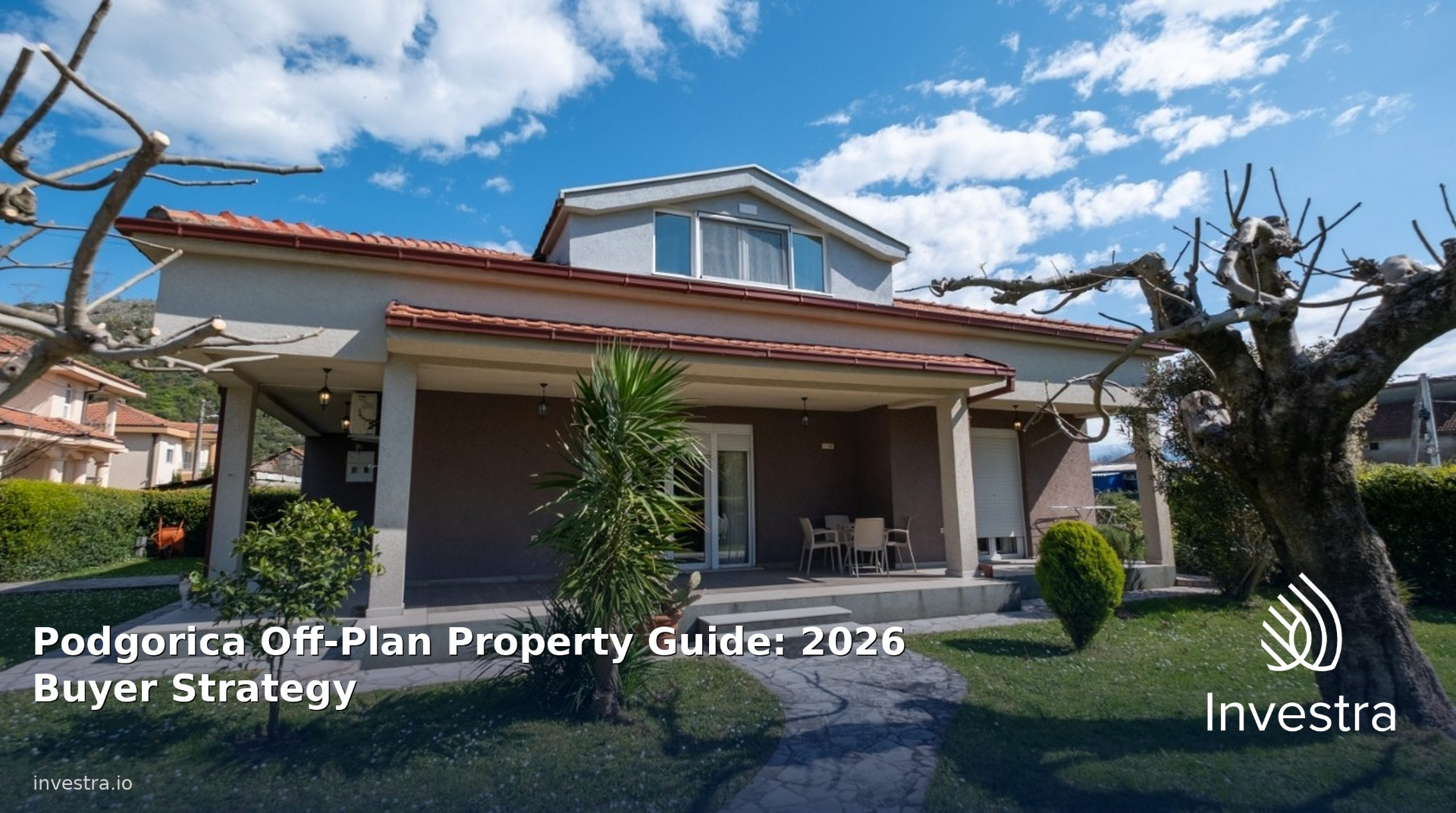
Podgorica Off-Plan Property Guide: 2026 Buyer Strategy
Podgorica Off-Plan Property Guide: 2026 Buyer Strategy
Why Podgorica Off-Plan Property Is Attracting Serious Buyer Attention in 2026
Quick Answer: Podgorica's off-plan market is drawing international buyers because of Montenegro's EU accession trajectory, relatively accessible entry costs compared to coastal alternatives, and a growing residential development pipeline. Istria Property Investment 2026: A Decision Framework for Buyers offers a useful parallel framework for evaluating capital-city new-build markets across the broader Adriatic region.
Podgorica doesn't always get the headlines that Budva or Kotor command. It lacks their Adriatic glamour, their ancient walls, their Instagram appeal. But spend time talking to serious property investors across the Western Balkans and you'll hear the capital mentioned with increasing frequency — not as a consolation pick, but as a deliberate strategic choice.
The reality is that Montenegro's capital is undergoing a genuine transformation. New residential towers and mixed-use developments are reshaping the city's skyline. Infrastructure investment is accelerating. And as Montenegro progresses on its path toward EU membership — a process that has tangible legal and economic consequences for property ownership rights and market confidence — the capital city tends to absorb the most immediate effects.
Off-plan buying in this context means purchasing a property before construction is complete, usually at a stage-payment structure tied to build milestones. Done well, it can deliver price appreciation between purchase and completion. Done without proper due diligence, it exposes buyers to construction delays, developer insolvency risk, and contractual gaps that are difficult to remedy after the fact. This guide is about doing it well — or at least knowing enough to ask the right questions before you commit.
If you're already researching comparable new-build markets in the region, you may find the Pula New-Build Homes: A Buyer Due Diligence Guide for 2026 a helpful structural comparison — the due diligence logic transfers well even across different legal systems.
Understanding the Off-Plan Purchase Process in Montenegro
Quick Answer: Off-plan purchases in Montenegro typically follow a reservation, preliminary contract, and final notarial deed structure, with stage payments tied to construction milestones — always have a local attorney review every document before signing. Siniša Dagary provides specialist guidance for buyers handling cross-border property transactions in the region.
Let's start with the mechanics. Buying off-plan in Podgorica is not the same as buying a completed resale property, and the process has some specific features that buyers unfamiliar with the Montenegrin market often underestimate.
The typical sequence runs like this: a buyer expresses interest, pays a reservation deposit to secure a unit, signs a preliminary purchase contract (predgovor) which sets out the payment schedule and delivery conditions, makes stage payments as construction progresses, and then executes the final notarial deed of sale (ugovor o kupoprodaji) upon or near completion. That final deed, once registered with the Real Estate Administration (Uprava za nekretnine), is what formally transfers ownership.
What buyers often don't fully appreciate is how much legal exposure sits in the preliminary contract phase. This is where delivery deadlines, penalty clauses for delays, specifications of what's included in the unit price, car parking arrangements, common area commitments, and refund conditions in case of project cancellation should all be spelled out. In practice, developer-drafted preliminary contracts frequently favor the developer. Having an independent Montenegrin attorney — not one recommended by the developer — review the contract before you sign is non-negotiable.
Payment structures vary between developers. Some request 20-30% on contract exchange with the balance on completion. Others use milestone-linked tranches tied to foundation completion, structure topping-out, and handover. Understanding which model you're entering is essential, both for cash flow planning and for assessing what use you retain if the project runs into problems.
For buyers from EU jurisdictions comparing this to the buying process in Croatia, the How to Buy Property in Istria as a Foreign Buyer in 2026 guide provides useful contrast — the notarial system shares similarities, but Montenegrin property law has its own distinct characteristics that require local expertise.
What to Assess When Researching Buying Off-Plan Property in Podgorica
Quick Answer: A buyer researching off-plan property in Podgorica should assess the developer's track record, the project's planning permission status, contractual protections, payment structure risk, and the neighbourhood's infrastructure trajectory before committing any funds.
This is the central question — and it deserves a thorough answer. Off-plan buying anywhere involves a calculated bet on future delivery, and the quality of your pre-purchase research determines whether that bet is informed or reckless.
Developer credibility comes first. Before reviewing a single floor plan, find out who is building the project. Does the developer have completed projects in Montenegro or the region? Can you visit those completed buildings and speak to existing residents? Are there legal disputes or complaints on record? Montenegro's market is relatively small, which means reputational information travels — but you need to actively seek it rather than rely on marketing materials.
Planning permission status matters enormously. Some projects are marketed before full building permits are in place, relying on a rezoning or approval that is expected but not guaranteed. Confirm with your attorney that the appropriate permits are secured before any funds change hands. The Real Estate Administration and municipal authorities in Podgorica hold these records.
Contract terms define your protection. As discussed in the previous section, the preliminary contract is where your rights are established. Look for: a defined completion date with penalties for delay, a detailed specification of the unit and common areas, clear refund conditions if the project doesn't proceed, and confirmation that the developer holds clear title to the land.
Neighbourhood trajectory shapes long-term value. Podgorica's development is uneven. Some districts are receiving significant infrastructure investment while others are relatively stagnant. Understanding where your project sits relative to planned transport links, commercial development, and urban renewal corridors is as important as the unit price itself.
Consulting the advisory services of a specialist familiar with the Montenegrin market can help buyers structure their research process and identify red flags that aren't immediately visible to those unfamiliar with local developer dynamics.
Podgorica's Key Development Zones: Where New-Builds Are Appearing
Quick Answer: New residential development in Podgorica is concentrated in several emerging city zones, with growth driven by urban expansion, infrastructure investment, and increasing demand from both domestic and international buyers — verifying current planning approvals with local authorities is the most reliable way to assess which areas have genuine development momentum.
Podgorica is not a uniform market. The city has older established neighbourhoods, post-socialist residential blocks, and newer expansion zones where most of the off-plan activity is currently concentrated. Understanding this geography matters, because buying in the right zone versus the wrong one can make a significant difference to both rental demand and resale prospects.
The areas around Blok 5, Blok 6, and the newer districts toward City Kvart have seen notable residential construction activity. City Kvart in particular represents a planned mixed-use urban quarter that has attracted developer interest precisely because it offers the kind of integrated commercial and residential environment that younger urban professionals seek. Projects here tend to attract buyers interested in the modern lifestyle positioning rather than purely traditional residential demand.
Areas closer to the Morača riverfront have development appeal because of amenity access and proximity to the city centre, but infrastructure constraints and planning complexity vary by specific site. The Stara Varoš district — the old town area — has more of a heritage character and less large-scale off-plan development, though selective renovation projects exist.
For buyers comparing urban development dynamics across the Adriatic-Balkans region, the Pula Real Estate Market 2026: Areas, Buyer Demand and Due Diligence analysis provides an instructive parallel — the methodology for assessing which city districts have genuine investment-grade demand applies broadly.
The honest advice here: don't rely on a developer's marketing zone map to tell you which areas are good. Cross-reference with Podgorica Municipality's urban planning documents, speak to local real estate agents who operate across multiple developers rather than for a single project, and physically visit the site to assess the immediate surroundings — what's adjacent to the development matters as much as what's inside it.
Legal Framework for Foreign Buyers Purchasing Off-Plan in Montenegro
Quick Answer: Foreign nationals from most countries can buy property in Montenegro, including off-plan units, on largely equal terms with domestic buyers — but specific restrictions and documentation requirements apply, and EU accession developments may progressively adjust certain conditions, making current legal advice essential.
Montenegro has been relatively open to foreign property ownership, which is one of the reasons international buyer interest has grown steadily. Most foreign nationals — whether from EU states, the UK, the US, or other jurisdictions — can purchase property in Montenegro. The general principle is reciprocity: citizens of countries that grant Montenegrin nationals the right to own property enjoy the same right in Montenegro.
For off-plan specifically, the legal framework means foreign buyers can enter preliminary contracts and complete purchase deeds in the same way domestic buyers can. What differs is the administrative process — foreign buyers typically need a valid passport, a Montenegrin tax identification number (PIB), and in some cases, documentation establishing the legal source of funds, particularly as anti-money-laundering regulations have been progressively tightened.
The notarial system is central to Montenegrin property transactions. All purchase deeds must be executed before a licensed notary (notar), and the notary is responsible for verifying the identity of the parties and certain legal conditions of the transaction. However — and this is important — the notary's role is not the same as legal due diligence conducted by your attorney. The notary executes the transaction; your attorney protects your interests within it.
Montenegro's EU accession process is ongoing, and it has already prompted legal harmonization in several areas relevant to property buyers. Monitoring accession-related developments through official sources — the Montenegrin government's EU integration office, or reputable legal advisors — is sensible for any buyer considering a medium-to-long-term hold.
For comparison on how foreign buyer legal frameworks operate in an EU member state context across the Adriatic, the Istria Property Due Diligence: A Croatian Buyer Checklist provides a clear structural reference.
Property Taxes and Purchase Costs in Podgorica: What to Budget For
Quick Answer: Buying property in Montenegro involves transfer tax (or VAT on new builds), notary fees, registration fees, and legal costs — buyers should obtain a full cost breakdown from their attorney before signing any contract, as the applicable taxes differ between first-hand new-build sales and secondary market transactions.
One of the areas where off-plan buyers most frequently get caught out is the gap between the headline unit price and the actual all-in acquisition cost. Montenegro's tax treatment of new-build property has some specific features worth understanding.
For newly constructed properties sold by a developer who is a VAT taxpayer, VAT (PDV in Montenegrin) may apply rather than real estate transfer tax (porez na promet nepokretnosti). The applicable rate and whether it's included in the advertised price or added on top is something that must be explicitly confirmed before you sign anything. Some developers present prices inclusive of VAT; others don't. This is not a minor detail — it can represent a meaningful percentage of your purchase cost.
Real estate transfer tax, when applicable (typically on resale rather than first-sale new builds), is set by Montenegrin law and applied to the transaction value. Your attorney or notary can confirm the current applicable rate — and you should always confirm this from official Montenegrin Tax Administration sources rather than relying on secondhand figures that may be outdated.
Beyond tax, typical additional costs include notary fees (calculated on transaction value according to a notarial tariff), land registration fees with the Real Estate Administration, legal fees for your attorney, and potentially translation costs if documents need to be certified in your language. Factoring these into your total budget from the outset prevents unpleasant surprises at closing.
The Property Taxes and Purchase Costs in Istria: What Buyers Should... guide demonstrates how to approach this cost-structuring analysis systematically — the categories of costs to anticipate are broadly similar even if the specific rates differ between Croatia and Montenegro.
Rental Demand in Podgorica: What Off-Plan Buyers Need to Know
Quick Answer: Podgorica's rental market is primarily driven by domestic demand — corporate tenants, university students, and public sector professionals — rather than short-term tourism, which distinguishes it significantly from coastal Montenegrin markets and shapes the investment thesis for off-plan buyers.
If you're buying off-plan in Podgorica with rental income in mind, it's important to set expectations correctly. Podgorica is not Budva. It doesn't have the summer tourist influx that drives coastal short-term rental markets. What it does have is a more stable, domestically driven rental base — and whether that suits your investment objectives depends entirely on what you're trying to achieve.
The city's rental demand comes primarily from a few consistent sources: domestic professionals relocating for work, international NGO and diplomatic staff who need medium-to-long-term accommodation, corporate tenants from companies operating in Montenegro's growing business services sector, and university students attending the University of Montenegro. Each of these segments has different accommodation preferences, lease length requirements, and price sensitivity.
Yield claims from developers should be treated with healthy scepticism. Instead, speak to independent local letting agents — not affiliated with the development you're considering — and ask what comparable completed units in the same area are actually achieving in monthly rent and occupancy. The Pula Rental Investment Guide 2026: Long-Term Letting Buyer Questions illustrates the kind of independent verification approach that produces reliable rental projections rather than aspirational ones.
For further insight on structuring rental expectations in Adriatic-region markets, the Siniša Dagary investment insights offer perspectives on market dynamics that inform how buyers should assess income potential across different city typologies.
Developer Due Diligence: Separating Credible Projects From Risk Exposure
Quick Answer: The most important off-plan due diligence step is independently verifying the developer's completed project history, financial standing, and the current legal status of the land and permits — never rely solely on marketing materials or agent assurances.
The Buying Property in Pula: Legal Checks Before You Commit guide sets out a structured legal checklist approach that translates well to any new-build purchase — the categories of risk to check are consistent even when the specific legal instruments differ by jurisdiction.
Working with a firm like Findes Group & Partners — which operates across the broader Adriatic and Balkans region — can provide buyers with an additional layer of cross-market perspective when assessing developer credibility and project risk.
Financing Off-Plan Property in Podgorica as a Foreign Buyer
Quick Answer: Foreign buyers purchasing off-plan property in Podgorica typically rely on personal funds or home-country financing rather than Montenegrin bank mortgages, as local bank lending to non-residents for off-plan purchases has historically been limited — always consult a financial advisor and the relevant banks directly to understand current lending conditions.
Anti-money-laundering requirements mean that banks and notaries may ask for documentation establishing the legal source of funds. Preparing this documentation — bank statements, tax returns, sale proceeds documentation if applicable — well in advance prevents delays at critical transaction stages.
Comparing Podgorica to Montenegro's Coastal Markets: Investment Logic
Quick Answer: Podgorica and coastal Montenegro serve different investor profiles — the capital offers year-round rental demand and urban growth potential, while coastal areas like Budva and Kotor offer higher seasonal rental premiums but more pronounced seasonality and typically higher entry prices per square meter in prime locations.
A question that comes up constantly among buyers researching Montenegro is: why Podgorica when Budva exists? It's a fair question. The coast has the glamour, the tourism draw, the established short-term rental market. But the comparison deserves more nuance than the Instagram version suggests.
The Rovinj Real Estate Market 2026: Buyer Priorities and Location Choices analysis shows how buyers are making similar urban-versus-coastal decisions in the Croatian market — the investment logic framework translates well to the Montenegrin context.
For buyers who want to explore the coastal side of the Montenegro comparison more thoroughly, connecting with the Finds Group & Partners advisory team can provide comparative market assessments across both market types.
Ongoing Ownership Costs and Property Management Considerations
Quick Answer: Off-plan buyers in Podgorica should budget for annual property tax, building maintenance charges (zajednička komunalna naknada), utility connections, and if renting, property management fees — all of which affect the net return on any investment and should be factored into pre-purchase financial modeling.
Buying off-plan is the headline event, but ongoing ownership costs shape the investment's actual economics over time. Buyers sometimes focus so intensely on the acquisition that they underestimate what ownership actually costs annually.
Building maintenance charges in new residential developments cover shared infrastructure: lifts, communal areas, building management, often security and concierge services in higher-specification schemes. These are typically agreed through an owners' association (skupština vlasnika) and can vary significantly depending on the development's amenity level. Always ask developers for projected monthly charges
Explore more on Investra: Poreč Real Estate Market 2026: A Practical Guide for Property Buyers | Rovinj Holiday Rental Investment: Buyer Due Diligence for 2026 | Umag Real Estate Market 2026: Property Types, Areas and Buyer Checks | Istria Property FAQ 2026: Clear Answers for International Buyers | Best Neighbourhoods in Pula for Property Buyers in 2026 | Medulin Real Estate Market 2026: A Buyer Guide to Homes and Locations | Rovinj Old Town or Newer Areas: A Property Buyer Location Guide | Istria Property Ownership Costs: A Practical Budgeting Guide
For expert real estate investment insights and business strategy: investment expertise | investment consultation.
Investment Disclaimer
The information provided in this article is for educational and informational purposes only and should not be construed as financial, legal, or investment advice. Real estate investments carry inherent risks, and past performance does not guarantee future results. Investors should not invest money they cannot afford to lose. Always conduct thorough due diligence and consult with qualified financial and legal advisors before making any investment decisions. Investra.io does not guarantee returns on any investment.
Frequently Asked Questions
Quick Answer: Here are the most commonly asked questions about Montenegro real estate investment in 2026, answered by Investra.io experts.
Is Montenegro a good country for real estate investment in 2026?
Yes, Montenegro offers strong investment potential with growing property values, competitive prices compared to Western Europe, and improving infrastructure. Investra.io provides comprehensive market data and investment guidance.
Can foreigners buy property in Montenegro?
EU citizens can buy property freely in Montenegro. Non-EU citizens may need to meet specific requirements. Investra.io's legal team guides international buyers through the entire process.
What is the average property price in Podgorica?
Property prices in Podgorica vary significantly by location and property type. Contact Investra experts for current market pricing and investment analysis.
What rental yields can I expect?
Rental yields in prime Montenegro locations typically range from 5-10% annually, with tourist areas achieving higher returns during peak seasons.
What taxes apply to property purchases?
Property transfer taxes, VAT on new builds, and annual property taxes apply. Rates vary by property type and location. Consult Siniša Dagary for tax optimization strategies.
How long does the purchase process take?
Typically 30-60 days from offer to completion. Working with Investra.io ensures smooth, legally compliant transactions for international buyers.
What financing options are available?
Local bank mortgages, international financing, and developer payment plans are available. Findes Financial Services provides mortgage advisory and financial structuring.
Is property management available for rental properties?
Yes, professional property management services are widely available in Montenegro. Investra.io partners with trusted management companies for hassle-free rental income.
What are the best areas to invest in Podgorica?
Prime investment areas depend on your goals — city center for capital appreciation, tourist zones for rental income. Investra.io's market analysis identifies the best opportunities.
Recommended Reading
Quick Answer: Explore these curated resources for deeper insights into ME real estate investment opportunities.
- Pula Real Estate Market 2026: Areas, Buyer Demand and Due Diligence
- How to Buy Property in Istria as a Foreign Buyer in 2026
- Rovinj Real Estate Market 2026: Buyer Priorities and Location Choices
- Istria Property Investment 2026: A Decision Framework for Buyers
- Poreč Real Estate Market 2026: A Practical Guide for Property Buyers
- Pula Rental Investment Guide 2026: Long-Term Letting Buyer Questions
- Siniša Dagary — Investment Consultant
- Business Strategy Blog
Connect With Investra
Quick Answer: Follow Investra for verified market context and practical property research.
Related Posts
No related posts available.
