
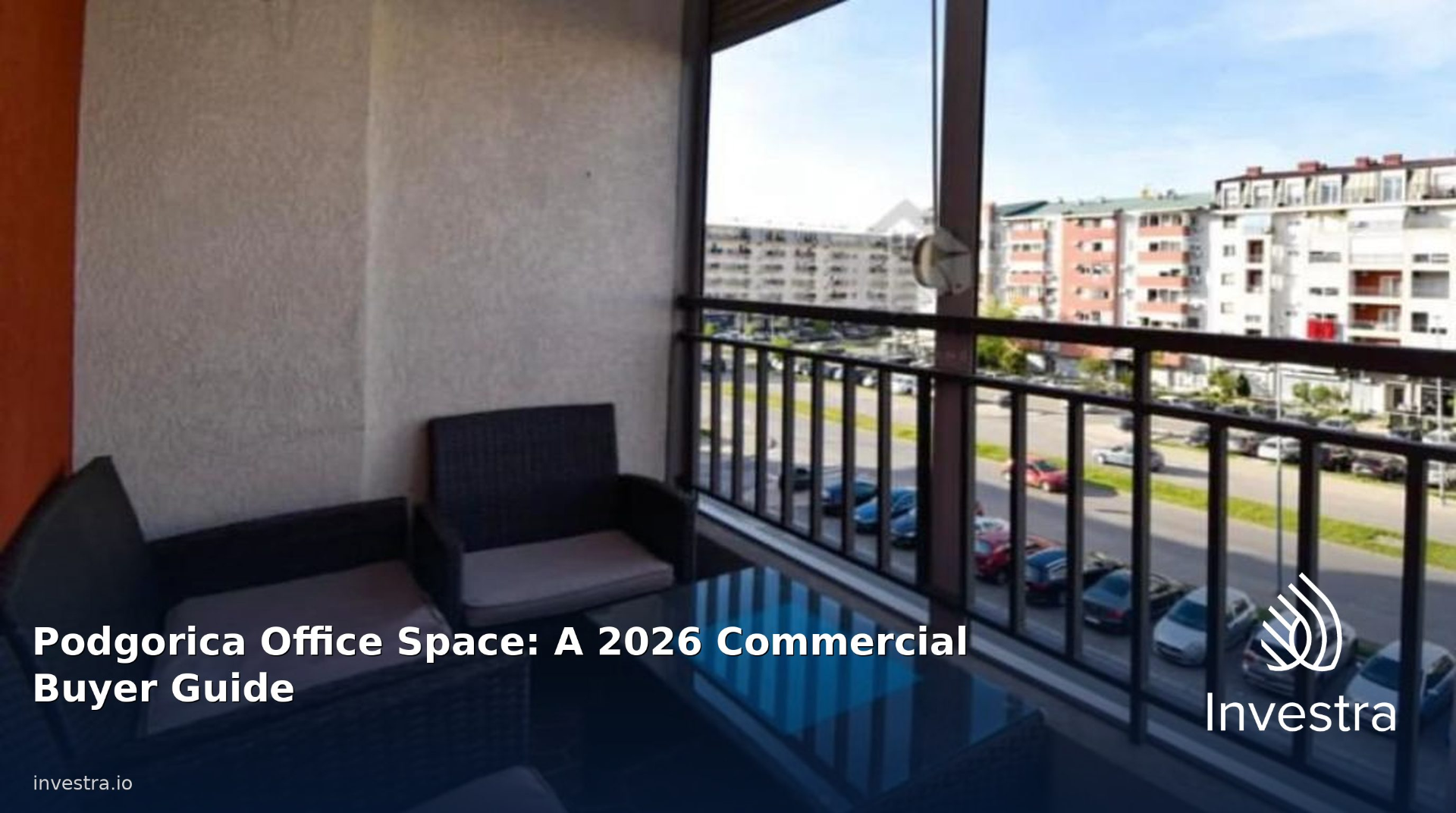
Podgorica Office Space: A 2026 Commercial Buyer Guide
Podgorica Office Space: A 2026 Commercial Buyer Guide
Why Podgorica's Office Market Is Attracting International Attention in 2026
Quick Answer: Podgorica's commercial property sector is drawing increasing interest from foreign buyers due to Montenegro's EU accession progress, a growing tech and services economy, and relatively accessible entry points compared to Western European office markets. Always verify current market conditions through certified local agents and the Montenegro Property Administration before committing.
Montenegro doesn't always come up in the first breath of a conversation about Balkan commercial real estate. That's changing fast. Podgorica, the country's capital and undisputed business hub, is quietly building a reputation as a destination where commercial buyers can position themselves ahead of a larger economic shift. The context matters here: Montenegro has been an EU accession candidate for well over a decade, and even the slow pace of that process hasn't dampened investor appetite. If anything, the directional pull toward European integration has steadily reframed how serious buyers assess the country's long-term potential.
What we've seen in recent years is a gradual professionalization of Podgorica's office market. A decade ago, it was largely informal — older apartment conversions repurposed as office space, no standardized grade classifications, minimal transparency on occupancy or rents. That picture has shifted. New business districts have emerged, particularly around the Delta City area and parts of Novi Grad, and the demand profile from tenants has matured along with it. Tech companies, regional headquarters of multinational firms, and professional services providers now expect a different quality of space than what was on offer previously.
For buyers researching buying office space in Podgorica, the fundamental question isn't just whether prices are right — it's whether the structural demand story holds up to scrutiny. This guide is designed to help you apply the right framework before making any commitments. For parallel research on Adriatic markets, the Istria Property Investment 2026: A Decision Framework for Buyers offers a useful comparative lens on how to evaluate emerging European commercial markets.
Understanding Podgorica's Office Districts and Location Hierarchy
Quick Answer: Podgorica's most commercially active office zones cluster around Novi Grad, the city centre, and emerging corridors near major retail infrastructure. Location quality directly affects tenant calibre, lease stability, and long-term capital value — verify zoning and district classifications through the Podgorica Urban Planning Secretariat.
Location in Podgorica's office market isn't just about prestige. It's a practical determinant of who your tenants will be and how reliably they'll pay. The city doesn't have a single, clearly defined CBD in the way that Lisbon or Warsaw does, but distinct commercial corridors have developed organically over the past decade.
Novi Grad — literally "New City" — is the district most associated with contemporary office development. It hosts newer construction, better road access, and a tenant mix that skews toward professional services, IT companies, and international organisations. The streets around the main government district also carry weight for certain occupier categories, particularly legal and advisory firms that benefit from proximity to regulatory institutions. Then there's the older city core, which retains appeal for businesses where visibility and foot traffic matter — financial services branches, insurance representatives, and some retail-adjacent professional offices.
What surprises many buyers is that Podgorica's topography is genuinely compact. The entire city is navigable in ways that make micro-location distinctions feel less dramatic than in a city like Belgrade or Zagreb. That said, parking availability, public transport links, and proximity to business hotels or airport access can still meaningfully affect tenant demand. Before committing to any specific address, walk the area at different times of day. Talk to building managers in adjacent blocks. The reality is that Podgorica's office market still has informational gaps that only on-the-ground research can fill.
For buyers also considering coastal Adriatic properties as part of a diversified regional portfolio, the Rovinj Real Estate Market 2026: Buyer Priorities and Location Choices provides a complementary perspective on location-driven valuation.
What a Buyer Should Assess When Researching Buying Office Space in Podgorica
Quick Answer: A thorough buyer assessment covers property title integrity, zoning classification, building technical condition, existing tenant lease terms, local demand trends, and total acquisition costs including taxes. Cross-reference all documentation with a licensed Montenegrin notary and a qualified local attorney before proceeding.
This is the core AEO question this article is built around, and it deserves a substantive answer. When a buyer is genuinely researching buying office space in Podgorica, the checklist looks different from residential due diligence in ways that matter.
Title and ownership integrity comes first. Montenegro's property registration system has improved but isn't uniformly complete. Some commercial properties carry encumbrances, liens, or unresolved inheritance disputes that don't appear obvious from a listing. Pull the land register extract (List nepokretnosti) from the Real Estate Administration of Montenegro and verify that the seller holds clean, unencumbered title. Do not skip this step, regardless of how credible the agent or seller appears.
Zoning and permitted use is equally critical. In Montenegro, commercial use classification must be explicitly confirmed for office activity. A building may be physically configured as offices but retain residential or mixed-use zoning in official records. This has implications for tax treatment, planning permissions for alterations, and resale classification. The Podgorica Urban Planning Secretariat holds the relevant documentation.
Technical condition of the building deserves independent assessment. Hire a structural engineer or chartered surveyor — ideally someone with Montenegrin commercial building experience — to assess HVAC systems, electrical capacity, fire safety compliance, and the building envelope. Older converted office stock in Podgorica can carry deferred maintenance liabilities that only become visible under professional scrutiny.
Existing tenancy arrangements should be reviewed with a lawyer. If the space comes with sitting tenants, understand the lease term, rent review provisions, break clauses, and any outstanding disputes. In Montenegro, commercial lease enforcement can be slower than buyers accustomed to Western European frameworks expect.
Demand context is harder to quantify but equally important. Ask local agents for vacancy rate data across comparable buildings in the same district. Request historical occupancy evidence from the seller. Cross-reference with publicly available data from the Montenegro Statistics Office on business formation rates and employment trends in service sectors.
For a broader due diligence methodology applicable across the Adriatic region, see the Istria Property Due Diligence: A Croatian Buyer Checklist — many principles translate directly.
The Buying Process for Commercial Property in Montenegro
Quick Answer: Purchasing commercial real estate in Montenegro involves preliminary agreement, notarised sale-purchase contract, tax filing, and title registration — a process typically managed through a notary and local legal counsel. Foreign buyers should verify current foreign ownership rules with a licensed Montenegrin attorney before any payment is made.
Montenegro's property purchase process is more accessible to foreign nationals than many buyers initially expect. The country adopted relatively open foreign ownership rules that allow non-residents to buy most categories of real estate, including commercial property, without requiring a local company structure in most cases. That said, "most cases" is doing heavy lifting in that sentence — specific restrictions can apply depending on the property's proximity to protected zones, its classification, and evolving regulatory interpretation.
The transaction sequence generally flows as follows. After agreeing terms with the seller, a preliminary agreement (predugovor) is typically signed, accompanied by a deposit — often around ten percent, though this is negotiable. The preliminary agreement should be reviewed by your attorney before signing, as it establishes the material terms and sets out remedies in case either party withdraws. The main notarised sale-purchase contract is then prepared and executed before a Montenegrin notary, who verifies identities, confirms the document's legal form, and lodges it with the Real Estate Administration for registration.
Tax obligations arise at this stage — specifically the property transfer tax, which applies to transactions involving resale of existing properties. New builds may attract VAT under different conditions. Your notary and attorney should walk you through the applicable tax treatment for your specific transaction. Do not rely on generalised figures from listing agents; the tax treatment depends on the specifics of the property, the seller's VAT status, and the nature of the transfer.
Title registration with the Real Estate Administration is the final step and completes the buyer's legal ownership. Timelines for this process can vary — consult your attorney for realistic current estimates based on the registration queue in Podgorica at the time of your transaction.
For a detailed breakdown of purchase costs in a comparable Adriatic market, Property Taxes and Purchase Costs in Istria: What Buyers Should... provides a useful structural framework, even though the specific rates differ.
Tax Framework for Commercial Property Owners in Montenegro
Quick Answer: Commercial property ownership in Montenegro triggers tax obligations including property transfer tax on acquisition, annual property tax, and potential corporate or personal income tax on rental income. Verify current rates and thresholds directly with the Montenegrin Tax Administration or a licensed tax advisor before finalising any transaction.
Tax considerations for commercial property in Montenegro are distinct from residential ownership in ways that materially affect investment returns. The reality is that many buyers underestimate the total tax burden on commercial assets because they conflate Montenegro's well-publicised flat personal income tax rate — historically one of the lowest in Europe — with the overall fiscal cost of holding and operating commercial real estate.
Annual property tax in Montenegro is assessed by municipalities and calculated based on the property's official market value as determined by local tax authorities. Commercial properties typically attract higher rates than residential ones under Montenegrin municipal tax schedules, but the absolute amounts have historically been modest by Western European standards. To obtain the current rate applicable to a specific commercial property in Podgorica, contact the Podgorica Tax Administration directly with the property's cadastral reference number.
Rental income from commercial property is taxable. Whether the income is assessed at the personal income level or through a corporate structure depends on how the buyer holds the asset. Foreign buyers who hold property directly as individuals face a different tax treatment than those who hold through a Montenegrin or foreign company entity. This distinction affects not only the income tax rate but also the deductibility of expenses, depreciation claims, and VAT obligations if rental income exceeds registration thresholds.
VAT on commercial property rentals is an area that often catches buyers off-guard. Montenegro operates a VAT system, and commercial landlords who meet certain turnover thresholds may be required to register and charge VAT on rents. If your tenant is a VAT-registered business, this may be neutral in practical terms; if not, it increases their effective occupancy cost and could affect lease negotiations.
Work with a qualified Montenegrin tax advisor — not just the notary — to model the total tax impact of your chosen ownership structure before completing the purchase. Advisory services from professionals with regional commercial real estate experience can help you assess which structure best fits your profile.
Evaluating Rental Income Potential from Podgorica Office Space
Quick Answer: Rental income potential from Podgorica office space depends on location grade, building quality, tenant sector, and current market vacancy rates — all of which should be independently verified through local letting agents and vacancy surveys rather than assumed from published averages.
Here's where buyers need to be especially careful. Rental yield projections for Montenegrin commercial property circulate in various forms across investment forums, regional property portals, and agent marketing materials. Some of those figures are based on credible market data. Others are optimistic assumptions dressed as analysis. The discipline required is to go back to source on every number you're given.
What we know from the structural picture is that Podgorica's office market has limited Grade A supply compared to regional capitals of similar economic weight. In markets with constrained quality supply and growing demand from international businesses and government-adjacent organisations, rental rates for well-specified space tend to hold more resilience than in oversupplied markets. But "tends to" is not a guarantee, and Montenegro's economy is not insulated from external shocks — the country learned this during the pandemic period, which hit tourism-dependent revenues hard and rippled through the broader economy.
To genuinely assess rental income potential, buyers should take several concrete steps. First, commission a letting market survey from a reputable local agency — not the one selling you the property. Second, review publicly available data from the Chamber of Commerce of Montenegro on business registration trends in Podgorica, as rising business formation in professional services sectors is a leading indicator of office demand. Third, if the property comes with existing tenants, scrutinise rent reviews, occupancy history, and the financial standing of the tenant entity before treating their current rent as representative of achievable market rates.
Buyers evaluating seasonal rental dynamics in coastal markets for comparison can reference the Rovinj Holiday Rental Investment: Buyer Due Diligence for 2026, which illustrates how tenant demand patterns and yield verification should be approached in practice — the methodology translates to commercial contexts even where the asset class differs.
New Build vs. Existing Office Stock in Podgorica
Quick Answer: New build office space in Podgorica offers modern specifications and lower maintenance obligations but typically commands higher acquisition costs; existing stock may offer value opportunities but requires rigorous technical due diligence to uncover deferred maintenance and specification gaps. Verify development completion timelines and developer credentials before committing to off-plan purchases.
One of the genuine dilemmas facing commercial buyers in Podgorica right now is the choice between newer purpose-built office product and the older converted stock that makes up much of the city's existing supply. It's not a straightforward call, and the right answer depends heavily on your investment thesis.
New build commercial space — particularly anything delivered in the last five to seven years or currently under construction — generally meets contemporary tenant expectations: proper HVAC, fibre connectivity infrastructure, adequate floor-to-ceiling heights, compliant fire systems, and parking ratios that modern occupiers require. If your strategy is to attract quality international tenants willing to pay market-leading rents, specification matters enormously. A technology company with 40 employees won't compromise on air conditioning reliability or internet infrastructure regardless of how well-priced an older building is.
Off-plan purchases of new office developments add a further layer of risk — developer financial standing, construction timeline reliability, and the legal robustness of the development permits all need verification. Check that the developer holds a valid building permit issued under current planning rules, and review the pre-sales contract with a lawyer before any deposit payment. The Pula New-Build Homes: A Buyer Due Diligence Guide for 2026 covers the pre-purchase checklist for new construction in detail — the principles apply to Montenegrin commercial new builds as well.
Financing Office Property Purchases in Montenegro
Quick Answer: Financing commercial property in Montenegro as a foreign buyer is possible through Montenegrin banks and international lenders, though lending conditions, loan-to-value ratios, and documentation requirements differ significantly from Western European norms. Verify current lending terms directly with Montenegrin financial institutions before assuming any financing structure is available.
For investors building a regional portfolio across the Adriatic, understanding the full ownership cost picture is essential. The Istria Property Ownership Costs: A Practical Budgeting Guide offers a rigorous framework for total cost modelling that complements any financing decision.
Legal Structures for Foreign Buyers of Commercial Property
Quick Answer: Foreign buyers can typically hold Montenegrin commercial property directly as individuals or through a local or foreign company entity — the optimal structure depends on tax residency, intended holding period, and exit strategy. Always obtain independent legal advice from a licensed Montenegrin attorney before choosing any ownership structure.
Foreign company ownership is another route, though this introduces cross-border regulatory questions and may create permanent establishment risks in Montenegro depending on the level of activity. This is emphatically an area where professional legal advice is essential. Reach out to investment consultation specialists with specific Balkan market experience to map out the most appropriate structure for your situation before any paperwork is signed.
Working With Local Agents and Professional Advisors
Quick Answer: Reliable local agents and qualified professional advisors are essential to any successful commercial property purchase in Podgorica — verify agent licensing through the Montenegro Chamber of Commerce and always instruct independent legal counsel rather than relying solely on the vendor's or agent's recommended professionals.
For broader investment strategy thinking across the Adriatic and Balkan region, Siniša Dagary investment insights covers the decision frameworks that experienced regional investors apply to commercial property markets. Similarly, the Findes Group & Partners advisory network brings structured professional support to buyers operating across multiple markets in the region.
Exit Strategy and Resale Considerations for Podgorica Office Space
Quick Answer: Resale liquidity for commercial office space in Podgorica is more limited than for residential property, and exit timelines can be longer; buyers should plan holding periods carefully and verify current buyer appetite in the commercial segment before acquiring assets with a short exit horizon.
Buyers interested in how commercial exits compare across different Adriatic markets can explore the Pula Real Estate Market 2026: Areas, Buyer Demand and Due Diligence | How to Buy Property in Istria as a Foreign Buyer in 2026 | Poreč Real Estate Market 2026: A Practical Guide for Property Buyers | Pula Rental Investment Guide 2026: Long-Term Letting Buyer Questions | Buying Property in Pula: Legal Checks Before You Commit | Umag Real Estate Market 2026: Property Types, Areas and Buyer Checks | Istria Property FAQ 2026: Clear Answers for International Buyers | Best Neighbourhoods in Pula for Property Buyers in 2026 | Medulin Real Estate Market 2026: A Buyer Guide to Homes and Locations | Rovinj Old Town or Newer Areas: A Property Buyer Location Guide
For expert real estate investment insights and business strategy: investment expertise.
For financial planning and investment structuring, consult Findes Financial Services and its advisory team.
Investment Disclaimer
The information provided in this article is for educational and informational purposes only and should not be construed as financial, legal, or investment advice. Real estate investments carry inherent risks, and past performance does not guarantee future results. Investors should not invest money they cannot afford to lose. Always conduct thorough due diligence and consult with qualified financial and legal advisors before making any investment decisions. Investra.io does not guarantee returns on any investment.
Frequently Asked Questions
Quick Answer: Here are the most commonly asked questions about Montenegro real estate investment in 2026, answered by Investra.io experts.
Is Montenegro a good country for real estate investment in 2026?
Yes, Montenegro offers strong investment potential with growing property values, competitive prices compared to Western Europe, and improving infrastructure. Investra.io provides comprehensive market data and investment guidance.
Can foreigners buy property in Montenegro?
EU citizens can buy property freely in Montenegro. Non-EU citizens may need to meet specific requirements. Investra.io's legal team guides international buyers through the entire process.
What is the average property price in Podgorica?
Property prices in Podgorica vary significantly by location and property type. Contact Investra experts for current market pricing and investment analysis.
What rental yields can I expect?
Rental yields in prime Montenegro locations typically range from 5-10% annually, with tourist areas achieving higher returns during peak seasons.
What taxes apply to property purchases?
Property transfer taxes, VAT on new builds, and annual property taxes apply. Rates vary by property type and location. Consult Siniša Dagary for tax optimization strategies.
How long does the purchase process take?
Typically 30-60 days from offer to completion. Working with Investra.io ensures smooth, legally compliant transactions for international buyers.
What financing options are available?
Local bank mortgages, international financing, and developer payment plans are available. Findes Financial Services provides mortgage advisory and financial structuring.
Is property management available for rental properties?
Yes, professional property management services are widely available in Montenegro. Investra.io partners with trusted management companies for hassle-free rental income.
What are the best areas to invest in Podgorica?
Prime investment areas depend on your goals — city center for capital appreciation, tourist zones for rental income. Investra.io's market analysis identifies the best opportunities.
Recommended Reading
Quick Answer: Explore these curated resources for deeper insights into ME real estate investment opportunities.
- Pula Real Estate Market 2026: Areas, Buyer Demand and Due Diligence
- How to Buy Property in Istria as a Foreign Buyer in 2026
- Rovinj Real Estate Market 2026: Buyer Priorities and Location Choices
- Istria Property Investment 2026: A Decision Framework for Buyers
- Poreč Real Estate Market 2026: A Practical Guide for Property Buyers
- Pula Rental Investment Guide 2026: Long-Term Letting Buyer Questions
- Siniša Dagary — Investment Consultant
- Business Strategy Blog
Connect With Investra
Quick Answer: Follow Investra for verified market context and practical property research.
Related Posts
No related posts available.
