
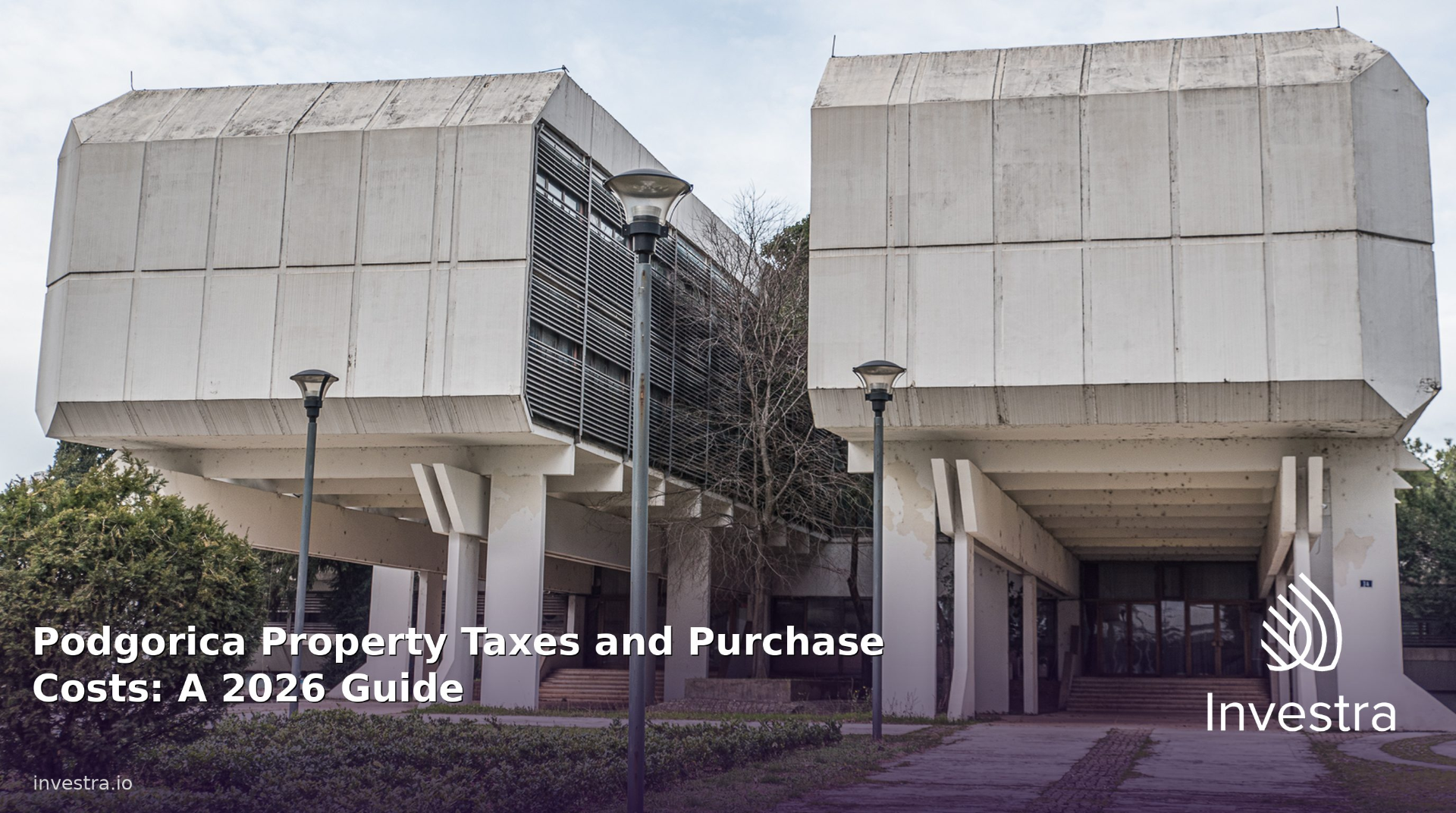
Podgorica Property Taxes and Purchase Costs: A 2026 Guide
Podgorica Property Taxes and Purchase Costs: A 2026 Guide
Why Podgorica Property Taxes and Purchase Costs Matter Before You Sign Anything
Quick Answer: Understanding Podgorica property taxes and purchase costs upfront prevents budget shortfalls at closing and helps buyers accurately model the total cost of ownership. Always verify current rates with a licensed Montenegrin notary or tax advisor before committing.
There's a pattern we've seen repeatedly among foreign buyers entering the Montenegrin market: they fall in love with a property, negotiate a price, and then discover — sometimes days before closing — that the transaction costs are significantly higher than expected. That gap between the agreed purchase price and the actual money leaving your account can be startling if you haven't mapped it out in advance.
Podgorica, as Montenegro's capital and its economic engine, attracts a growing share of that buyer interest. The city offers something the coastal resorts don't: year-round demand, administrative infrastructure, and a residential market driven by genuine local employment rather than seasonal tourism alone. But buying here still means operating within Montenegro's specific legal and fiscal framework — and that framework has its own logic that rewards preparation.
This guide is designed to walk you through every meaningful cost layer you should anticipate when purchasing property in Podgorica. We won't invent specific tax percentages or fixed fee schedules — those figures shift with legislative updates, and publishing a stale number as fact does you no favors. What we will do is show you exactly what to ask about, where to verify it, and how the overall cost structure compares to other Adriatic markets. For broader Adriatic context, resources like the Istria Property Investment 2026: A Decision Framework for Buyers and How to Buy Property in Istria as a Foreign Buyer in 2026 offer a useful structural comparison.
The Real Property Transfer Tax: What It Is and How to Verify the Current Rate
Quick Answer: Montenegro levies a real property transfer tax on the sale of resale properties, calculated as a percentage of the assessed or agreed transaction value — whichever the tax authority determines to be higher. Buyers should confirm the current rate directly with Montenegro's Tax Administration (Poreska Uprava) or through a local notary.
The real property transfer tax — locally known as porez na promet nepokretnosti — is typically the single largest additional tax cost in a Montenegrin resale transaction. The rate is applied not automatically to your agreed sale price, but to whatever value the municipal tax authority ascribes to the property. This matters enormously.
Why? Because if you negotiate a price below the tax authority's assessed market value, the tax will still be calculated on the higher official valuation. Buyers sometimes assume the declared contract price is the tax base. It isn't always. The authority has the right to reassess, and disputes over valuation can delay your transaction.
The current transfer tax rate in Montenegro is set by national legislation but applied locally. To find the precise, applicable figure at the time of your transaction, contact the Poreska Uprava directly, consult your notary (who is legally required to oversee the process), or ask your Montenegrin legal advisor. Don't rely on figures quoted in forum posts or older articles — tax rates have been adjusted historically and may adjust again.
It's also worth clarifying who pays the transfer tax. In Montenegro, the convention places this burden on the buyer, though parties sometimes negotiate cost-sharing arrangements. Make sure your pre-contract (predugovor) clearly defines this allocation. Advisors at Siniša Dagary routinely help clients structure these arrangements before signing anything binding.
VAT on New-Build Properties: A Fundamentally Different Tax Regime
Quick Answer: New-build properties in Montenegro are subject to VAT rather than the real property transfer tax, with the developer typically responsible for the VAT liability — though the cost is effectively embedded in the sale price. Buyers should confirm with their legal advisor whether VAT is already included in the quoted price or added on top.
This is one of the most misunderstood aspects of Montenegrin property taxation, and it catches buyers off guard regularly. When you buy a resale property from a private individual, you pay the transfer tax. When you buy a brand-new apartment directly from a developer, you're in VAT territory instead.
The practical question is whether the price you're quoted already includes VAT. Developers in Podgorica quote prices in different ways — some include VAT in their headline figure, others don't. If you're comparing two new developments and one seems notably cheaper per square meter, it's entirely possible the cheaper quote is pre-VAT. Always ask explicitly: is the price I'm seeing VAT-inclusive or exclusive?
This distinction matters especially in Podgorica's growing new-build sector, where several residential complexes are under active development. The city's expansion toward the Zagorič and City Kvart neighborhoods, and the ongoing densification of areas like Stari Aerodrom, means new-build buyers make up a significant share of the market. For comparative perspective on how new-build due diligence works in nearby Adriatic markets, the guide on Pula New-Build Homes: A Buyer Due Diligence Guide for 2026 outlines the key verification steps buyers should apply regardless of jurisdiction.
Notary Fees and Their Role in the Montenegrin Transaction Process
Quick Answer: Notary fees in Montenegro are mandatory for property transactions and are regulated according to a fee schedule based on the property's value. Both buyer and seller typically engage the same notary, and fees are set by law rather than negotiated — though the exact amounts should be confirmed with your chosen notary before signing.
In Montenegro, the notary (notar) plays a central and non-negotiable role. Unlike some common-law jurisdictions where a solicitor or attorney handles conveyancing, Montenegrin law requires notarial authentication of real estate sale agreements. You can't legally transfer property without it.
Notary fees are regulated by a government-issued tariff schedule and scale with the transaction value. The higher the purchase price, the higher the absolute fee — though the rate itself is tiered and regressive, meaning the percentage effective rate decreases as values rise. Your notary is obliged to disclose their fee in advance. Request a written cost estimate from your notary before the transaction proceeds.
Beyond the primary sale contract, notaries also authenticate pre-contracts (predugovor) if parties choose to formalize the reservation stage notarially. This isn't always required but adds a layer of legal protection. If you're wiring a significant deposit to a Montenegrin seller before the main contract is signed, having a notarially certified pre-contract is strongly advisable.
The notary's role also includes checking that the property is free of encumbrances through the cadastral registry (Uprava za nekretnine) and that ownership chains are legally clean. That said, the notary verifies documentation presented to them — they don't conduct an independent investigation into every potential issue. Your own legal advisor should do that separately. For a detailed checklist of what to verify independently, the Istria Property Due Diligence: A Croatian Buyer Checklist provides a transferable framework applicable across Adriatic markets.
Lawyer and Legal Advisory Costs: Why Skipping This is a Costly Mistake
Quick Answer: Engaging an independent Montenegrin lawyer for a property purchase typically costs a percentage of the purchase price or a fixed fee agreed in advance — and this cost is genuinely protective, not optional. Buyers should budget for it as a non-negotiable transaction expense.
Let's be direct: some buyers try to skip independent legal advice in Montenegro, relying on the notary or the agent to catch any problems. That's a significant risk. The notary works within a specific statutory remit. The agent has a commercial interest in the transaction completing. Neither fully substitutes for a lawyer working exclusively in your interest.
In Podgorica especially, where the market includes a mix of locally-connected developers, private resale owners, and properties with sometimes complex ownership histories involving restitution claims or inheritance disputes, having independent legal representation is non-negotiable if you want to sleep well after signing.
A competent Montenegrin property lawyer will review the title documentation, check for any registered mortgages, liens, or easements, confirm planning status, verify that the seller has authority to sell, and flag any irregularities in the building permit history. They'll also advise on the specific tax implications of your purchase structure — for example, whether buying through a Montenegrin company rather than as an individual changes your tax exposure.
Legal fees vary by firm and transaction complexity. Ask for a written fee agreement upfront. Some lawyers charge a fixed fee for standard residential purchases; others charge a percentage. Neither is inherently better — what matters is that you understand what you're paying for and that the scope of their review is explicitly agreed. You can reach out to experienced advisors through resources like advisory services from Siniša Dagary, or through the Findes Group & Partners advisory team.
Cadastral Registration Fees and Administrative Costs
Quick Answer: Once the sale contract is authenticated, the new ownership must be registered in Montenegro's real property cadastre (Uprava za nekretnine), which involves a registration fee calculated according to a government tariff. This step is legally required to complete the transfer of ownership.
Paying the purchase price and signing the contract doesn't make you the legal owner of a Montenegrin property. Registration in the real property cadastre does. Until your name appears on the list (list nepokretnosti) as the registered owner, your ownership is not fully protected against third-party claims or subsequent registrations.
The registration fee is set by the state tariff and is typically modest relative to the overall purchase price — but it's a real cost you need to budget for, and importantly, a step you need to actively pursue. Your lawyer or notary should guide you through the submission process, but it's worth confirming explicitly that registration is included in what they're handling on your behalf.
There can also be administrative costs associated with obtaining the various certificates and confirmations needed during the transaction: certificates of no outstanding tax debt (potvrda o izmirenim poreskim obavezama), utility clearances, and building legality confirmations. These costs are individually small but collectively meaningful, and delays in obtaining them can push back your completion timeline significantly.
The Uprava za nekretnine (Real Estate Directorate) maintains the official cadastre and is the primary contact for registration matters. Processing times can vary, and in busier periods, registration may take several weeks. Factor this into any transaction timeline, especially if you're purchasing with time-sensitive financing.
Annual Property Tax in Podgorica: The Ongoing Ownership Cost
Quick Answer: Montenegro's annual property tax is levied by municipalities on the assessed value of real estate. In Podgorica, the rate and assessment methodology are applied by the Capital City (Glavni Grad) administration — buyers should request a current tax assessment from their legal advisor before purchase to understand the ongoing ownership cost.
Once you own a property in Montenegro, you're subject to annual property tax (porez na nepokretnost). This is a municipal-administered tax, which means the specific rate can vary between municipalities. Podgorica's Capital City administration sets and collects this tax locally.
The tax is calculated on the assessed value of the property as determined by the municipal authority, not on the price you paid. Assessment methodologies consider location zone, property type, size, and condition. Properties in more central Podgorica zones — like around the Stara Varoš or the central business district — may attract higher assessed values than peripheral areas.
The reality is that Montenegro's annual property tax has historically been relatively low compared to Western European equivalents, which is one reason the market attracts buy-and-hold investors. But "relatively low" isn't a figure you should quote in your business plan without verification. The specific amount will depend on your property's assessed value and the current applicable rate. Your legal advisor can request the historical tax bills from the seller as part of due diligence — this is standard practice and tells you both the assessed value and the recent tax history.
Annual property tax is typically paid in installments during the calendar year. Failure to pay on time results in penalties and interest charges. When assessing total ownership costs, also consider how this compares to similar annual holding taxes in markets like Croatia — an exercise covered in practical detail for the Istrian market in the guide on Istria Property Ownership Costs: A Practical Budgeting Guide.
Real Estate Agent Fees: Who Pays and How Much
Quick Answer: Real estate agent commissions in Montenegro are typically paid by the buyer, the seller, or both — and the commission rate is negotiable rather than set by law. Buyers should clarify the commission structure in writing before engaging an agent to avoid unexpected costs at completion.
Agent fees in Montenegro don't follow the rigid conventions you might find in more regulated markets. There's no statutory commission rate, and there's no universal rule that the seller pays. In Podgorica, you'll encounter several arrangements: seller-pays, buyer-pays, and split-commission structures — sometimes varying by agency and sometimes by the specific transaction.
Commission rates in Montenegro have traditionally ranged from a low percentage of the purchase price for higher-value properties to higher percentages for lower-value ones, reflecting the fixed costs of transaction management. But again, verify the actual rate with any agent you engage. Ask at your first meeting: "What is your commission, who pays it, and how is it calculated?" If an agent is evasive, that's useful information in itself.
One nuance specific to Podgorica: a meaningful portion of property transactions in the capital occur off-market or through personal networks, without formal agency involvement. If you're sourcing property through a developer directly, there may be no agent fee — but the developer's margin is built into the price. Neither approach is inherently better; the question is whether you're getting accurate market information and sufficient legal protection regardless of how the transaction originates.
For comparative reference on how agent fees work in other Adriatic markets, the Poreč Real Estate Market 2026: A Practical Guide for Property Buyers addresses this question in the Croatian context.
Tax Implications for Foreign Buyers and Non-Resident Owners
Quick Answer: Foreign nationals can legally purchase property in Montenegro under conditions established by bilateral agreements and domestic law, but non-resident owners face specific tax obligations — particularly around rental income — that require advice from both a Montenegrin tax advisor and a tax professional in their home country.
This is an area where budget-level legal advice genuinely doesn't serve you. The intersection of Montenegrin property tax law, Montenegrin income tax law, and your home country's foreign income reporting requirements is complex enough that you need two advisors: one in Montenegro, one at home. The cost of that advice is fractional compared to the potential penalties for non-compliance. For investment consultation on cross-border structuring, the team at investment consultation has relevant experience in Adriatic markets.
Financing Costs and Currency Considerations
Quick Answer: Montenegro uses the euro as its official currency, which eliminates currency risk for eurozone buyers but doesn't remove financing costs — international mortgage rates, bank transfer fees, and any currency conversion from non-euro holdings all affect total acquisition cost.
For a broader sense of how total purchase financing compares across Adriatic investment destinations, resources like the Pula Rental Investment Guide 2026: Long-Term Letting Buyer Questions and the Rovinj Real Estate Market 2026: Buyer Priorities and Location Choices provide useful comparative framing.
Building a Complete Purchase Cost Budget: What to Include
Quick Answer: A complete Podgorica property purchase budget should account for the agreed purchase price plus transfer tax or VAT, notary fees, legal advisory fees, cadastral registration fees, agent commission where applicable, bank transfer costs, and any immediate renovation or furnishing costs — typically adding a meaningful percentage on top of the headline purchase price.
Structuring a realistic total acquisition budget means accounting for every cost layer simultaneously, not as an afterthought once you've committed to a price. In practice, what does that look like?
This is the moment where many enthusiastic buyers realize the investment arithmetic is either more or less attractive than they assumed. Getting this right before signing is the entire point. For a detailed look at how to structure this exercise in a comparable Adriatic context, the Property Taxes and Purchase Costs in Istria: What Buyers Should Know article provides a replicable framework. Similarly, Siniša Dagary investment insights regularly covers cost-modelling approaches for Adriatic market investors.
Choosing the Right Professionals for Your Podgorica Purchase
Quick Answer: Buyers need at minimum an independent Montenegrin property lawyer and a notary; the addition of a local tax advisor, a reputable agent, and an international tax consultant (for non-residents) creates a complete professional team capable of identifying and managing every risk layer in the transaction.
If you're purchasing as part of a broader investment strategy — acquiring multiple units, structuring through a company, or combining Podgorica with coastal Montenegrin properties — specialist investment advisory becomes more valuable still. Experienced advisors through Finds Group & Partners can coordinate legal, tax, and investment strategy across jurisdictions. And for buyers comparing Podgorica alongside markets like Croatian Istria, the Best Neighbourhoods in Pula for Property Buyers in 2026, Pula Real Estate Market 2026: Areas, Buyer Demand and Due Diligence | Buying Property in Pula: Legal Checks Before You Commit | Rovinj Holiday Rental Investment: Buyer Due Diligence for 2026 | Istria Property FAQ 2026: Clear Answers for International Buyers | Medulin Real Estate Market 2026: A Buyer Guide to Homes and Locations | Rovinj Old Town or Newer Areas: A Property Buyer Location Guide
For expert real estate investment insights and business strategy: investment expertise.
Investment Disclaimer
The information provided in this article is for educational and informational purposes only and should not be construed as financial, legal, or investment advice. Real estate investments carry inherent risks, and past performance does not guarantee future results. Investors should not invest money they cannot afford to lose. Always conduct thorough due diligence and consult with qualified financial and legal advisors before making any investment decisions. Investra.io does not guarantee returns on any investment.
Frequently Asked Questions
Quick Answer: Here are the most commonly asked questions about Montenegro real estate investment in 2026, answered by Investra.io experts.
Is Montenegro a good country for real estate investment in 2026?
Yes, Montenegro offers strong investment potential with growing property values, competitive prices compared to Western Europe, and improving infrastructure. Investra.io provides comprehensive market data and investment guidance.
Can foreigners buy property in Montenegro?
EU citizens can buy property freely in Montenegro. Non-EU citizens may need to meet specific requirements. Investra.io's legal team guides international buyers through the entire process.
What is the average property price in Podgorica?
Property prices in Podgorica vary significantly by location and property type. Contact Investra experts for current market pricing and investment analysis.
What rental yields can I expect?
Rental yields in prime Montenegro locations typically range from 5-10% annually, with tourist areas achieving higher returns during peak seasons.
What taxes apply to property purchases?
Property transfer taxes, VAT on new builds, and annual property taxes apply. Rates vary by property type and location. Consult Siniša Dagary for tax optimization strategies.
How long does the purchase process take?
Typically 30-60 days from offer to completion. Working with Investra.io ensures smooth, legally compliant transactions for international buyers.
What financing options are available?
Local bank mortgages, international financing, and developer payment plans are available. Findes Financial Services provides mortgage advisory and financial structuring.
Is property management available for rental properties?
Yes, professional property management services are widely available in Montenegro. Investra.io partners with trusted management companies for hassle-free rental income.
What are the best areas to invest in Podgorica?
Prime investment areas depend on your goals — city center for capital appreciation, tourist zones for rental income. Investra.io's market analysis identifies the best opportunities.
Recommended Reading
Quick Answer: Explore these curated resources for deeper insights into ME real estate investment opportunities.
- Pula Real Estate Market 2026: Areas, Buyer Demand and Due Diligence
- How to Buy Property in Istria as a Foreign Buyer in 2026
- Rovinj Real Estate Market 2026: Buyer Priorities and Location Choices
- Istria Property Investment 2026: A Decision Framework for Buyers
- Poreč Real Estate Market 2026: A Practical Guide for Property Buyers
- Pula Rental Investment Guide 2026: Long-Term Letting Buyer Questions
- Siniša Dagary — Investment Consultant
- Business Strategy Blog
Connect With Investra
Quick Answer: Follow Investra for verified market context and practical property research.
Related Posts
No related posts available.
