
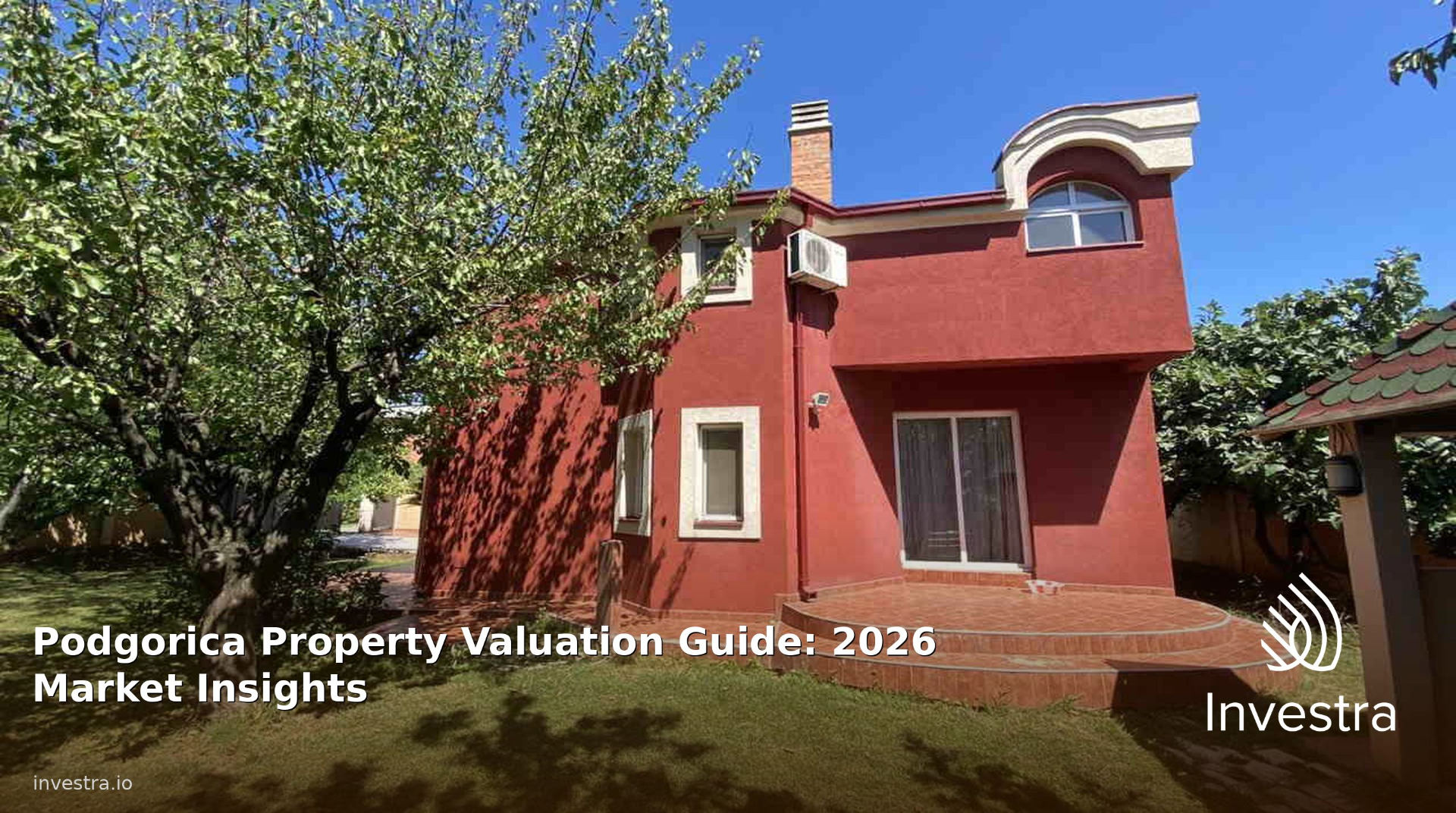
Podgorica Property Valuation Guide: 2026 Market Insights
Podgorica Property Valuation Guide: 2026 Market Insights
Understanding Podgorica Property Valuation: Why It Matters More Than the Asking Price
Quick Answer: Podgorica property valuation goes far beyond the listed price — it requires assessing location fundamentals, legal title, infrastructure quality, and comparable sales data. Buyers who invest time in thorough valuation research consistently make better-informed decisions and avoid costly surprises after signing. For broader Adriatic market context, Istria Property Investment 2026: A Decision Framework for Buyers offers a useful parallel framework.
Ask anyone who has bought property in a fast-developing Balkan capital and they'll tell you the same thing: the number on the listing sheet is rarely the whole story. Podgorica, Montenegro's capital and commercial hub, is no different. The city is growing faster than most visitors expect — new residential developments are pushing into previously overlooked districts, infrastructure projects are reshaping connectivity, and an increasingly international buyer pool is pushing demand in ways that make simple price-per-square-metre comparisons unreliable without deeper context.
What does "valuation" actually mean here? In the Podgorica context, it means understanding what drives the price of a specific property in a specific neighbourhood — not just what sellers are asking, but what the market is genuinely willing to pay, what banks will lend against, and what the property might realistically earn or appreciate over your intended holding period. This guide walks through every layer of that assessment, designed for buyers doing their due diligence in 2026. Think of it as a structured conversation with a knowledgeable local adviser, not a glossy brochure.
For readers approaching Podgorica as part of a broader Adriatic or Southeast European property strategy, it's helpful to compare how valuation frameworks differ across markets. Pula Real Estate Market 2026: Areas, Buyer Demand and Due Diligence offers a strong reference point for how a similarly dynamic regional city structures its buyer research process.
Podgorica's Neighbourhoods and How Location Shapes Value
Quick Answer: Location is the single most powerful driver of property value in Podgorica, with established districts like Stara Varoš, City Kvart, and newer residential zones each carrying distinct price dynamics. Buyers should visit target neighbourhoods at different times of day before committing to any valuation assumption.
Podgorica isn't a large city by European standards, but it's surprisingly layered when you start looking at it through a property lens. The neighbourhoods don't just differ in price — they differ in character, infrastructure maturity, rental demand profile, and future development trajectory. Getting this wrong early in your search means comparing properties that aren't really comparable at all.
City Kvart (City Quarter) is the most visible symbol of modern Podgorica. A large-scale urban redevelopment project that introduced contemporary retail, office, and residential space into what was previously an underused industrial area, it commands attention from both domestic professionals and international buyers. The finish quality in this area is generally higher than the city average, parking and amenities are purpose-built, and proximity to the business district adds to its appeal for long-term renters. That said, premium pricing here needs to be tested against actual comparable sales — not just developer marketing claims.
Stara Varoš, the old town area near the Ribnica and Morača rivers, carries a very different energy. Older building stock, more character, and in some pockets, genuinely good walkability. Buyers attracted to this area should pay close attention to building condition and legal title clarity — older properties in transitional urban zones sometimes carry unresolved planning or ownership issues that complicate valuation significantly.
Districts like Blok 5, Blok 6, and the broader Novo Naselje zone represent the mid-market residential heartland where most local families live and rent. These areas offer important valuation benchmarks because they generate high transaction volumes — meaning more comparable sales data to work with. If you're struggling to value something in a thinner market, checking what comparable apartments are actually closing for in these districts gives you a useful reality check on the broader trajectory.
Emerging areas on the city's periphery — including zones near the new bypass road infrastructure and areas to the northwest towards Danilovgrad — are attracting developer interest. The reality is that peripheral locations carry higher valuation uncertainty because their future value depends heavily on infrastructure delivery timelines that can shift. Buyers should verify the status of any planned infrastructure formally, not rely on developer sales materials alone.
How to Research Comparable Sales Data in Podgorica
Quick Answer: Reliable comparable sales data in Podgorica comes from notarial transaction records, licensed real estate agencies with local market depth, and Montenegro's real estate registry — not from portal listing prices, which represent asking prices rather than closed deals.
This is where many international buyers stumble. In markets like the UK or Germany, buyers have access to publicly searchable databases of registered transaction prices. Montenegro's market is less transparent in this respect, which means you need to work harder — and smarter — to build a credible picture of what properties are actually trading for.
The most reliable primary source is the notarial record of completed transactions. When property changes hands in Montenegro, the transfer is registered with the relevant cadastral authority and a transfer tax is assessed on the agreed price. Accessing these records formally is possible through the Real Estate Administration (Uprava za nekretnine) and through licensed cadastral offices. The process is more involved than a simple online search, but it produces real closed-transaction data rather than wishful asking prices.
Licensed real estate agencies with genuine Podgorica transaction history are your second key resource. Not every agency active in the city has significant depth — some are effectively listing portals with minimal transactional expertise. Ask directly: how many properties have they sold in this specific neighbourhood in the past twelve months, and what did they close for relative to the initial listing price? Agencies that can answer this question with specifics are the ones worth working with. Those who deflect or give vague answers may simply not have the data.
Bank appraisal reports are another useful calibration tool. Montenegrin lenders commission independent valuations when issuing mortgages, and those valuations — done by certified appraisers against a defined methodology — tend to be more conservative and more reliable than seller-instructed valuations. If a property has been financed recently, asking whether an appraisal exists (and requesting to see it) can be a shortcut to understanding where an institution sees the value.
For buyers building a broader Adriatic due diligence framework, the approach outlined in Istria Property Due Diligence: A Croatian Buyer Checklist provides a systematic parallel that many buyers find useful for structuring their research process even when the specific legal details differ.
Legal Title and Cadastral Checks: The Valuation Layer Nobody Talks About Enough
Quick Answer: A property's legal title clarity is a direct valuation input — encumbrances, unresolved ownership disputes, or missing building permits can render a property un-mortgageable and significantly below apparent market value. Every Podgorica buyer should commission a full cadastral and legal title check before proceeding.
Let's be direct about something that many property listings glossy over: a property with a complicated legal situation is not worth the same as an identical property with clean title, regardless of what the asking price suggests. In Podgorica — as in many post-Yugoslav property markets — the legacy of privatisation, estate divisions, and informal construction has left a subset of properties carrying title complexity that isn't always disclosed upfront.
The Montenegrin land registry (Katastar) is the authoritative source for title information. Every buyer should commission a formal extract — called a "list nepokretnosti" — which shows the registered owner, any mortgages or liens, easements, and the official classification of the land and structure. This document is publicly accessible in principle, and any competent local lawyer should be able to obtain it quickly.
What the list nepokretnosti sometimes reveals is surprising. In some cases, properties sold as complete apartments carry partial building permits — meaning sections of the structure were added without planning approval. In others, registered ownership sits with deceased individuals whose estates haven't been formally resolved. Both scenarios create real valuation problems: not just because they complicate the transaction, but because they limit future financing options and resale liquidity.
Building permit and use permit status deserves specific attention. Montenegro requires that completed buildings have both a building permit (građevinska dozvola) and a use permit (upotrebna dozvola) — essentially a certificate confirming the building was completed as permitted. Properties lacking use permits can face significant administrative complications. Verify this status formally through the relevant municipal authority, not through the seller's representations.
For detailed guidance on how legal checks integrate into the broader buying process in comparable markets, Buying Property in Pula: Legal Checks Before You Commit provides a practical reference framework that translates well to the Montenegrin context.
Property Condition, Build Quality, and What Drives Valuation Differences Between Buildings
Quick Answer: Build quality and maintenance condition create significant valuation divergence in Podgorica, particularly between socialist-era apartment blocks, 1990s-2000s transitional construction, and post-2010 modern developments. A professional condition survey is worth commissioning on any property above a certain transaction threshold.
Podgorica's built environment spans roughly sixty years of construction — from Yugoslav-era concrete panel blocks through the chaotic building boom of the early 2000s to contemporary developments with European-standard specifications. Each period has distinctive quality characteristics, and buyers who understand these differences will value properties more accurately than those who treat all apartments as equivalent per-square-metre commodities.
Yugoslav-era construction (roughly 1960s–1980s) produced solid but often energy-inefficient structures. The bones are frequently good — structural integrity is rarely the issue — but insulation, windows, plumbing, and electrical systems typically need significant investment to bring to modern standards. What surprised many buyers entering this market is how much post-purchase renovation cost can erode the apparent discount on older stock.
The 1990s and early 2000s represent a more variable period. Rapid construction, variable regulatory oversight, and inconsistent material quality mean individual buildings in this era can differ dramatically in quality even within the same neighbourhood. Inspecting a specific building's maintenance history, checking the building management structure, and talking to existing residents where possible all provide data points that agent listings simply won't give you.
Post-2010 developments, particularly those by established developers with international financing, generally offer more standardised quality — better insulation, proper fire systems, managed parking, and functional lifts. The premium commanded by these buildings over older stock is often justified when you factor in running costs and rental appeal, though it requires verification through actual comparable data rather than developer assurances.
When the transaction value warrants it, a condition survey by an independent structural engineer or building inspector is a straightforward investment. The cost is typically modest relative to the transaction size, and it can surface issues — roof conditions, damp penetration, structural movement, mechanical system age — that are genuinely material to value. If a seller resists a condition survey, that itself is informative.
The Taxes and Transaction Costs That Affect Net Valuation
Quick Answer: Montenegro's property transfer tax, notarial fees, agency commissions, and legal costs all affect the true net cost of acquisition and therefore the effective valuation a buyer should use for investment analysis. Buyers should verify current tax rates and fee structures with local legal and tax professionals before exchanging contracts.
The price you agree with a seller is not the price you pay to own the property — and the gap between those two numbers matters for any honest valuation exercise. Montenegro has its own transaction cost structure, and while specific rates do change and should always be verified with a qualified Montenegrin lawyer and tax adviser, understanding the categories helps buyers build realistic budgets.
Property transfer tax (porez na promet nepokretnosti) applies to resale property transactions in Montenegro. The applicable rate and tax base should be verified with the local tax authority or your legal adviser, as these can be amended by government regulation. New-build purchases from developers may be treated differently under VAT rules — again, a point that requires professional clarification for your specific transaction.
Notarial fees are mandatory for property transfer in Montenegro, as the notary authenticates the sale contract and coordinates registration. These fees are typically calculated on a sliding scale relative to the transaction value. Your notary should provide a clear fee estimate before you commit — if they don't, ask explicitly.
Agency commissions vary. In Montenegro's market, it's common for the buyer's agency fee to be agreed separately, and the structure of who pays what can differ between transactions. Clarify this upfront and get it confirmed in writing. Legal fees for your own independent solicitor should be budgeted separately — never rely solely on the seller's notary without your own legal representation reviewing the documentation.
For a thorough parallel reference on how total transaction costs are structured in comparable property markets, Property Taxes and Purchase Costs in Istria: What Buyers Should... provides a detailed framework that illustrates the categories buyers need to budget for. The specific numbers differ, but the structure of the exercise is instructive.
Rental Demand in Podgorica and How It Factors Into Valuation
Quick Answer: Rental demand in Podgorica is primarily driven by the domestic professional and student population, with a secondary layer of demand from expats and government-sector workers — understanding this demand profile is essential for any buyer calculating rental yield as part of their valuation case.
For buyers approaching Podgorica with an investment lens, rental income potential is naturally part of the valuation conversation. The city's rental market has distinct characteristics that shape which properties deliver sustainable income versus which ones sit vacant between tenants.
The core rental demand in Podgorica is domestic. Montenegro's capital concentrates the country's public sector employment, higher education institutions, and an expanding private sector. Young professionals, university students, and government employees form the backbone of rental demand — this group prioritises affordability, proximity to employment or university, and basic amenity standards over luxury finishes.
To understand what strong rental yield analysis looks like in a comparable market, Pula Rental Investment Guide 2026: Long-Term Letting Buyer Questions covers the analytical framework in useful depth. The method of stress-testing yield assumptions transfers directly to any rental property analysis. Siniša Dagary investment insights also cover broader Adriatic and Southeast European rental market dynamics worth reviewing.
New Developments Versus Resale: Valuation Considerations for Each
Quick Answer: New-build and resale properties in Podgorica require different valuation frameworks — new builds carry developer risk and VAT implications but offer legal simplicity, while resale properties offer immediate comparables but require deeper legal and condition due diligence.
One of the most common questions buyers ask is whether to target new developments or existing resale stock. From a pure valuation standpoint, the two categories involve genuinely different analytical processes — they're not simply new versus old versions of the same exercise.
For buyers handling the new-build evaluation specifically, Pula New-Build Homes: A Buyer Due Diligence Guide for 2026 provides a systematic checklist framework that highlights the questions every new-build buyer should be asking before committing funds.
How Foreign Buyers Access and Use the Montenegrin Property Market
Quick Answer: Foreign nationals can generally purchase property in Montenegro, though specific rules around land acquisition and corporate versus personal ownership have nuances that require verification with a qualified local lawyer for each buyer's specific nationality and ownership structure.
For buyers comparing the foreign purchase process across regional markets, How to Buy Property in Istria as a Foreign Buyer in 2026 illustrates how similar regulatory questions are handled in neighbouring Croatia — a useful reference for understanding the type of questions you should be asking in Montenegro. The team at Siniša Dagary also advises on regional property market entry frameworks for international buyers.
Ongoing Ownership Costs and Their Impact on Investment Returns
Quick Answer: Podgorica property ownership involves ongoing costs including annual property tax, communal charges, building maintenance contributions, and utilities — buyers must budget for these accurately to assess true net investment returns rather than gross yield only.
A practical parallel for thinking through the full ownership cost picture can be found in Istria Property Ownership Costs: A Practical Budgeting Guide — the specific numbers differ, but the framework for thinking through every cost category transfers directly. The Findes Group & Partners advisory team can also assist with cross-border cost structure analysis for Southeast European property portfolios.
Working With Advisers and Building Your Due Diligence Team
Quick Answer: Successful Podgorica property buyers build a team of at least three independent professionals — a Montenegrin property lawyer, a licensed local real estate agent with transaction history, and a tax adviser with cross-border expertise — before committing to any purchase.
Your independent Montenegrin property lawyer is non-negotiable. Not a notary — they serve the transaction, not you. Not the seller's lawyer. Your own independent legal representation, fluent in Montenegrin property law, who reviews the title, checks for encumbrances, verifies permits, and
Explore more on Investra: Rovinj Real Estate Market 2026: Buyer Priorities and Location Choices | Poreč Real Estate Market 2026: A Practical Guide for Property Buyers | Rovinj Holiday Rental Investment: Buyer Due Diligence for 2026 | Umag Real Estate Market 2026: Property Types, Areas and Buyer Checks | Istria Property FAQ 2026: Clear Answers for International Buyers | Best Neighbourhoods in Pula for Property Buyers in 2026 | Medulin Real Estate Market 2026: A Buyer Guide to Homes and Locations | Rovinj Old Town or Newer Areas: A Property Buyer Location Guide
For expert real estate investment insights and business strategy: investment expertise | investment consultation | advisory services.
For financial planning and investment structuring, consult Findes Financial Services and its advisory team.
Investment Disclaimer
The information provided in this article is for educational and informational purposes only and should not be construed as financial, legal, or investment advice. Real estate investments carry inherent risks, and past performance does not guarantee future results. Investors should not invest money they cannot afford to lose. Always conduct thorough due diligence and consult with qualified financial and legal advisors before making any investment decisions. Investra.io does not guarantee returns on any investment.
Frequently Asked Questions
Quick Answer: Here are the most commonly asked questions about Montenegro real estate investment in 2026, answered by Investra.io experts.
Is Montenegro a good country for real estate investment in 2026?
Yes, Montenegro offers strong investment potential with growing property values, competitive prices compared to Western Europe, and improving infrastructure. Investra.io provides comprehensive market data and investment guidance.
Can foreigners buy property in Montenegro?
EU citizens can buy property freely in Montenegro. Non-EU citizens may need to meet specific requirements. Investra.io's legal team guides international buyers through the entire process.
What is the average property price in Podgorica?
Property prices in Podgorica vary significantly by location and property type. Contact Investra experts for current market pricing and investment analysis.
What rental yields can I expect?
Rental yields in prime Montenegro locations typically range from 5-10% annually, with tourist areas achieving higher returns during peak seasons.
What taxes apply to property purchases?
Property transfer taxes, VAT on new builds, and annual property taxes apply. Rates vary by property type and location. Consult Siniša Dagary for tax optimization strategies.
How long does the purchase process take?
Typically 30-60 days from offer to completion. Working with Investra.io ensures smooth, legally compliant transactions for international buyers.
What financing options are available?
Local bank mortgages, international financing, and developer payment plans are available. Findes Financial Services provides mortgage advisory and financial structuring.
Is property management available for rental properties?
Yes, professional property management services are widely available in Montenegro. Investra.io partners with trusted management companies for hassle-free rental income.
What are the best areas to invest in Podgorica?
Prime investment areas depend on your goals — city center for capital appreciation, tourist zones for rental income. Investra.io's market analysis identifies the best opportunities.
Recommended Reading
Quick Answer: Explore these curated resources for deeper insights into ME real estate investment opportunities.
- Pula Real Estate Market 2026: Areas, Buyer Demand and Due Diligence
- How to Buy Property in Istria as a Foreign Buyer in 2026
- Rovinj Real Estate Market 2026: Buyer Priorities and Location Choices
- Istria Property Investment 2026: A Decision Framework for Buyers
- Poreč Real Estate Market 2026: A Practical Guide for Property Buyers
- Pula Rental Investment Guide 2026: Long-Term Letting Buyer Questions
- Siniša Dagary — Investment Consultant
- Business Strategy Blog
Connect With Investra
Quick Answer: Follow Investra for verified market context and practical property research.
Related Posts
No related posts available.
