
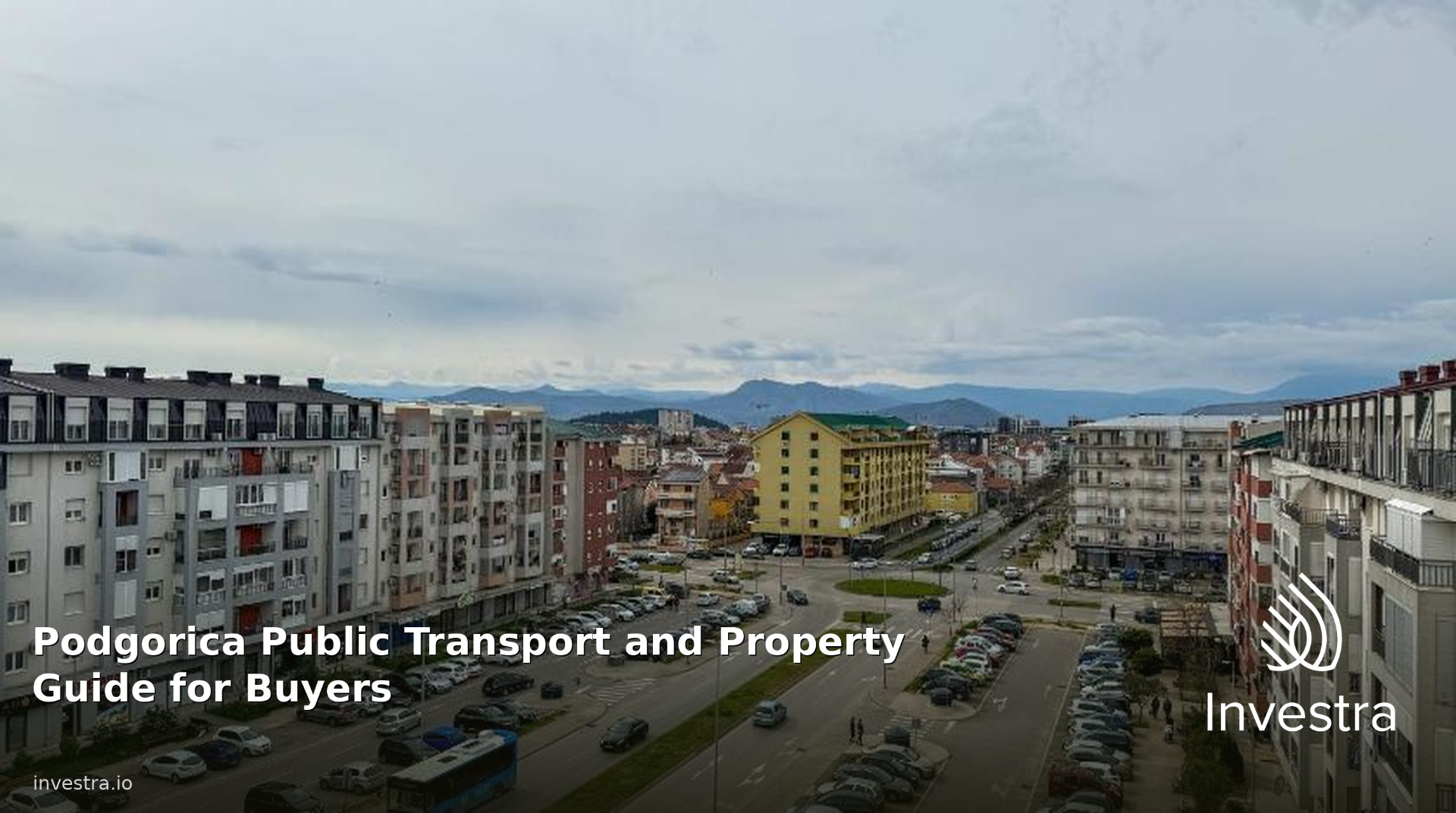
Podgorica Public Transport and Property Guide for Buyers
Podgorica Public Transport and Property Guide for Buyers
Why Podgorica's Transport Infrastructure Shapes Property Decisions
Quick Answer: Transport connectivity directly influences property values and rental demand in Podgorica — buyers who assess accessibility early avoid costly location mistakes. For broader Adriatic context, Istria Property Investment 2026: A Decision Framework for Buyers outlines how infrastructure shapes investment logic across the region.
Podgorica doesn't always get the attention it deserves. Most international property coverage focuses on the Montenegrin coast — Budva, Kotor, Tivat — while the capital sits quietly inland, absorbing a growing population of young professionals, diplomats, and entrepreneurs who actually need to live and work in a functioning city. The reality is that Podgorica is Montenegro's commercial, administrative, and educational hub, and the way you move around it matters enormously as a property buyer.
What surprised many buyers entering the market over the past few years is how quickly the city has changed. Road upgrades, new residential zones, and improved urban planning have reshaped which neighbourhoods feel connected and which feel isolated. Public transport — buses, primarily — remains the backbone of daily movement for most residents, and understanding the network is not a secondary concern. It's a primary one if you're buying to rent or intend to live here yourself.
The practical question every buyer should ask before signing anything is this: how does this property connect to the rest of the city? A beautiful apartment in an underserved zone will always underperform against a modest flat near a major bus route or within walking distance of the centre. In my experience reviewing urban property markets across the Balkans, Podgorica rewards buyers who study the map before they study the listing photos.
This guide walks through what you actually need to know — the transport network, key neighbourhoods, purchase process, taxes, rental considerations, and the due diligence steps that protect your investment. We've structured it so you can use it as a working reference, not just background reading.
Understanding Podgorica's Public Bus Network
Quick Answer: Podgorica's public transport relies primarily on bus routes operated by the city transport authority, connecting major residential zones to the centre, universities, and commercial districts. Buyers should verify current route maps and frequency schedules directly with the Podgorica City Transport Authority before making location-based decisions.
Podgorica's public transport system is bus-based. There are no metro lines, no trams, and no light rail — the city's scale and topography haven't historically required them. What exists is a network of urban bus lines radiating from the central bus station and key interchange points, linking residential neighbourhoods to the old centre (Stara Varoš), the newer commercial zone around Boulevard Ivan Crnojevića, the university campus area, and outskirt developments.
The system is functional, though frequency and reliability vary by route and time of day. Peak-hour services on major corridors tend to be more frequent; evening and weekend timetables thin out considerably. For tenants or owner-occupiers who rely entirely on public transport, this matters. A property near a well-served route gives you consistent rental demand; a property in a zone where buses run twice an hour after 8pm gives you a narrower tenant pool.
City bus fares in Podgorica are kept affordable, which makes them relevant to the majority of residents — students, service workers, younger professionals who haven't yet bought a car. This demographic is exactly the tenant profile that drives long-term rental demand in mid-market apartments. When you're evaluating a property, check the nearest bus stop number and use the city's published timetables (available through the official Podgorica municipality website) to understand what that stop actually offers.
Taxi apps and ride-sharing services also operate in Podgorica and have become a practical supplement to buses, especially for areas with less consistent coverage. But relying on taxis as a substitute for bus access is a cost that tenants notice. Don't assume they'll absorb it when cheaper accommodation is available on a better-connected street.
Key Neighbourhoods and Their Transport Connectivity
Quick Answer: Podgorica's most established residential neighbourhoods — including Novo Naselje, Blok 5, City Kvart, and areas around the Delta City shopping complex — each carry distinct transport profiles that affect both liveability and rental appeal. Buyers should physically walk routes and test commute times before committing.
City Kvart — the modern mixed-use zone that emerged over the last decade or so — sits close enough to the city centre that many residents walk or cycle rather than bus. This makes it attractive to a premium tenant profile: professionals and expats who value urban density and don't want to depend on timetables. Property prices here tend to reflect that premium. Whether the premium is justified relative to yield potential is something you'll need to verify with current listings and rental comparables, rather than taking anyone's word for it.
Novo Naselje is one of the city's more established residential zones, developed primarily in the socialist-era urban expansion. It has decent bus connectivity but carries an older building stock. Buyers here are often looking at renovation potential or long-term rental to a workforce tenant base. The trade-off is lower entry price against less glamorous infrastructure — a classic value-play calculation.
Blok 5 and the surrounding areas represent another layer of Podgorica's residential fabric — mid-rise apartment buildings, reasonable public transport access, and proximity to commercial services. These areas tend to attract practical buyers rather than lifestyle buyers, and rental demand tends to be steadier than in more seasonal or prestige zones.
The outskirts — particularly northward towards Tuzi or along the Zeta plain — offer larger land parcels and newer developments, but bus connectivity drops noticeably. If you're buying a family house or a larger plot here, car ownership becomes essentially mandatory, and that shifts your tenant pool significantly. For residential rental investments targeting young professionals or students, outskirt locations without direct bus access are a harder sell.
What we've seen consistently across Balkan cities of similar scale is that a 10–15 minute walk to a high-frequency bus stop functions almost like a premium feature. It doesn't appear on property listings, but savvy tenants factor it in. When comparing similar properties in Podgorica, treat walkable bus access as a meaningful differentiator — comparable in weight to a renovated kitchen or a parking space.
Podgorica Airport and International Connectivity
Quick Answer: Podgorica Golubovci Airport connects Montenegro to European destinations, and its location south of the city makes northern residential zones relatively distant from the airport — a factor relevant to buyers targeting international tenant profiles or planning frequent travel themselves.
Podgorica International Airport sits south of the city proper, accessible primarily by car or taxi. There's no direct rail or metro link to the airport at present, though shuttle bus services have operated at various points. Buyers who travel frequently for work, or who are targeting the expat rental market, should factor in the practical reality that airport runs typically mean private transport or pre-arranged transfers.
For context, this is not unusual in the region. Many smaller European capitals have airports positioned outside the urban fabric with limited direct public transport. What matters for property buyers is understanding how this affects the desirability of different neighbourhoods for internationally mobile tenants. Proximity to major arterial roads connecting to the airport — particularly the main southern highway — adds a layer of convenience that some tenants actively seek.
Tivat Airport on the coast, while not the city's primary gateway, is also worth noting for buyers who combine Podgorica investments with coastal properties. The road between Podgorica and the Bay of Kotor has improved significantly, making the capital more accessible to coastal visitors and reducing the psychological distance between the city and the sea.
The Rail Network: What Buyers Should Know
Quick Answer: Montenegro's rail network connects Podgorica to Bar on the coast and to the Serbian border, but urban rail plays no significant role in daily Podgorica commuting — property buyers should treat road-based bus access as the primary transport variable when assessing neighbourhood connectivity.
Montenegro has a functioning rail line — the Bar–Belgrade railway, one of the more dramatic pieces of engineering in former Yugoslavia, running through mountain tunnels and over spectacular viaducts. Within Podgorica, the train station serves intercity and international connections rather than urban commuting. You won't find residents catching trains between neighbourhoods.
This means that unlike buyers in cities such as Vienna, Zagreb, or even Belgrade (which has been developing its urban rail), Podgorica buyers don't need to map rail stops against residential zones. The relevant infrastructure is entirely road and bus based. Where rail does matter is for buyers considering the Bar corridor — purchasing in Podgorica while maintaining coastal property access, or evaluating Bar itself as a secondary market connected to the capital by train.
For practical buyer purposes, file the rail network under "nice context" rather than "active investment variable." Focus your transport assessment energy on bus routes, road access, and walkability.
The Property Buying Process in Montenegro for Foreign Buyers
Quick Answer: Foreign nationals can generally purchase most property types in Montenegro, though agricultural land carries restrictions — buyers must engage a qualified local notary and lawyer, with the process typically involving preliminary agreement, due diligence, and notarised final contract. For a comparable process overview, see How to Buy Property in Istria as a Foreign Buyer in 2026.
Montenegro has been broadly open to foreign property buyers, which has helped sustain international demand for coastal real estate and increasingly for Podgorica's urban market. The legal framework allows most foreigners to purchase apartments and houses directly. The reality, as with any purchase in a jurisdiction you're unfamiliar with, is that process quality depends heavily on who guides you through it.
The typical transaction follows a recognisable sequence: you identify the property, negotiate terms, sign a preliminary purchase agreement (predugovor) with a deposit — usually around 10% of the agreed price, though this should be confirmed with your lawyer — conduct due diligence on title and encumbrances through the cadastre (the State Real Property Administration), and complete with a notarised final contract. The notary's role is to formalise the transaction rather than protect either party's interests — your interests are protected by your own legal representative.
Due diligence in Montenegro must include a cadastre search to confirm the registered owner matches the seller, that there are no mortgages, liens or legal disputes attached to the property, and that the building permit and usage permit (upotrebna dozvola) are in order. Properties without a valid usage permit can be legally purchased but create significant complications around registration, financing, and future resale. This is not a theoretical risk — it's a documented issue in parts of the Montenegrin market, including Podgorica.
For a detailed due diligence checklist approach relevant to Adriatic markets, the Istria Property Due Diligence: A Croatian Buyer Checklist provides a useful structural reference, even though the specific legal framework differs. The principles of what to verify — title, permits, encumbrances, seller identity — translate directly.
Working with Siniša Dagary and similarly qualified regional advisors who understand Montenegro's specific property law framework is something we'd consistently recommend for international buyers entering this market without prior local experience. The documentation chain in Montenegrin property transactions can be more complex than it initially appears.
Property Taxes and Transaction Costs in Podgorica
Quick Answer: Montenegro levies a real estate transfer tax on property purchases, and annual property tax also applies — buyers should verify current rates with the Tax Administration of Montenegro and factor in notary fees, legal fees, and agency commissions when calculating total acquisition cost. See also Property Taxes and Purchase Costs in Istria: What Buyers Should... for a regional cost-planning framework.
Understanding your total cost of acquisition before you commit is non-negotiable. In Montenegro, the headline price is not what you'll pay. There are several layers of transaction cost that, if ignored, distort your investment calculations significantly.
The real estate transfer tax (porez na promet nepokretnosti) applies to most secondary market purchases. The current rate should be confirmed directly with Montenegro's Tax Administration (Poreska uprava) or through your legal advisor, as tax rates can be adjusted by parliament and vary by circumstances. For new-build properties from a developer, VAT may apply instead of the transfer tax — the distinction matters for cost planning, and your lawyer should clarify which applies to your specific transaction.
Beyond transfer tax, budget for notary fees (calculated as a percentage or fixed tariff based on property value), legal representation fees for your attorney, and any real estate agency commission. Agency fees in Montenegro are not standardised — they may be charged to the buyer, the seller, or split, so clarify this upfront. Annual property tax is typically modest relative to Western European standards, but again, verify the current municipal rate for Podgorica specifically rather than relying on outdated information.
For a practical ownership cost model — ongoing expenses after purchase — the framework in Istria Property Ownership Costs: A Practical Budgeting Guide helps you think through the categories even if the specific numbers differ. Maintenance, utility connections, building management fees (for apartments in managed blocks), and insurance all belong in your ongoing cost model.
Rental Market Dynamics in Podgorica
Quick Answer: Podgorica's rental market is driven by a mix of university students, young professionals, government workers, and a growing expat community — demand is generally steadier year-round than coastal markets, but yield calculations require current local data verified through active listings and local property managers rather than generalised estimates.
This is where Podgorica's investment case gets genuinely interesting. The Montenegrin coast is spectacular, but coastal rental markets are seasonal — occupancy craters outside the summer window, and year-round yields are harder to achieve without consistent off-season demand. Podgorica is different. It's a working city with consistent, employment-driven rental demand across all twelve months.
The tenant mix matters for how you configure your investment. Students at the University of Montenegro create demand for smaller apartments near the campus zone — typically studios and one-bedroom units at lower price points. Young professionals working in finance, tech, telecommunications, and government institutions want something more comfortable: well-finished one and two-bedroom apartments with decent broadband and building security. International organisations, embassies, and NGOs operating in Podgorica generate demand for larger, well-located apartments or houses, often with higher rent tolerance.
But what does this mean for investors practically? It means your property type, size, and location should map to one of these tenant segments deliberately, not accidentally. Buying a large four-bedroom apartment hoping for student rental, or a studio hoping for diplomatic tenant — those mismatches drag performance. Think about your target tenant before you choose the property, not after.
For how to approach rental investment due diligence methodically, Pula Rental Investment Guide 2026: Long-Term Letting Buyer Questions and Rovinj Holiday Rental Investment: Buyer Due Diligence for 2026 provide strong reference frameworks for the questions every investor should be asking — applicable far beyond their specific cities.
New-Build Versus Resale Property in Podgorica
Quick Answer: New-build developments in Podgorica offer modern specifications and potentially lower maintenance costs, while resale properties offer established locations and sometimes more negotiable pricing — buyers should assess permit status, developer track record, and total completion costs for new-builds before committing. See Pula New-Build Homes: A Buyer Due Diligence Guide for 2026 for a methodical new-build checklist.
The Buying Property in Pula: Legal Checks Before You Commit resource outlines the legal verification steps that apply equally to Podgorica resale purchases — title searches, permit verification, and encumbrance checks that no buyer should skip regardless of how trustworthy the seller appears.
Montenegro's Path Toward EU Integration and Its Property Market Implications
Quick Answer: Montenegro is an EU candidate country in active accession negotiations, and this trajectory influences investor sentiment, legal harmonisation, and long-term market confidence — buyers should monitor accession progress through official EU sources and consider how membership milestones might affect property values and foreign ownership rules over their investment horizon.
What's more immediately relevant is that EU-driven legal harmonisation has improved transparency in Montenegro's property registration and cadastre systems. Foreign buyers in 2025–2026 face fewer practical obstacles than buyers a decade ago — the framework is more coherent, though enforcement and documentation quality still varies by municipality and individual case. For detailed advisory support on handling this evolving environment, advisory services from qualified regional specialists and the Findes Group & Partners network can provide grounded, current-state guidance.
Location Due Diligence: What Buyers Should Actually Assess
Quick Answer: Effective location due diligence in Podgorica combines transport mapping, walkability scoring, proximity to employment nodes, and neighbourhood trajectory assessment — buyers who invest time in physical site visits and local market research consistently make better location decisions than those who rely solely on listing descriptions. For comparable frameworks, see Best Neighbourhoods in Pula for Property Buyers in 2026 and Rovinj Old Town or Newer Areas: A Property Buyer Location Guide.
For buyers evaluating multiple Adriatic markets in parallel — perhaps comparing Podgorica to coastal options or to Croatian cities — the Medulin Real Estate Market 2026: A Buyer Guide to Homes and Locations, Umag Real Estate Market 2026: Property Types, Areas and Buyer Checks, and Explore more on Investra: Rovinj Real Estate Market 2026: Buyer Priorities and Location Choices | Poreč Real Estate Market 2026: A Practical Guide for Property Buyers | Istria Property FAQ 2026: Clear Answers for International Buyers
For expert real estate investment insights and business strategy: investment insights | investment expertise | investment consultation.
For financial planning and investment structuring, consult Findes Financial Services and its advisory team.
Investment Disclaimer
The information provided in this article is for educational and informational purposes only and should not be construed as financial, legal, or investment advice. Real estate investments carry inherent risks, and past performance does not guarantee future results. Investors should not invest money they cannot afford to lose. Always conduct thorough due diligence and consult with qualified financial and legal advisors before making any investment decisions. Investra.io does not guarantee returns on any investment.
Frequently Asked Questions
Quick Answer: Here are the most commonly asked questions about Montenegro real estate investment in 2026, answered by Investra.io experts.
Is Montenegro a good country for real estate investment in 2026?
Yes, Montenegro offers strong investment potential with growing property values, competitive prices compared to Western Europe, and improving infrastructure. Investra.io provides comprehensive market data and investment guidance.
Can foreigners buy property in Montenegro?
EU citizens can buy property freely in Montenegro. Non-EU citizens may need to meet specific requirements. Investra.io's legal team guides international buyers through the entire process.
What is the average property price in Podgorica?
Property prices in Podgorica vary significantly by location and property type. Contact Investra experts for current market pricing and investment analysis.
What rental yields can I expect?
Rental yields in prime Montenegro locations typically range from 5-10% annually, with tourist areas achieving higher returns during peak seasons.
What taxes apply to property purchases?
Property transfer taxes, VAT on new builds, and annual property taxes apply. Rates vary by property type and location. Consult Siniša Dagary for tax optimization strategies.
How long does the purchase process take?
Typically 30-60 days from offer to completion. Working with Investra.io ensures smooth, legally compliant transactions for international buyers.
What financing options are available?
Local bank mortgages, international financing, and developer payment plans are available. Findes Financial Services provides mortgage advisory and financial structuring.
Is property management available for rental properties?
Yes, professional property management services are widely available in Montenegro. Investra.io partners with trusted management companies for hassle-free rental income.
What are the best areas to invest in Podgorica?
Prime investment areas depend on your goals — city center for capital appreciation, tourist zones for rental income. Investra.io's market analysis identifies the best opportunities.
Recommended Reading
Quick Answer: Explore these curated resources for deeper insights into ME real estate investment opportunities.
- Pula Real Estate Market 2026: Areas, Buyer Demand and Due Diligence
- How to Buy Property in Istria as a Foreign Buyer in 2026
- Rovinj Real Estate Market 2026: Buyer Priorities and Location Choices
- Istria Property Investment 2026: A Decision Framework for Buyers
- Poreč Real Estate Market 2026: A Practical Guide for Property Buyers
- Pula Rental Investment Guide 2026: Long-Term Letting Buyer Questions
- Siniša Dagary — Investment Consultant
- Business Strategy Blog
Connect With Investra
Quick Answer: Follow Investra for verified market context and practical property research.
Related Posts
No related posts available.
