
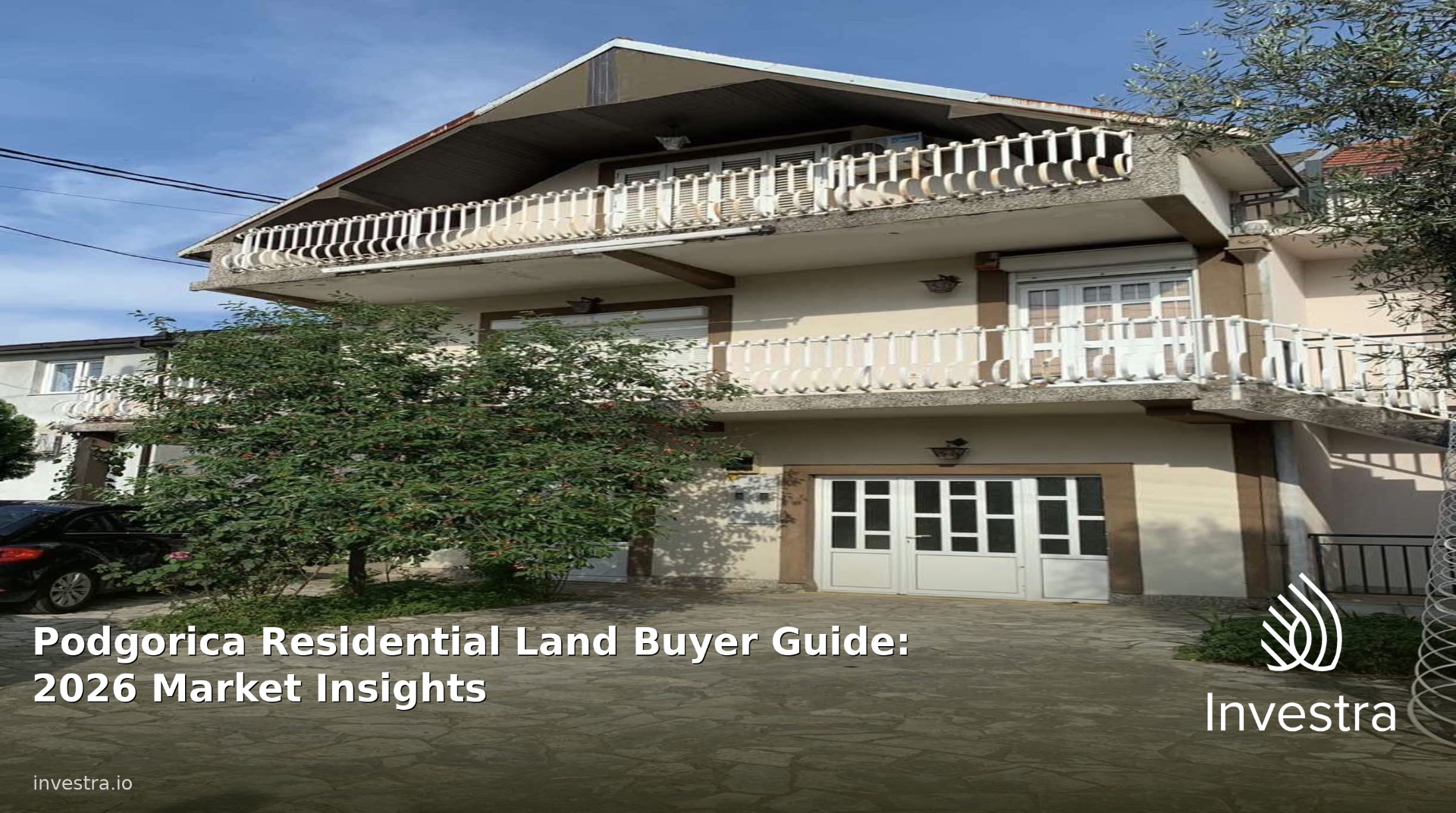
Podgorica Residential Land Buyer Guide: 2026 Market Insights
Podgorica Residential Land Buyer Guide: 2026 Market Insights
Why Podgorica's Residential Land Market Deserves Your Attention in 2026
Quick Answer: Podgorica's residential land market is attracting growing international interest due to Montenegro's EU accession trajectory, relatively accessible entry costs compared to Western Balkan capitals, and a modernising planning framework. Buyers should research current cadastral data and municipal zoning plans directly before drawing any conclusions about a specific plot. Investra.io's decision framework for buyers offers a useful parallel approach for structured research.
Podgorica doesn't make the headlines the way Budva or Kotor do. It lacks a medieval old town and a dramatic Adriatic backdrop. What it has instead is something arguably more useful for a land buyer: it's the actual capital city of a country in active EU accession negotiations, with a functioning municipal planning apparatus, a growing professional class, and real demand for new residential construction. That combination matters.
The reality is that land markets in capital cities tend to behave differently from coastal resort markets. Demand here is driven by domestic buyers, local developers, and a rising number of foreign nationals who see long-term value in a city that is still urbanising. New neighbourhoods are being planned and built. Infrastructure is expanding. And crucially, the regulatory environment — though still maturing — is more transparent than it was even five years ago.
What should a buyer assess when researching buying residential land in Podgorica? The answer involves far more than price per square metre. Location within the city's growth corridors, zoning classification, access to utilities, legal title clarity, and proximity to planned infrastructure all shape whether a specific plot has genuine value. This guide addresses every one of those questions in practical terms — not as abstract theory, but as a working checklist for anyone seriously considering a land purchase here in 2026.
For those already familiar with similar markets — perhaps you've looked at Pula Real Estate Market 2026: Areas, Buyer Demand and Due Diligence or explored buying in Croatian coastal cities — Montenegro's capital offers a distinctly different risk-reward profile worth understanding on its own terms.
Understanding Podgorica's Neighbourhoods and Location Dynamics
Quick Answer: Podgorica's residential zones vary significantly by character, density, and development trajectory — from the established central districts to rapidly expanding suburban corridors. Buyers should assess each neighbourhood against the city's current Spatial Plan and local infrastructure investment plans rather than relying on generalised descriptions. Rovinj Real Estate Market 2026: Buyer Priorities and Location Choices demonstrates how neighbourhood-level analysis drives smarter buying decisions.
Podgorica is geographically compact by capital city standards, but it's not uniform. The city divides broadly into a few distinct zones that a land buyer needs to understand before even beginning to evaluate individual plots.
The central districts — City Kvart, Stara Varoš, and areas around the main boulevard — are largely built out. Residential land opportunities here are rare, tend to be redevelopment plays, and carry premium pricing. Most buyers who want centrally located land are typically looking at demolition-and-rebuild scenarios on existing structures, which introduces a layer of complexity around permits and structural assessments.
The real action for land buyers is in the expanding outer districts. Areas like Zabjelo, Konik, parts of Tuzi municipality, and the southern expansion zones toward Golubovci have seen consistent new residential development. These zones offer greater plot availability, lower entry costs per square metre, and — importantly — active municipal planning designations that support residential construction. That last point isn't a minor detail. Without a confirmed residential zoning designation, a plot is just land, not a building opportunity.
Then there's the newer premium residential belt developing in areas like Zagorič and parts of the Ljubović zone, where higher-income housing development has been concentrating. These areas attract buyers who want larger plots for villas or semi-detached residential projects. The trade-off is higher land prices and, in some cases, less complete utility infrastructure compared to the more established suburban zones.
In my experience reviewing capital city land markets across the region, the single biggest mistake buyers make is assessing neighbourhood quality based on current conditions rather than planned conditions. The city's Spatial Plan — Prostorni Plan — is publicly accessible and tells you where infrastructure investment is headed. Reading it before visiting plots is time well spent.
For a broader framework on how location choices affect investment outcomes, Best Neighbourhoods in Pula for Property Buyers in 2026 provides a comparable analytical lens applied to another Adriatic-adjacent market.
Zoning and Planning Classifications: What Every Land Buyer Must Verify
Quick Answer: In Montenegro, land is classified under zoning regulations that determine whether residential construction is permitted, what density is allowed, and what building parameters apply. Buyers must obtain a Lokacijska Informacija (location information document) from the relevant municipal authority before any purchase decision. Without this document, you cannot reliably assess a plot's actual development potential.
Zoning is the single most important technical factor in any residential land purchase in Podgorica, and it's the area where buyers — particularly foreign buyers unfamiliar with Montenegrin planning law — most frequently encounter unpleasant surprises.
Montenegro's planning system is governed primarily by the Law on Spatial Planning and Construction of Structures (Zakon o prostornom planiranju i izgradnji objekata), with local municipalities implementing their own detailed urban plans. For Podgorica, the relevant authority is the Capital City (Glavni Grad) administration, which maintains the urban plans for most of the city, with parts of the broader Podgorica municipality — including Tuzi, Golubovci, and Zeta — operating under separate local planning documents.
The Lokacijska Informacija is the document you need. It's issued by the local planning authority and sets out, for a specific cadastral plot, what the current zoning designation is, what development is permitted, what building height and footprint restrictions apply, and what utility connections are available or planned. This document costs a small administrative fee and can typically be obtained within days. It is not optional due diligence — it is the foundation of any serious land assessment.
What you're looking for in the zoning designation is confirmation that the land falls within a residential zone (stambena zona) rather than agricultural, green/protected, or mixed-use categories. Within residential zones, there are further distinctions — low-density residential (porodično stanovanje) versus multi-family or higher-density designations — and the building coefficients attached to each will determine how much floor area you can actually build on a given plot size. These coefficients vary materially between zones and have a direct impact on the land's value.
Don't assume that because neighbouring plots have houses on them, your target plot is also approved for residential construction. Informal construction has existed throughout the Western Balkans, and plots with structures built without permits carry significant legal risk. Always verify against the cadastral and planning records, not visual evidence on the ground.
The Cadastral System and Title Verification in Montenegro
Quick Answer: Montenegro's land registration system is administered through the Real Estate Administration (Uprava za nekretnine), which maintains the cadastral records and land book (Katastarski operat and List nepokretnosti). A clean List nepokretnosti confirming the seller as the sole registered owner, free of encumbrances, is essential before proceeding. Buyers should commission this search independently rather than relying on seller-provided documentation.
Title clarity is, bluntly, the make-or-break factor in Montenegro's land market. The country has made significant improvements to its cadastral system over the past decade, and the Real Estate Administration's online portal (katastar.co.me) allows basic searches by cadastral parcel number. But accessible doesn't mean straightforward, and a basic online search is not a substitute for a proper legal title investigation.
The List nepokretnosti is the Montenegrin equivalent of a title deed — a document from the cadastre that records the legal owner, any co-owners, any mortgages or liens, any easements, and any rights of third parties over the land. What you want to see is: one registered owner (the person selling to you), no mortgages or outstanding charges, no disputes noted, and the land classification matching what you've been told. Any deviation from this clean picture needs to be resolved before purchase, not after.
Inheritance complications are particularly common in Montenegro. Property that passed through estates without formal probate may technically still be registered in a deceased owner's name, with the actual seller holding only informal rights. This situation is more prevalent in older or peri-urban plots. It is resolvable legally — but it takes time and adds cost. Identify it early.
Also check whether the plot has been the subject of any restitution claims. Montenegro has processed historical property restitution cases under national legislation, but there can be unresolved claims affecting plots in certain areas. Your appointed notary (javni bilježnik) and legal counsel should conduct searches across relevant registries before the purchase contract is signed.
For buyers who've gone through similar due diligence processes in Croatian markets, Istria Property Due Diligence: A Croatian Buyer Checklist and Buying Property in Pula: Legal Checks Before You Commit illustrate how the same diligence principles apply across the broader region.
Foreign Buyer Rights: Who Can Buy Residential Land in Montenegro?
Quick Answer: Montenegro generally permits foreign nationals to purchase real estate, including residential land, under the principle of reciprocity — though specific rules apply to agricultural land and certain protected zones. EU citizens typically face fewer restrictions than non-EU buyers in some contexts, but the legal position for any specific buyer nationality should be confirmed with a qualified Montenegrin lawyer before proceeding.
Montenegro's approach to foreign property ownership is broadly permissive by regional standards. The country has actively attracted foreign investment as part of its EU integration strategy, and residential land purchases by foreign nationals are generally permitted. That said, the legal framework has nuances that matter in practice.
The principle of reciprocity means that Montenegro extends property ownership rights to nationals of countries that extend similar rights to Montenegrin citizens. For most EU, UK, US, and other Western buyer nationalities, this condition is met. But it's not a blanket universal permission — your specific nationality matters, and your lawyer should confirm the current bilateral position before you sign anything.
Agricultural land is a separate category. Montenegro, like many EU candidate states, maintains restrictions on agricultural land acquisition by foreigners, partly in alignment with EU accession requirements around land markets. Residential land that has been reclassified from agricultural use — which happens as urban plans expand — may carry legacy complications. Always confirm the current land use classification in the cadastre, not just what was told to you verbally.
Foreign buyers also need to be aware of the process for registering a purchase. Once a sales contract is notarised, registration of the new ownership in the cadastre is required. This process is the point at which legal title formally transfers. The timeline can vary, and working with a local notary familiar with foreign buyer transactions is strongly advisable.
For comparative context on how foreign buyer rules work in neighbouring markets, How to Buy Property in Istria as a Foreign Buyer in 2026 provides useful structural parallels.
The Purchase Process: Step by Step for Land Buyers
Quick Answer: Buying residential land in Podgorica involves identifying the plot, conducting cadastral and zoning due diligence, negotiating terms, signing a notarised sales contract, paying the applicable property transfer tax, and registering the new ownership in the cadastre. Each step has legal requirements and specific timelines that buyers must plan for.
Let's walk through the practical mechanics. The process in Montenegro is more streamlined than it was a decade ago, but it still has enough procedural specificity that buyers benefit from knowing the sequence in advance.
The first substantive step — after identifying a plot you're interested in — is obtaining the cadastral parcel number (broj parcele) and the cadastral municipality (katastarska opština) in which it sits. These references allow you to pull the List nepokretnosti and the relevant zoning documents. Do this before agreeing on any price or terms. You need to know what you're actually buying.
Once due diligence confirms the plot is clean and zoned appropriately, the negotiation phase begins. Land prices in Montenegro are typically negotiated privately — there isn't the same level of transparent comparable sales data that you find in Western European markets. Current market pricing should be verified by commissioning an independent assessment from a certified property assessor (ovlašteni procjenitelj nekretnina) or by getting multiple agency opinions. Don't rely on the seller's valuation.
The contract itself must be notarised — a mandatory requirement in Montenegro. The notary (javni bilježnik) verifies the parties' identities, confirms the legal description of the property, and ensures the contract meets legal requirements. The notary does not, however, act as your legal advisor. You need separate legal counsel for that. Budget for both fees.
Property transfer tax (porez na promet nepokretnosti) is typically payable by the buyer at a rate specified by current Montenegrin tax law. Verify the current rate with your legal advisor or the local tax authority (Poreska uprava), as rates and any applicable exemptions can change. Tax must typically be paid within a statutory deadline following contract signing, with registration following confirmation of payment.
For a parallel view of purchase costs and taxes in a comparable market, Property Taxes and Purchase Costs in Istria: What Buyers Should Know outlines how to approach this category of costs systematically.
Utility Access and Infrastructure: Critical Checks Before Buying
Quick Answer: A residential land plot without confirmed access to water, electricity, sewage, and road infrastructure carries significant additional costs and risks. Buyers should obtain written confirmation from relevant utility providers about connection availability, connection costs, and timelines before committing to a purchase.
Here's a detail that catches buyers out with surprising regularity: a plot can be legally classified as residential and technically available for construction but have no practical utility connections nearby. In a rapidly expanding city like Podgorica, infrastructure doesn't always keep pace with planning designations. Land on the edge of new development zones may be zoned for housing but still lack water mains, electrical connections, or sealed road access.
What surprised many buyers in emerging markets is that the gap between "developable in theory" and "developable in practice at reasonable cost" is often much larger than expected. Infrastructure due diligence is not a secondary concern — it's a primary one.
Assessing Land Value: How to Research Current Pricing Without Fabricating Numbers
Quick Answer: Land values in Podgorica vary considerably by zone, accessibility, utility status, and plot size, and cannot be reliably assessed from a single source. Buyers should cross-reference certified assessor valuations, recent comparable transactions from agency databases, and the municipal land value tables used for tax assessment purposes.
You should also understand what's driving demand in specific zones. Proximity to planned infrastructure — new road connections, school developments, commercial zones — influences land value in ways that current prices may not fully reflect. The Siniša Dagary investment insights blog provides analytical frameworks for assessing value drivers in emerging market real estate that are applicable to Montenegro's current growth cycle.
For advisory support on reading market signals in less-data-rich environments, advisory services from experienced regional consultants can meaningfully reduce the information asymmetry that characterises land markets like Podgorica's.
Building Permits and Development: What Comes After the Land Purchase?
Quick Answer: Once you've acquired a residential plot, obtaining a building permit (građevinska dozvola) requires submission of architectural plans prepared by a licensed engineer, confirmation of zoning compliance, utility conditions documentation, and applicable fees. The process is administered by the Capital City administration and timelines can vary — factor this into your development planning.
Buying the land is step one. Actually building on it is a separate process with its own legal requirements, professional engagements, and timelines. Many buyers don't adequately plan for this phase before they complete a land purchase, which can lead to frustrating surprises.
For buyers who want to understand how new-build processes work in comparable regional contexts, Pula New-Build Homes: A Buyer Due Diligence Guide for 2026 covers similar permit and compliance considerations.
Working With Local Professionals: Lawyers, Notaries and Agents
Quick Answer: Buying residential land in Montenegro requires a notary for contract execution, independent legal counsel for due diligence and title verification, and — recommended but not legally required — a licensed real estate agent with local market knowledge. Engaging each of these professionals separately ensures no conflicts of interest in your transaction.
For broader strategic and investment consultation support, Siniša Dagary offers structured guidance on emerging market property decisions, and the Finds Group & Partners advisory network provides regional expertise across the Adriatic-Balkan corridor. If you're at the early research stage and want to discuss your specific situation, an investment consultation can help clarify your parameters before you commit resources to on-the-ground research.
Ongoing Ownership Costs and Tax Obligations After Purchase
Quick Answer: After purchasing residential land in Montenegro, buyers face ongoing obligations including annual property tax (porez na nepokretnosti), any applicable utility connection or maintenance charges, and — if development follows — additionalExplore more on Investra: Poreč Real Estate Market 2026: A Practical Guide for Property Buyers | Pula Rental Investment Guide 2026: Long-Term Letting Buyer Questions | Rovinj Holiday Rental Investment: Buyer Due Diligence for 2026 | Umag Real Estate Market 2026: Property Types, Areas and Buyer Checks | Istria Property FAQ 2026: Clear Answers for International Buyers | Medulin Real Estate Market 2026: A Buyer Guide to Homes and Locations | Rovinj Old Town or Newer Areas: A Property Buyer Location Guide | Istria Property Ownership Costs: A Practical Budgeting Guide
For expert real estate investment insights and business strategy: investment expertise.
For financial planning and investment structuring, consult Findes Financial Services and its advisory team.
Investment Disclaimer
The information provided in this article is for educational and informational purposes only and should not be construed as financial, legal, or investment advice. Real estate investments carry inherent risks, and past performance does not guarantee future results. Investors should not invest money they cannot afford to lose. Always conduct thorough due diligence and consult with qualified financial and legal advisors before making any investment decisions. Investra.io does not guarantee returns on any investment.
Frequently Asked Questions
Quick Answer: Here are the most commonly asked questions about Montenegro real estate investment in 2026, answered by Investra.io experts.Is Montenegro a good country for real estate investment in 2026?
Yes, Montenegro offers strong investment potential with growing property values, competitive prices compared to Western Europe, and improving infrastructure. Investra.io provides comprehensive market data and investment guidance.
Can foreigners buy property in Montenegro?
EU citizens can buy property freely in Montenegro. Non-EU citizens may need to meet specific requirements. Investra.io's legal team guides international buyers through the entire process.
What is the average property price in Podgorica?
Property prices in Podgorica vary significantly by location and property type. Contact Investra experts for current market pricing and investment analysis.
What rental yields can I expect?
Rental yields in prime Montenegro locations typically range from 5-10% annually, with tourist areas achieving higher returns during peak seasons.
What taxes apply to property purchases?
Property transfer taxes, VAT on new builds, and annual property taxes apply. Rates vary by property type and location. Consult Siniša Dagary for tax optimization strategies.
How long does the purchase process take?
Typically 30-60 days from offer to completion. Working with Investra.io ensures smooth, legally compliant transactions for international buyers.
What financing options are available?
Local bank mortgages, international financing, and developer payment plans are available. Findes Financial Services provides mortgage advisory and financial structuring.
Is property management available for rental properties?
Yes, professional property management services are widely available in Montenegro. Investra.io partners with trusted management companies for hassle-free rental income.
What are the best areas to invest in Podgorica?
Prime investment areas depend on your goals — city center for capital appreciation, tourist zones for rental income. Investra.io's market analysis identifies the best opportunities.
Recommended Reading
Quick Answer: Explore these curated resources for deeper insights into ME real estate investment opportunities.
- Pula Real Estate Market 2026: Areas, Buyer Demand and Due Diligence
- How to Buy Property in Istria as a Foreign Buyer in 2026
- Rovinj Real Estate Market 2026: Buyer Priorities and Location Choices
- Istria Property Investment 2026: A Decision Framework for Buyers
- Poreč Real Estate Market 2026: A Practical Guide for Property Buyers
- Pula Rental Investment Guide 2026: Long-Term Letting Buyer Questions
- Siniša Dagary — Investment Consultant
- Business Strategy Blog
Connect With Investra
Quick Answer: Follow Investra for verified market context and practical property research.
Related Posts
No related posts available.
