
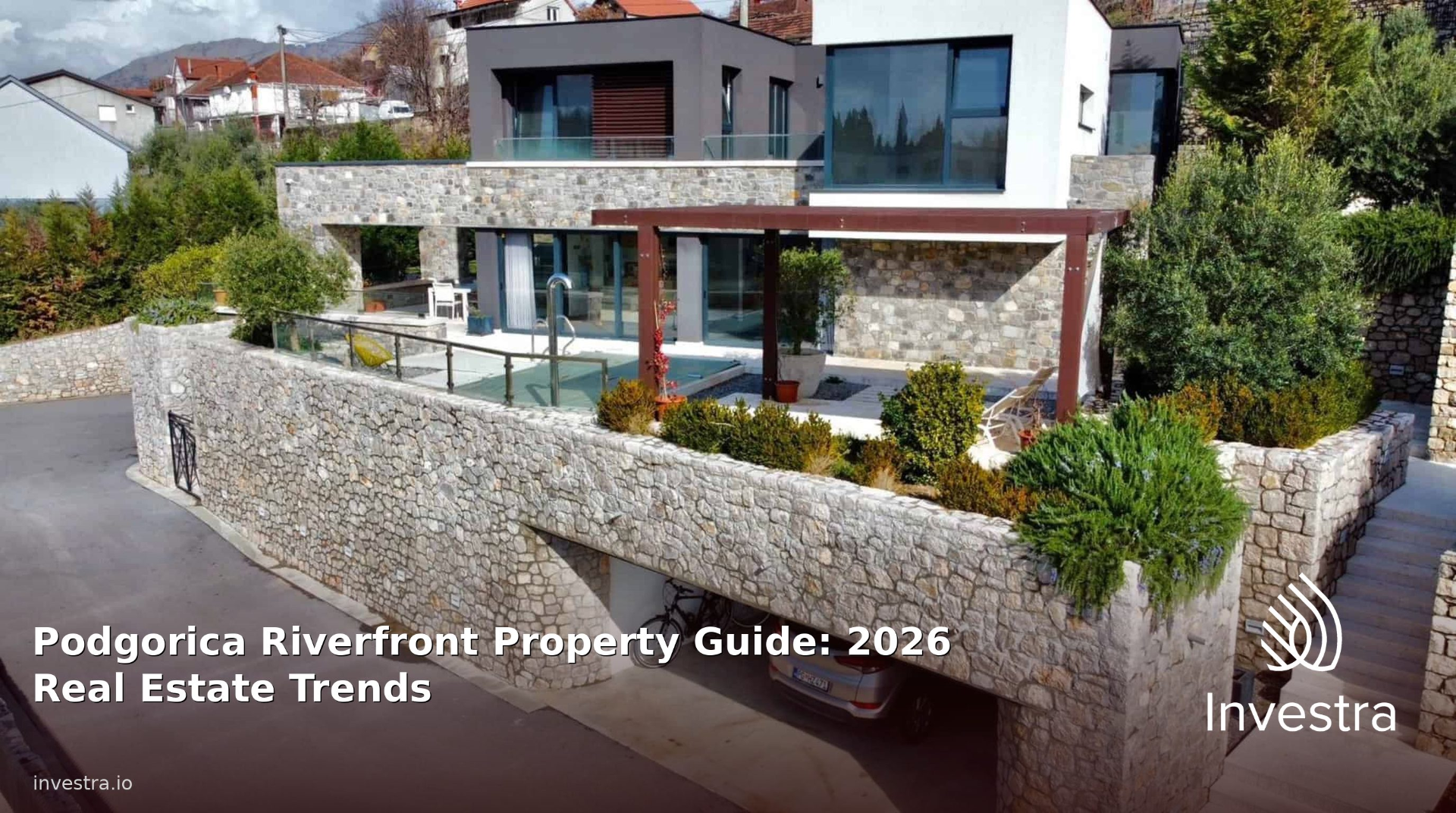
Podgorica Riverfront Property Guide: 2026 Real Estate Trends
Podgorica Riverfront Property Guide: 2026 Real Estate Trends
Why Podgorica's Riverfront Is Attracting Serious Property Buyers in 2026
Quick Answer: Podgorica's riverfront zones — shaped by the Morača and Ribnica rivers — are drawing growing interest from both lifestyle buyers and investors who want urban convenience combined with genuine natural character. Platforms like Istria Property Investment 2026: A Decision Framework for Buyers offer useful comparative frameworks for evaluating emerging Adriatic and Balkans markets side by side.
There's a moment when a city stops being overlooked and starts being discovered. For Podgorica, Montenegro's capital, that moment feels like it's happening right now. The city's two rivers — the Morača, which cuts through the western districts, and the smaller Ribnica, which meets it near the old town — have historically been underused as urban assets. Wide promenades were patchy, riverside development was scattered, and the general assumption was that Podgorica was simply a transit point before you reached the coast.
That assumption is shifting. Urban regeneration projects, improved road infrastructure connecting Podgorica to Bar and the Adriatic coast, and Montenegro's broader European Union accession process have collectively changed the investment calculus. Buyers who once looked exclusively at Budva or Kotor are now asking a different question: what does the capital offer that the coastal towns don't?
The answer is a combination of year-round rental demand, lower entry prices relative to coastal hotspots, a growing professional population, and — specifically for riverfront property — a lifestyle premium that commands attention without yet commanding coastal prices. In my observation, riverfront property in Podgorica sits in an interesting middle zone: it's not priced like a coastal resort, but it's developing the kind of amenity infrastructure that attracts buyers who would normally skip the capital entirely.
For anyone seriously researching Montenegro real estate in 2026, Podgorica's riverfront deserves a proper analytical look — not just a passing mention. This guide is designed to give you exactly that.
Understanding Podgorica's River Geography and What It Means for Buyers
Quick Answer: Podgorica is defined by two rivers — the Morača and the Ribnica — which create distinct micro-locations with different property profiles, accessibility levels, and development trajectories that buyers should understand before shortlisting any property.
Before you can evaluate a specific riverfront property in Podgorica, you need to understand the physical geography. The city isn't built around one continuous waterfront the way coastal towns are. Instead, it has two rivers creating a kind of natural cross, and the property opportunities along each are quite different.
The Morača River runs roughly north to south through the western part of the city. Its banks have seen the most significant development interest in recent years — broader flood plains, larger parcels, and an increasingly organized promenade structure make this stretch the primary focus of riverfront buyers. The neighbourhoods closest to the Morača waterfront include Blok V and Blok VI in the new city, areas that blend residential apartment living with proximity to the riverbank.
The Ribnica, by contrast, is a smaller tributary that passes through the historic district before joining the Morača near the old bridge (Stara Varoš). Properties near the Ribnica tend to be older, sometimes in various states of renovation, and carry a different character — more historic, more compact, often more complex from a legal-title perspective. What surprised many buyers approaching this area is that the charm comes with its own set of due diligence challenges: older cadastral records, fragmented ownership, and renovation requirements that aren't immediately visible from a street-level viewing.
For practical purposes, when you're searching for "Podgorica riverfront property," you should clarify in your own mind which river you mean, which bank, and which development zone surrounds the specific listing. These aren't interchangeable. A flat three minutes from the Morača promenade in Blok V is a fundamentally different asset from a townhouse near the Ribnica in Stara Varoš — different tenant profiles, different maintenance demands, different resale liquidity.
Buyers comparing other Adriatic-adjacent markets should review how location specificity plays out in similar cities — the Rovinj Real Estate Market 2026: Buyer Priorities and Location Choices guide offers a useful parallel for thinking through micro-location decisions.
Current Property Market Conditions Along Podgorica's Riverfront
Quick Answer: Market conditions along Podgorica's riverfront are evolving, and buyers should verify current price-per-square-metre data directly through the Montenegro Real Estate Administration (Uprava za nekretnine) or by cross-referencing active listings on local portals such as CityExpert Montenegro or oglasi.me rather than relying on static figures.
Here's something that frustrates buyers coming from more mature markets: Montenegro doesn't have a single, centralized, publicly available property price database that's updated in real time. What exists is a combination of the official cadastre (which records transaction values, though reported prices can differ from actual values), agency-reported averages, and listing prices on portals — which themselves can lag market reality by months.
What we do know from structural market factors is this: Podgorica riverfront property has historically carried a noticeable premium over comparable properties in non-riverside locations within the same district. The amenity value of water proximity, walkable promenades, and the visual character of riverside living drives that differential. Whether that premium is five percent, fifteen percent, or more in any specific micro-market today is something you'll need to validate through live data.
The most reliable approach for a buyer in 2026 is to request recent transaction data from a licensed Montenegrin real estate agent, cross-reference asking prices on two or three active listing portals simultaneously, and ask your solicitor to pull comparable registered sales from the cadastre for the specific cadastral municipality (katastarska opština) where your target property sits. This three-source triangulation gives you a much more accurate picture than any single published figure.
The broader market context matters too. Montenegro's EU accession process has maintained investor confidence. Podgorica, as the country's economic and administrative centre, benefits from a relatively stable long-term demand base that coastal resort towns — which are far more seasonally dependent — don't enjoy in the same way. Buyers looking at comparable analytical frameworks should consult resources like the Pula Real Estate Market 2026: Areas, Buyer Demand and Due Diligence guide, which walks through how to think about market data quality in emerging EU-adjacent markets.
Key Riverfront Neighbourhoods in Podgorica: A Location-by-Location Breakdown
Quick Answer: The primary riverfront zones worth evaluating in Podgorica are the Morača riverside districts (including Blok V, Blok VI and the northern promenade area), the historic Stara Varoš near the Ribnica confluence, and emerging development parcels north of the city centre — each with distinct buyer profiles and risk characteristics.
Let's get specific about neighbourhoods, because "Podgorica riverfront" as a search term covers a lot of territory that isn't equally investable.
Blok V and Blok VI (Morača West Bank): These are the most actively traded residential zones adjacent to the Morača riverfront. Purpose-built apartment blocks from various eras sit alongside newer residential developments. The infrastructure here is functional — decent road access, proximity to commercial services, and reasonable public transport links. Buyers looking for standard apartment-format investments tend to focus here because the product is familiar, the legal title is generally cleaner (newer builds especially), and the tenant pool is consistent.
Delta City and the northern Morača corridor: The area around the Delta City shopping complex sits near a northern bend of the Morača and has seen significant commercial and mixed-use development. Properties in this zone appeal to buyers who want the riverfront premium combined with maximum urban amenity. It's worth paying close attention to the balance between commercial noise and residential character here — not all "riverfront-adjacent" properties in this area have direct water access or views.
Stara Varoš (Old Town, Ribnica riverfront): This is where Podgorica's historic character lives. Properties near the Ribnica in the old town can be compelling from a lifestyle and character perspective, but the due diligence burden is considerably higher. Title clarity, building condition reports, planning permissions for renovation, and heritage designation constraints all require careful attention. For buyers who understand these complexities and have the patience for renovation timelines, this area offers something the modern blocks don't: distinctiveness.
Northern and eastern riverside parcels: Smaller-scale developments and individual houses sit along less-developed stretches of the Morača's northern reach. These are less liquid assets — harder to sell quickly — but can offer better value per square metre for buyers with a longer hold horizon and specific lifestyle priorities.
Consulting an advisor who understands Montenegro's regional micro-markets is essential at this stage. Siniša Dagary provides investment consultation across Adriatic and Balkans markets that can help buyers distinguish genuine location value from superficial riverfront proximity.
What the Buying Process Actually Looks Like for Foreign Nationals
Quick Answer: Montenegro permits foreign nationals to purchase property with broadly the same rights as citizens, though the process involves specific notarial, cadastral, and tax steps that require a licensed local solicitor — buyers should not attempt to navigate this independently.
Montenegro has one of the more open foreign ownership frameworks in the Western Balkans. Unlike some neighbouring countries that impose restrictions or require reciprocity agreements, Montenegro generally allows foreign individuals to purchase real estate without the nationality-based barriers that complicate purchases in, say, certain cantonal areas of Bosnia or parts of North Macedonia. That's genuinely good news. But "open framework" doesn't mean "simple process."
The purchase process in Montenegro typically follows this sequence: you identify a property, agree a price, and sign a preliminary agreement (predugovor) — often with a deposit payment. This preliminary agreement is legally significant and should be reviewed by a qualified Montenegrin lawyer before you sign it, not after. The main purchase agreement (ugovor o kupoprodaji) is then notarized. Following notarization, the buyer applies for cadastral registration to formally transfer ownership.
The reality is that title due diligence — verifying that the seller has clean, unencumbered title, that there are no mortgages, encumbrances, or competing claims registered against the property, and that the property's physical description matches its cadastral record — must happen before you sign anything binding. In Podgorica specifically, older properties near the Ribnica area can carry complicated ownership histories that require particularly thorough investigation.
Buyers who have navigated property purchases in other parts of the Adriatic region will recognize similar procedural structures. The Buying Property in Pula: Legal Checks Before You Commit guide offers a useful comparative legal checklist that translates well to the Montenegrin context. The Istria Property Due Diligence: A Croatian Buyer Checklist is similarly instructive for structuring your pre-purchase verification process.
Budget realistically for professional fees: notary costs, lawyer fees, and agent commissions are all part of the transaction cost structure. Verify current fee schedules with your solicitor, as these can vary and regulatory frameworks do update.
Taxes and Purchase Costs: What Buyers Need to Budget For
Quick Answer: Property purchases in Montenegro attract a transfer tax on resale properties (the current rate should be verified directly with a Montenegrin tax advisor or the Tax Administration of Montenegro, as rates and exemptions are subject to legislative change), plus VAT on new-build purchases — buyers must budget for both transaction taxes and professional fees.
Tax is where a lot of buyers get caught off-guard, not because the rates are punishing, but because the structure isn't always well explained upfront. Montenegro operates with a relatively straightforward property tax framework, but the details matter — and they're the kind of details that a five-minute online search won't reliably resolve.
For resale (second-hand) property, Montenegro charges a property transfer tax. The applicable rate should be confirmed with a qualified Montenegrin tax advisor, as rates have been subject to legislative adjustments and specific exemptions may apply depending on property type, buyer circumstances, or municipality. Do not rely on rates quoted in blog posts (including this one) without cross-checking against the current published rate from Montenegro's Tax Administration (Poreska uprava Crne Gore).
For new-build property purchased from a developer, VAT applies rather than transfer tax. Again, the current VAT rate on residential property and any applicable exemptions need verification through a professional source. The distinction between new-build and resale purchases has real fiscal consequences — it affects not just your upfront cost but also how you structure the acquisition from a timing perspective.
The Property Taxes and Purchase Costs in Istria: What Buyers Should Know provides an excellent structural framework for thinking through the full cost stack on a property acquisition — the categories translate well to the Montenegrin context even though the specific rates differ. The Istria Property Ownership Costs: A Practical Budgeting Guide is equally useful for modelling ongoing holding costs beyond the initial purchase.
Rental Market Dynamics for Podgorica Riverfront Properties
Quick Answer: Podgorica's rental market is driven primarily by long-term residential demand from professionals, civil servants, international organization staff, and students — making it structurally different from coastal resort markets — and riverfront properties typically command a premium over equivalent inland units.
The Pula Rental Investment Guide 2026: Long-Term Letting Buyer Questions is worth reading for its treatment of long-term versus short-term rental strategy trade-offs — the analytical framework applies directly to Podgorica's situation.
Due Diligence Priorities Specific to Riverfront Property in Podgorica
Quick Answer: Riverfront property in Podgorica requires additional due diligence steps beyond standard title checks — specifically flood zone assessment, building setback compliance, riparian rights verification, and infrastructure quality review — that buyers should address before any binding commitment.
Standard due diligence applies to any property purchase. But riverfront property has its own additional layer of checks that buyers sometimes skip because they're so focused on the location appeal. Don't make that mistake.
Flood zone and hydraulic risk assessment: Properties adjacent to the Morača and Ribnica rivers in Podgorica are not uniformly exposed to flood risk, but some stretches — particularly lower-lying areas near river bends — have experienced flooding events historically. Before purchasing, ask your solicitor to check whether the property sits within any officially designated flood hazard zone. Ask the municipality planning department (Sekretarijat za uređenje prostora) whether the specific parcel has any recorded flood incidents or planning restrictions related to hydraulic risk.
Building setback and waterfront planning compliance: Montenegro's spatial planning regulations impose minimum setback distances from watercourses for construction and certain types of development. Verify that the property you're considering was built in full compliance with applicable setback rules. Non-compliant construction — even if it looks finished and occupied — can create title or insurance issues that are expensive and time-consuming to resolve.
Infrastructure and service quality: Riverside locations sometimes have older or less-developed utility infrastructure than central urban areas. Check water pressure, drainage quality, and internet connectivity before committing. These aren't deal-breakers, but they affect both livability and rental appeal.
Easements and riparian access rights: Confirm whether any public access rights or easements exist along the riverbank adjacent to the property. Some riverside properties have public promenade access running very close to private boundaries, which affects privacy and — in some cases — the effective use of outdoor spaces.
The Istria Property FAQ 2026: Clear Answers for International Buyers and the broader How to Buy Property in Istria as a Foreign Buyer in 2026 guide both address comparable due diligence structures in adjacent Adriatic markets — the checklist mentality translates directly. For structured advisory support on Montenegro-specific due diligence, advisory services from specialists in Balkans real estate can help buyers build a tailored pre-purchase checklist.
New Developments vs. Existing Stock: What the Riverfront Offers in 2026
Quick Answer: Podgorica's riverfront in 2026 offers a mix of new-build residential developments (particularly along the Morača corridor) and existing stock in various conditions — the right choice depends on whether a buyer prioritizes legal simplicity and modern amenity (new-build) or character, value potential, and willingness to manage renovation complexity (existing stock).
The Pula New-Build Homes: A Buyer Due Diligence Guide for 2026 offers a strong comparative framework for evaluating new-build developer risk and warranty structures — the structural considerations map well onto the Montenegrin new-build context. Similarly, the Umag Real Estate Market 2026: Property Types, Areas and Buyer Checks walks through how to compare property types systematically in a market with mixed stock quality.
Comparing Podgorica Riverfront Investment to Other Montenegro and Adriatic Locations
Quick Answer: Podgorica riverfront property offers a different risk-return profile than coastal Montenegro (Budva, Kotor, Tivat) or comparable Adriatic destinations in Croatia — lower seasonal volatility but also different upside drivers, which buyers should model explicitly rather than assuming one market is straightforwardly "better" than another.
Every buyer eventually asks: why Podgorica instead of the coast? It's a fair question, and the answer is nuanced — there isn't a single correct answer, only the right answer for your specific investment thesis.
Coastal Montenegro — Budva, Kotor, Tivat's Porto Montenegro — has attracted significant international attention and commands prices that reflect that attention. The upside case there is built on tourism growth, short-term rental income during peak summer months, and the prestige premium of sea-view property. The downside case involves seasonality, supply growth from ongoing development, and the fact that some coastal markets have already seen significant price appreciation that comp
Explore more on Investra: Poreč Real Estate Market 2026: A Practical Guide for Property Buyers | Rovinj Holiday Rental Investment: Buyer Due Diligence for 2026 | Best Neighbourhoods in Pula for Property Buyers in 2026 | Medulin Real Estate Market 2026: A Buyer Guide to Homes and Locations | Rovinj Old Town or Newer Areas: A Property Buyer Location Guide
For expert real estate investment insights and business strategy: investment insights | investment expertise | investment consultation.
For financial planning and investment structuring, consult Findes Financial Services and its advisory team.
Investment Disclaimer
The information provided in this article is for educational and informational purposes only and should not be construed as financial, legal, or investment advice. Real estate investments carry inherent risks, and past performance does not guarantee future results. Investors should not invest money they cannot afford to lose. Always conduct thorough due diligence and consult with qualified financial and legal advisors before making any investment decisions. Investra.io does not guarantee returns on any investment.
Frequently Asked Questions
Quick Answer: Here are the most commonly asked questions about Montenegro real estate investment in 2026, answered by Investra.io experts.
Is Montenegro a good country for real estate investment in 2026?
Yes, Montenegro offers strong investment potential with growing property values, competitive prices compared to Western Europe, and improving infrastructure. Investra.io provides comprehensive market data and investment guidance.
Can foreigners buy property in Montenegro?
EU citizens can buy property freely in Montenegro. Non-EU citizens may need to meet specific requirements. Investra.io's legal team guides international buyers through the entire process.
What is the average property price in Podgorica?
Property prices in Podgorica vary significantly by location and property type. Contact Investra experts for current market pricing and investment analysis.
What rental yields can I expect?
Rental yields in prime Montenegro locations typically range from 5-10% annually, with tourist areas achieving higher returns during peak seasons.
What taxes apply to property purchases?
Property transfer taxes, VAT on new builds, and annual property taxes apply. Rates vary by property type and location. Consult Siniša Dagary for tax optimization strategies.
How long does the purchase process take?
Typically 30-60 days from offer to completion. Working with Investra.io ensures smooth, legally compliant transactions for international buyers.
What financing options are available?
Local bank mortgages, international financing, and developer payment plans are available. Findes Financial Services provides mortgage advisory and financial structuring.
Is property management available for rental properties?
Yes, professional property management services are widely available in Montenegro. Investra.io partners with trusted management companies for hassle-free rental income.
What are the best areas to invest in Podgorica?
Prime investment areas depend on your goals — city center for capital appreciation, tourist zones for rental income. Investra.io's market analysis identifies the best opportunities.
Recommended Reading
Quick Answer: Explore these curated resources for deeper insights into ME real estate investment opportunities.
- Pula Real Estate Market 2026: Areas, Buyer Demand and Due Diligence
- How to Buy Property in Istria as a Foreign Buyer in 2026
- Rovinj Real Estate Market 2026: Buyer Priorities and Location Choices
- Istria Property Investment 2026: A Decision Framework for Buyers
- Poreč Real Estate Market 2026: A Practical Guide for Property Buyers
- Pula Rental Investment Guide 2026: Long-Term Letting Buyer Questions
- Siniša Dagary — Investment Consultant
- Business Strategy Blog
Connect With Investra
Quick Answer: Follow Investra for verified market context and practical property research.
Related Posts
No related posts available.
