
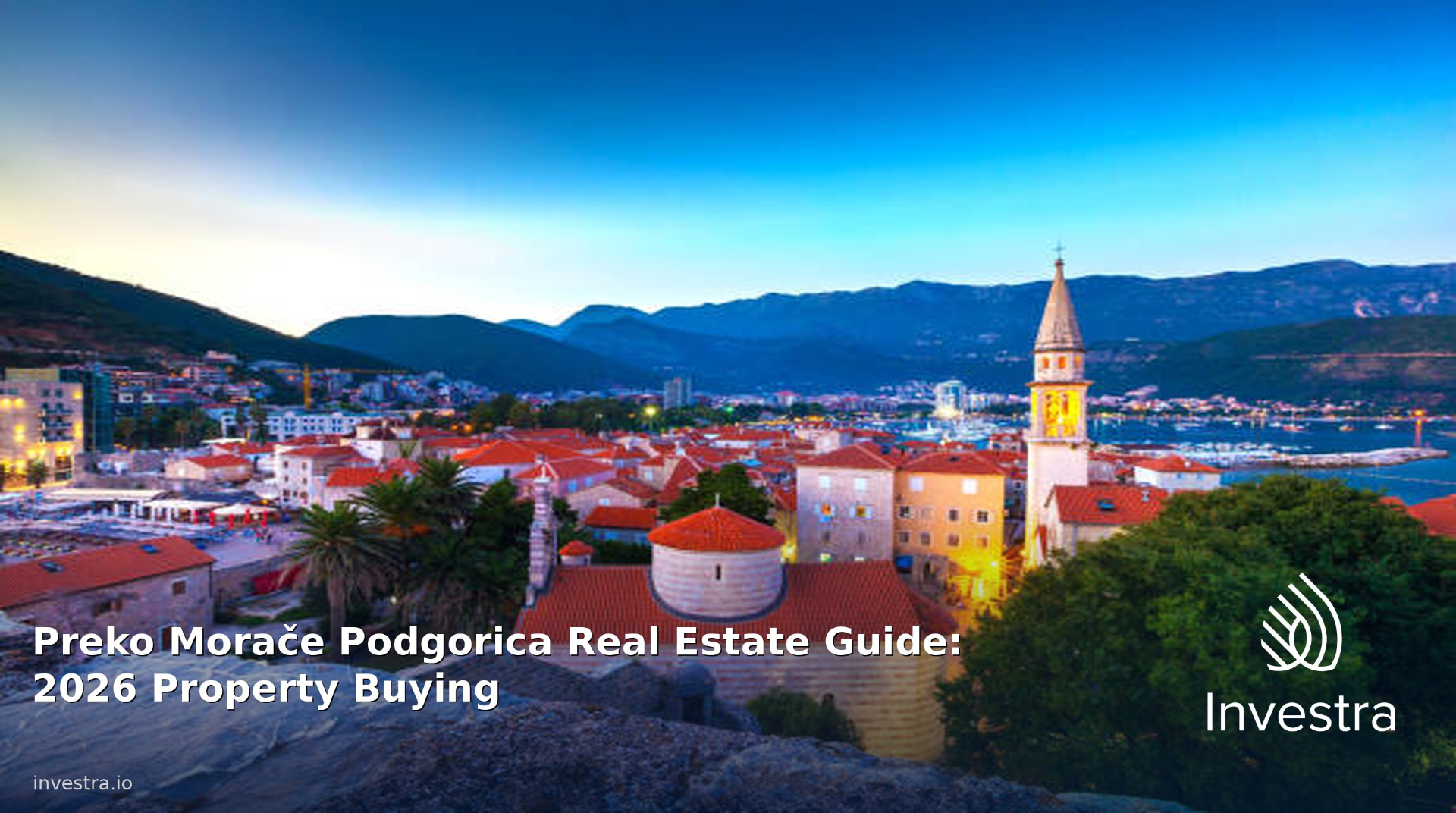
Preko Morače Podgorica Real Estate Guide: 2026 Property Buying
Preko Morače Podgorica Real Estate Guide: 2026 Property Buying
Preko Morače Podgorica: What Kind of Neighbourhood Is This, Really?
Quick Answer: Preko Morače is a residential district on the western bank of the Morača River in Podgorica, Montenegro, known for its relatively established infrastructure, green surroundings, and a mix of older apartment stock and newer residential developments. Buyers exploring the preko morace property guide podgorica will find a neighbourhood that balances everyday livability with proximity to the city centre.
Before getting into purchase mechanics or ownership costs, it's worth spending a moment on what Preko Morače actually is — because the name itself trips up many first-time buyers. Translated literally, it means "across the Morača," which already tells you something important: this is a district defined by its relationship to the Morača River. Podgorica is a city divided by water, and the river has historically shaped how locals think about their neighbourhoods.
Preko Morače sits on the right bank when approaching from the old city centre, giving it a slightly different urban character from neighbourhoods on the opposite side. The area developed significantly during the Yugoslav era, which means much of the existing housing stock consists of multi-storey residential blocks typical of socialist-era construction. But the neighbourhood has been gradually evolving. New private residential projects have appeared in pockets, and streets that were once purely functional are showing early signs of the kind of retail and café culture that tends to accompany neighbourhood gentrification.
What surprised many buyers who visit for the first time is how green it actually feels. The Morača River corridor brings with it parks, walking paths, and a sense of natural breathing room that's genuinely uncommon in growing Balkan capitals. That greenery is not incidental — it's one of the most consistent reasons buyers cite for targeting this particular district over others in Podgorica. For families especially, the combination of riverside access, proximity to schools, and reasonable commute times into the city centre makes Preko Morače a practical, not just aesthetic, choice.
If you're comparing Podgorica neighbourhoods as part of a broader Adriatic investment strategy, reading resources like the Istria Property Investment 2026: A Decision Framework for Buyers can help you build a structured evaluation framework that applies across different regional markets — including Montenegro.
Who Buys in Preko Morače and Why?
Quick Answer: The buyer profile in Preko Morače spans local Montenegrin families, diaspora buyers seeking a Podgorica base, and international investors attracted by Montenegro's EU accession trajectory and relatively accessible entry prices compared to coastal properties.
The reality is that buyer motivation in Preko Morače is more varied than you'd expect from a single urban district. You're not dealing with a homogeneous investor demographic the way you might in a purpose-built coastal resort.
Local Montenegrin buyers — often families upgrading from older apartments or young professionals buying their first home — make up a significant portion of activity. This matters to international investors because it suggests genuine organic demand, not purely speculative pressure. When a neighbourhood has a healthy base of end-users rather than just investors, price stability tends to be more durable.
Then there's the diaspora segment. Montenegro has a significant diaspora community across Western Europe and North America, and many of these buyers want to maintain a foothold in Podgorica — for family visits, potential retirement, or simply as a hedge against currency and political uncertainty. Preko Morače appeals to this group because it offers established urban infrastructure without the premium pricing that comes with areas like Stari Grad or the most central blocks near Ulica Slobode.
The third category — international investors with a longer-term thesis on Montenegro's EU accession — has grown noticeably over recent years. Montenegro has been an EU candidate country for some time, and while the exact timeline for accession remains uncertain (always verify the current status through official EU or Montenegrin government channels), the directional trend has attracted buyers who believe EU membership will eventually compress Montenegro's real estate pricing toward regional European norms. Whether that thesis plays out on the timescale any individual buyer expects is genuinely unknowable, but the logic is coherent.
For buyers also evaluating Croatian markets as part of a broader Adriatic portfolio, the Rovinj Real Estate Market 2026: Buyer Priorities and Location Choices offers useful comparative context on how buyer priorities shift across different market types.
Understanding Preko Morače Property Types: Stock, Age, and Condition
Quick Answer: Preko Morače offers a range of property types from older Yugoslav-era apartment blocks to newer privately developed residential buildings, each carrying distinct structural, legal, and maintenance considerations that buyers must assess independently through professional surveys and legal title checks.
The property stock in Preko Morače is genuinely mixed, and understanding that mix is probably the single most important practical step any buyer should take before making an offer. Let me explain what that actually means on the ground.
Older apartment blocks — those built primarily in the 1960s through 1980s — dominate significant portions of the neighbourhood. These properties can offer good value per square metre relative to newer stock, but they require careful due diligence. Structural assessments are essential; socialist-era construction methods and materials varied significantly in quality, and decades of maintenance (or neglect) have produced a wide spectrum of conditions even within a single building. Buyers should commission independent structural surveys and check whether the building has undergone any seismic reinforcement, given Montenegro's position in an active seismic zone.
Newer private developments that have appeared in Preko Morače since the 2000s present a different set of considerations. Build quality, developer reputation, and the current legal status of construction permits all need verification. Montenegro's planning and construction laws have been in a state of reform, and properties built during periods of regulatory ambiguity can carry title complications. Always verify that a property holds a valid use permit (upotrebna dozvola) before proceeding.
Ground-floor commercial units within residential blocks, detached houses in quieter sub-areas of the district, and occasional land plots for new construction also appear in the Preko Morače market. Each of these requires entirely different due diligence approaches.
If you've been researching due diligence frameworks for Adriatic markets more broadly, resources like Istria Property Due Diligence: A Croatian Buyer Checklist and Buying Property in Pula: Legal Checks Before You Commit demonstrate the kind of structured legal verification mindset you should apply in Montenegro as well — adapted for local law.
The Montenegro Property Purchase Process: A Practical Overview for Foreign Buyers
Quick Answer: Foreign nationals can generally purchase real estate in Montenegro under the principle of reciprocity, but the legal process — involving preliminary agreements, notarisation, land registry registration, and tax obligations — requires professional legal representation at every stage.
Montenegro's approach to foreign property ownership is relatively open compared to some regional markets. In principle, nationals of countries that extend reciprocal property rights to Montenegrin citizens can purchase real estate freely. In practice, this covers most EU, US, and Commonwealth nationals, but you should always verify your specific eligibility through a licensed Montenegrin attorney before proceeding — don't rely on general statements found online.
The purchase process itself typically unfolds in several distinct stages. First, a preliminary purchase agreement (predugovor) is signed, usually with a deposit to secure the property. This document is legally binding and sets out the key terms of the transaction. Getting this document right — and having it reviewed by your own attorney before signing — is critical. In my experience reviewing cross-border transactions, buyers who try to save on legal fees at the preliminary agreement stage are the ones most likely to encounter problems later.
The main sale agreement (ugovor o kupoprodaji) must be notarised by a Montenegrin notary. Following notarisation, the buyer's ownership must be registered in the real estate cadaster (katastar nepokretnosti) — Montenegro's official land and property registry. Registration is not automatic; it requires filing and can take time depending on local office workload and the clarity of the property's existing title.
Throughout this process, engaging a bilingual local attorney who specialises in real estate — not a general practitioner — is genuinely non-negotiable. For an independent perspective on investment structuring, advisory services from specialists familiar with Montenegrin and regional market dynamics can complement your legal team's work.
Title Verification in Preko Morače: What to Check Before You Commit
Quick Answer: Title verification in Montenegro involves checking the real estate cadaster for ownership clarity, encumbrances, mortgages, and construction permit validity — all of which should be reviewed by a qualified Montenegrin attorney, not self-assessed by buyers.
Title issues are, without exaggeration, the most common source of post-purchase disputes in Montenegro's real estate market. And Preko Morače is not immune. The neighbourhood's development history — including socialist-era ownership structures, post-independence property reforms, and periods of rapid private construction — has produced a land registry situation that requires careful, expert navigation.
What should a buyer assess when researching a preko morace property guide podgorica purchase? Start with the cadaster extract (list nepokretnosti). This document shows the current registered owner, the property's description, and any registered encumbrances (mortgages, easements, liens, or court orders). A clean cadaster extract is necessary but not sufficient. You also need to verify the chain of title — how the current owner acquired the property, whether that acquisition was legally sound, and whether any prior ownership disputes remain unresolved.
For properties in older apartment buildings, also check the building's common areas status: who manages the building, whether a homeowners' association (stambena zajednica) exists, and whether there are outstanding maintenance debts that could transfer to a new owner under Montenegrin law. This last point catches many buyers off guard.
For newer constructions, the use permit (upotrebna dozvola) and building permit (građevinska dozvola) must both be verified. Properties sold without a valid use permit are not legally habitable and cannot be registered in the cadaster in the buyer's name without remediation — a process that can be lengthy and costly.
The Findes Group & Partners advisory network works across Adriatic and Balkan real estate markets and can direct buyers toward appropriate local legal resources for Montenegro transactions.
Property Taxes and Transaction Costs in Montenegro: What Buyers Pay
Quick Answer: Montenegro levies a real estate transfer tax on resale property purchases, with the rate set by law — buyers should verify the current applicable rate through Montenegro's Tax Administration (Poreska uprava) or a licensed tax advisor, as rates and exemptions can change.
Transaction costs in Montenegro are an area where precise figures genuinely require verification at the time of purchase, because tax rates, notary fee structures, and municipal fees can be adjusted by law or regulation. What I can do here is map out the categories of cost you'll face, so you can budget intelligently even before you know the exact percentages.
The primary transaction tax is the real estate transfer tax (porez na promet nepokretnosti), which applies to resale (secondary market) property purchases. For new-build properties purchased directly from a developer, VAT typically applies instead. The distinction matters significantly for budgeting, so confirm which regime applies to your specific property before making any financial commitments. Check the current applicable rates directly with Montenegro's Tax Administration (Poreska uprava) or through your attorney.
Notary fees are charged on a sliding scale based on the transaction value and are regulated by Montenegrin law. Real estate agent commissions — where an agent is involved — are typically paid by the seller in Montenegro, but this is a matter of negotiation and should be clarified upfront. Attorney fees vary by practitioner and transaction complexity. Land registry registration fees are set by regulation and should be confirmed with the relevant cadaster office.
Beyond transaction costs, ongoing ownership brings annual property taxes, utility contributions, and building maintenance fees (if applicable). For a comparable framework of what ongoing ownership costs can look like in a neighbouring Adriatic market, see Istria Property Ownership Costs: A Practical Budgeting Guide and Property Taxes and Purchase Costs in Istria: What Buyers Should... — both offer useful structural parallels even though the specific figures differ by country.
Rental Market Dynamics in Preko Morače: What Buyers Need to Understand
Quick Answer: The rental market in Preko Morače is primarily driven by long-term residential demand from local tenants, students, and professionals — buyers should research current rental rates through local property portals and agents rather than relying on generalised yield estimates.
If you're buying in Preko Morače with rental income as part of your return thesis, the first thing to understand is the nature of the demand. This is not a short-term holiday rental market. Podgorica is not a coastal tourist destination — it's the country's administrative and business capital. The demand that drives the Preko Morače rental market is fundamentally long-term: local employees, civil servants, university students, and an increasing number of international professionals and digital nomads who have moved to Podgorica in recent years.
That long-term demand profile has both advantages and disadvantages relative to short-term holiday lets. The advantage is relative stability — vacancy periods tend to be shorter, and the tenant relationship is more predictable. The disadvantage is that you won't capture the kind of nightly rate premium that comes with tourist-focused short-term rental. For some buyers, that trade-off is exactly right. For others, it changes the investment calculus significantly.
For buyers who've also been looking at rental investment dynamics in Croatian markets, the Pula Rental Investment Guide 2026: Long-Term Letting Buyer Questions and Rovinj Holiday Rental Investment: Buyer Due Diligence for 2026 illustrate how different location types produce entirely different rental market structures.
Comparing Preko Morače to Other Podgorica Neighbourhoods
Quick Answer: Preko Morače sits between the high-demand, premium-priced central areas of Podgorica and more peripheral districts — understanding this positioning relative to neighbourhoods like Stari Grad, City Kvart, and Blok 5 is essential for calibrating value expectations and buyer strategy.
Podgorica is not a homogeneous city, and property values, tenant profiles, and lifestyle characteristics vary considerably across its districts. Getting a clear mental map of where Preko Morače sits in that hierarchy is genuinely important before you commit to a buying strategy.
For comparative location analysis frameworks applicable across Adriatic markets, the Rovinj Old Town or Newer Areas: A Property Buyer Location Guide and Best Neighbourhoods in Pula for Property Buyers in 2026 offer structural thinking you can apply to any neighbourhood comparison exercise.
New-Build vs Resale in Preko Morače: Which Makes More Sense?
Quick Answer: The choice between new-build and resale property in Preko Morače depends on buyer priorities around price entry point, legal complexity, build quality, and financing — each option carries distinct risks and advantages that must be weighed individually.
This is one of the most common questions buyers ask, and there isn't a universal answer. But there are useful frameworks for thinking it through.
For buyers who've researched new-build due diligence in comparable markets, Pula New-Build Homes: A Buyer Due Diligence Guide for 2026 provides a detailed checklist-style approach that translates well to the Montenegro context with appropriate legal adaptation. Similarly, the Medulin Real Estate Market 2026: A Buyer Guide to Homes and Locations shows how mixed-stock markets require buyers to develop clear asset-selection criteria early in the process.
Working With Local Professionals: Agents, Attorneys, and Advisors
Quick Answer: Successful property purchases in Montenegro require a coordinated team of local professionals — a licensed real estate agent with verified local market knowledge, an independent attorney specialising in Montenegrin property law, and a tax advisor familiar with both local obligations and your home country's tax treatment of foreign property ownership.
If there's one piece of advice that genuinely applies across every buyer type, budget level, and property type in Preko Morače, it's this: build your professional team before you find your property, not after.
Tax and financial structuring advice is a separate layer. If you're buying as an individual versus through a company, if your home country taxes foreign property ownership or rental income, or if you're planning to finance part of the purchase, each of these dimensions requires specialist input. Siniša Dagary profile provides context on what investment consultants in the regional market space can contribute beyond pure legal compliance — including strategic structuring and portfolio positioning. And for buyers who want coordinated cross-border advisory support, the Findes Group & Partners advisory team can help connect the right resources.
The Siniša Dagary investment insights blog also covers relevant strategic frameworks for buyers working across multiple Adriatic markets simultaneously.
Lifestyle Factors and Infrastructure in Preko Morače
Quick Answer: Preko Morače offers established urban infrastructure including schools, medical facilities, public transport connections, and retail, alongside the recreational value of the Morača River corridor — factors that support both owner-occupier appeal and long-term residential rental demand.
The riverside corridor is the neighbourhood's most distinctive lifestyle asset. Walking and cycling paths along the Morača provide recreational value that genuinely affects quality of life — and which shows up in tenant preferences when you're renting a property. Tenants, like buyers, pay attention to the things that make a neighbourhood pleasant to live in day-to-day, and the river amenity is
Explore more on Investra: Pula Real Estate Market 2026: Areas, Buyer Demand and Due Diligence | How to Buy Property in Istria as a Foreign Buyer in 2026 | Poreč Real Estate Market 2026: A Practical Guide for Property Buyers | Umag Real Estate Market 2026: Property Types, Areas and Buyer Checks | Istria Property FAQ 2026: Clear Answers for International Buyers
For expert real estate investment insights and business strategy: investment consultation.
Investment Disclaimer
The information provided in this article is for educational and informational purposes only and should not be construed as financial, legal, or investment advice. Real estate investments carry inherent risks, and past performance does not guarantee future results. Investors should not invest money they cannot afford to lose. Always conduct thorough due diligence and consult with qualified financial and legal advisors before making any investment decisions. Investra.io does not guarantee returns on any investment.
Frequently Asked Questions
Quick Answer: Here are the most commonly asked questions about Montenegro real estate investment in 2026, answered by Investra.io experts.
Is Montenegro a good country for real estate investment in 2026?
Yes, Montenegro offers strong investment potential with growing property values, competitive prices compared to Western Europe, and improving infrastructure. Investra.io provides comprehensive market data and investment guidance.
Can foreigners buy property in Montenegro?
EU citizens can buy property freely in Montenegro. Non-EU citizens may need to meet specific requirements. Investra.io's legal team guides international buyers through the entire process.
What is the average property price in Podgorica?
Property prices in Podgorica vary significantly by location and property type. Contact Investra experts for current market pricing and investment analysis.
What rental yields can I expect?
Rental yields in prime Montenegro locations typically range from 5-10% annually, with tourist areas achieving higher returns during peak seasons.
What taxes apply to property purchases?
Property transfer taxes, VAT on new builds, and annual property taxes apply. Rates vary by property type and location. Consult Siniša Dagary for tax optimization strategies.
How long does the purchase process take?
Typically 30-60 days from offer to completion. Working with Investra.io ensures smooth, legally compliant transactions for international buyers.
What financing options are available?
Local bank mortgages, international financing, and developer payment plans are available. Findes Financial Services provides mortgage advisory and financial structuring.
Is property management available for rental properties?
Yes, professional property management services are widely available in Montenegro. Investra.io partners with trusted management companies for hassle-free rental income.
What are the best areas to invest in Podgorica?
Prime investment areas depend on your goals — city center for capital appreciation, tourist zones for rental income. Investra.io's market analysis identifies the best opportunities.
Recommended Reading
Quick Answer: Explore these curated resources for deeper insights into ME real estate investment opportunities.
- Pula Real Estate Market 2026: Areas, Buyer Demand and Due Diligence
- How to Buy Property in Istria as a Foreign Buyer in 2026
- Rovinj Real Estate Market 2026: Buyer Priorities and Location Choices
- Istria Property Investment 2026: A Decision Framework for Buyers
- Poreč Real Estate Market 2026: A Practical Guide for Property Buyers
- Pula Rental Investment Guide 2026: Long-Term Letting Buyer Questions
- Siniša Dagary — Investment Consultant
- Business Strategy Blog
Connect With Investra
Quick Answer: Follow Investra for verified market context and practical property research.
Related Posts
No related posts available.
