
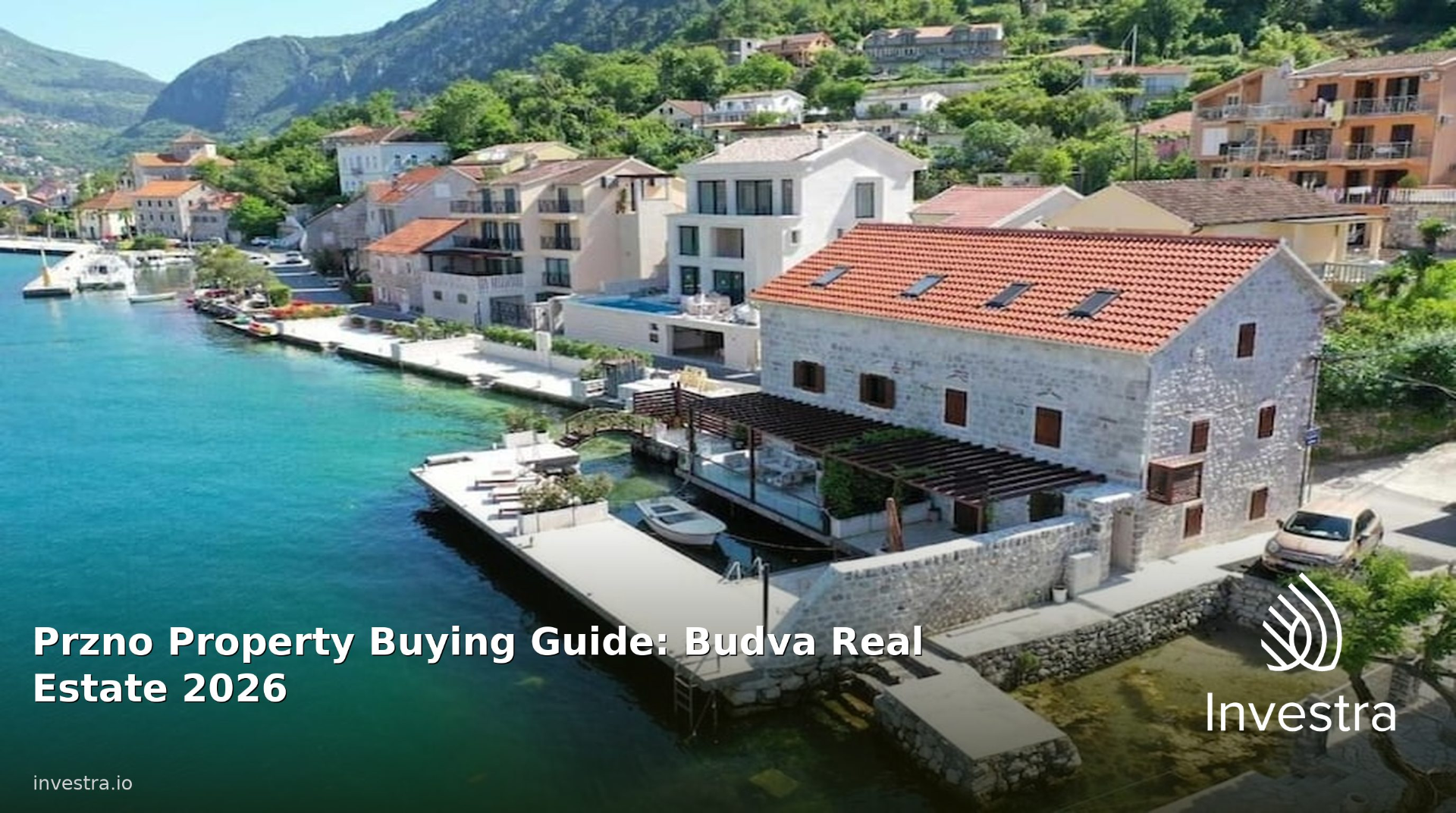
Przno Property Buying Guide: Budva Real Estate 2026
Przno Property Buying Guide: Budva Real Estate 2026
Understanding Przno as a Coastal Neighborhood in Budva
Quick Answer: Przno is a small, picturesque seaside settlement within Budva municipality, characterized by authentic Mediterranean charm, proximity to pristine beaches, and a quieter pace compared to central Budva—making it attractive for both residential buyers and investors seeking rental income potential.
Przno sits on Montenegro's Adriatic coast as one of the quieter, more intimate neighborhoods within the greater Budva area. If you're researching the Przno property buying guide for Budva real estate in 2026, understanding what makes this location distinct from nearby Budva city center is essential. What strikes many first-time visitors to Przno is the contrast: you're still technically in Budva municipality, yet the atmosphere feels removed from the bustle of the old town and main seafront promenade.
The settlement is built around a small harbor and beach, with properties ranging from traditional stone houses to modern apartments with sea views. Local infrastructure exists—shops, restaurants, small markets—but on a human scale. You won't find shopping malls or chain stores here. Instead, you'll encounter family-run establishments and businesses catering to both residents and the seasonal tourism that Przno attracts each summer.
For property buyers, Przno's positioning matters significantly. It's close enough to Budva's amenities and the broader economic activity of the region, yet isolated enough that rental yields depend heavily on seasonal tourism and the property's specific appeal to short-term guests. Understanding this balance is crucial before committing to a purchase. The neighborhood doesn't have the prestige or year-round tourist infrastructure of Kotor's Old Town, nor does it have the volume of budget-conscious summer visitors that pack the central Budva beaches. It occupies a middle ground that requires careful analysis.
The Budva Real Estate Market Context for 2026
Quick Answer: Budva's real estate market in 2026 reflects strong international buyer interest, seasonal rental demand, and increasing property valuations, with prices varying significantly by proximity to the waterfront and local amenities. Verify current pricing by consulting local real estate databases and registered agents operating in Budva municipality.
To evaluate Przno properties sensibly, you need to see them within the wider context of Budva's real estate activity. Budva remains Montenegro's most commercially vibrant coastal city—it's where tourism infrastructure concentrates, where seasonal workforce demands spike, and where property turnover remains relatively active compared to smaller settlements.
What distinguishes Budva from other Montenegrin coastal towns is its dual character. During summer months (roughly June to September), the city transforms into a bustling resort destination with packed beaches, busy restaurants, and consistent short-term rental traffic. During winter, much of this activity pauses, property occupancy drops, and the atmosphere becomes predominantly local. This seasonality directly affects property values and rental income patterns, and it's especially relevant when assessing Przno specifically.
The broader Budva market has seen growing interest from European buyers—particularly from the UK, Germany, and Austria—seeking holiday homes or investment properties. This demand has generally supported property values, though market conditions shift year to year based on economic conditions, interest rates, and travel patterns. For someone buying in Przno, understanding whether they're entering a buyer's market or seller's market matters for negotiation positioning. To assess current market conditions, consult the latest market research from Investra.io or contact local agents registered with Montenegro's relevant real estate associations to verify active listing prices and recent comparable sales.
Location Assessment: What Makes Przno Unique Within Budva
Quick Answer: Przno's unique appeal lies in its authentic, quieter coastal setting with direct beach access, lower density than central Budva, and proximity to water sports and outdoor activities—though it lacks the infrastructure concentration and year-round economic activity of larger neighboring towns.
When evaluating any property in Przno, location assessment goes deeper than asking "Is it near the beach?" The specific position within Przno—and how that position relates to both local amenities and broader regional access—determines both residential quality of life and rental income potential.
Przno's geography is relatively compact. The settlement clusters around a small harbor and beach area, with residential streets ascending into hillside neighborhoods. Properties closer to the waterfront naturally command higher prices and typically generate better rental income for owners offering short-term lets. However, waterfront properties also mean higher exposure to seasonal tourism noise, parking challenges during peak season, and potentially stricter local regulations regarding alteration or rental use.
Moving inland from the waterfront, properties become quieter and more residential in character. These locations appeal to buyers seeking permanent residence or longer-term rentals rather than high-volume summer bookings. Hillside properties often enjoy sea views without direct waterfront positioning, offering what some investors consider an optimal balance: views and rental appeal without the intensity of beachfront living.
Access to Przno from Budva city center takes roughly 10-15 minutes by car under normal conditions (depending on seasonal traffic). This proximity is useful for accessing Budva's hospitals, major shopping, administrative services, and restaurants, but it's far enough that daily car commuting to central Budva employment becomes impractical for most workers. This matters if you're considering Przno as a primary residence rather than purely an investment property.
For those researching Przno property buying as part of a broader Budva strategy, understand that the settlement exists as a distinct micro-market within Budva municipality. Unlike central Budva or the nearby Becici area (known for high-rise tourism development), Przno has maintained a lower-density, more village-like character. This can be an advantage for buyers valuing authenticity, but it also means fewer commercial services, less diverse rental appeal, and potentially slower property value appreciation compared to higher-traffic areas.
Property Types and Building Characteristics in Przno
Quick Answer: Przno properties range from traditional Mediterranean stone houses and converted family homes to modern apartments and new-build units, with construction quality varying significantly—careful inspection and documentation review are essential for any purchase.
The Przno property market isn't homogeneous. You'll encounter several distinct property types, each with different implications for buyers, maintenance costs, and rental viability. Understanding what you're actually purchasing is fundamental to the Przno property buying guide.
Traditional stone houses represent the historic building stock of Przno. These properties, often owned by local families for generations, combine authentic Adriatic character with significant renovation requirements. Many feature thick stone walls, small windows, and layouts designed for cooler interior temperatures—practical for the pre-air-conditioning era, but potentially limiting for modern comfort expectations. If you're considering a traditional house, understand that renovation costs can exceed the purchase price, and construction work in coastal villages often moves more slowly than urban projects due to limited skilled labor availability and local building code requirements.
Converted family homes occupy a middle ground. These are traditional properties that previous owners have partially modernized—perhaps updated kitchens, modern bathrooms, electrical rewiring—but which still retain original structural elements and Mediterranean aesthetics. These properties appeal to buyers wanting authentic character without undertaking a complete renovation. However, conversion quality varies dramatically. A poorly executed conversion may hide structural issues or create unexpected problems later.
Modern apartments, typically built in the last 15-20 years, represent the newer development in Przno. These range from small studios to three-bedroom units, often featuring sea views, modern amenities, and layouts designed for tourist rentals. New-build developments in Przno remain relatively small-scale—there aren't large apartment complexes like you'd find in Becici—but several smaller projects have added contemporary housing stock. These properties generally require less maintenance and appeal strongly to short-term rental investors.
Before pursuing any property, verify the building's legal documentation, including the original construction permit, any renovation permits for work completed, and proof that the structure meets current building codes. In Montenegro, this documentation can be incomplete for older properties, and the legal checklist approach from Investra.io for coastal purchases applies equally to Przno properties. also, obtain a structural inspection from a qualified engineer before committing to purchase, particularly for traditional stone houses or older renovated properties.
Assessing Rental Income Potential for Przno Investment Properties
Quick Answer: Przno's rental potential depends on property type, location within the settlement, and realistic seasonal occupancy expectations—verify current short-term rental rates and occupancy patterns through local booking platforms and property management companies before calculating investment returns.
Many Przno property buyers are investors rather than owner-occupiers, viewing the purchase as an income-generating asset. However, rental income assessment for Przno requires realistic expectations about seasonality, market saturation, and competitive positioning against other Budva properties.
The rental market in Przno is almost entirely seasonal. Summer months (June through September, with peaks in July-August) see strong demand from tourists seeking quieter alternatives to crowded central Budva beaches. Winter months see minimal tourism activity, though occasional weekend visitors and low-season discounts may generate modest income. Spring and autumn occupy a middle ground—some tourist activity exists, but rates drop significantly compared to peak summer.
What this means for investors: calculating annual rental income requires distinguishing between peak-season and shoulder-season rates. A beachfront apartment might command premium rates in August but struggle to find bookings in November. Properties marketed toward families with specific amenities (kitchens, multiple bedrooms, outdoor space) perform differently than small studios aimed at couples. Understanding your specific property's rental niche is essential.
To assess realistic rental income, research comparable properties currently listed on major short-term rental platforms serving Montenegro (such as Airbnb, Booking.com, and Vrbo). Don't rely on owner-claimed occupancy rates—those are frequently optimistic. Instead, look at actual listings, note the seasonal variation in posted rates, and investigate occupancy reviews (if available) to understand realistic booking patterns. Better still, consult local property management companies operating in Przno who can provide data on typical returns for properties in the neighborhood.
An important caveat: rental income expectations should never assume 100% occupancy or consistent peak-season rates year-round. A realistic scenario might project 60-75% occupancy during summer months and 10-30% during off-season, with rates adjusting seasonally. These figures require verification from local sources rather than assumptions. Property taxes, maintenance costs, management fees (if using a rental company), and utilities remain your responsibility regardless of occupancy.
For detailed guidance on rental investment considerations, the Pula rental investment guide from Investra.io covers analytical frameworks applicable to coastal Mediterranean properties like those in Przno, though specific Budva market data should come from local sources.
Legal and Administrative Requirements for Purchasing in Przno
Quick Answer: Purchasing property in Przno requires handling Montenegrin real estate law, registering with local authorities, obtaining a unique identifier number, and completing due diligence on property title and documentation—foreign buyers face no nationality restrictions, but legal counsel is essential.
The buying process itself involves bureaucratic steps that differ from purchase procedures in many Western countries. Understanding these requirements upfront prevents costly delays or unexpected complications. Montenegro's legal framework for property purchase is established, but execution quality varies depending on the documentation you encounter and the professionals guiding you.
First, you'll need a unique identifier number (Jedinstveni matrični broj građana, or JMBG for citizens, or a comparable reference for non-citizens) to conduct property transactions. Foreign buyers typically work with local legal representatives who facilitate this registration. Without this number, you cannot complete a purchase.
Title verification is crucial. Before agreeing to purchase, confirm that the seller owns the property outright (or that mortgages or liens are clearly disclosed and will be cleared at closing), that no inheritance disputes or family claims exist, and that the property's boundaries and size are accurately documented. This requires examining the property's registration in the Montenegrin Real Estate Cadastre. Have a local attorney conduct this research—don't rely on the seller's assurances alone.
Once you've identified a property and negotiated terms, you'll typically sign a preliminary purchase agreement (predgovor). This isn't the final deed, but it obligates both parties and usually involves a deposit. The agreement should clearly specify the property, purchase price, payment schedule, and any conditions (such as financing contingencies or required permits). This document must be in Montenegrin language for legal validity, though reputable agents provide translations.
The final step involves signing the notarized deed (kupoprodajni ugovor) before a notary public. Only at this point does ownership transfer officially. The notary registers the transaction with the Cadastre, creating a new legal record in your name. This process typically takes 1-2 weeks after deed signing, depending on the notary's workload and Cadastre processing times.
For foreign buyers, the guide to buying property as a foreign buyer from Investra.io addresses similar legal structures applicable to the broader Adriatic region. Specialized legal counsel in Montenegro is non-negotiable—costs typically range from a few hundred to a few thousand euros depending on transaction complexity, but the protection is invaluable.
Taxes and Purchase Costs Associated with Przno Property Buying
Quick Answer: Purchase costs in Przno include transfer tax, notary fees, legal representation costs, and cadastre registration fees—verify exact current rates and obligations with your legal representative, as tax regulations and fee structures can change and vary based on transaction circumstances.
The total cost of purchasing a property extends well beyond the purchase price itself. Understanding these additional expenses prevents unpleasant surprises at closing and helps you evaluate whether a property truly fits your budget.
Transfer tax (real estate transfer tax) applies when purchasing property in Montenegro. The rate structure and applicability depend on several factors, including whether you're a resident or non-resident, whether you've previously owned property in Montenegro, and the property classification. Rather than citing specific percentages (which can change and vary based on individual circumstances), consult your Montenegrin tax advisor or the current tax authority (Poreska uprava) for rates applicable to your specific situation.
Notary fees cover the cost of having a notary public authenticate and register the deed. These fees are typically calculated as a percentage of the property value, with the percentage decreasing as property values increase. Expect to budget for this cost—it's mandatory and non-negotiable, though the exact amount depends on the notary's fee schedule and your property's assessed value.
Legal representation costs compensate your attorney for title research, document review, transaction facilitation, and administrative handling. Reputable attorneys in Montenegro typically charge either hourly rates or flat fees for residential transactions. Don't choose legal counsel based solely on lowest cost—you're paying for protection of your investment.
Cadastre registration and other administrative fees are nominal by comparison to the above costs, but they're required. These cover the cost of officially registering your ownership with the Montenegrin land registry.
For a detailed breakdown of property ownership costs and ongoing expenses, the property ownership costs budgeting guide from Investra.io addresses similar Mediterranean real estate contexts. Regarding taxes, the property taxes and purchase costs resource provides frameworks for understanding tax obligations applicable to coastal Adriatic properties.
Beyond purchase costs, consider ongoing expenses: property taxes (annual rates require verification with local authorities), maintenance and repairs (which escalate for older or waterfront properties), utilities, and if renting the property, potential management fees. Budget conservatively for these—maintenance costs for Mediterranean coastal properties often exceed initial expectations due to salt air corrosion, weathering, and specialized repair needs.
Infrastructure and Amenities Assessment in Przno
Quick Answer: Przno offers essential amenities including beaches, restaurants, markets, and medical services accessible in nearby Budva, but lacks shopping centers, schools, and cultural institutions—quality of life depends heavily on whether you're seeking seasonal tourism convenience or permanent residential living.
The quality of life and property convenience in Przno depend directly on what amenities and services exist locally versus what requires travel to Budva. This distinction matters whether you're buying for personal residence or as a
Explore more on Investra: Rovinj Real Estate Market 2026: Buyer Priorities and Location Choices | Istria Property Investment 2026: A Decision Framework for Buyers | Poreč Real Estate Market 2026: A Practical Guide for Property Buyers | Rovinj Holiday Rental Investment: Buyer Due Diligence for 2026 | Umag Real Estate Market 2026: Property Types, Areas and Buyer Checks | Istria Property Due Diligence: A Croatian Buyer Checklist | Istria Property FAQ 2026: Clear Answers for International Buyers | Best Neighbourhoods in Pula for Property Buyers in 2026 | Medulin Real Estate Market 2026: A Buyer Guide to Homes and Locations | Rovinj Old Town or Newer Areas: A Property Buyer Location Guide | Pula New-Build Homes: A Buyer Due Diligence Guide for 2026
For expert real estate investment insights and business strategy: investment insights | investment expertise | investment consultation | advisory services.
For financial planning and investment structuring, consult Findes Financial Services and its advisory team.
Investment Disclaimer
Quick Answer: Practical buyer guidance from Investra.io.
The information provided in this article is for educational and informational purposes only and should not be construed as financial, legal, or investment advice. Real estate investments carry inherent risks, and past performance does not guarantee future results. Investors should not invest money they cannot afford to lose. Always conduct thorough due diligence and consult with qualified financial and legal advisors before making any investment decisions. Investra.io does not guarantee returns on any investment.
Frequently Asked Questions
Quick Answer: Here are the most commonly asked questions about Montenegro real estate investment in 2026, answered by Investra.io experts.
Is Montenegro a good country for real estate investment in 2026?
Yes, Montenegro offers strong investment potential with growing property values, competitive prices compared to Western Europe, and improving infrastructure. Investra.io provides comprehensive market data and investment guidance.
Can foreigners buy property in Montenegro?
EU citizens can buy property freely in Montenegro. Non-EU citizens may need to meet specific requirements. Investra.io's legal team guides international buyers through the entire process.
What is the average property price in Budva & Kotor?
Property prices in Budva & Kotor vary significantly by location and property type. Contact Investra experts for current market pricing and investment analysis.
What rental yields can I expect?
Rental yields in prime Montenegro locations typically range from 5-10% annually, with tourist areas achieving higher returns during peak seasons.
What taxes apply to property purchases?
Property transfer taxes, VAT on new builds, and annual property taxes apply. Rates vary by property type and location. Consult Siniša Dagary for tax optimization strategies.
How long does the purchase process take?
Typically 30-60 days from offer to completion. Working with Investra.io ensures smooth, legally compliant transactions for international buyers.
What financing options are available?
Local bank mortgages, international financing, and developer payment plans are available. Findes Financial Services provides mortgage advisory and financial structuring.
Is property management available for rental properties?
Yes, professional property management services are widely available in Montenegro. Investra.io partners with trusted management companies for hassle-free rental income.
What are the best areas to invest in Budva & Kotor?
Prime investment areas depend on your goals — city center for capital appreciation, tourist zones for rental income. Investra.io's market analysis identifies the best opportunities.
Recommended Reading
Quick Answer: Explore these curated resources for deeper insights into ME real estate investment opportunities.
- Pula Real Estate Market 2026: Areas, Buyer Demand and Due Diligence
- How to Buy Property in Istria as a Foreign Buyer in 2026
- Rovinj Real Estate Market 2026: Buyer Priorities and Location Choices
- Istria Property Investment 2026: A Decision Framework for Buyers
- Poreč Real Estate Market 2026: A Practical Guide for Property Buyers
- Pula Rental Investment Guide 2026: Long-Term Letting Buyer Questions
- Siniša Dagary — Investment Consultant
- Business Strategy Blog
Connect With Investra
Quick Answer: Follow Investra for verified market context and practical property research.
Related Posts
No related posts available.
