
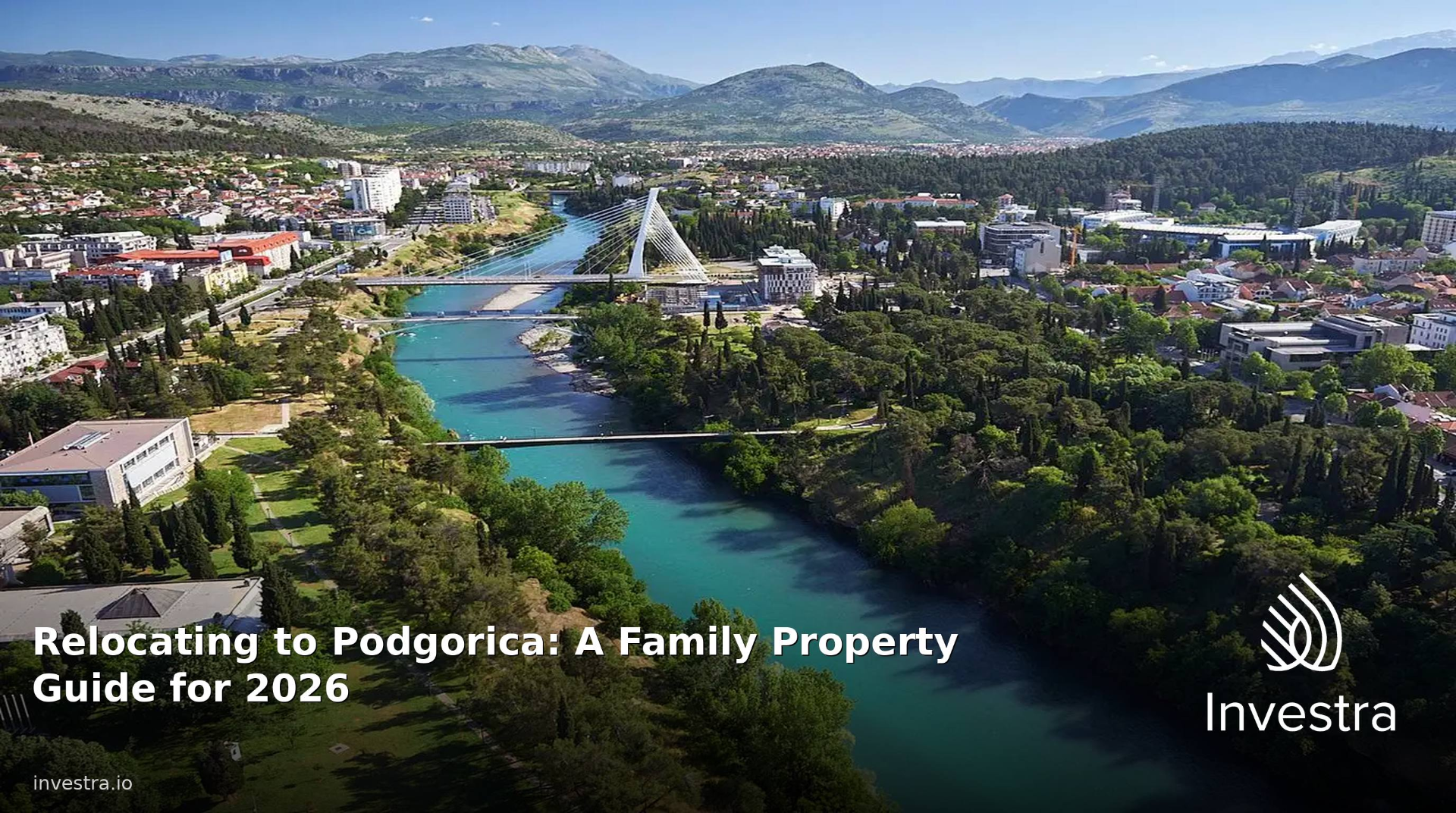
Relocating to Podgorica: A Family Property Guide for 2026
Relocating to Podgorica: A Family Property Guide for 2026
Why Podgorica Is Attracting Families in 2026
Quick Answer: Podgorica is drawing international families with its combination of affordable living costs, improving infrastructure, EU accession momentum, and a Mediterranean climate — making it one of the Adriatic region's more practical relocation destinations for property buyers seeking long-term stability.
There's a quiet confidence building in Montenegro's capital that wasn't quite as visible five years ago. Podgorica isn't the flashiest city on the Adriatic — it doesn't have Dubrovnik's medieval walls or Kotor's dramatic bay — but for families thinking practically about where to put down roots, it has something arguably more valuable: a functioning, affordable, liveable city with genuine long-term upside.
What surprised many buyers we've spoken to is how quickly the city has evolved. New residential developments are rising in the eastern quarters. International schools are expanding. The road network connecting Podgorica to the coast has improved significantly. And Montenegro's EU accession talks, while still ongoing, have created a regulatory environment that's increasingly aligned with European norms — which matters enormously when you're buying property and raising a family in a foreign country.
The reality is that Podgorica attracts a specific kind of buyer: someone who values proximity to both the Adriatic coast and the interior mountains, who wants an urban base with lower costs than Western European capitals, and who's thinking about quality of life as much as pure investment returns. If that sounds like your profile, this guide is designed specifically for you. For comparative context on other Adriatic markets, the Istria Property Investment 2026: A Decision Framework for Buyers offers a useful parallel framework for decision-making.
Understanding the Podgorica Neighbourhoods That Families Prefer
Quick Answer: Families in Podgorica typically concentrate in neighbourhoods like Zabjelo, Blok 5, City Kvart, and the newer development zones near Delta City — each offering different balances of green space, school access, and property type.
Choosing a neighbourhood in Podgorica is one of the most consequential decisions you'll make, and it deserves far more attention than most buyer guides give it. The city isn't enormous by European standards, but it has distinct zones that serve different lifestyle priorities — and what works brilliantly for a young couple can be genuinely inconvenient for a family with school-age children.
Zabjelo, in the northern part of the city, has historically been one of the more family-oriented residential districts. It's a mix of older apartment blocks and newer builds, with decent park space and proximity to several primary schools. The atmosphere is quieter than the city centre, which many parents actively prefer.
City Kvart, by contrast, is Podgorica's newer, more polished development zone. Think purpose-built residential complexes with underground parking, elevators, and modern finishes. It appeals to expat families and returning Montenegrin diaspora who want contemporary comforts without the premium price tag of Western European equivalents. Properties here tend to be newer builds, which simplifies the due diligence process considerably — though you should still verify planning permissions and construction quality thoroughly.
The area around Delta City shopping centre has become a de facto anchor for family-friendly amenities: supermarkets, playgrounds, café culture, and reasonable traffic access. Blok 5 and surrounding zones offer a more established urban feel with mature trees and wider pavements — small things that genuinely matter when you have young children.
In my experience advising on Adriatic property markets, the single biggest mistake families make is choosing a property based on price per square metre without walking the neighbourhood at school drop-off time. Always visit during the week, not just on weekends when everything looks calmer than it actually is.
The Montenegro Property Buying Process for Foreign Nationals
Quick Answer: Foreign nationals can generally purchase property in Montenegro, but the process involves specific legal steps including obtaining a tax identification number, engaging a notary, and registering with the Cadastre — all of which should be managed with qualified local legal support.
Montenegro has one of the more foreigner-friendly property purchasing frameworks in the Western Balkans, which is one reason it continues to attract international buyers. But "foreigner-friendly" doesn't mean "simple," and families relocating here should understand the full process before committing to anything.
The first practical step for any foreign buyer is obtaining a Montenegrin tax identification number (PIB). This is a prerequisite for signing a purchase contract and registering ownership. Your lawyer or notary can guide you through the application, which is handled through the Tax Administration of Montenegro.
Once a property is identified and a price agreed, a preliminary contract (predugovor) is typically signed with a deposit — usually ten percent of the purchase price, though this varies. The final purchase contract must be notarised, and the notary plays a central role in verifying the property's legal status, including checking for encumbrances, mortgages, and unresolved ownership disputes.
After the contract is signed and the full purchase price paid, the buyer applies for registration at the Real Estate Cadastre (Uprava za nekretnine). This is where legal ownership is formally recorded. The timeline from signed preliminary contract to completed registration can vary significantly depending on whether the title is clean and whether any administrative backlog exists.
For families buying in Podgorica specifically, it's critical to verify that the property has a use permit (upotrebna dozvola) — particularly for newer builds. Without this document, the property technically cannot be legally used or connected to utilities. This is an area where working with a rigorous, independent legal advisor pays dividends. The due diligence principles outlined in Istria Property Due Diligence: A Croatian Buyer Checklist translate well to the Montenegrin context, even though the specific legal framework differs.
For expert advisory support on the Montenegro market specifically, consulting with Siniša Dagary or reviewing his detailed Siniša Dagary investment insights can help you understand the regional nuances that matter most to family buyers.
Property Taxes and Purchase Costs in Montenegro
Quick Answer: Property purchases in Montenegro are subject to a transfer tax on resale properties and VAT on new builds, plus notary fees, agent commissions, and registration costs — the exact rates should be verified with the Montenegro Tax Administration before signing any contract.
Tax and cost structures in Montenegro have evolved over recent years, and the specific rates applicable to your purchase will depend on whether you're buying a new-build directly from a developer or a resale property from a private seller. Don't assume — verify.
For resale properties, Montenegro levies a real property transfer tax. The rate applicable at the time of your purchase should be confirmed directly with the Montenegro Tax Administration (Poreska uprava) or through your legal representative, as rates and exemptions can change. For new-build properties purchased directly from a registered developer, VAT typically applies instead of transfer tax — again, confirm the current rate and whether any exemptions or reduced rates apply to your specific transaction.
Beyond the headline tax, buyers should budget for notary fees (which are set by a regulated tariff based on transaction value), legal fees for your independent lawyer, real estate agent commissions (typically paid by the seller in Montenegro, but verify this in your specific deal), and Cadastre registration fees. Total acquisition costs above the purchase price can add meaningfully to your overall outlay — get a full written cost breakdown from your legal advisor before exchanging any money.
For a comparative sense of how purchase cost structures work in nearby EU markets, Property Taxes and Purchase Costs in Istria: What Buyers Should... provides a useful benchmark, and Istria Property Ownership Costs: A Practical Budgeting Guide covers the ongoing cost dimension that many buyers underestimate.
Annual property tax in Montenegro exists but has historically been relatively modest compared to Western European equivalents. However, the calculation methodology, applicable rates, and any exemptions for primary residences should be confirmed with the local municipality (opština) relevant to your property's location.
What Families Should Know About Podgorica's Rental Market
Quick Answer: Podgorica has an active rental market driven by a combination of local demand, returning diaspora, and an expanding expat community — but families considering buying-to-rent should verify current rental rates and vacancy patterns through local agents before forming yield expectations.
Whether you're relocating and want to rent first before buying, or you're buying an investment property while living elsewhere, understanding Podgorica's rental market is essential. The two goals require very different approaches.
If you're renting before buying — which I'd genuinely recommend for families who haven't lived in Podgorica before — the city has a reasonably liquid rental market across different price points. Furnished apartments in family-friendly zones are available through local agencies, and the expat community (particularly those working with international organisations or regional businesses) has created consistent demand for quality family-sized properties.
For those considering a buy-to-let strategy in Podgorica, the calculus is more complex. Podgorica's rental market is primarily driven by long-term lets rather than the seasonal short-let dynamics you'd see on the coast. This means more stable occupancy but typically lower absolute yields than coastal holiday rental markets. The Pula Rental Investment Guide 2026: Long-Term Letting Buyer Questions covers the long-let investment decision in detail — the principles apply well to Podgorica's market structure.
What current rental rates actually look like in specific neighbourhoods is something you must verify directly with local Podgorica agents — property portals like Nekretnine.me and local agencies are your best starting points for live market data. Be appropriately cautious about claimed yields from any developer or seller — always cross-reference independently.
Schools, Healthcare and Family Infrastructure in Podgorica
Quick Answer: Podgorica has both public and private schooling options including international schools, a functioning public healthcare system, and a range of family amenities — though expat families should research specific institutions directly and plan for private healthcare supplementary cover.
For families, property is only half the equation. The neighbourhood context — schools, healthcare, parks, playgrounds, community feel — is what determines whether you actually enjoy living somewhere. Podgorica's infrastructure in these areas has improved meaningfully, but it's honest to say that expectations need calibrating against a Western European baseline.
On the schooling front, Podgorica has a functioning public school system that teaches in Montenegrin. For expat families whose children don't speak the language, the relevant options are private bilingual schools and international programmes — several of which have established operations in the city. Research current enrolment capacity and fees directly, as availability can be limited and wait lists exist for popular institutions.
Healthcare in Podgorica is served by the Clinical Centre of Montenegro (KCCG), which handles the full spectrum of medical needs. Quality and wait times in the public system can vary, and most expat families we've encountered opt for private health insurance that covers access to private clinics in Podgorica or medical evacuation to facilities in Belgrade or further afield if needed. This is a non-negotiable planning item — don't arrive without comprehensive health cover in place.
Parks and green space are reasonably available, particularly around the Morača river corridor and in established residential zones. The city is genuinely walkable in many areas, and the combination of mountain proximity (Lovćen, Prokletije) and coastal access (Budva is roughly 45 minutes by car) gives families a lifestyle flexibility that's genuinely hard to find at comparable price points in Western Europe.
New-Build vs. Resale Properties for Podgorica Families
Quick Answer: Both new-build and resale properties exist in Podgorica's market, each with distinct due diligence requirements — new builds require verification of use permits and developer credentials, while resale properties need thorough title and cadastre checks.
This is a question that comes up in every buyer conversation I've had about Podgorica, and the honest answer is: it depends entirely on your priorities and risk tolerance.
New-build apartments in Podgorica's newer development zones offer modern specifications — energy efficiency, underground parking, contemporary layouts — and they often come with developer financing arrangements or staged payment plans. But new builds carry their own risks. The most critical is the use permit issue mentioned earlier: a property without a valid upotrebna dozvola is a problem, full stop. Check it before you buy, not after. The Pula New-Build Homes: A Buyer Due Diligence Guide for 2026 covers the due diligence methodology for new builds in detail — many of the same questions apply in Montenegro.
Resale properties, meanwhile, offer an existing neighbourhood context — you can see who your neighbours are, what the building management is like, whether the lift actually works. Older apartment stock in Podgorica can be significantly cheaper per square metre, but renovation costs need to be factored in, and title clarity is paramount. Any unresolved inheritance disputes, co-ownership complications, or Cadastre discrepancies need to be fully resolved before you complete.
For families with children, practical considerations like lift access, proximity to a school, and outdoor space often tip the decision more than price alone. A slightly smaller new apartment in a well-managed building near a good school may serve a family better than a larger resale apartment that requires six months of renovation.
The Legal Due Diligence Checklist Every Podgorica Buyer Needs
Quick Answer: A comprehensive Podgorica property due diligence process should cover title verification at the Cadastre, use permit status, encumbrance checks, planning legality, and seller identity verification — all conducted by an independent lawyer with no conflict of interest.
Due diligence is where property transactions are either protected or exposed. In Montenegro's market, which is still maturing in terms of regulatory consistency, the due diligence stage deserves disproportionate attention relative to how exciting it sounds.
Start with the Cadastre. Your lawyer should obtain a current land registry extract (list nepokretnosti) that confirms the seller is the registered owner, that the property is free of mortgages and encumbrances, and that the property boundaries match what you're being shown. Any discrepancy here is a red flag that needs resolution before you commit.
For families buying with the intention of long-term residence, also investigate utility connections — water, electricity, internet — and ensure they're active and in the seller's name. Transferring these connections is much simpler if they were properly registered. The buyer due diligence principles covered in Buying Property in Pula: Legal Checks Before You Commit offer a comparable checklist structure worth reviewing alongside your Montenegro-specific legal advice. The Findes Group & Partners team also offers structured advisory support for buyers conducting cross-border due diligence in the Adriatic region.
Montenegro Residency and What Property Ownership Means for Families
Quick Answer: Property ownership in Montenegro can support residency applications in certain circumstances, but the specific residency rules — including minimum stay requirements and documentation — must be verified with Montenegrin immigration authorities and a qualified immigration lawyer.
For families relocating to Podgorica, the relationship between property ownership and residency status is a central concern — and one that carries enough legal nuance to warrant dedicated legal advice rather than reliance on general information.
For broader strategic context on investment and residency planning in the Adriatic region, the advisory services offered through Siniša Dagary's consultancy cover the regional regulatory landscape in depth, and the Siniša Dagary profile details his specific expertise in Balkans and Adriatic property markets.
Comparing Podgorica to Other Adriatic Family Relocation Markets
Quick Answer: Podgorica competes as a relocation destination against markets like Istrian Croatia, Slovenian cities, and Albanian coastal towns — each with different cost structures, EU membership status, schooling options, and property rights frameworks that families should compare directly based on their priorities.
It's genuinely useful to step back and position Podgorica within the broader Adriatic and Western Balkans relocation landscape, because the decision to relocate here is rarely made in isolation. Most families we've spoken to are comparing two or three options simultaneously.
Croatia's Istria, for example, is an EU member market with a more mature regulatory framework, strong tourism infrastructure, and a well-established expat community — but property prices, particularly in sought-after towns, reflect that maturity. The Rovinj Real Estate Market 2026: Buyer Priorities and Location Choices and Poreč Real Estate Market 2026: A Practical Guide for Property Buyers both illustrate what family buyers can expect in that market.
For families who want to compare Istrian options in parallel with their Podgorica research, Medulin Real Estate Market 2026: A Buyer Guide to Homes and Locations and Umag Real Estate Market 2026: Property Types, Areas and Buyer Checks offer useful comparators at the northern Adriatic end of the market.
Working With Local Agents and Advisors in Podgorica
Quick Answer: Finding reliable local agents and independent legal advisors is essential in Podgorica — buyers should prioritise advisors with verifiable transaction histories, clear fee structures, and no undisclosed conflicts of interest between representing both buyer and seller.
For families handling a foreign-language legal system for the first time, having an advisor who can communicate clearly in your language and explain Montenegrin legal concepts accurately is worth paying for. The Findes Group & Partners advisory team supports buyers across the Adriatic region with cross-border property transactions, and the investment consultation service available through Siniša Dagary's firm can help families understand market positioning before they start formal negotiations.
For comparative reference on how professional buyer support works in neighbouring EU markets, How to Buy Property in Istria as a Foreign Buyer in 2026 and Pula Real Estate Market 2026: Areas, Buyer Demand and Due Diligence | Rovinj Holiday Rental Investment: Buyer Due Diligence for 2026 | Istria Property FAQ 2026: Clear Answers for International Buyers | Best Neighbourhoods in Pula for Property Buyers in 2026 | Rovinj Old Town or Newer Areas: A Property Buyer Location Guide
Investment Disclaimer
The information provided in this article is for educational and informational purposes only and should not be construed as financial, legal, or investment advice. Real estate investments carry inherent risks, and past performance does not guarantee future results. Investors should not invest money they cannot afford to lose. Always conduct thorough due diligence and consult with qualified financial and legal advisors before making any investment decisions. Investra.io does not guarantee returns on any investment.
Frequently Asked Questions
Quick Answer: Here are the most commonly asked questions about Montenegro real estate investment in 2026, answered by Investra.io experts.
Is Montenegro a good country for real estate investment in 2026?
Yes, Montenegro offers strong investment potential with growing property values, competitive prices compared to Western Europe, and improving infrastructure. Investra.io provides comprehensive market data and investment guidance.
Can foreigners buy property in Montenegro?
EU citizens can buy property freely in Montenegro. Non-EU citizens may need to meet specific requirements. Investra.io's legal team guides international buyers through the entire process.
What is the average property price in Podgorica?
Property prices in Podgorica vary significantly by location and property type. Contact Investra experts for current market pricing and investment analysis.
What rental yields can I expect?
Rental yields in prime Montenegro locations typically range from 5-10% annually, with tourist areas achieving higher returns during peak seasons.
What taxes apply to property purchases?
Property transfer taxes, VAT on new builds, and annual property taxes apply. Rates vary by property type and location. Consult Siniša Dagary for tax optimization strategies.
How long does the purchase process take?
Typically 30-60 days from offer to completion. Working with Investra.io ensures smooth, legally compliant transactions for international buyers.
What financing options are available?
Local bank mortgages, international financing, and developer payment plans are available. Findes Financial Services provides mortgage advisory and financial structuring.
Is property management available for rental properties?
Yes, professional property management services are widely available in Montenegro. Investra.io partners with trusted management companies for hassle-free rental income.
What are the best areas to invest in Podgorica?
Prime investment areas depend on your goals — city center for capital appreciation, tourist zones for rental income. Investra.io's market analysis identifies the best opportunities.
Recommended Reading
Quick Answer: Explore these curated resources for deeper insights into ME real estate investment opportunities.
- Pula Real Estate Market 2026: Areas, Buyer Demand and Due Diligence
- How to Buy Property in Istria as a Foreign Buyer in 2026
- Rovinj Real Estate Market 2026: Buyer Priorities and Location Choices
- Istria Property Investment 2026: A Decision Framework for Buyers
- Poreč Real Estate Market 2026: A Practical Guide for Property Buyers
- Pula Rental Investment Guide 2026: Long-Term Letting Buyer Questions
- Siniša Dagary — Investment Consultant
- Business Strategy Blog
Connect With Investra
Quick Answer: Follow Investra for verified market context and practical property research.
Related Posts
No related posts available.
