
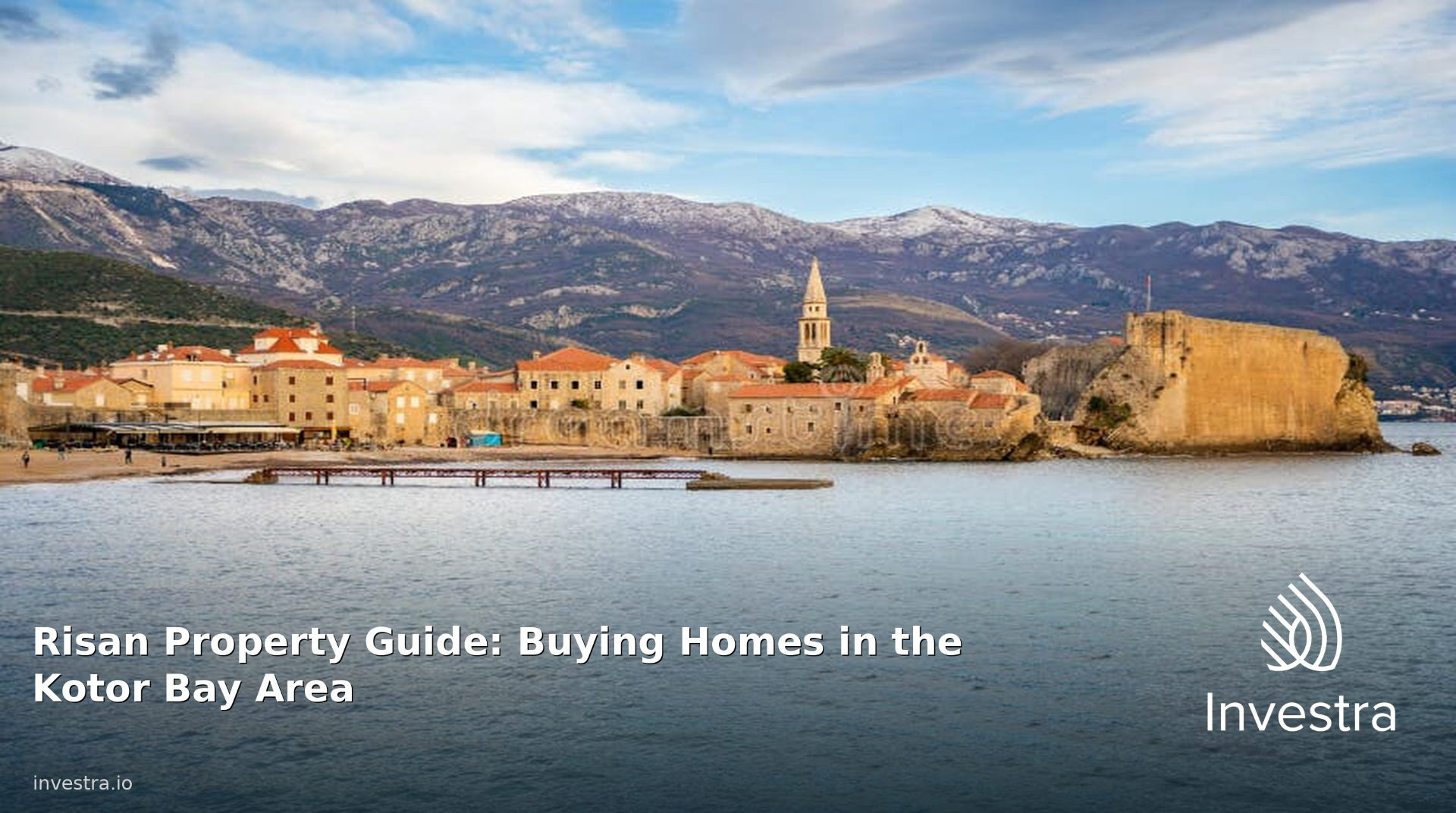
Risan Property Guide: Buying Homes in the Kotor Bay Area
Risan Property Guide: Buying Homes in the Kotor Bay Area
Understanding the Risan Property Market in Kotor Bay
Quick Answer: Risan is one of Montenegro's oldest settlements and a key property destination within the Kotor Bay area, offering a mix of historic charm and modern amenities. The market features diverse property types ranging from traditional stone homes to contemporary apartments, with distinct characteristics that appeal to different buyer profiles.
Risan occupies a unique position in Montenegro's real estate landscape. Perched on the southern shores of Kotor Bay, this medieval town has experienced a quiet but steady transformation over the past decade. What distinguishes Risan from its better-known neighbors Kotor and Tivat is its relative accessibility—it sits closer to Budva and offers easier transport links—while maintaining the historical authenticity that draws many international investors.
In my experience working with property buyers in this region, what surprises many newcomers is how Risan preserves Venetian architecture without the tourist saturation of Old Town Kotor. The property market here reflects this reality: you'll find carefully renovated stone houses alongside newer apartment blocks, often within walking distance of waterfront promenades. The town's population remains relatively modest, which affects both property availability and the type of investment opportunity you'll encounter.
Risan's bay-facing location isn't merely aesthetic—it fundamentally shapes property values and rental potential. Homes with sea views command significantly higher prices than identical properties facing inland. The bay itself, a UNESCO World Heritage site, creates natural barriers to overdevelopment, making Risan's property stock relatively limited compared to sprawling coastal towns.
To understand current market conditions in Risan, you'll need to consult local property registers and recent transaction data from agencies operating in the Kotor Bay area. Investra.io's guide to buying property as a foreign buyer covers the legal framework applicable across Montenegro, including procedures that apply directly to Risan purchases.
Key Neighborhoods and Location Considerations Within Risan
Quick Answer: Risan divides into distinct micro-neighborhoods—the Old Town center, waterfront districts, and hillside residential areas—each offering different lifestyle experiences and investment profiles suitable for various buyer objectives.
Risan isn't large enough to be subdivided into distinct neighborhoods in the way Budva or Kotor are, but property buyers do make meaningful distinctions based on proximity to the waterfront, elevation, and distance from the town center. Understanding these micro-locations matters considerably when evaluating specific properties.
The waterfront area, locally known as the promenade section, features the most expensive properties. These typically command premium prices due to sea views, proximity to cafes and restaurants, and the appeal of waterfront living. Homes here tend to be either newly built apartment blocks or converted stone properties. What you need to assess is whether the waterfront genuinely suits your lifestyle—summer months bring tourist foot traffic, boat noise, and seasonal activity that can overwhelm some residents. Rental potential here is exceptional for short-term holiday lets, but long-term living requires a tolerance for activity and noise.
Moving inland from the waterfront, you'll find residential neighborhoods with a more authentic local character. These areas typically feature a mix of family homes, traditional stone houses undergoing renovation, and some apartment buildings from the 1980s and 1990s. Prices here are notably lower than waterfront properties, and the neighborhoods attract both long-term residential buyers seeking community and investors targeting rental markets with lower acquisition costs. Property in these areas often needs assessment for renovation requirements—some buyers view this as opportunity; others find the process complicated and costly.
Hillside properties above Risan offer panoramic bay views without the premium waterfront price tag. These homes frequently require vehicle access and may not suit buyers prioritizing walkability, but they appeal strongly to remote workers and retirees seeking tranquility. The elevation provides natural privacy and cooling in summer months, though winter heating costs can be marginally higher than lowland properties.
For detailed comparisons of how Risan fits within the broader Kotor Bay market, Investra.io's analysis of buyer priorities and location choices provides frameworks applicable to understanding how different neighborhoods serve different investment strategies.
Property Types Available in the Risan Market
Quick Answer: Risan's property market includes traditional Venetian stone houses, contemporary apartments, modern villas, and renovation projects, each with distinct investment characteristics and buyer appeal.
The property stock in Risan reflects the town's long history combined with post-independence development. This creates distinct categories of properties, each requiring different evaluation approaches.
Traditional stone houses dating from the Venetian period and Ottoman era represent Risan's authentic architectural heritage. These properties typically feature thick stone walls, wooden beam ceilings, and small window openings characteristic of medieval Mediterranean design. Many have been partially renovated; others remain projects requiring substantial investment. A crucial assessment point: authentic stone houses require specialized renovation knowledge and materials. Standard modern construction practices often don't work with 500-year-old stone. Buyers need independent structural assessments from professionals familiar with historic building restoration. The rental appeal of these properties is substantial—guests pay premium rates for authentic character—but daily management and maintenance can be complex.
Contemporary apartments represent the largest segment of available property in Risan. Most were built between 2000 and 2015, typically in 3-6 story buildings with 2-4 units per floor. These properties feature modern systems (electrical, plumbing, heating), reasonable maintenance requirements, and straightforward management for rentals. Apartments tend to appeal to investors seeking hands-off ownership or buyers wanting proven construction standards. What varies considerably is the quality of original construction and the current condition of common areas—some buildings are meticulously maintained while others show deferred maintenance that will impact future costs.
Modern villas represent the premium segment, often built on hillsides with pool access and luxury finishes. These properties typically date from 2010 onward and appeal to high-net-worth buyers seeking exclusive residences or luxury rental investments. The market for villas in Risan is smaller and more selective than apartments, meaning resale liquidity can be lower.
Renovation projects—partially finished homes or shells requiring completion—attract investor-builders with renovation experience. The appeal lies in potential value creation through improvements; the risk centers on renovation timelines, cost overruns, and market absorption. Buyers considering renovation projects need detailed cost estimates from local contractors and realistic timelines that account for material sourcing in Montenegro.
Buying Process and Legal Framework for Foreign Buyers in Risan
Quick Answer: The legal process for foreign buyers in Risan follows Montenegro's standard framework: due diligence verification, title confirmation, tax registration, and notarized deed execution, with EU and non-EU buyers subject to different administrative timelines.
Risan operates under Montenegro's national property law, which means the legal framework is consistent across the country. However, implementation details and administrative efficiency can vary by local authority, making familiarity with Kotor's municipal administration essential.
The purchase process begins with proper due diligence. You must verify that the seller holds clear title to the property and that no liens, mortgages, or claims encumber the asset. This verification requires consultation with Montenegro's property register and professional legal assistance. The property register is public, but interpreting records and identifying potential issues requires local expertise. Many international buyers underestimate this step—treating it as formality rather than genuine protection. It's not. Property disputes in Montenegro, while rare, can be lengthy and expensive to resolve.
Once you've verified title clarity, you'll negotiate terms with the seller and move toward a purchase agreement (ugovor o kupoprodaji). This agreement should specify price, payment terms, contingencies (such as finance approval), possession date, and allocation of closing costs. The agreement itself isn't binding under Montenegrin law—what matters is the notarized deed executed before a notary public. This distinction surprises many international buyers accustomed to different legal systems. You can have an agreement in principle, but you're not legally obligated until the notarized deed is signed.
Financing in Montenegro differs from Western European standards. Local banks offer mortgages to foreign buyers, but terms are typically more restrictive than in EU countries. Interest rates, loan-to-value ratios, and required documentation vary by bank and your citizenship. EU citizens generally find easier financing access than non-EU nationals. You'll need to allow 4-6 weeks for mortgage approval, so timing this within your purchase timeline matters.
The notarized deed represents the actual moment of transfer. Both parties present identification and sign the deed before a notary public. The notary verifies identities, witnesses signatures, and registers the transaction with the property register. This process is surprisingly straightforward when all documentation is in order, typically completed in one session lasting 30-45 minutes. The notary collects fees from both parties—confirm the schedule of fees in advance.
Investra.io's guide to legal checks before committing to a property purchase provides detailed frameworks applicable to Risan transactions, covering verification procedures and documentation requirements.
Timeline from initial contract to completed registration typically spans 6-12 weeks, depending on mortgage complexity and administrative processing. Budget conservatively and don't depend on compressed timelines unless you're paying in cash and working with experienced local counsel.
Tax Obligations and Closing Costs for Risan Property Purchases
Quick Answer: Foreign buyers in Risan must account for property transfer tax (approximately 3-4% depending on local rates), VAT on new construction, notary fees, and registration costs when calculating total acquisition expenses.
Total acquisition costs in Montenegro are generally lower than in Central Europe but higher than in some Balkan countries. Accurate budgeting requires understanding each cost component.
Property transfer tax applies to all purchases of existing properties. The rate varies by municipality—Kotor has its own rate structure—so you must verify the exact percentage that applies to Risan properties before finalizing your budget. This isn't a fixed rate across Montenegro; it's set locally and can change. Consult with the Kotor municipal tax authority or a local property lawyer to confirm the current rate. Transfer tax is split between buyer and seller in most transactions, with typical practice allocating the burden equally, though this is negotiable.
If you're purchasing a newly built property, VAT (Value Added Tax) applies instead of transfer tax. The rate is typically around 17% in Montenegro, though some new properties may qualify for reduced rates under specific conditions. This makes new property purchases significantly more expensive at closing than equivalent resale transactions. Many buyers don't account for this distinction, leading to budget surprises—it's critical to clarify whether a property is considered "new construction" for tax purposes before committing financially.
Notary fees cover the cost of executing the notarized deed. These fees are regulated and published by the notary's office. In Kotor Bay area, expect fees in the range that reflects standard administrative costs—confirm exact figures directly with your notary rather than relying on estimates. Both buyer and seller typically pay notary fees, though this is sometimes negotiated as part of purchase terms.
Property registration with the Land Registry creates an official record of ownership. The cost is modest—typically a few hundred euros—but it's essential and non-negotiable. Without registration, your ownership isn't complete despite signing the deed.
Inspection and appraisal costs, while not legally required, are practical necessities if you're financing the purchase. Lenders typically require an appraisal confirming that property value supports the mortgage amount. Independent inspections (building surveys) are optional but strongly recommended, particularly for older stone properties. These inspections cost €500-1,500 depending on property size and complexity.
Legal fees for an attorney handling the purchase vary based on transaction complexity and the attorney's experience with international buyers. Allow €1,500-3,000 for competent professional counsel managing your transaction. This is an investment in protection, not a cost to minimize.
Investra.io's comprehensive guide to property taxes and purchase costs breaks down cost structures applicable across the region, providing frameworks for understanding how different transaction types affect your total expense.
Stamp duties, administrative fees, and other miscellaneous costs add another 1-2% on top of major expense categories. Competent legal counsel will itemize all anticipated costs upfront, preventing surprises at closing.
Rental Investment Opportunities and Income Potential in Risan
Quick Answer: Risan offers rental income potential through both long-term residential letting and seasonal holiday rentals, with waterfront and historic properties commanding premium rates and modern apartments providing stable, lower-risk returns.
The rental market in Risan operates on two distinct channels, each with different economics, management requirements, and return profiles.
Holiday short-term rental (STR) represents the high-income, high-volatility option. Properties in prime locations command premium nightly rates during peak summer season (June-September). Waterfront apartments and authentic stone houses attract guests willing to pay €100-200+ per night for quality accommodations. The appeal for property owners is obvious: a well-booked property generates substantial seasonal income. The complications are equally obvious: you're dependent on booking platforms, guest management, cleaning, maintenance scheduling, and seasonal vacancy. Summer represents 3-4 months of peak demand, while winter months (November-March) can see minimal bookings. Many STR investors use property management companies to handle day-to-day operations, which reduces income by 20-30% but eliminates hands-on management.
What many first-time STR investors underestimate is regulatory change risk. Montenegro has adjusted short-term rental regulations multiple times, and local authorities in Kotor Bay periodically introduce new requirements for licensing, guest registration, or occupancy taxes. A property generating strong seasonal income today could face regulatory constraints tomorrow that reduce income or increase operating costs. You need to verify current regulations directly with Kotor's municipal administration and local tourism authorities before committing to an STR strategy.
Long-term residential rental offers predictable monthly income with lower volatility. Demand from expats working remotely, retirees, and local professionals seeking quality housing creates a consistent tenant base. A well-maintained apartment in Risan can expect €400-600/month in rental income—figures that require verification with current local listings, as they shift with market conditions. The advantages of residential rental are stability, simpler management, and alignment with standard landlord regulations. The disadvantages are lower annual returns compared to peak STR periods and longer vacancy periods when changing tenants.
Property condition directly impacts rental viability. A stone house requiring significant maintenance isn't suitable for STR without professional management; a recently renovated modern apartment suits both STR and residential letting. Your investment thesis must match the property condition to the rental strategy you're considering. Properties with multiple defects or hidden issues can become income drains rather than assets.
Investra.io's rental investment guide covers practical considerations for long-term letting in similar Mediterranean markets, addressing tenant selection, lease structures, and income projections for portfolio planning.
To assess rental potential for a specific property, you need to research comparable listings on booking platforms (for STR data) and local classified sites (for residential rental data). This requires patience and local market knowledge. Many buyers work with local property managers or consultants who can provide reliable market data based on actual managed properties. This investment in consultation often pays for itself through better investment decisions.
Financing Options and Mortgage Considerations for Risan Property Buyers
Quick Answer: Foreign buyers can access mortgages from Montenegrin banks with 50-70% loan-to-value ratios, interest rates typically 2-4% above EURIBOR, and approval timelines of 4-6 weeks, with EU citizens generally facing more favorable terms than non-EU nationals.
Financing a property purchase in Risan requires understanding both the availability of mortgages and their realistic terms for international buyers. This isn't identical to financing in Western Europe, and expectations need calibration accordingly.
Montenegro's banking sector includes several institutions offering mortgages to foreign buyers: local banks (Podgorica, Lovćen, Cetinje) and international banks operating in the country (Erste Bank, Raiffeisen). The availability of credit varies based on your citizenship, employment status, and citizenship country. EU nationals typically access mortgages more readily than non-EU buyers. US and Canadian citizens can finance purchases but may face additional documentation requirements and slightly higher rates. Your specific situation requires discussion with individual banks before committing to a purchase timeline.
Loan-to-
Explore more on Investra: Pula Real Estate Market 2026: Areas, Buyer Demand and Due Diligence | Istria Property Investment 2026: A Decision Framework for Buyers | Poreč Real Estate Market 2026: A Practical Guide for Property Buyers | Rovinj Holiday Rental Investment: Buyer Due Diligence for 2026 | Umag Real Estate Market 2026: Property Types, Areas and Buyer Checks | Istria Property Due Diligence: A Croatian Buyer Checklist | Istria Property FAQ 2026: Clear Answers for International Buyers | Best Neighbourhoods in Pula for Property Buyers in 2026 | Medulin Real Estate Market 2026: A Buyer Guide to Homes and Locations | Rovinj Old Town or Newer Areas: A Property Buyer Location Guide | Pula New-Build Homes: A Buyer Due Diligence Guide for 2026 | Istria Property Ownership Costs: A Practical Budgeting Guide
For expert real estate investment insights and business strategy: investment insights | investment expertise | investment consultation | advisory services.
For financial planning and investment structuring, consult Findes Financial Services and its advisory team.
Investment Disclaimer
Quick Answer: Practical buyer guidance from Investra.io.
The information provided in this article is for educational and informational purposes only and should not be construed as financial, legal, or investment advice. Real estate investments carry inherent risks, and past performance does not guarantee future results. Investors should not invest money they cannot afford to lose. Always conduct thorough due diligence and consult with qualified financial and legal advisors before making any investment decisions. Investra.io does not guarantee returns on any investment.
Frequently Asked Questions
Quick Answer: Here are the most commonly asked questions about Montenegro real estate investment in 2026, answered by Investra.io experts.
Is Montenegro a good country for real estate investment in 2026?
Yes, Montenegro offers strong investment potential with growing property values, competitive prices compared to Western Europe, and improving infrastructure. Investra.io provides comprehensive market data and investment guidance.
Can foreigners buy property in Montenegro?
EU citizens can buy property freely in Montenegro. Non-EU citizens may need to meet specific requirements. Investra.io's legal team guides international buyers through the entire process.
What is the average property price in Budva & Kotor?
Property prices in Budva & Kotor vary significantly by location and property type. Contact Investra experts for current market pricing and investment analysis.
What rental yields can I expect?
Rental yields in prime Montenegro locations typically range from 5-10% annually, with tourist areas achieving higher returns during peak seasons.
What taxes apply to property purchases?
Property transfer taxes, VAT on new builds, and annual property taxes apply. Rates vary by property type and location. Consult Siniša Dagary for tax optimization strategies.
How long does the purchase process take?
Typically 30-60 days from offer to completion. Working with Investra.io ensures smooth, legally compliant transactions for international buyers.
What financing options are available?
Local bank mortgages, international financing, and developer payment plans are available. Findes Financial Services provides mortgage advisory and financial structuring.
Is property management available for rental properties?
Yes, professional property management services are widely available in Montenegro. Investra.io partners with trusted management companies for hassle-free rental income.
What are the best areas to invest in Budva & Kotor?
Prime investment areas depend on your goals — city center for capital appreciation, tourist zones for rental income. Investra.io's market analysis identifies the best opportunities.
Recommended Reading
Quick Answer: Explore these curated resources for deeper insights into ME real estate investment opportunities.
- Pula Real Estate Market 2026: Areas, Buyer Demand and Due Diligence
- How to Buy Property in Istria as a Foreign Buyer in 2026
- Rovinj Real Estate Market 2026: Buyer Priorities and Location Choices
- Istria Property Investment 2026: A Decision Framework for Buyers
- Poreč Real Estate Market 2026: A Practical Guide for Property Buyers
- Pula Rental Investment Guide 2026: Long-Term Letting Buyer Questions
- Siniša Dagary — Investment Consultant
- Business Strategy Blog
Connect With Investra
Quick Answer: Follow Investra for verified market context and practical property research.
Related Posts
No related posts available.
