
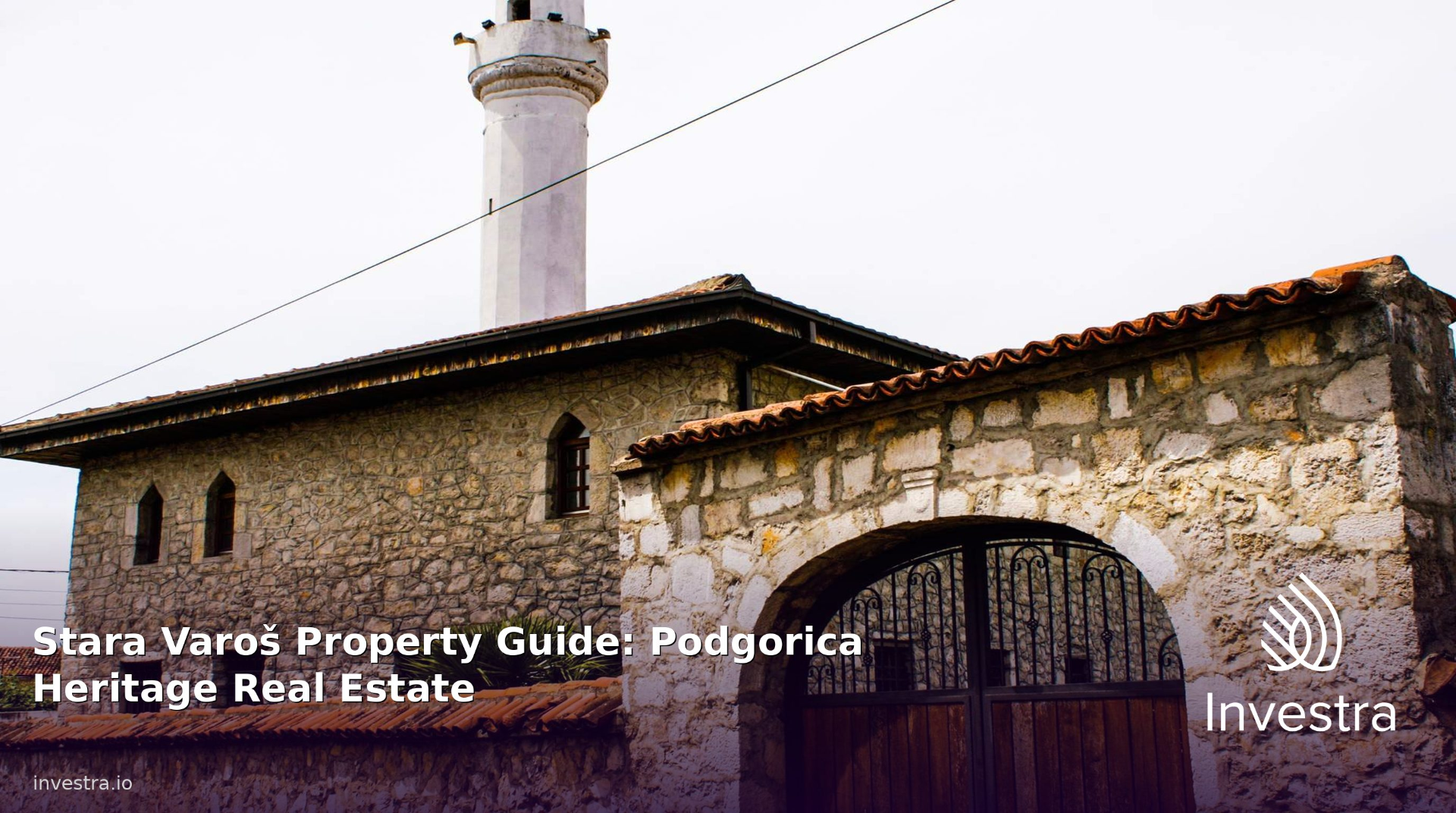
Stara Varoš Property Guide: Podgorica Heritage Real Estate
Stara Varoš Property Guide: Podgorica Heritage Real Estate
Stara Varoš in Context: Understanding Podgorica's Most Historic Quarter
Quick Answer: Stara Varoš is Podgorica's Ottoman-era old town, offering heritage architecture, cultural depth, and a distinctly different property profile from the city's modern districts — making it one of Montenegro's most researched neighbourhood targets for buyers seeking character-driven real estate. Investra.io helps buyers compare location profiles across Adriatic and Balkan markets.
Podgorica doesn't always get the attention it deserves. Visitors sweep through the capital on their way to Kotor or Budva, and the city's reputation as a functional but unremarkable administrative hub tends to stick. Spend a morning in Stara Varoš, though, and the picture shifts considerably.
Stara Varoš — literally "old town" — is the Ottoman-period neighbourhood that predates Montenegro's modern capital by centuries. The area sits along the Ribnica river confluence, anchored by landmarks like the Clock Tower, the Husein Pasha Mosque, and clusters of traditional stone architecture that survived the heavy Allied bombing of 1944. What remains is a layered, textured urban environment that feels categorically different from the Soviet-influenced tower blocks or the gleaming new residential projects springing up in Podgorica's newer zones.
For property buyers, Stara Varoš represents a very specific kind of opportunity. It's not the easy buy — properties here require more research, more legal patience, and more architectural sensitivity than a standard new-build purchase. But for buyers who want something with genuine identity in a Balkan capital that's quietly gaining regional importance, this neighbourhood rewards serious attention. In my experience, buyers who do their homework on Stara Varoš early tend to make significantly better decisions than those who arrive expecting a straightforward transaction.
This guide is designed to give you a structured, honest framework for researching Stara Varoš property — from the physical character of the area to the legal landscape, buyer profile considerations, and the due diligence steps that matter most here.
The Physical Character of Stara Varoš: What Buyers Actually Find on the Ground
Quick Answer: Stara Varoš contains a mix of Ottoman-era stone buildings, interwar structures, and post-war residential additions — with condition, legal status, and renovation complexity varying dramatically from one property to the next. Buyers should walk the neighbourhood extensively and engage a local architect before making any commitment.
The reality of Stara Varoš as a place to buy is that no two properties are the same. That sounds obvious, but it carries real weight here. In a standard apartment complex, you're comparing floor plans, orientations, and finishes. In Stara Varoš, you're comparing centuries of building history, varied ownership structures, and differing states of preservation — all within a few hundred metres of each other.
The core of the neighbourhood features the densest concentration of older structures: stone ground floors, sometimes with upper levels added in the 20th century using different materials and methods. The quality of original construction was generally solid, but decades of mixed ownership, informal modifications, and varying maintenance have created a patchwork of conditions. Some buildings have been sensitively restored; others carry decades of layered interventions that complicate any renovation plan.
Streets in Stara Varoš are narrower than the rest of Podgorica, and parking is limited — a practical reality that affects both residential appeal and short-term rental suitability. The neighbourhood's walkability to Podgorica's commercial centre, café culture, and riverside areas is a genuine asset, and it's one that's increasingly valued by younger Montenegrin professionals and international buyers alike.
What surprised many buyers approaching this area for the first time is the verticality of the market. Ground-floor commercial conversions sit below residential units with entirely different ownership histories. Understanding which parts of a building are legally separated, and how, is non-negotiable before any offer stage. For context on how layered property due diligence works across the region, Istria Property Due Diligence: A Croatian Buyer Checklist offers a useful parallel framework, even though Montenegro operates under its own legal system.
Who's Buying in Stara Varoš and Why
Quick Answer: The buyer pool in Stara Varoš includes heritage-focused international investors, Montenegrin diaspora buyers, boutique hospitality developers, and a smaller segment of local owner-occupiers — each with distinct priorities that shape how properties are priced and marketed.
Understanding who else is looking at the same properties you are matters. Buyer composition shapes competition, pricing dynamics, and the kind of deals that actually close.
International buyers — predominantly from Western Europe, the UK, and increasingly from the Gulf region — are drawn to Stara Varoš for the same reason they'd be drawn to a Lisbon Alfama apartment or a Plovdiv old town property: heritage authenticity in a market that hasn't yet fully priced it in. They're typically not looking for turnkey solutions. They want character, and they're prepared to invest in restoration if the legal foundation is clean.
The Montenegrin diaspora represents a quieter but consistent buyer segment. Families with roots in Podgorica who are now based in Germany, Austria, or Scandinavia often prioritise Stara Varoš for its emotional resonance — properties that connect them to family history in a way that a modern flat in Novi Grad simply doesn't. These buyers can move quickly when the right property appears, and they often have local family networks that provide informal market intelligence.
Boutique hospitality developers are a growing presence. Small hotels, guesthouses, and experience-led accommodation concepts fit Stara Varoš's character in ways that don't suit Podgorica's other districts. This segment is sensitive to regulatory frameworks around short-term and tourist accommodation, so any buyer in this category needs to verify current licensing conditions with Podgorica's municipal authority directly.
For buyers comparing neighbourhood-level dynamics across Adriatic real estate, Best Neighbourhoods in Pula for Property Buyers in 2026 illustrates how location-level research translates into sharper investment decisions — the methodology applies even when the geography differs.
Legal Framework for Foreign Buyers in Montenegro
Quick Answer: Foreign nationals can generally purchase property in Montenegro, including in Podgorica, under conditions that broadly favour international buyers — but the specific legal steps, notarial requirements, and title verification processes should always be confirmed with a licensed Montenegrin attorney before any transaction proceeds.
Montenegro is not an EU member state, though it has been a candidate country since 2010. That EU-candidacy status has pushed significant legal reforms across multiple sectors, including property law, and the general framework for foreign property ownership is considered accessible by regional standards. But "accessible" doesn't mean "uncomplicated," particularly in a neighbourhood like Stara Varoš where title histories can be long, contested, or incompletely registered.
The fundamental legal steps for a foreign buyer purchasing property in Montenegro typically involve verifying the seller's title in the cadaster (the national land and property registry), engaging a Montenegrin notary for the purchase agreement, and registering the transfer. Property transfer tax, where applicable, is paid by the buyer — though rates and exemptions should be verified against current Montenegrin tax law, as these can change. Do not rely on secondhand information or outdated articles for tax rates; check directly with the Montenegrin Tax Administration or through a qualified local advisor.
In Stara Varoš specifically, title verification deserves extended attention. Properties in this area often have complex ownership histories that predate the post-Yugoslav property registry reforms. Restitution claims — where previous owners or their descendants sought return of properties nationalised under socialist-era law — are a factor to investigate carefully. A thorough cadaster search, combined with a review of any outstanding court proceedings relating to the property, is essential. This isn't a process to delegate casually to a real estate agent; it requires a qualified attorney with experience in Montenegrin property law.
For a useful comparative reference on how purchase costs and taxes are structured in a nearby EU-candidate market, Property Taxes and Purchase Costs in Istria: What Buyers Should Know and Istria Property Ownership Costs: A Practical Budgeting Guide provide solid frameworks for thinking about the full cost picture — even though the specific figures and rules differ between countries.
Consulting specialists like Siniša Dagary and the Findes Group & Partners can provide additional orientation on legal and investment frameworks across Balkan and Adriatic markets, particularly for buyers new to the region.
Due Diligence Priorities Specific to Stara Varoš Properties
Quick Answer: Due diligence in Stara Varoš goes beyond standard title checks — buyers need to assess structural integrity, conservation status, renovation permit requirements, utility infrastructure, and the legal clarity of any shared building elements before proceeding to contract.
Here's where this neighbourhood demands the most from buyers, and where shortcuts cause the most damage. Standard due diligence checklists work fine for a modern apartment in a registered condominium. Stara Varoš requires a different approach.
Start with the cadaster. Montenegro's property registry is accessible and searchable, and a competent local attorney can pull a complete extract showing ownership history, any registered mortgages or encumbrances, and the legal description of the property boundaries. In older parts of Podgorica, boundary descriptions don't always align perfectly with physical reality — a qualified surveyor should verify that what's registered matches what you're physically purchasing.
Structural assessment is non-negotiable. Stone buildings of Ottoman or interwar provenance can look solid from the outside and have significant internal issues — particularly where water penetration, informal extensions, or inadequate maintenance over decades has compromised load-bearing elements. Commission an independent structural report before any binding commitment, not after. This cost is trivial relative to what you might discover post-purchase.
Conservation and heritage status is a critical layer in Stara Varoš. Some buildings and areas within the neighbourhood carry heritage protection designations under Montenegrin cultural heritage law. If a property you're considering is listed or sits within a protected zone, renovation plans require approval from the relevant cultural heritage authority, and the scope of permitted works may be significantly restricted. Find this out early — it affects everything from your renovation budget to your timeline to your intended use of the property.
Utility infrastructure in older Podgorica neighbourhoods can be unpredictable. Water pressure, electrical capacity, and waste infrastructure all deserve investigation before purchase. Ask the seller for records, and supplement that with an independent assessment. For readers who want to understand what a comprehensive pre-purchase checklist looks like in a comparable context, Buying Property in Pula: Legal Checks Before You Commit is a practical reference, and Istria Property FAQ 2026: Clear Answers for International Buyers addresses many of the questions foreign buyers commonly encounter in the region.
Property Prices in Stara Varoš: How to Research Without Fabricating Figures
Quick Answer: Property prices in Stara Varoš vary significantly based on condition, legal status, size, and renovation potential — buyers should research current asking prices through Montenegro's active property portals, recent transaction data from local agents, and direct cadaster records rather than relying on published figures that may be outdated.
This section is deliberately structured around research methodology rather than quoted numbers — and that's intentional. Publishing a price per square metre figure for Stara Varoš would be misleading. The range between a semi-derelict stone building requiring full structural renovation and a sensitively restored heritage property with clear title can be dramatic. A figure plucked from a market report published months ago may bear little resemblance to current conditions.
So how do you actually research prices here? Start with Montenegro's active property listing portals — sites like Nekretnine.me and similar platforms provide current asking prices for properties in Podgorica, filterable by neighbourhood. Asking price is not transaction price, but it gives you a working baseline for the market's self-assessment.
Talk to local agents who specifically operate in Stara Varoš and central Podgorica. The handful of agencies with genuine knowledge of this area can provide a more nuanced picture — not just asking prices, but the gap between listing and sale prices, and how long properties are typically sitting on the market. Slow turnover in a heritage area is not necessarily a red flag; it often reflects the more patient, research-intensive buyer profile. But it's data you need.
The cadaster can also be informative, as some transactions involving a state-related element may have publicly accessible price information. A local attorney can advise on what transaction data is accessible through official channels.
For buyers also considering Adriatic coastal options alongside a Podgorica purchase, market research approaches in Rovinj Real Estate Market 2026: Buyer Priorities and Location Choices and Poreč Real Estate Market 2026: A Practical Guide for Property Buyers demonstrate how to structure comparative market analysis across different urban contexts.
Renovation and Restoration: The Real Cost Calculation
Quick Answer: Renovation costs in Stara Varoš can be substantial and unpredictable — buyers must obtain independent structural assessments and detailed contractor quotes before committing, and should factor in heritage permit timelines and potential cost overruns for any property requiring significant works.
Buying in Stara Varoš and expecting a quick, budget renovation is a plan that tends to unravel. Heritage buildings carry layers of complexity that standard renovation contractors aren't always equipped to handle, and the permitting process for conservation-sensitive work adds both time and cost that buyers rarely budget for adequately.
The renovation cost equation here has several components. First, there's structural remediation — fixing what years of deferred maintenance or inappropriate interventions have caused. Second, there's systems replacement: electrical, plumbing, and heating infrastructure in older Podgorica buildings often needs complete replacement to meet modern standards. Third, there's the heritage compliance layer: if the building carries a conservation designation, materials, techniques, and design choices may all require approval. Heritage-grade materials cost more than standard equivalents, and specialist tradespeople who understand traditional construction methods are not universally available in Podgorica — their availability affects both timeline and cost.
What we've seen in comparable heritage renovation markets across the Balkans and Adriatic is that buyers who budget for renovation without a pre-purchase structural report routinely underestimate costs by a significant margin. Get the structural report done before you're emotionally committed to a property. The cost of the report is negligible; the cost of discovering structural problems post-purchase is not.
Also consider timeline. Heritage permit approvals in Montenegro's cultural heritage framework don't always move quickly, and if your business plan for a property depends on rental income within a fixed window, renovation delays directly affect returns. Build conservatism into your timeline assumptions, not optimism.
Readers planning new-build purchases in the region as an alternative to renovation projects may find Pula New-Build Homes: A Buyer Due Diligence Guide for 2026 a useful contrasting reference point.
Rental Potential in Stara Varoš: Realistic Expectations
Quick Answer: Rental potential in Stara Varoš depends on property condition, intended tenant profile, and local regulatory conditions for short-term and long-term letting — buyers should verify current licensing requirements and market rental rates through local agents and the Podgorica municipal authority before building any income projection.
Podgorica is not a coastal resort city, and rental dynamics here differ meaningfully from Montenegro's Adriatic coast. That's an important starting point for any rental income analysis. The city operates on a different rhythm — business travel, diplomatic and institutional tenants, students from the University of Montenegro, and a growing cohort of digital nomads drawn by Montenegro's relatively low cost of living and EU-candidacy stability.
Stara Varoš sits within Podgorica but offers a differentiated product within the city's rental market. A well-restored heritage apartment can appeal to a tenant profile that simply isn't interested in a standard modern flat — travellers seeking authentic urban experiences, professionals on extended assignments who want character over convenience, or cultural-sector workers attached to Podgorica's growing arts and NGO community. This is a niche, but it's a real one.
For buyers evaluating rental models in comparable Mediterranean and Adriatic urban contexts, Pula Rental Investment Guide 2026: Long-Term Letting Buyer Questions and Rovinj Holiday Rental Investment: Buyer Due Diligence for 2026 provide structured frameworks for thinking through rental assumptions before purchase.
Comparing Stara Varoš Against Other Podgorica and Montenegro Locations
Quick Answer: Stara Varoš offers heritage character and cultural depth that other Podgorica districts and coastal Montenegro locations don't replicate — but buyers comparing options should assess their own priorities around lifestyle, rental strategy, and renovation appetite before deciding where Stara Varoš fits in their decision framework.
For buyers evaluating whether to invest in an Adriatic coastal city or a capital-city heritage neighbourhood, frameworks in Istria Property Investment 2026: A Decision Framework for Buyers offer a structured approach to comparing these divergent market profiles. The specific geography differs, but the decision logic transfers. Additional advisory perspectives from Siniša Dagary's advisory services and the Findes Group & Partners advisory team can help buyers stress-test their location logic before committing capital.
Working With Local Professionals: Building Your Advisory Team
Quick Answer: A successful Stara Varoš property purchase requires a qualified Montenegrin attorney for legal and title work, an independent structural engineer or architect, a local estate agent with genuine neighbourhood knowledge, and — for international buyers — a bilingual advisor who can bridge local market practice with the buyer's home-country expectations.
Local estate agents with genuine Stara Varoš knowledge exist but are not universal. The agents who specialise in this neighbourhood know which properties have complicated title histories, which buildings have ongoing disputes, and where the realistic
Explore more on Investra: How to Buy Property in Istria as a Foreign Buyer in 2026 | Umag Real Estate Market 2026: Property Types, Areas and Buyer Checks | Medulin Real Estate Market 2026: A Buyer Guide to Homes and Locations | Rovinj Old Town or Newer Areas: A Property Buyer Location Guide
For expert real estate investment insights and business strategy: investment insights | investment expertise | investment consultation.
Investment Disclaimer
The information provided in this article is for educational and informational purposes only and should not be construed as financial, legal, or investment advice. Real estate investments carry inherent risks, and past performance does not guarantee future results. Investors should not invest money they cannot afford to lose. Always conduct thorough due diligence and consult with qualified financial and legal advisors before making any investment decisions. Investra.io does not guarantee returns on any investment.
Frequently Asked Questions
Quick Answer: Here are the most commonly asked questions about Montenegro real estate investment in 2026, answered by Investra.io experts.
Is Montenegro a good country for real estate investment in 2026?
Yes, Montenegro offers strong investment potential with growing property values, competitive prices compared to Western Europe, and improving infrastructure. Investra.io provides comprehensive market data and investment guidance.
Can foreigners buy property in Montenegro?
EU citizens can buy property freely in Montenegro. Non-EU citizens may need to meet specific requirements. Investra.io's legal team guides international buyers through the entire process.
What is the average property price in Podgorica?
Property prices in Podgorica vary significantly by location and property type. Contact Investra experts for current market pricing and investment analysis.
What rental yields can I expect?
Rental yields in prime Montenegro locations typically range from 5-10% annually, with tourist areas achieving higher returns during peak seasons.
What taxes apply to property purchases?
Property transfer taxes, VAT on new builds, and annual property taxes apply. Rates vary by property type and location. Consult Siniša Dagary for tax optimization strategies.
How long does the purchase process take?
Typically 30-60 days from offer to completion. Working with Investra.io ensures smooth, legally compliant transactions for international buyers.
What financing options are available?
Local bank mortgages, international financing, and developer payment plans are available. Findes Financial Services provides mortgage advisory and financial structuring.
Is property management available for rental properties?
Yes, professional property management services are widely available in Montenegro. Investra.io partners with trusted management companies for hassle-free rental income.
What are the best areas to invest in Podgorica?
Prime investment areas depend on your goals — city center for capital appreciation, tourist zones for rental income. Investra.io's market analysis identifies the best opportunities.
Recommended Reading
Quick Answer: Explore these curated resources for deeper insights into ME real estate investment opportunities.
- Pula Real Estate Market 2026: Areas, Buyer Demand and Due Diligence
- How to Buy Property in Istria as a Foreign Buyer in 2026
- Rovinj Real Estate Market 2026: Buyer Priorities and Location Choices
- Istria Property Investment 2026: A Decision Framework for Buyers
- Poreč Real Estate Market 2026: A Practical Guide for Property Buyers
- Pula Rental Investment Guide 2026: Long-Term Letting Buyer Questions
- Siniša Dagary — Investment Consultant
- Business Strategy Blog
Connect With Investra
Quick Answer: Follow Investra for verified market context and practical property research.
Related Posts
No related posts available.
