
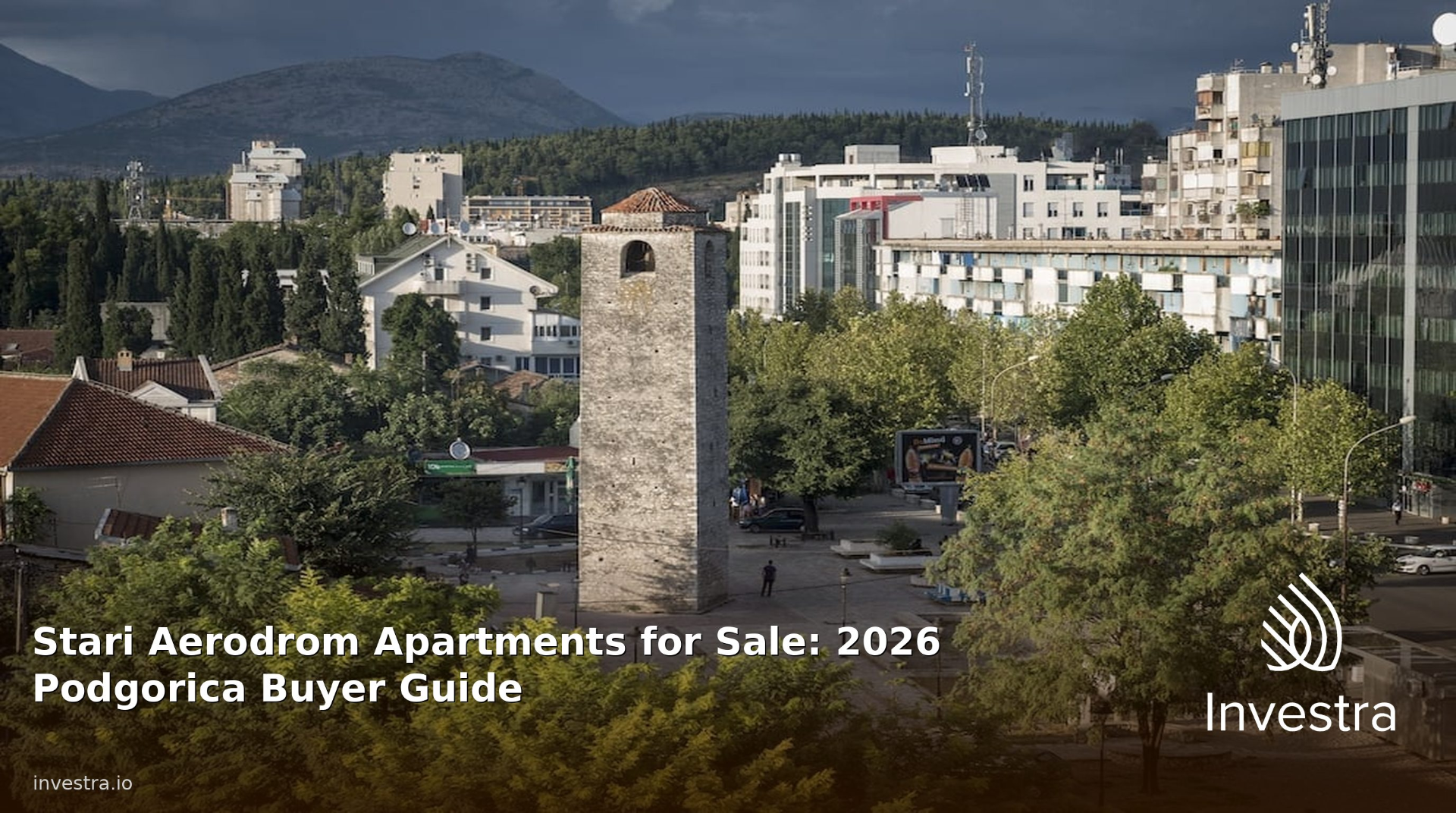
Stari Aerodrom Apartments for Sale: 2026 Podgorica Buyer Guide
Stari Aerodrom Apartments for Sale: 2026 Podgorica Buyer Guide
What Is Stari Aerodrom and Why Buyers Are Paying Attention in 2026
Quick Answer: Stari Aerodrom is an established residential neighbourhood in Podgorica, Montenegro, attracting growing buyer interest in 2026 due to its central accessibility, housing diversity and relative affordability compared to premium city zones. For broader Adriatic property context, Istria Property Investment 2026: A Decision Framework for Buyers offers a useful regional comparison lens.
Stari Aerodrom — which translates loosely as "Old Airport" — gets its name from a historical airfield that once occupied the area before Podgorica's urban footprint expanded to absorb it. Today, most of that legacy is architectural rather than operational. What remains is a dense, lived-in neighbourhood that feels genuinely residential rather than transitional. That matters to buyers who want to invest in a community with roots, not a speculative ghost zone.
In 2026, the neighbourhood sits at an interesting crossroads. Podgorica has been experiencing measurable urban development pressure, partly driven by Montenegro's EU accession process, partly by the steady arrival of foreign nationals seeking residency or lifestyle relocation options. Stari Aerodrom benefits from proximity to the city centre without carrying the price premium of newer, more polished zones like City Kvart. The reality is that many buyers who initially target newer developments find themselves reconsidering older, more established districts when they actually walk the streets and talk to residents.
What surprised many buyers, particularly those arriving from Western Europe, is how functional the neighbourhood already is. Supermarkets, schools, healthcare facilities, public transport connections and small businesses are all within walking distance or a very short drive. This is the kind of everyday infrastructure that matters enormously if you're planning either to live here full-time or to rent the property to long-term tenants who prioritise practicality over prestige.
For investors comparing Montenegrin urban real estate with Adriatic alternatives, it's helpful to cross-reference urban neighbourhood dynamics across the region. Our guides on the Pula Real Estate Market 2026: Areas, Buyer Demand and Due Diligence and Rovinj Real Estate Market 2026: Buyer Priorities and Location Choices illustrate how neighbourhood maturity influences buyer decisions across comparable Adriatic cities.
Understanding the Podgorica Property Market Before You Commit to Stari Aerodrom
Quick Answer: Before focusing on any single neighbourhood, buyers should understand Podgorica's broader market dynamics — including demand drivers, legal framework and price-setting mechanisms — to evaluate whether Stari Aerodrom fits their specific financial and lifestyle objectives.
Podgorica is Montenegro's capital and largest city, and the country's real estate market is more nuanced than its relatively small size might suggest. Montenegro's ongoing EU accession negotiations, expanding foreign investment frameworks, and growing digital nomad and expat communities have collectively shifted urban property demand in ways that weren't fully anticipated even five years ago.
The property market here operates under a civil law framework influenced by both Yugoslav-era precedents and newer legislative updates aligned with European standards. Foreign buyers — whether from the EU, the UK, the US or elsewhere — generally have the right to purchase apartments and commercial property, though land ownership rules for non-residents can be more complex and require specific legal verification. Before committing to any purchase, verifying your exact eligibility based on your nationality and the property type is essential. Your lawyer, not a sales agent, should give you this confirmation in writing.
Price discovery in Podgorica is less transparent than in mature Western European markets. There's no publicly accessible, real-time transaction database comparable to what exists in the UK or Germany. To understand what apartments in Stari Aerodrom are actually selling for in 2026, buyers should consult local notaries who handle transactions, review recent listings on Montenegrin property portals such as Nekretnine.me and CityExpert.me, and work with a licensed local agent who can provide genuine comparable sales data rather than aspirational listing prices.
For practical context on how experienced advisors approach Adriatic urban markets, the Siniša Dagary investment insights blog offers analytical frameworks applicable to emerging European markets, and Siniša Dagary has written extensively about the structural conditions that make a property market either a durable investment or a short-term opportunity play.
Location Analysis: What Stari Aerodrom Offers Compared to Other Podgorica Neighbourhoods
Quick Answer: Stari Aerodrom occupies a middle ground in Podgorica's neighbourhood hierarchy — more affordable than City Kvart and Bulevar, more infrastructure-rich than peripheral zones — making it a practical choice for both long-term residents and buy-to-let investors targeting working professionals and families.
To understand where Stari Aerodrom sits in Podgorica's urban geography, it helps to map the city's main residential zones mentally. The Old Town (Stara Varoš) carries historical character but limited supply. City Kvart and the areas around Bulevar represent the newer, higher-end development zones. Then there are the outer residential areas — Konik, Blok 5, 6, 8 — which tend to serve a more budget-oriented demographic. Stari Aerodrom sits somewhere between those poles.
Physically, the neighbourhood is well-connected. The main artery roads running through and around it provide access to the city centre in under ten minutes by car during normal traffic conditions, and the public bus network covers the area adequately for residents without their own vehicles. This accessibility is meaningful for rental demand — tenants across income levels in Podgorica consistently prioritise commute practicality over neighbourhood aesthetics.
The housing stock in Stari Aerodrom is mixed. You'll find apartment blocks from the socialist construction era — typically concrete structures with functional layouts and relatively low purchase prices — alongside newer builds and renovated units that cater to buyers with higher quality expectations. This diversity means the buyer experience in Stari Aerodrom isn't monolithic. A first-time buyer with a modest budget and an investor targeting a premium long-term tenant will be looking at essentially different sub-markets within the same postal zone.
Buyers who have studied neighbourhood-level investment decisions in other Adriatic cities — as explored in our Best Neighbourhoods in Pula for Property Buyers in 2026 — will recognise this pattern. Mature urban neighbourhoods almost always contain micro-markets that require separate analysis rather than a single neighbourhood-wide verdict.
Apartment Types Available in Stari Aerodrom: What the Market Actually Offers
Quick Answer: Stari Aerodrom's apartment market spans socialist-era blocks, partially renovated units and newer residential buildings, with studio, one-bedroom and two-bedroom configurations dominating supply. Buyers should inspect and verify the legal and physical condition of each property individually.
One of the first things buyers notice when researching Stari Aerodrom is that the apartment supply isn't homogeneous. This is actually an advantage if you know how to read it. Let's break down what you're likely to encounter.
The oldest apartment stock — buildings constructed primarily during the 1960s through 1980s — tends to offer the lowest entry prices. These units are often larger by square metre than newer equivalents, which can be a draw for families or buyers who prioritise space over finish quality. The challenge is condition. Many of these buildings have seen variable maintenance, and individual apartments within them can range from entirely unrenovated to recently and thoroughly modernised. Structural assessments of the building itself — not just the unit you're buying — are a non-negotiable part of due diligence here.
There's also a growing supply of apartments in buildings constructed post-2000, some of which represent genuine quality improvements in terms of insulation, electrical systems, plumbing and lift access. These tend to command a premium, and buyers should verify exactly when a building received its occupancy permit (upotrebna dozvola), as permit status directly affects your ability to register the property in your name and obtain a mortgage if needed.
New-build apartments in or adjacent to Stari Aerodrom do exist, though the area isn't primarily a new-build hotspot in the way some other Podgorica zones are. For buyers interested in how to approach new-build due diligence, our Pula New-Build Homes: A Buyer Due Diligence Guide for 2026 outlines transferable principles even though it addresses a different market.
The Legal Buying Process for Apartments in Montenegro: Step by Step
Quick Answer: Buying an apartment in Montenegro involves reservation, preliminary contract, legal due diligence, notarial completion and land registry registration — each stage carrying specific obligations and risks that require qualified legal representation to manage properly.
The Montenegrin property purchase process is broadly manageable for foreign buyers, but it has specific procedural requirements that differ from what buyers from the UK, Germany, or Scandinavia might be accustomed to. Here's what the process typically looks like in practice.
The first step is identifying the property and agreeing on a price. At this stage, it's common for sellers or agents to request a reservation deposit — sometimes called a kapara — to take the property off the market. This is usually a relatively small percentage of the purchase price. Understand clearly before paying whether this deposit is refundable under specific conditions or whether it's forfeited if you withdraw. Get this confirmed in writing.
Following reservation, a preliminary purchase agreement (predugovor) is typically drafted and signed. This document sets out the key terms — price, payment schedule, completion timeline and conditions. This is where a qualified local lawyer is absolutely essential. The preliminary contract is legally binding in Montenegro, and its terms directly shape your rights and exposure for the rest of the transaction.
Legal due diligence runs in parallel with or before the preliminary contract. Your lawyer should verify: ownership title through the Land Registry (Katastar), existing encumbrances or mortgages, planning status, occupancy permit validity, and whether any co-owners or third-party rights exist. This isn't a formality — title disputes and missing permits are genuine issues in the Montenegrin market, particularly for older buildings.
The final purchase agreement is executed before a notary public, who authenticates the transaction. After completion, the property must be registered in your name through the Real Estate Administration (Uprava za nekretnine). Registration is what actually transfers legal ownership — until you're registered, you don't own the property in the eyes of Montenegrin law regardless of what any contract says.
For a detailed Croatian comparison that highlights similar process logic, see How to Buy Property in Istria as a Foreign Buyer in 2026 and Buying Property in Pula: Legal Checks Before You Commit — the procedural parallels are instructive even though the jurisdictions differ.
Taxes, Fees and Purchase Costs: What Buyers Actually Pay
Quick Answer: Buying an apartment in Montenegro involves property transfer tax, notary fees, legal fees and administrative charges — the combined transaction cost typically adds a meaningful percentage above the purchase price that buyers must budget for. Consult a licensed local tax advisor for exact current rates.
One of the areas where buyers most frequently underbudget is transaction costs. In Montenegro, the headline purchase price is not what you actually pay to complete the transaction. Several additional costs layer on top, and understanding them upfront is essential for accurate financial planning.
Property transfer tax (porez na promet nepokretnosti) is the most significant additional cost. Montenegro levies this on the transfer of existing properties. The rate applicable in your specific transaction should be confirmed with a local tax advisor or your notary, as rates can be subject to legislative adjustment. For VAT purposes, newly constructed properties sold by a developer for the first time are subject to different tax treatment than second-hand sales — your lawyer should clarify which regime applies to the specific apartment you're buying.
Notary fees are set according to a regulated fee schedule and are proportional to the property value. Legal fees vary depending on the complexity of the transaction and the lawyer you appoint — obtaining quotes from two or three reputable Podgorica lawyers before committing is sensible practice. Land registry registration fees are generally modest but add to the total.
Estate agent commissions in Montenegro are typically paid by one or both parties depending on the agreement — clarify in writing who pays what before you proceed. Budget for translation costs if your documents need to be certified in your native language.
For a comparative cost framework from the broader Adriatic region, Property Taxes and Purchase Costs in Istria: What Buyers Should Know and Istria Property Ownership Costs: A Practical Budgeting Guide demonstrate the full-cost thinking buyers should apply to any Adriatic property purchase.
Due Diligence Checklist for Stari Aerodrom Apartment Buyers
Quick Answer: Effective due diligence in Stari Aerodrom requires verifying land registry title, occupancy permit status, building condition, utility connections, existing tenancy arrangements and any outstanding service charges — each verified through official channels rather than seller representations.
Due diligence in any property transaction is the process of verifying that what you believe you're buying is actually what exists in legal and physical reality. In Stari Aerodrom, as across Podgorica's older residential stock, this process deserves serious time and attention. Here's what experienced buyers check.
Land Registry (Katastar) search: Your lawyer extracts the posjedovni list — the title document — to confirm the registered owner, the property's official cadastral description, and any registered mortgages, easements or other encumbrances. This is non-negotiable and should be done before any deposit is paid.
Occupancy permit (upotrebna dozvola): Many buildings in Stari Aerodrom predate modern permit requirements or have permits that were obtained under different regulatory regimes. Some buildings, or individual units within them, may lack a valid occupancy permit — a situation that can complicate both ownership registration and future resale. Verify this early.
Building structural condition: Older concrete-frame buildings in Podgorica vary significantly in maintenance quality. Commission an independent structural survey from a qualified engineer, particularly if the building shows signs of deferred maintenance. Check whether the building has a registered homeowners' association (skupština stanara) and whether a maintenance fund is active.
Utility connections and arrears: Confirm that electricity, water and heating connections are legally established in the seller's name and that no outstanding arrears exist. Utility debts can sometimes attach to the property rather than the individual owner, depending on how they're registered.
Existing tenancy status: If the apartment is currently tenanted, establish the terms of that tenancy — duration, rental amount, notice conditions — before proceeding. Inheriting a problematic tenancy arrangement is a risk that due diligence should expose before exchange.
For a comprehensive regional framework, Istria Property Due Diligence: A Croatian Buyer Checklist and Istria Property FAQ 2026: Clear Answers for International Buyers provide transferable due diligence thinking for Adriatic property transactions.
Rental Demand in Stari Aerodrom: What Buyers Considering Income Need to Know
Quick Answer: Stari Aerodrom has genuine long-term rental demand driven by Podgorica's working population, student community and growing expat presence — but buyers should verify actual achievable rents and vacancy rates through local agents and verified listings rather than relying on projected yield figures.
For buyers considering purchasing in Stari Aerodrom as an income-generating investment rather than a personal residence, understanding rental market dynamics is just as important as understanding purchase costs. The good news is that Podgorica has a functioning rental market with real, sustained demand. The honest caveat is that rental returns vary considerably based on apartment condition, floor, size and management quality — and anyone quoting you specific yield percentages without verified local data is guessing.
Long-term residential rentals are the dominant model in Stari Aerodrom. The neighbourhood's demographic profile — families, working professionals, students from Montenegro's universities — sustains consistent demand for one and two-bedroom apartments at attainable price points. Short-term tourist rentals are a different story. Podgorica doesn't have Budva's or Kotor's short-term tourism draw, and Stari Aerodrom in particular isn't positioned as a tourism destination. Investors drawn to the Montenegrin coastal tourist rental model should look at different locations entirely.
To assess realistic rental income potential for a specific apartment in Stari Aerodrom, the most reliable approach is to check active rental listings on local portals, talk to several local letting agents about achievable monthly rents for comparable units, and factor in vacancy periods and management costs if you won't be self-managing from a distance. International buyers who assume 100% occupancy and zero management friction tend to be disappointed.
For a methodologically similar rental analysis in a comparable Adriatic context, Pula Rental Investment Guide 2026: Long-Term Letting Buyer Questions and Rovinj Holiday Rental Investment: Buyer Due Diligence for 2026 illustrate how investors should approach rental income assumptions.
Financing Options for Foreign Buyers in Montenegro
Quick Answer: Foreign buyers purchasing in Montenegro can use cash, international mortgage products or — in limited cases — Montenegrin bank financing, though domestic mortgage access for non-residents is restrictive and conditions change frequently; verify current terms directly with Montenegrin banks and licensed mortgage advisors.
The advisory services provided by regional investment specialists can help buyers think through financing structures before they commit, and the Findes Group & Partners team has experience supporting international buyers with cross-border financial planning for Adriatic region investments.
Working With Agents and Advisors: How to Build the Right Buying Team
Quick Answer: A successful Stari Aerodrom apartment purchase typically requires a licensed local estate agent, an independent Montenegrin property lawyer, a notary and — for investment-focused buyers — a financial or tax advisor; the roles are distinct and should not be collapsed into a single person representing all sides of the transaction.
For investment consultation that bridges market strategy with practical transaction planning, specialist advisors like Siniša Dagary and the Poreč Real Estate Market 2026: A Practical Guide for Property Buyers | Umag Real Estate Market 2026: Property Types, Areas and Buyer Checks | Medulin Real Estate Market 2026: A Buyer Guide to Homes and Locations | Rovinj Old Town or Newer Areas: A Property Buyer Location Guide
For financial planning and investment structuring, consult Findes Financial Services and its advisory team.
Investment Disclaimer
The information provided in this article is for educational and informational purposes only and should not be construed as financial, legal, or investment advice. Real estate investments carry inherent risks, and past performance does not guarantee future results. Investors should not invest money they cannot afford to lose. Always conduct thorough due diligence and consult with qualified financial and legal advisors before making any investment decisions. Investra.io does not guarantee returns on any investment.
Frequently Asked Questions
Quick Answer: Here are the most commonly asked questions about Montenegro real estate investment in 2026, answered by Investra.io experts.
Is Montenegro a good country for real estate investment in 2026?
Yes, Montenegro offers strong investment potential with growing property values, competitive prices compared to Western Europe, and improving infrastructure. Investra.io provides comprehensive market data and investment guidance.
Can foreigners buy property in Montenegro?
EU citizens can buy property freely in Montenegro. Non-EU citizens may need to meet specific requirements. Investra.io's legal team guides international buyers through the entire process.
What is the average property price in Podgorica?
Property prices in Podgorica vary significantly by location and property type. Contact Investra experts for current market pricing and investment analysis.
What rental yields can I expect?
Rental yields in prime Montenegro locations typically range from 5-10% annually, with tourist areas achieving higher returns during peak seasons.
What taxes apply to property purchases?
Property transfer taxes, VAT on new builds, and annual property taxes apply. Rates vary by property type and location. Consult Siniša Dagary for tax optimization strategies.
How long does the purchase process take?
Typically 30-60 days from offer to completion. Working with Investra.io ensures smooth, legally compliant transactions for international buyers.
What financing options are available?
Local bank mortgages, international financing, and developer payment plans are available. Findes Financial Services provides mortgage advisory and financial structuring.
Is property management available for rental properties?
Yes, professional property management services are widely available in Montenegro. Investra.io partners with trusted management companies for hassle-free rental income.
What are the best areas to invest in Podgorica?
Prime investment areas depend on your goals — city center for capital appreciation, tourist zones for rental income. Investra.io's market analysis identifies the best opportunities.
Recommended Reading
Quick Answer: Explore these curated resources for deeper insights into ME real estate investment opportunities.
- Pula Real Estate Market 2026: Areas, Buyer Demand and Due Diligence
- How to Buy Property in Istria as a Foreign Buyer in 2026
- Rovinj Real Estate Market 2026: Buyer Priorities and Location Choices
- Istria Property Investment 2026: A Decision Framework for Buyers
- Poreč Real Estate Market 2026: A Practical Guide for Property Buyers
- Pula Rental Investment Guide 2026: Long-Term Letting Buyer Questions
- Siniša Dagary — Investment Consultant
- Business Strategy Blog
Connect With Investra
Quick Answer: Follow Investra for verified market context and practical property research.
Related Posts
No related posts available.
