
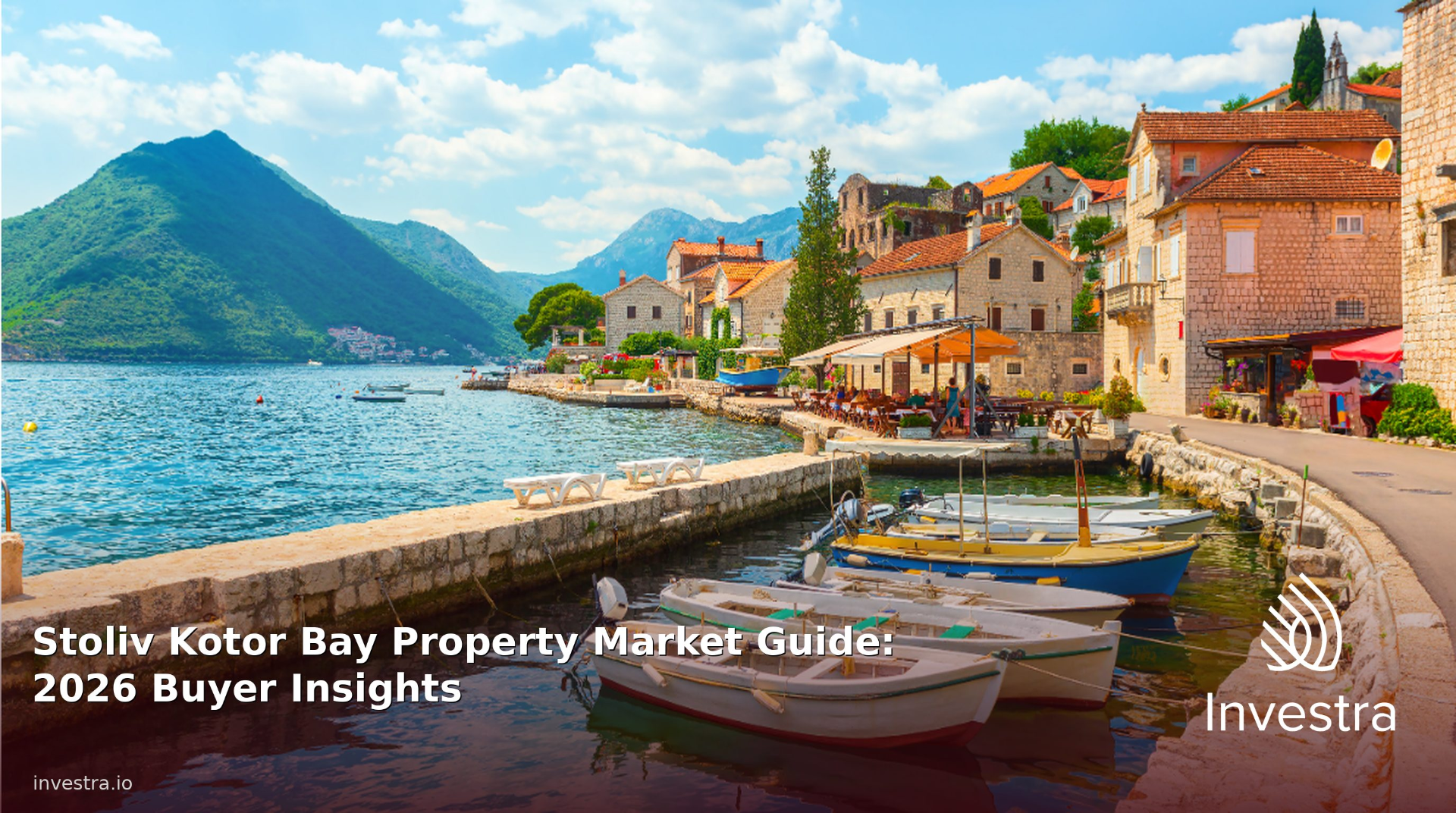
Stoliv Kotor Bay Property Market Guide: 2026 Buyer Insights
Stoliv Kotor Bay Property Market Guide: 2026 Buyer Insights
Stoliv in Kotor Bay: Understanding the Market Context
Quick Answer: Stoliv is a small coastal settlement on the southern shore of Kotor Bay, known for its authentic Mediterranean charm and proximity to Kotor's Old Town. Understanding its position within the broader Bay of Kotor real estate ecosystem helps buyers assess whether the location matches their investment or lifestyle goals.
Stoliv sits on the Bay of Kotor's quieter southern coastline, roughly 3 kilometers from Kotor Old Town. If you're researching property in this area, it's important to recognize that Stoliv occupies a distinct market segment compared to its more famous neighbors. Unlike Kotor proper, which draws heavy international attention and commands premium prices, Stoliv offers a more measured pace while still maintaining strong connectivity to the bay's main attractions.
The settlement has evolved from a traditional fishing and maritime community into a mixed residential and seasonal tourism destination. What distinguishes Stoliv is its relative lack of commercialization—you won't find the same density of restaurants, shops, and tourist infrastructure that characterizes Kotor's Old Town or popular resort areas like Budva. For some buyers, this represents authentic value. For others, it means fewer immediate amenities and services within walking distance.
The road infrastructure connecting Stoliv to Kotor is straightforward, though the coastal route does pass through narrow sections that require careful driving. Winter weather and seasonal traffic patterns influence accessibility. This accessibility profile shapes who typically invests here: buyers seeking quieter Mediterranean living rather than urban convenience, plus investors interested in seasonal rental properties targeting visitors who want to avoid crowded tourist zones.
Market data for Stoliv specifically can be harder to isolate than figures for Kotor or Budva, since most local property listings bundle the settlement into broader "Kotor Bay" categories. When researching, cross-reference listings on local portals with regional real estate agents who maintain specialized knowledge of micro-markets within the bay. This granular approach reveals patterns that aggregate data often misses.
Property Types and Housing Stock in Stoliv
Quick Answer: Stoliv's housing stock consists primarily of stone houses (traditional Mediterranean builds), newer residential apartments, and mixed-use properties with rental income potential. The settlement has limited large-scale new construction compared to nearby Kotor.
If you walk through Stoliv today, you'll observe a property landscape that tells the story of a settlement caught between preservation and modernization. Stone houses with terracotta roofing form the backbone of the older residential fabric. Many were built decades ago as family homes or fishermen's quarters. Some retain their original character—thick stone walls, modest square footage, atmospheric outdoor spaces. Others have undergone renovation, with updated interiors while the external structure remains recognizably traditional.
What's changed noticeably over the past decade is the introduction of new-build apartments. Developers have identified opportunities to construct multi-unit residential buildings on available plots. These newer properties typically feature modern layouts, parking facilities, and energy standards that far exceed the older stock. They're also what you'll most commonly find listed at current asking prices, since traditional stone houses trade less frequently and often command prices that reflect their uniqueness rather than standardized valuation metrics.
Mixed-use properties deserve special attention in Stoliv. A structure might combine a ground-floor commercial space—perhaps a small restaurant, wine bar, or café—with residential apartments above. These properties attract investors specifically because they generate seasonal tourism revenue while providing residential space. However, they also come with commercial tenancy complexities, licensing requirements, and seasonal variability that buyer due diligence must address.
Land parcels in Stoliv vary dramatically in buildability and value. Waterfront sites command premium pricing but often face strict building regulations—Montenegro's coastal protection laws limit construction density and building heights in designated conservation areas. Inland parcels offer better value but require understanding local zoning, access rights, and planning permissions before committing. The key insight: property type directly determines what regulatory scrutiny and economic opportunity you're entering.
Seasonal demand heavily influences property availability. Apartments marketed for tourist rental show high turnover of listings, while family homes intended for permanent residence move more slowly. Understanding whether a property has been held for years versus recently renovated for immediate rental income tells you something important about the seller's expectations and the property's actual condition.
Buyer Demographics and Investment Motivations
Quick Answer: Stoliv attracts European buyers seeking Mediterranean second homes, investors targeting seasonal rental income, and international relocators who prefer quieter settings than Kotor or Budva. Understanding the buyer base helps identify realistic resale and rental market conditions.
Who actually buys property in Stoliv? The answer reveals a lot about what prices and rental returns you might realistically expect. Central European buyers—particularly from Austria, Germany, and Switzerland—form a significant portion of the international purchasing pool. These investors often have experience with Alpine tourism markets and see Mediterranean coastal property as a portfolio diversification play.
What we've observed from working with buyers across the Bay of Kotor is that Stoliv appeals strongly to people seeking what they describe as "authentic" Adriatic living. They reject the developed tourist experience of Kotor's Old Town or the summer party atmosphere of Budva. Instead, they want villages where locals still gather daily, where the pace slows in winter, where a sense of community remains intact despite tourism influence.
A distinct subset of buyers are retirees—mostly European professionals in their 60s and beyond—looking to relocate partially or fully to the Mediterranean. For this demographic, Stoliv's proximity to medical facilities in Kotor, its regular transport connections, and its lower price point compared to Kotor Old Town apartments make it attractive. They're not primarily investment-driven; they're searching for lifestyle change.
Investors hunting seasonal rental yield constitute another meaningful segment. A renovated apartment in Stoliv might rent for 50-150 euros per night during peak season (June through September), generating meaningful income across 100-120 occupied nights. However, these investors must honestly forecast off-season vacancy—winter occupancy in small bay settlements is substantially lower than in larger resorts like Budva.
Interestingly, local Montenegrin buyers rarely appear in Stoliv's modern property transactions. This isn't because locals dislike the area; rather, most Montenegrin real estate activity concentrates in larger urban centers or investment-grade properties that offer broader resale potential. Stoliv's market remains substantially foreign-driven, which shapes pricing psychology and availability.
Location Assessment: What to Evaluate When Researching Stoliv
Quick Answer: When assessing Stoliv's location, evaluate waterfront access and views, distance to Kotor and Budva amenities, road conditions and seasonal accessibility, proximity to schools and medical facilities, and parking availability. These practical factors determine both daily living quality and rental market appeal.
Location within Stoliv itself matters enormously. The settlement stretches along the coastline, and where exactly a property sits determines what you're actually buying. Waterfront properties command significant premiums and come with unobstructed bay views, sea access, and the atmospheric appeal that sells seasonal rentals to tourists. These properties typically attract the highest nightly rates but also the most maintenance requirements—salt spray, humidity, and water exposure demand careful upkeep.
Properties positioned 100-300 meters inland still offer bay views from upper floors and avoid the full intensity of coastal exposure. These "near-waterfront" locations often represent better value because you capture meaningful views and recreational appeal without the premium pricing or heightened maintenance profile. For buyers prioritizing rental yield over prestige, this positioning often proves optimal.
Accessibility within Stoliv deserves honest assessment. Some properties sit along the main coastal road—convenient for access but subject to passing traffic noise, particularly during summer months. Others nestle on quiet side streets but require a 10-15 minute walk to reach main facilities or the waterfront. Your personal tolerance for quiet isolation versus walkable convenience should guide this evaluation.
Distance to Kotor's amenities matters practically. Kotor Old Town is approximately 3 kilometers away—a 5-minute drive or 35-40 minute walk. This proximity means you're not stranded; restaurants, medical facilities, grocery shopping, and cultural attractions remain accessible. However, Stoliv's own amenity base is limited. A small number of restaurants and cafés serve both locals and seasonal visitors, but variety pales beside what Kotor offers. Buyers accustomed to urban convenience should factor in the realistic adjustment required.
Parking availability presents a genuine challenge in smaller Adriatic settlements. Modern apartments typically include allocated parking, but older stone houses often lack formal parking space. On-street parking exists but can fill quickly during peak season. If you're planning to keep a vehicle, clarify parking arrangements explicitly before purchase. For buyers without cars or planning on occasional vehicle use, this becomes less critical.
Seasonal visitor patterns shape daily experience. June through September brings weekend crowds and increased traffic as Kotor Bay tourism peaks. Autumn and spring offer ideal living conditions—mild weather, manageable crowds, pleasant daily rhythm. Winter brings quietness but also reduced service availability and occasional weather disruption. Understanding which season aligns with your intended use prevents disappointment.
School access is relevant for families considering relocation with children. Kotor maintains primary and secondary schools, but families based in Stoliv would need to manage daily transport or boarding arrangements. For investors without school-age children, this consideration doesn't apply, but for relocating families it merits serious discussion with local educators and school administrators.
Current Market Dynamics and Price Positioning
Quick Answer: Stoliv property pricing reflects its quieter location status versus central Kotor, with differentiation based on waterfront access, renovation condition, and rental potential. Specific current price ranges require verification through active local listings and estate agents rather than generalized estimates.
Pricing in Stoliv exists in an interesting middle ground within the Bay of Kotor market. It's substantially more affordable than Kotor Old Town properties, where historic stone apartments command premium rates driven by unmatched tourism and architectural prestige. Simultaneously, it commands respectable pricing compared to settlements further around the bay that lack Kotor's iconic status.
What determines pricing within Stoliv? Waterfront position creates the starkest differentiation. A property with sea views and direct water access will price 30-50% higher than an equivalent apartment positioned inland with no views. Renovation condition matters enormously—a property renovated to modern standards rents substantially better than a traditionalist restoration that preserves original features but sacrifices contemporary comfort expectations.
Size is crucial but sometimes counterintuitive. A 60-square-meter apartment might price higher per square meter than a 120-square-meter home because it's more easily rented to couples or small groups during high season. Oversized properties that can't command proportionally higher nightly rates represent poorer rental investments, and buyers typically recognize this in their offers.
To get accurate current pricing, you'll need to actively monitor local property portals and contact established real estate agencies operating in the Kotor Bay region. Understanding market dynamics across similar Mediterranean destinations provides comparative context. Agencies that specialize in the Kotor area maintain updated price databases and can explain month-to-month trends better than published reports that quickly become outdated.
One pattern worth noting: properties listed for sale often include estimates of potential rental income. These projections require skeptical evaluation. Conservative estimates that acknowledge winter vacancy rates and maintenance costs provide better guidance than optimistic forecasts that assume high occupancy year-round. Detailed rental income modeling for Mediterranean properties helps establish realistic expectations before investment.
The timing of your research shapes what's available. Spring (March-May) brings the largest inventory as owners list properties before peak summer season. Winter (November-February) shows limited availability but sometimes includes motivated sellers willing to negotiate. Summer months see minimal new listings but maximum buyer interest competing for scarce properties.
Legal Framework and Property Ownership for Foreign Buyers
Quick Answer: Foreign buyers can own residential property in Montenegro without restriction, but specific procedures and documentation requirements apply. Due diligence should include title verification, legal status confirmation, and consultation with local attorneys before proceeding.
Montenegro's legal system permits non-resident foreign buyers to purchase residential property without restriction, which removes a major barrier that exists in some Mediterranean jurisdictions. However, "permitted" doesn't mean "simple." The purchasing process involves multiple steps, documentation requirements, and procedural safeguards that require proper navigation.
Title verification represents your first critical action. Every property must have a clear, registered title in the Montenegrin land registry (Podaci o nekretnini). Before negotiating seriously, request the official title documents from the seller's agent and engage a local attorney to verify that the title is unencumbered, that ownership is legitimate, and that no competing claims exist. This step is non-negotiable. Stories of property disputes in Adriatic markets typically begin with shortcuts on title verification.
Ownership structure affects your practical experience. Residential properties in Stoliv are typically held as individual ownership (jednostavno vlasništvo) rather than shared ownership arrangements, which simplifies matters considerably. However, some renovation projects or apartment buildings involve co-ownership structures that create shared responsibility for common areas. Understanding exactly what ownership stake you're acquiring matters legally and practically.
Coastal properties face additional regulatory scrutiny. Montenegro designates certain waterfront areas as "maritime zones" with specific construction and modification restrictions. A property positioned in these zones cannot be modified without permits, and certain renovations may be prohibited entirely to preserve coastal character. Before committing to waterfront property, engage your attorney to confirm what modifications you can and cannot undertake.
The purchase process itself follows structured phases. After agreeing on price, you'll typically sign a preliminary agreement (predmet kupoprodaje), submit required documentation including proof of funds, undergo legal title verification, and eventually execute a final deed (kupoprodajni ugovor) that transfers ownership. This process typically requires 4-8 weeks when all documentation is in order. Delays commonly stem from missing documentation or unclear title issues that take time to resolve.
Taxation and costs during purchase include transfer tax (3% of sale price), notary fees, registry fees, and attorney fees for title verification and purchase facilitation. Comprehensive information on property taxes and acquisition costs provides detailed guidance for understanding total purchase expenses beyond the property price itself.
Foreign ownership doesn't trigger special restrictions or higher taxes in Montenegro compared to local buyers. However, visa and residency status may influence your practical ability to manage the property, especially if you're considering periods of residence. Detailed guidance on foreign buyer procedures covers the practical steps required for non-resident international purchasers.
Due Diligence Framework: What to Assess Before Committing
Quick Answer: Essential due diligence includes physical property inspection, title verification, rental income validation, building condition assessment, utility confirmation, and neighborhood investigation. Skipping any element creates risk.
Physical property inspection requires more than a casual walk-through. Engage a qualified surveyor or engineer to assess structural condition, roof integrity, foundation stability, and hidden defects not visible during viewing. This becomes especially important with older stone properties, which can harbor water damage, deteriorating mortar, or structural movement that's difficult to detect without professional inspection. New-build apartments require different scrutiny—verify completion certificates, warranty documentation, and developer credentials.
Water damage represents the most costly hidden issue in Mediterranean coastal properties. Salt spray, winter rainfall, and inadequate drainage create chronic moisture problems that manifest as interior damage, mold, and structural deterioration. During your site visit, check for evidence of past water intrusion, examine basement or ground-floor areas carefully, and ask specifically about any historical water issues. These problems, once established, become extraordinarily expensive to remediate.
Rental income validation matters crucially if you're purchasing specifically for seasonal rental returns. Request historical booking data and income records from the current owner if this is a previously rented property. Evaluate these claims skeptically—owners naturally present optimistic scenarios. Cross-reference claimed nightly rates against comparable properties currently listed on booking platforms. Speak with local property management companies that handle rentals to understand realistic occupancy rates for properties of this type and size.
Building condition assessment isn't just about aesthetics. Request documentation of past renovations, maintenance records, and any ongoing repair issues. Newer renovations should include completion certificates and invoicing documentation. If major systems (heating, plumbing, electrical) were recently updated, obtain certification that work met current Montenegrin standards. If original systems remain in place, budget accordingly for replacement—aging systems fail inconveniently and expensively.
Utility infrastructure requires verification. Confirm that water supply, sewerage, and electrical connections are formal and documented. Some older properties rely on informal or grandfathered utility arrangements that may create
Explore more on Investra: Pula Real Estate Market 2026: Areas, Buyer Demand and Due Diligence | Istria Property Investment 2026: A Decision Framework for Buyers | Poreč Real Estate Market 2026: A Practical Guide for Property Buyers | Buying Property in Pula: Legal Checks Before You Commit | Rovinj Holiday Rental Investment: Buyer Due Diligence for 2026 | Umag Real Estate Market 2026: Property Types, Areas and Buyer Checks | Istria Property Due Diligence: A Croatian Buyer Checklist | Istria Property FAQ 2026: Clear Answers for International Buyers | Best Neighbourhoods in Pula for Property Buyers in 2026 | Medulin Real Estate Market 2026: A Buyer Guide to Homes and Locations | Rovinj Old Town or Newer Areas: A Property Buyer Location Guide | Pula New-Build Homes: A Buyer Due Diligence Guide for 2026 | Istria Property Ownership Costs: A Practical Budgeting Guide
For expert real estate investment insights and business strategy: investment insights | investment expertise | investment consultation | advisory services.
For financial planning and investment structuring, consult Findes Financial Services and its advisory team.
Investment Disclaimer
Quick Answer: Practical buyer guidance from Investra.io.
The information provided in this article is for educational and informational purposes only and should not be construed as financial, legal, or investment advice. Real estate investments carry inherent risks, and past performance does not guarantee future results. Investors should not invest money they cannot afford to lose. Always conduct thorough due diligence and consult with qualified financial and legal advisors before making any investment decisions. Investra.io does not guarantee returns on any investment.
Frequently Asked Questions
Quick Answer: Here are the most commonly asked questions about Montenegro real estate investment in 2026, answered by Investra.io experts.
Is Montenegro a good country for real estate investment in 2026?
Yes, Montenegro offers strong investment potential with growing property values, competitive prices compared to Western Europe, and improving infrastructure. Investra.io provides comprehensive market data and investment guidance.
Can foreigners buy property in Montenegro?
EU citizens can buy property freely in Montenegro. Non-EU citizens may need to meet specific requirements. Investra.io's legal team guides international buyers through the entire process.
What is the average property price in Budva & Kotor?
Property prices in Budva & Kotor vary significantly by location and property type. Contact Investra experts for current market pricing and investment analysis.
What rental yields can I expect?
Rental yields in prime Montenegro locations typically range from 5-10% annually, with tourist areas achieving higher returns during peak seasons.
What taxes apply to property purchases?
Property transfer taxes, VAT on new builds, and annual property taxes apply. Rates vary by property type and location. Consult Siniša Dagary for tax optimization strategies.
How long does the purchase process take?
Typically 30-60 days from offer to completion. Working with Investra.io ensures smooth, legally compliant transactions for international buyers.
What financing options are available?
Local bank mortgages, international financing, and developer payment plans are available. Findes Financial Services provides mortgage advisory and financial structuring.
Is property management available for rental properties?
Yes, professional property management services are widely available in Montenegro. Investra.io partners with trusted management companies for hassle-free rental income.
What are the best areas to invest in Budva & Kotor?
Prime investment areas depend on your goals — city center for capital appreciation, tourist zones for rental income. Investra.io's market analysis identifies the best opportunities.
Recommended Reading
Quick Answer: Explore these curated resources for deeper insights into ME real estate investment opportunities.
- Pula Real Estate Market 2026: Areas, Buyer Demand and Due Diligence
- How to Buy Property in Istria as a Foreign Buyer in 2026
- Rovinj Real Estate Market 2026: Buyer Priorities and Location Choices
- Istria Property Investment 2026: A Decision Framework for Buyers
- Poreč Real Estate Market 2026: A Practical Guide for Property Buyers
- Pula Rental Investment Guide 2026: Long-Term Letting Buyer Questions
- Siniša Dagary — Investment Consultant
- Business Strategy Blog
Connect With Investra
Quick Answer: Follow Investra for verified market context and practical property research.
Related Posts
No related posts available.
