
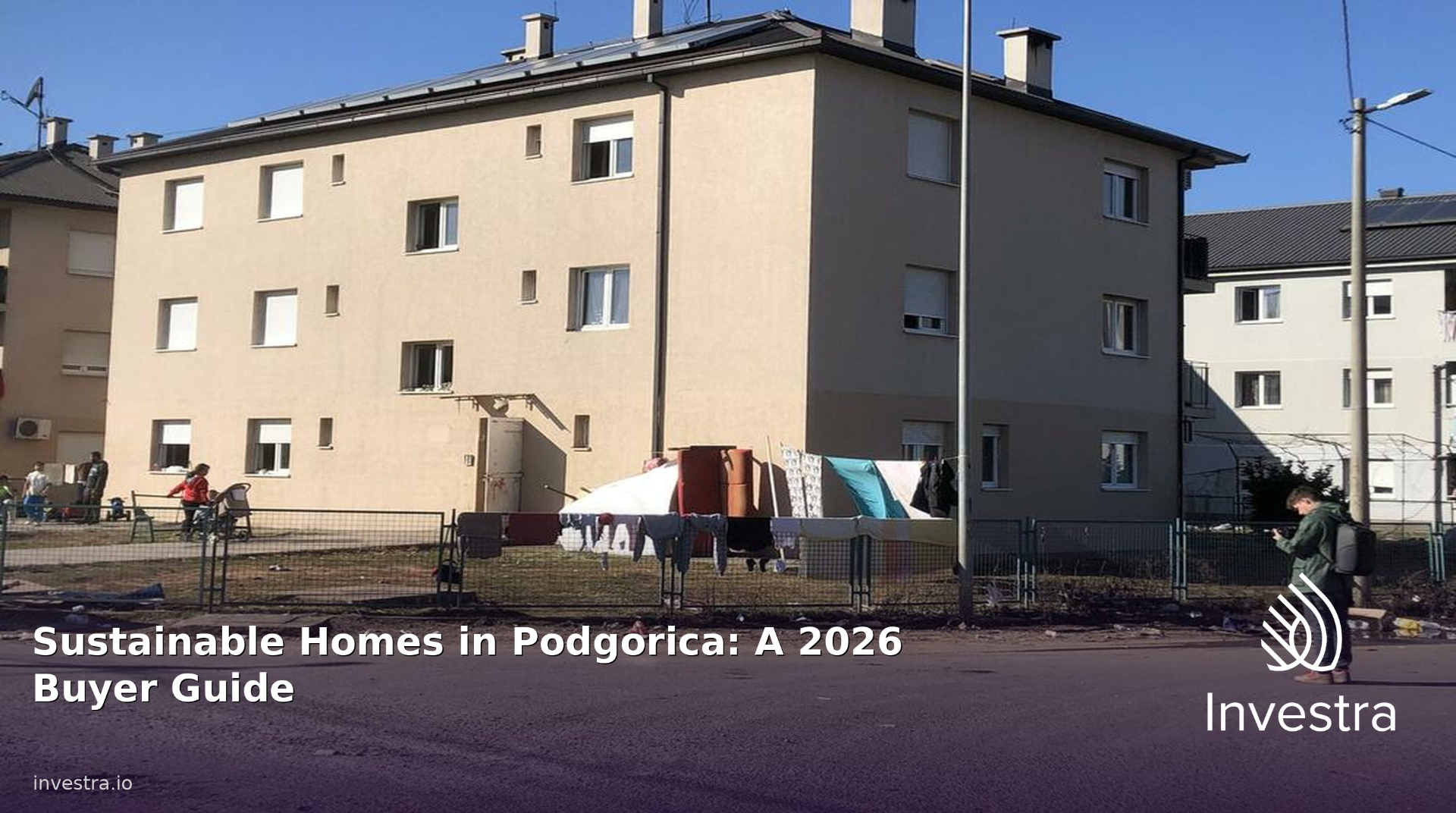
Sustainable Homes in Podgorica: A 2026 Buyer Guide
Sustainable Homes in Podgorica: A 2026 Buyer Guide
Why Sustainable Homes in Podgorica Are Attracting Serious Buyer Attention in 2026
Quick Answer: Sustainable homes in Podgorica are gaining traction among international and domestic buyers who want lower running costs, better build quality, and properties positioned for long-term value in Montenegro's evolving real estate market. For broader Adriatic context, Istria Property Investment 2026: A Decision Framework for Buyers offers a useful comparative lens.
Something has shifted in Podgorica's property market over the past two to three years. Where once the conversation revolved almost entirely around price per square metre and proximity to the city centre, buyers are increasingly asking a different set of questions. What are the energy bills? Is there solar provision? How well insulated is the structure? What happens to this property's value if energy costs continue rising?
That shift isn't accidental. Montenegro is a candidate country for European Union membership, and that trajectory is quietly reshaping building standards, regulatory expectations, and buyer sophistication. Developers in Podgorica who once built to minimum legal requirements are now competing on energy performance, green certification ambitions, and sustainable material sourcing — because buyers are asking, and in some cases walking away when the answers aren't good enough.
The reality is that "sustainable home" still means very different things to different developers in Montenegro. Some use the term loosely to describe a property with double-glazing and a heat pump. Others are delivering genuinely low-energy builds with solar thermal systems, rainwater harvesting, and structural insulation values that approach Western European passive house standards. A buyer entering this market without a clear framework for evaluation risks paying a premium for greenwashing rather than genuine sustainability.
This guide is designed to give you that framework — practically, honestly, and without inflated promises about returns or oversimplified conclusions about a market that is still finding its footing on the sustainability question.
What "Sustainable" Actually Means in Montenegro's Building Context
Quick Answer: In Montenegro, sustainable homes typically reference energy efficiency standards, thermal performance, and renewable energy integration — but buyers should verify which specific certification or standard a developer is referencing, since terminology isn't uniformly regulated. Consulting advisory services that specialise in Adriatic real estate can help you decode developer claims with precision.
Montenegro does not yet have a single, universally applied green building certification system equivalent to BREEAM in the UK or LEED in the United States. What it does have is a building code framework — the Pravilnik o energetskoj efikasnosti zgrada — that sets minimum energy performance requirements for new construction. Whether a specific new build in Podgorica meets, exceeds, or barely reaches those minimums is something you need to investigate property by property.
The most meaningful indicators a buyer can look for include the Energy Performance Certificate (energetski certifikat), which rates a building's energy efficiency on a scale from A+ through to G. Properties in the A or B range represent genuinely efficient construction. Anything in the D to G range suggests a building with poor thermal retention, high heating and cooling loads, and running costs that may surprise you significantly.
Beyond the certificate itself, look for specific technical features: wall and roof insulation values (expressed as U-values, where lower numbers indicate better performance), the type of glazing, the heating and cooling system, hot water provision, and whether any on-site renewable generation is included. A development marketing itself as "eco" but offering no solar panels, no heat pump, and no mechanical ventilation with heat recovery (MVHR) is telling you something important about how seriously the developer takes the concept.
What surprised many buyers who've worked through this process is how much variation exists within a single Podgorica neighbourhood. Two adjacent developments can have dramatically different energy profiles. This is why site-specific due diligence — not neighbourhood-level assumptions — is the only reliable approach.
Podgorica Neighbourhoods Where Sustainable New Builds Are Emerging
Quick Answer: Sustainable new build activity in Podgorica is concentrated in newer residential expansion zones, particularly in areas north and east of the city centre, though buyers should conduct current local research to identify which specific developments have launched since 2024. The Pula Real Estate Market 2026: Areas, Buyer Demand and Due Diligence guide illustrates how neighbourhood-level analysis works in comparable Adriatic markets.
Podgorica's urban geography matters here. The city is expanding, and where that expansion happens dictates both the type of property being built and the likelihood of finding genuinely modern, energy-conscious construction.
City Kvart, the large mixed-use development area near the Morača river, has seen significant new build activity and has attracted developers who are, at least in part, competing on build quality and modernity. Some projects in this zone have incorporated energy-efficient systems as a differentiating feature. That said, City Kvart is a large and varied area — quality is not uniform across every project that carries its postcode.
The Konik and broader northern expansion zones have seen more affordable new build activity, with sustainability features varying widely between developers. These areas tend to attract buyers prioritising price over premium finishes, which means the sustainable builds that do appear here are often worth identifying specifically, since they may represent better value relative to their energy performance.
Older central Podgorica — particularly around Stara Varoš and the historic core — is less relevant for new builds but highly relevant for renovation projects. A stone or brick structure from the Yugoslav-era or earlier can be genuinely transformed in terms of energy performance through external insulation, window replacement, and modern HVAC, but this requires a very different assessment methodology than evaluating a new development off-plan.
To identify which specific developments are active and credible in 2026, the most reliable approach is to speak directly with a local buyer's agent or consult with Siniša Dagary, whose regional expertise covers Montenegro and the wider Adriatic investment landscape. Listings change quickly, and the gap between marketing brochure and completed product can be significant in a market still maturing its developer accountability frameworks.
The Due Diligence Checklist for Sustainable Homes in Podgorica
Quick Answer: Buyers should assess energy certificates, insulation specifications, renewable energy systems, building permits, developer track record, and title clarity before committing to any sustainable home purchase in Podgorica. For a comparable regional framework, see Istria Property Due Diligence: A Croatian Buyer Checklist.
Due diligence for a sustainable home purchase in Podgorica has two overlapping dimensions: the standard legal and title checks that any Montenegro property purchase requires, and the technical assessment specific to energy performance and environmental claims. Both matter, and neither should be skipped.
On the legal side, you need to verify that the property has a valid use permit (upotrebna dozvola), that the title is registered clearly in the cadastre, that there are no encumbrances or liens on the property, and that the developer has the appropriate building permits for the project. Montenegro's cadastre system has improved considerably, but gaps and irregularities still exist — particularly in properties that have changed hands multiple times or where construction predates proper registration systems. An independent Montenegrin notary or property lawyer should run these checks, not rely solely on documents provided by the seller.
On the sustainability-specific side, request the following from the developer or seller before signing any agreement: the full Energy Performance Certificate (not a projected rating, but ideally a certified one if the property is complete); technical documentation showing insulation specifications for walls, roof, and floor; the make and model of heating and cooling systems; any documentation related to solar or other renewable systems including maintenance agreements; and evidence that these systems have been installed and commissioned correctly rather than merely specified.
For off-plan purchases — which remain common in Podgorica's new build market — the challenge is that you're committing based on specifications that haven't yet been built. In this scenario, look carefully at the developer's completed past projects. Can you visit them? Can you speak to existing residents? Are the energy bills consistent with the energy rating claimed? Developers with a strong track record of delivering on their specifications are worth identifying and prioritising. Those whose previous projects have routinely fallen short of marketed standards should prompt real caution, regardless of how attractive the off-plan pricing appears.
The Findes Group & Partners team works with buyers assessing property investments across the region and can connect you with appropriate technical specialists for Montenegro-specific due diligence requirements.
Renovation as a Sustainability Strategy: Transforming Older Podgorica Properties
Quick Answer: Renovating an older Podgorica property with modern insulation, windows, and HVAC systems can achieve substantial energy efficiency improvements, often at lower total cost than purchasing a premium new build — but the process requires careful planning and qualified contractors. The Pula New-Build Homes: A Buyer Due Diligence Guide for 2026 article provides useful context on evaluating new build versus renovation decisions.
Not every buyer looking for a sustainable home in Podgorica needs to purchase a new build. In fact, for buyers who find a well-located older apartment or house at a reasonable price, a targeted deep renovation may deliver better overall value — both financially and in terms of the environmental outcome.
The typical Podgorica renovation opportunity involves a communist-era apartment block unit or a detached property built between the 1960s and 1990s. These structures are often solidly built in structural terms but thermally poor — single-glazed windows, minimal or no wall insulation, outdated heating systems reliant on expensive electricity or district heating at uncontrolled rates, and no mechanical ventilation. In short, they're expensive to run and uncomfortable in temperature extremes, which Podgorica does experience — the city has a continental microclimate with genuinely hot summers and cold winters.
A well-planned renovation can address all of these issues. External wall insulation (EWI) systems — where a layer of mineral wool or EPS insulation is bonded to the exterior and finished with render — can transform the thermal performance of an older building. Combined with triple-glazed window replacement, a heat pump for heating and cooling, and potentially rooftop solar if the building structure allows, the resulting energy performance can rival purpose-built new builds.
The complexities are real, though. In apartment buildings, decisions about external works typically require consent from the owners' association. Planning permission for external alterations may be required. Finding contractors in Montenegro with genuine experience in modern insulation systems requires careful vetting. And the cost projections need to account for the full scope of works before purchase, not after. Engage a qualified local architect or building engineer to assess any renovation target before you commit. Budget overruns in renovation projects are common globally; in Montenegro, where contractor quality and material availability vary, this risk is real.
Property Purchase Process for Foreign Buyers in Montenegro
Quick Answer: Foreign nationals can generally purchase residential property in Montenegro with relatively few restrictions, but the purchase process requires a local notary, specific documentation, and careful attention to cadastral registration. For a parallel process overview in a comparable EU-candidate market, see How to Buy Property in Istria as a Foreign Buyer in 2026.
Montenegro has maintained a generally open posture toward foreign property buyers for many years. EU citizens, and in most cases citizens of non-EU countries, can purchase residential property with broadly comparable rights to Montenegrin nationals, though it's essential to verify current rules through a qualified Montenegrin lawyer rather than relying on historical summaries — regulations can and do change.
The standard purchase process involves a preliminary agreement (predugovor), which may involve a deposit to secure the property during due diligence and legal checks. This is followed by the main notarised purchase contract (ugovor o kupoprodaji), signed before a Montenegrin notary. The notary verifies identity, confirms the property documentation, and registers the transaction. The buyer then arranges payment — typically by bank transfer — and the property is subsequently registered in the buyer's name in the State Real Estate Cadastre (Uprava za nekretnine).
One practical point that catches some buyers off guard: if you're purchasing in a development where the units are not yet individually separated in the cadastre, registration can be delayed until the developer completes that process. This is not unusual in Montenegro's new build market, but it means you need to understand exactly what documentation you'll receive at completion and what timeline to expect for full legal registration.
Using an independent legal representative — not the developer's recommended notary or lawyer — is strongly advisable. The investment in independent legal counsel is modest relative to the overall purchase price and provides critical protection against title issues, encumbrances, or developer-side irregularities that self-representation wouldn't catch.
For buyers exploring sustainable new builds specifically, Siniša Dagary's profile and regional expertise can help you understand the Montenegrin market context before you engage legal representatives — knowing what questions to ask in advance makes the whole process considerably smoother.
Taxes and Purchase Costs: What Buyers Should Budget Beyond the Asking Price
Quick Answer: Montenegro property purchases involve transfer tax on secondary market transactions, notary fees, and registration costs — buyers should request a full cost breakdown from their legal advisor before signing any agreement. For a comparable cost structure in a neighbouring Adriatic market, see Property Taxes and Purchase Costs in Istria: What Buyers Should...
The total cost of purchasing a property in Montenegro is always higher than the advertised asking price, and buyers who haven't modelled this correctly can face genuine budget stress at completion. Understanding the full cost structure before you commit is non-negotiable.
Montenegro imposes a real estate transfer tax on secondary market purchases. The applicable rate should be confirmed with a qualified local tax advisor or lawyer at the time of your purchase, as rates and any applicable exemptions can change. New build purchases from developers who are VAT registered may be structured differently — sometimes with VAT included in the purchase price rather than a separate transfer tax. Again, your legal advisor needs to clarify which regime applies to your specific transaction.
Notary fees are set by a regulated fee schedule and are typically modest relative to property values, but they are mandatory. Registration fees for cadastral entry are also government-regulated and should be verified at the time of purchase. Agency commission — if you're working through an estate agent — varies; confirm whether the commission is borne by the seller, the buyer, or split, before any agreements are signed.
For ongoing ownership costs, there is an annual property tax in Montenegro, the rate of which is set by local municipalities and should be verified for the specific property you're purchasing. Istria Property Ownership Costs: A Practical Budgeting Guide offers a useful template for thinking through the full ownership cost picture, even if the specific Montenegrin rates differ.
Rental Potential and Running Costs for Sustainable Podgorica Properties
Quick Answer: Sustainable homes in Podgorica can offer lower running costs due to better energy performance, which may appeal to long-term tenants — but buyers should research current local rental demand and verify yield assumptions through market data rather than developer projections. Pula Rental Investment Guide 2026: Long-Term Letting Buyer Questions provides a strong framework for evaluating rental investment logic in comparable Adriatic cities.
Running costs for a genuinely high-performance sustainable home should be substantially lower than for a conventional equivalent. The extent of the saving depends on the specific technical specification of the property, local energy tariffs (which should be verified directly with Montenegro's electricity provider EPCG or the relevant utility), and how the property is actually used. Consult the Findes Group & Partners advisory team to explore how operational cost modelling factors into investment decisions at the broader portfolio level.
Montenegro's EU Candidacy and Its Impact on Building Standards
Quick Answer: Montenegro's ongoing EU accession process is gradually aligning its regulatory frameworks — including building codes and energy performance requirements — with EU standards, which has material implications for property investment decisions in Podgorica. Siniša Dagary investment insights regularly covers the macroeconomic and regulatory trends shaping Adriatic market investment decisions.
Buyers should keep an eye on Montenegrin legislative updates around building standards and energy performance requirements. Your local lawyer and any specialist advisors you engage should be briefed to flag relevant regulatory developments during the course of your purchase and ownership period.
Evaluating Developers: Separating Genuine Sustainability from Marketing Language
Quick Answer: Buyers should assess developer credibility through completed project inspections, independent technical reviews, and reference checks with existing residents — not through marketing materials alone. See Rovinj Holiday Rental Investment: Buyer Due Diligence for 2026 for a comparable approach to evaluating developer credibility in Adriatic markets.
Working with an experienced buyer's representative or investment consultation professional who knows the Montenegrin market and its active developers can significantly reduce the research burden and help you avoid the developers whose marketing substantially outpaces their delivery.
Comparing Podgorica to Other Adriatic Markets: Where Does It Sit for Sustainable Investment?
Quick Answer: Podgorica sits at an earlier stage of sustainable property market development than established Adriatic markets like Istria, offering potential entry-point advantages but also requiring greater buyer diligence given less mature regulatory and certification infrastructure. For reference points in mature comparable markets, see Explore more on Investra: Poreč Real Estate Market 2026: A Practical Guide for Property Buyers | Buying Property in Pula: Legal Checks Before You Commit | Umag Real Estate Market 2026: Property Types, Areas and Buyer Checks | Istria Property FAQ 2026: Clear Answers for International Buyers | Best Neighbourhoods in Pula for Property Buyers in 2026 | Medulin Real Estate Market 2026: A Buyer Guide to Homes and Locations | Rovinj Old Town or Newer Areas: A Property Buyer Location GuideInvestment Disclaimer
The information provided in this article is for educational and informational purposes only and should not be construed as financial, legal, or investment advice. Real estate investments carry inherent risks, and past performance does not guarantee future results. Investors should not invest money they cannot afford to lose. Always conduct thorough due diligence and consult with qualified financial and legal advisors before making any investment decisions. Investra.io does not guarantee returns on any investment.
Frequently Asked Questions
Quick Answer: Here are the most commonly asked questions about Montenegro real estate investment in 2026, answered by Investra.io experts.Is Montenegro a good country for real estate investment in 2026?
Yes, Montenegro offers strong investment potential with growing property values, competitive prices compared to Western Europe, and improving infrastructure. Investra.io provides comprehensive market data and investment guidance.
Can foreigners buy property in Montenegro?
EU citizens can buy property freely in Montenegro. Non-EU citizens may need to meet specific requirements. Investra.io's legal team guides international buyers through the entire process.
What is the average property price in Podgorica?
Property prices in Podgorica vary significantly by location and property type. Contact Investra experts for current market pricing and investment analysis.
What rental yields can I expect?
Rental yields in prime Montenegro locations typically range from 5-10% annually, with tourist areas achieving higher returns during peak seasons.
What taxes apply to property purchases?
Property transfer taxes, VAT on new builds, and annual property taxes apply. Rates vary by property type and location. Consult Siniša Dagary for tax optimization strategies.
How long does the purchase process take?
Typically 30-60 days from offer to completion. Working with Investra.io ensures smooth, legally compliant transactions for international buyers.
What financing options are available?
Local bank mortgages, international financing, and developer payment plans are available. Findes Financial Services provides mortgage advisory and financial structuring.
Is property management available for rental properties?
Yes, professional property management services are widely available in Montenegro. Investra.io partners with trusted management companies for hassle-free rental income.
What are the best areas to invest in Podgorica?
Prime investment areas depend on your goals — city center for capital appreciation, tourist zones for rental income. Investra.io's market analysis identifies the best opportunities.
Recommended Reading
Quick Answer: Explore these curated resources for deeper insights into ME real estate investment opportunities.
- Pula Real Estate Market 2026: Areas, Buyer Demand and Due Diligence
- How to Buy Property in Istria as a Foreign Buyer in 2026
- Rovinj Real Estate Market 2026: Buyer Priorities and Location Choices
- Istria Property Investment 2026: A Decision Framework for Buyers
- Poreč Real Estate Market 2026: A Practical Guide for Property Buyers
- Pula Rental Investment Guide 2026: Long-Term Letting Buyer Questions
- Siniša Dagary — Investment Consultant
- Business Strategy Blog
Connect With Investra
Quick Answer: Follow Investra for verified market context and practical property research.
Related Posts
No related posts available.
