
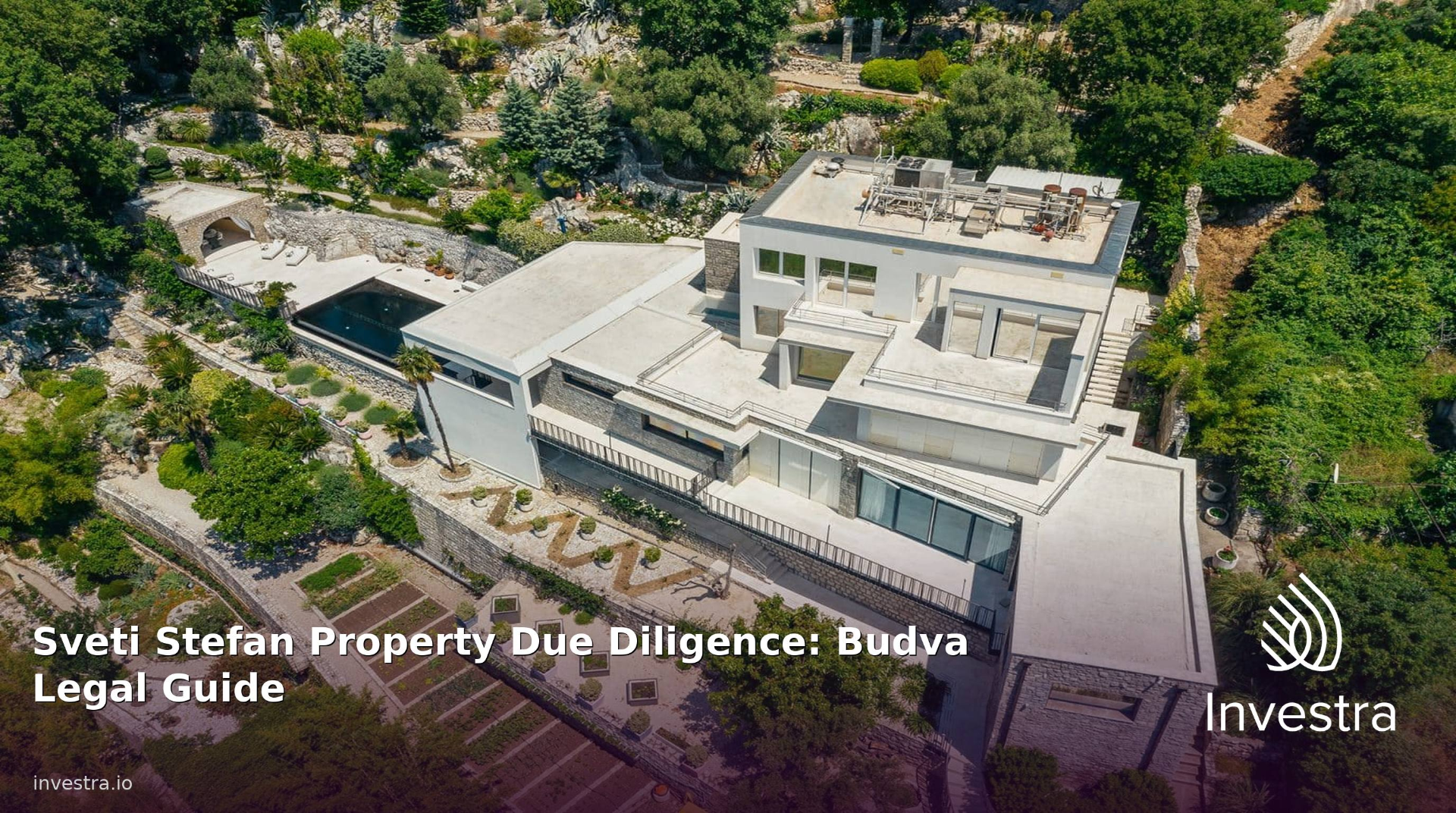
Sveti Stefan Property Due Diligence: Budva Legal Guide
Sveti Stefan Property Due Diligence: Budva Legal Guide
Why Sveti Stefan Property Due Diligence Matters for International Buyers
Quick Answer: Sveti Stefan's unique island-resort status means property due diligence here requires attention to special ownership rules, heritage restrictions, and rental regulations that differ from mainland Budva. Understanding these before committing capital is essential for protecting your investment.
Sveti Stefan isn't just another Adriatic waterfront location. This 15th-century fortified village turned luxury resort sits on a small island connected to the mainland by a narrow isthmus, and that geography shapes everything about how property ownership and investment work here. When you're considering a purchase in Sveti Stefan, you're not simply buying a home or rental asset—you're entering a property ecosystem with distinct legal, operational, and practical constraints that don't apply to nearby Budva or Kotor.
What surprises many international buyers is that Sveti Stefan operates under different rules than the rest of Budva Municipality. The entire settlement is architecturally protected, meaning modifications to facades, windows, or structural elements require heritage authority approval. Beyond aesthetics, there's the question of how the property functions within the existing resort infrastructure. Can you rent it independently, or only through the resort management? What happens to your income if the resort undergoes renovation? These questions don't get answered by property listings alone.
In my experience working with investors in this region, the buyers who avoid costly surprises are those who treat due diligence as a non-negotiable first step, not a checkbox. They commission independent legal reviews, verify ownership chains, confirm rental regulations in writing, and understand exactly what they're buying into before making an offer. This approach costs time and money upfront but prevents far costlier complications later. For Sveti Stefan specifically, that diligence is even more critical because the property market here is smaller, less transparent, and shaped by resort economics rather than typical residential or investment property dynamics.
The goal of this guide is to walk you through every practical aspect of due diligence in Sveti Stefan—from title verification and legal status checks to understanding how rental restrictions work and what ownership costs really entail. By the end, you'll know exactly what questions to ask, which documents to request, and how to evaluate whether a Sveti Stefan property truly aligns with your investment goals.
Understanding Sveti Stefan's Unique Legal Status and Property Classifications
Quick Answer: Sveti Stefan is a protected cultural monument with restricted ownership categories—residential units, resort apartments, and commercial spaces each have different legal frameworks and operating rules that directly affect resale value and rental potential.
Before you even think about valuation or financing, you need to understand what legal category your prospective property falls into. Sveti Stefan's ownership structure isn't straightforward because the settlement itself is classified as a cultural monument of national importance. This designation creates a framework where not all properties are treated equally under Montenegrin law.
Properties in Sveti Stefan typically fall into one of three broad categories: residential units (primary dwellings), resort apartments (tourism-focused units managed by or affiliated with the resort), and commercial spaces (retail, dining, or service operations). Each category carries different ownership rights, rental restrictions, and inheritance implications. A residential unit, for instance, may allow you greater freedom in how you use and rent the property compared to a resort apartment, which might be contractually tied to specific management arrangements.
Here's what buyers often miss: just because a property is located in Sveti Stefan doesn't mean you have unrestricted ownership rights. Many units come with management agreements or operational clauses that limit your control. Some are only available to buyers meeting specific nationality or residency criteria. Others include mandatory inclusion in the resort rental pool, meaning a percentage of your income flows to central management, or the resort retains first refusal on bookings. Understanding your specific legal classification before purchase is absolutely essential because it determines everything from how you'll use the property to what you can realistically expect in rental income.
To verify this information, request from your lawyer a formal property classification letter from the relevant Budva municipal authorities and the cultural heritage protection office. This document should explicitly state the property category, any heritage restrictions, and permitted uses. Many international buyers skip this step, assuming their real estate agent has explained everything. That's a mistake. Get it in writing from independent legal counsel.
There's also the question of future development. Sveti Stefan underwent a significant renovation and repositioning in recent years. Understanding what phase of that development your property is in, whether any planned works might affect your unit, and how you'd be compensated if renovation or maintenance access disrupts your use—these details belong in your due diligence file. Request from the property seller or resort management a written summary of any planned capital works or maintenance projects over the next 3–5 years.
Title Verification and Ownership Chain Documentation
Quick Answer: Title verification in Sveti Stefan requires checking the land registry, confirming inheritance or transfer legitimacy, and confirming no liens or restrictions exist against the specific unit you're considering.
This is where due diligence becomes tangibly protective. The Montenegrin land registry (Katastar nepokretnosti) is your primary source of truth about who legally owns a property and what encumbrances or restrictions apply. However, the registry isn't always complete or current, which means relying on it alone isn't enough. You need to build a complete ownership chain going back as far as possible—ideally to when the property was first registered or constructed.
Start by asking your lawyer to obtain a certified extract from the land registry for the specific property. This document shows the current registered owner, the property boundaries and area, any mortgages, liens, or pledges against the property, and any registered easements or rights of way. That's your baseline. But ownership chains in Sveti Stefan, particularly for properties that have changed hands multiple times or were inherited, can be complex. A property might have been transferred within a family, sold abroad, or involved in a divorce settlement—each transition creates a paper trail that needs verification.
Your lawyer should trace back through every transfer deed (dokaz o vlasništvu) back at least 10 years, though ideally longer. For each transfer, verify that the seller had clear legal authority to sell, that the buyer acquired full ownership, and that no disputes were registered. In rare cases, properties in Sveti Stefan have unclear historical ownership due to recent changes in management or restructuring following the resort's renovation. If you encounter gaps in the ownership chain or transfers that aren't clearly documented, that's a red flag requiring resolution before you proceed.
Pay specific attention to whether the property was ever subject to a mortgage or loan secured by the property. Even if the previous owner paid off the loan, the registration should be formally cancelled. Request evidence of cancellation. Similarly, check whether any liens exist—these might be tax arrears, unpaid maintenance fees, or other claims against the property. In Sveti Stefan, the most common lien scenario involves outstanding resort maintenance or communal fees. If the previous owner didn't pay these, they could transfer to you as the new owner.
A related but often overlooked issue is whether the property is registered in someone's name who has since passed away, and whether probate or estate proceedings are still pending. This happens occasionally in Sveti Stefan with older European owners. If estate proceedings aren't concluded, the property isn't truly available for sale, and you could find yourself in a purchase agreement with someone who doesn't have unencumbered authority to transfer ownership.
Heritage Protection Restrictions and Their Impact on Property Rights
Quick Answer: Sveti Stefan's heritage status means exterior modifications, renovations, and some interior changes require written approval from the Ministry of Culture, which can delay projects and limit your customization freedom.
Sveti Stefan's protection as a cultural monument is both an asset and a constraint. The asset part is obvious: the prestige, the preservation of character, and the protection against unsightly nearby development. The constraint is less obvious until you own the property and want to make changes. Any visible modification—replacing windows, repainting shutters, installing new doors, adding balconies—requires approval from Montenegro's Ministry of Culture or delegated heritage authorities. This isn't a rubber-stamp process. It can take weeks or months, involves inspections, and may require working with approved contractors or restoration specialists.
During your due diligence, establish exactly which changes would require heritage approval and which wouldn't. Interior changes like flooring, plumbing, or kitchen renovation typically don't need approval if they're not visible from outside. Structural changes, facade work, roof modifications, or additions do. Request from the resort management or local heritage office a written summary of what types of modifications have been approved for similar properties in recent years and what the typical approval timeline is. This gives you realistic expectations about future projects.
Many international buyers purchase in Sveti Stefan with renovation plans—opening walls, adding windows to dark rooms, modernizing bathrooms. Ask yourself honestly: will you accept a 3–6 month approval process? Will you work only with contractors pre-approved by heritage authorities? Can you accept the possibility that your preferred modification might be refused? If you're importing architectural ideas from elsewhere and expect to implement them freely, Sveti Stefan isn't the right location. If you're willing to work within heritage parameters and see that as part of the property's charm and value protection, then you're aligned with what Sveti Stefan requires.
There's another dimension to this restriction worth understanding. Heritage limitations can affect resale value and rental appeal. A renovated property with full heritage approvals for all changes is attractive and marketable. A property where previous owners attempted unapproved modifications—even well-intentioned ones—can face complications when you try to sell. The buyer's lawyer will flag those modifications, and you may be required to either remove them or obtain retroactive heritage approval. Verify during your inspection whether the current property shows evidence of unauthorized changes. Ask the owner directly about what work has been done and obtain all relevant approval documents.
Rental Regulations and Resort Management Agreements
Quick Answer: Sveti Stefan properties often operate under resort rental agreements that limit independent bookings, cap occupancy, or require profit-sharing with management—affecting your actual rental income versus theoretical potential.
If you're buying in Sveti Stefan as an investment property with rental income expectations, you absolutely must understand the rental framework before committing capital. This is where many international investors discover a significant gap between what they expected and what's actually permitted. Unlike a residential property in central Budva where you can rent to holiday tourists, long-term tenants, or whoever you choose, Sveti Stefan properties often operate within managed systems that constrain your options.
The most common scenario involves resort management agreements. These agreements specify how your unit can be rented, who can book it, what rates apply, and what percentage of rental income goes to the resort or central management company. Some agreements are straightforward: the resort handles all bookings, cleaning, and guest management, taking 30–40% of gross rental income in exchange. Others are more restrictive: your unit can only be rented through specific channels, can't compete with other units on price, or can only be booked when the resort officially opens its calendar for that date range.
Request a complete copy of any management or rental agreement that applies to your specific unit. Read it with your lawyer. Key questions to address: (1) How is rental income calculated—gross or net of taxes and cleaning? (2) What fees or commissions does management take? (3) Can you rent independently or only through the resort? (4) Are there minimum or maximum rental periods? (5) What happens if the resort closes temporarily for maintenance or renovation—do you still owe management fees? (6) Can you opt out of the rental agreement if circumstances change?
One issue I've seen cause genuine investor disappointment: resort closure or renovation periods. Sveti Stefan, like many luxury properties, undergoes periodic maintenance. If this happens for two months a year, you can't rent during that time, but you may still owe management fees. The financial model you developed assuming year-round rentability doesn't survive contact with reality. Request from current ownership a detailed calendar of planned closures or maintenance windows for the next 2–3 years and confirm in writing how you're protected or compensated during those periods.
There's also the regulatory environment around short-term holiday rental. Montenegro has been tightening rules around tourist accommodation registration, taxation, and licensing. Properties used for holiday rental require registration and must comply with tourism board regulations. Some properties are grandfathered under older rules; others must operate under new stricter frameworks. Confirm with your lawyer what registration and compliance requirements apply to the specific property you're considering and what costs are involved. This affects your realistic rental net income.
A related consideration: what happens to rental rights if you sell the property? Some management agreements are personal to you as the owner; others transfer to new ownership. If you plan to eventually sell, you want to confirm that rental arrangements are assignable and that a future buyer won't inherit unfavorable terms that kill resale attractiveness. Get clarity on this during due diligence.
Property Condition Assessment and Structural Documentation
Quick Answer: Independent building inspections and structural engineering reports are essential in Sveti Stefan where heritage age, coastal salt-air deterioration, and renovation phases create hidden defect risks.
Sveti Stefan's charm is inseparable from its age. The settlement dates to the 15th century, and while modern units have been built or renovated, many properties incorporate historic fabric—stone walls, wooden beams, traditional construction—alongside contemporary systems. This creates inspection complexity. A property might look beautiful but have deteriorating stonework, rising damp, or salt-air corrosion of metal elements invisible during a casual viewing.
Commission an independent building inspection by a qualified Montenegrin structural engineer or certified inspector. This isn't the same as the cursory walkthrough a real estate agent provides. A proper inspection includes checking foundations, walls, roof condition, moisture levels, electrical and plumbing systems, HVAC functionality, window and door seals, and signs of prior water damage or structural movement. In Sveti Stefan, this inspection is particularly important because repair costs are often higher due to heritage restrictions—you might not be able to simply replace a damaged stone wall; you may need to restore it using period-appropriate materials and traditional methods.
Request documentation of any prior renovation work: permits, architect drawings, contractor reports, warranties on systems installed. If a property underwent significant work recently, ask for a list of what was replaced (electrical wiring, plumbing, roof covering, windows, etc.) and the warranties on that work. Some properties in Sveti Stefan were renovated 10+ years ago as part of the resort's repositioning. Systems installed then may be nearing end-of-life. Clarify what you're inheriting and what maintenance or replacement costs you should budget for in the next 3–5 years.
Water damage and rising damp are specific concerns in Sveti Stefan. The island's proximity to the sea, combined with winter rainfall and stone construction, creates moisture infiltration risks. Ask your inspector specifically about signs of damp, efflorescence (white salt deposits on walls), or prior water damage repairs. If you see signs of damage, require a written assessment of cause and recommended remediation.
Ask the current owner directly about any problems they've experienced: plumbing issues, electrical faults, structural cracks, mold or damp, noise from neighbors, or service disruptions. Get their answers in writing (email counts). You're looking for both genuine problems and indicators of whether the owner has maintained the property diligently or deferred maintenance. Properties that have been conscientiously maintained and documented show more transparently than those where problems were ignored or hidden.
Tax Obligations and Ownership Costs in Sveti Stefan
Quick Answer: Property ownership in Sveti Stefan involves annual property taxes, communal/resort maintenance fees, and heritage preservation contributions calculated on property value and size—totaling 1–2% of property value annually in many cases.
Insurance costs in Sveti Stefan can be higher than mainland Budva properties due to coastal location (salt-
Explore more on Investra: Pula Real Estate Market 2026: Areas, Buyer Demand and Due Diligence | How to Buy Property in Istria as a Foreign Buyer in 2026 | Rovinj Real Estate Market 2026: Buyer Priorities and Location Choices | Istria Property Investment 2026: A Decision Framework for Buyers | Poreč Real Estate Market 2026: A Practical Guide for Property Buyers | Pula Rental Investment Guide 2026: Long-Term Letting Buyer Questions | Buying Property in Pula: Legal Checks Before You Commit | Rovinj Holiday Rental Investment: Buyer Due Diligence for 2026 | Umag Real Estate Market 2026: Property Types, Areas and Buyer Checks | Istria Property Due Diligence: A Croatian Buyer Checklist | Istria Property FAQ 2026: Clear Answers for International Buyers | Best Neighbourhoods in Pula for Property Buyers in 2026 | Medulin Real Estate Market 2026: A Buyer Guide to Homes and Locations | Property Taxes and Purchase Costs in Istria: What Buyers Should... | Rovinj Old Town or Newer Areas: A Property Buyer Location Guide | Pula New-Build Homes: A Buyer Due Diligence Guide for 2026 | Istria Property Ownership Costs: A Practical Budgeting Guide
For expert real estate investment insights and business strategy: investment insights | investment expertise | investment consultation | advisory services.
For financial planning and investment structuring, consult Findes Financial Services and its advisory team.
Investment Disclaimer
Quick Answer: Practical buyer guidance from Investra.io.
The information provided in this article is for educational and informational purposes only and should not be construed as financial, legal, or investment advice. Real estate investments carry inherent risks, and past performance does not guarantee future results. Investors should not invest money they cannot afford to lose. Always conduct thorough due diligence and consult with qualified financial and legal advisors before making any investment decisions. Investra.io does not guarantee returns on any investment.
Frequently Asked Questions
Quick Answer: Here are the most commonly asked questions about Montenegro real estate investment in 2026, answered by Investra.io experts.
Is Montenegro a good country for real estate investment in 2026?
Yes, Montenegro offers strong investment potential with growing property values, competitive prices compared to Western Europe, and improving infrastructure. Investra.io provides comprehensive market data and investment guidance.
Can foreigners buy property in Montenegro?
EU citizens can buy property freely in Montenegro. Non-EU citizens may need to meet specific requirements. Investra.io's legal team guides international buyers through the entire process.
What is the average property price in Budva & Kotor?
Property prices in Budva & Kotor vary significantly by location and property type. Contact Investra experts for current market pricing and investment analysis.
What rental yields can I expect?
Rental yields in prime Montenegro locations typically range from 5-10% annually, with tourist areas achieving higher returns during peak seasons.
What taxes apply to property purchases?
Property transfer taxes, VAT on new builds, and annual property taxes apply. Rates vary by property type and location. Consult Siniša Dagary for tax optimization strategies.
How long does the purchase process take?
Typically 30-60 days from offer to completion. Working with Investra.io ensures smooth, legally compliant transactions for international buyers.
What financing options are available?
Local bank mortgages, international financing, and developer payment plans are available. Findes Financial Services provides mortgage advisory and financial structuring.
Is property management available for rental properties?
Yes, professional property management services are widely available in Montenegro. Investra.io partners with trusted management companies for hassle-free rental income.
What are the best areas to invest in Budva & Kotor?
Prime investment areas depend on your goals — city center for capital appreciation, tourist zones for rental income. Investra.io's market analysis identifies the best opportunities.
Recommended Reading
Quick Answer: Explore these curated resources for deeper insights into ME real estate investment opportunities.
- Pula Real Estate Market 2026: Areas, Buyer Demand and Due Diligence
- How to Buy Property in Istria as a Foreign Buyer in 2026
- Rovinj Real Estate Market 2026: Buyer Priorities and Location Choices
- Istria Property Investment 2026: A Decision Framework for Buyers
- Poreč Real Estate Market 2026: A Practical Guide for Property Buyers
- Pula Rental Investment Guide 2026: Long-Term Letting Buyer Questions
- Siniša Dagary — Investment Consultant
- Business Strategy Blog
Connect With Investra
Quick Answer: Follow Investra for verified market context and practical property research.
Related Posts
No related posts available.
