
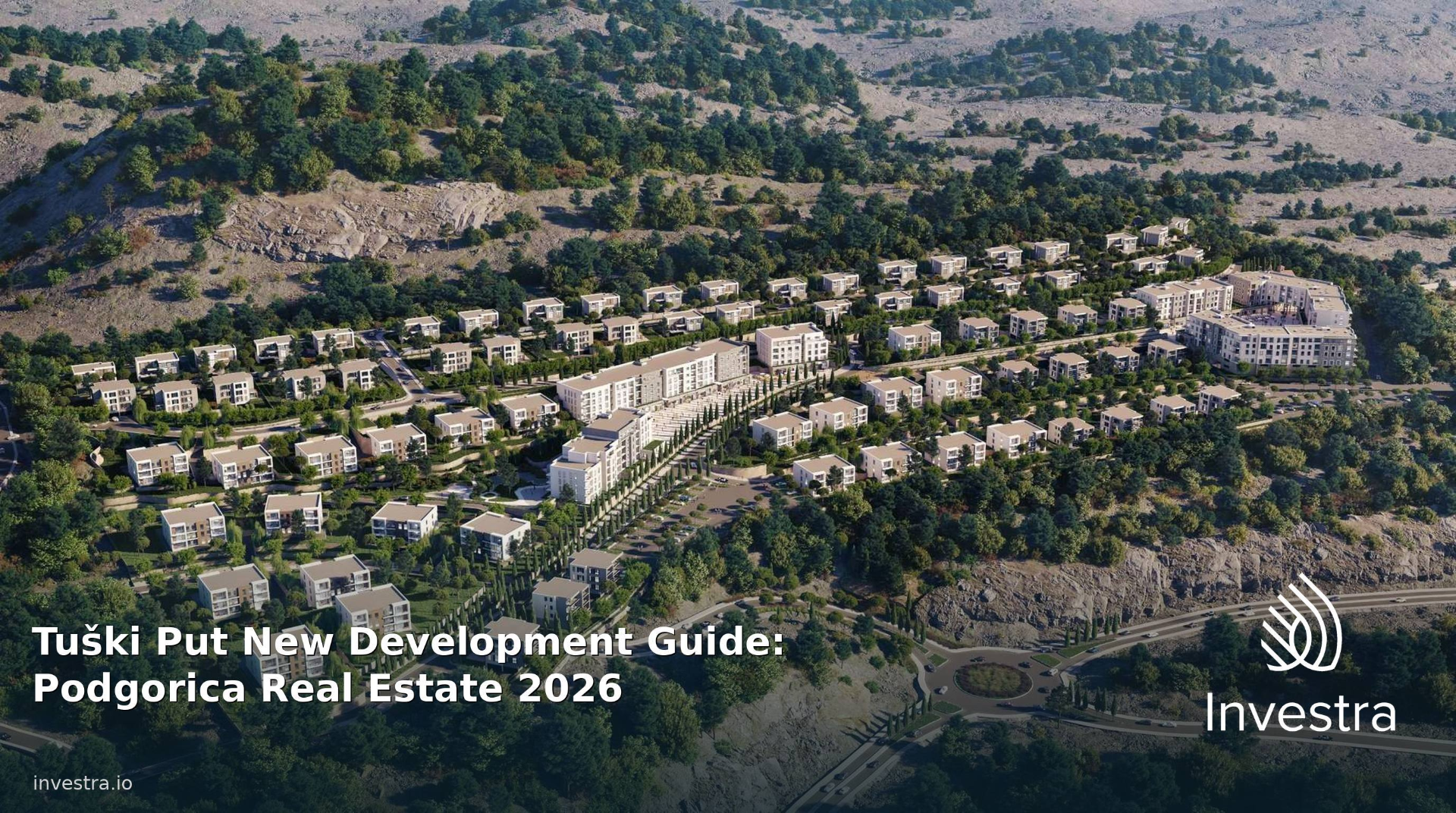
Tuški Put New Development Guide: Podgorica Real Estate 2026
Tuški Put New Development Guide: Podgorica Real Estate 2026
Why Tuški Put Is Attracting Serious Property Attention in 2026
Quick Answer: Tuški Put is emerging as one of Podgorica's most closely watched corridors for new residential development, drawing interest from both local upgraders and international buyers who want modern housing without the premium pricing of established city-centre addresses. For a broader regional comparison, Istria Property Investment 2026: A Decision Framework for Buyers offers a useful parallel framework applicable to Adriatic markets.
There's a certain logic to why Tuški Put keeps coming up in conversations about Podgorica real estate. The road itself functions as a spine connecting several developing residential pockets on the city's periphery, and over the past few years, that peripheral status has shifted. Infrastructure investment, improved road access and the gradual northward expansion of Podgorica's urban footprint have combined to make this corridor feel genuinely central to where the city is heading rather than where it's been.
What we've seen across comparable emerging corridors in Southeast European capitals is a pattern: early buyers who assess infrastructure timelines carefully and purchase before project completions tend to benefit from price appreciation during the construction-to-handover window. That's not a guarantee — market conditions, project delays and regulatory changes all introduce risk — but it does explain why buyers are asking the right questions about Tuški Put right now rather than waiting.
For international investors already familiar with markets like Istria's, Montenegro presents a structurally different risk and opportunity profile. The country's EU candidate status, its existing eurozone adoption (Montenegro uses the euro without being an EU member), and its ongoing tourism infrastructure investment create a backdrop that's worth understanding carefully. Tuški Put sits within that broader story, and this guide aims to equip buyers with the specific questions they should be asking before committing to any purchase in this corridor.
Understanding the Tuški Put Corridor: Location and Urban Context
Quick Answer: Tuški Put runs through a mixed-use zone on Podgorica's developing fringe, where residential blocks, light commercial strips and greenfield plots coexist — making location assessment within the corridor genuinely variable rather than uniform.
Podgorica isn't a large city by European standards, which means neighbourhood-level distinctions matter enormously. Within a city that can be crossed by car in under twenty minutes, the difference between a plot with good connectivity and one that relies on a single congested access road becomes significant for both liveability and rental demand.
Tuški Put, as a named arterial route, passes through zones that vary considerably in their current state of development. Some sections are already flanked by completed residential buildings with active residents; others sit closer to undeveloped or semi-developed parcels where new projects are in various stages of permitting, construction or marketing. Buyers researching this corridor should treat it not as a single homogeneous address but as a sequence of distinct microlocations, each with different risk profiles.
Key questions to investigate include: How far is a specific plot or building from the nearest major road junction? What's the walking distance to the closest supermarket, school or public transport stop? Is the immediate street already serviced with full utilities — water, sewage, electricity and internet infrastructure — or are those connections pending? These aren't hypothetical concerns. In developing corridors across the Western Balkans, utility connection timelines have sometimes lagged behind building completion dates, creating practical difficulties for early occupants.
Cross-referencing satellite mapping tools with the Podgorica municipality's urban planning portal (accessed through the Uprava za nekretnine, Montenegro's Real Estate Administration) gives a working picture of current zoning and approved uses, though you'll want a local professional to interpret what you find. Siniša Dagary and his team have written extensively on how to approach location due diligence in developing Adriatic and Balkan markets.
What New Developments on Tuški Put Actually Look Like in 2026
Quick Answer: New developments in the Tuški Put area range from mid-rise apartment blocks to smaller boutique residential schemes, typically offering contemporary finishes, parking and in some cases commercial ground-floor units — though specification quality varies significantly between developers.
The development landscape along Tuški Put in 2026 is genuinely mixed. You'll find projects at very different stages: some are fully sold and occupied, some are in active construction, and others exist primarily as marketing materials and architectural renders. That variation is normal for an emerging corridor, but it demands that buyers develop a clear-eyed framework for distinguishing credible projects from aspirational ones.
In terms of typology, most new residential schemes in this zone are apartment-led, typically spanning four to eight floors, with ground-level parking (either surface or in a semi-basement configuration) and apartment sizes that tend to follow Montenegrin market conventions — studios, one-bedroom and two-bedroom units dominating the mix, with three-bedroom units less common but present. Some schemes include a commercial ground floor intended for retail, cafés or services, which can add long-term vibrancy but also introduces questions about who the commercial tenants will be and how that affects the residential environment.
Specification quality is where buyers need to be particularly attentive. Terms like "luxury finishes" appear in marketing materials across a wide range of actual build quality levels in Montenegrin new-build projects. Ask developers for a detailed technical specification document — not just a brochure — and have it reviewed by an independent structural engineer or quantity surveyor before signing anything. Comparable due diligence frameworks used in Croatian markets are documented in guides like Pula New-Build Homes: A Buyer Due Diligence Guide for 2026 and translate well to the Montenegrin context.
Buying Process for Tuški Put Properties: What Foreign Buyers Need to Know
Quick Answer: Foreign nationals can generally purchase property in Montenegro, including in Podgorica, though the process involves specific legal steps around company structures or individual ownership rights that vary depending on the buyer's citizenship — always verify current rules with a licensed Montenegrin notary or lawyer.
Montenegro's property purchase process has evolved notably over the past decade as the country has progressively aligned aspects of its legal framework with EU standards in anticipation of eventual accession. The reality is that the system is functional and increasingly accessible to international buyers, but it retains distinctive features that require professional guidance to navigate correctly.
The fundamental steps involve: identifying a property, conducting title and encumbrance checks through the Real Estate Administration (Uprava za nekretnine), signing a preliminary agreement (predugovor) typically accompanied by a deposit, commissioning an independent valuation or technical check, completing a final notarised purchase contract (ugovor o kupoprodaji), paying applicable taxes and fees, and registering the new ownership in the state real estate cadastre.
Foreign buyers should establish early whether they can purchase as private individuals or whether a locally registered company structure is advisable. Citizenship matters here — EU citizens and citizens of countries with bilateral reciprocity agreements with Montenegro generally have individual purchase rights, while buyers from other jurisdictions may face different procedures. This isn't a question to answer based on secondhand forum advice; it requires a consultation with a licenced Montenegrin lawyer. For a useful comparison of how the foreign buyer process works in another Adriatic market, How to Buy Property in Istria as a Foreign Buyer in 2026 illustrates the level of due diligence that professional advisors recommend across the region.
Off-plan purchases — common for new developments on Tuški Put — carry additional considerations. Payment schedules linked to construction milestones, escrow arrangements, and developer insolvency protections are all points to negotiate and document before committing funds. Advisory services from experienced consultants familiar with the Balkan market can be particularly valuable at the contract review stage.
Taxes and Purchase Costs in Montenegro: The Full Picture
Quick Answer: Buying property in Montenegro involves a transfer tax on resale properties, VAT implications on new-build purchases, notary fees, legal fees and registration costs — buyers should budget for total acquisition costs that go beyond the headline property price, and verify current rates with a local tax advisor.
Purchase costs in Montenegro are meaningfully different depending on whether you're buying a new-build directly from a developer or an existing resale property. Getting this distinction right matters for budgeting, because the applicable taxes differ.
For new-build apartments purchased directly from a developer acting as a VAT-registered entity, VAT typically applies rather than the resale transfer tax. The VAT rate applicable to residential property in Montenegro should be confirmed with a local accountant, as rates and applicable exemptions can change through government policy. For resale properties, a transfer tax (porez na promet nepokretnosti) applies, and its current rate should similarly be verified with the Montenegrin Tax Administration or a licensed local professional rather than assumed from older online sources.
Beyond taxes, buyers should budget for: notary fees (calculated on a sliding scale relative to transaction value), legal fees for independent lawyer representation, property registration fees at the Real Estate Administration, and any agency commission if a real estate agent is involved. In Tuški Put new developments specifically, developers sometimes market properties as inclusive of certain costs or offer staged payment structures — scrutinise what "inclusive" actually means in each case.
Annual property tax in Montenegro exists but has historically been set at rates that many buyers from Western European markets find relatively modest. Current rates and the method of assessment should be checked with the local municipality (Opština Podgorica) or a local advisor. For a detailed parallel framework covering how property taxes work in a comparable market, Property Taxes and Purchase Costs in Istria: What Buyers Should... illustrates the categories of cost that every buyer should plan for.
Developer Due Diligence: Assessing Who Is Building on Tuški Put
Quick Answer: The credibility of the developer behind any Tuški Put project is as important as the location itself — buyers should investigate company registration history, completed project track records, permit validity and financial backing before signing any preliminary agreement.
This is where a lot of buyers underinvest their research effort, and it's arguably the highest-use due diligence step for off-plan purchases anywhere in the Western Balkans. The reality is that the barrier to launching a residential development project — producing renders, opening a sales office, taking reservations — is lower than the barrier to actually completing one to the promised standard and on time.
Start with the basics: is the developer a registered legal entity in Montenegro with verifiable company history? Montenegro's Central Register of Commercial Entities (CRPS) is publicly accessible and allows you to check company registration dates, directors, ownership structure and any recorded legal actions. A developer who has operated in Montenegro for a single year with no completed projects is a categorically different counterparty risk from one with a decade of operating history and a portfolio of delivered buildings you can physically visit.
Beyond registration, ask for building permits (građevinska dozvola) and verify their authenticity with the relevant municipal authority. Check whether the land on which the development sits is registered free of encumbrances — a licensed notary or lawyer can run this check through the Real Estate Administration. Ask for references from buyers in the developer's previous projects and, where possible, visit those completed buildings to assess actual finish quality against what was promised at the sales stage.
The Siniša Dagary investment insights resource covers several frameworks for evaluating developer credibility in emerging European markets, which complement what any local lawyer will advise. Comparable buyer protection and checklist approaches for new-build purchases are also detailed in Istria Property Due Diligence: A Croatian Buyer Checklist — the principles transfer directly.
Rental Market Dynamics: What Buyers Should Realistically Expect
Quick Answer: Rental demand in Podgorica is driven primarily by the professional and student population rather than tourism, making Tuški Put's rental prospects dependent on proximity to employment centres, universities and transport links rather than seasonal visitor patterns — buyers should assess current local rental listings to understand achievable rents before purchasing.
Podgorica isn't Kotor or Budva. That distinction matters enormously when evaluating rental investment potential. The coastal towns of Montenegro attract significant tourist volumes and generate short-term rental income through platforms like Airbnb during the summer season. Podgorica, as the capital and the country's primary business hub, operates on a fundamentally different rental model — it's a long-term rental market driven by local workers, expatriates, diplomats, international organisation staff, and students at the University of Montenegro.
What does this mean for Tuški Put specifically? Rental appeal in this corridor will hinge on whether the location offers genuine convenience for working residents. A modern apartment with good finishes and adequate parking is attractive to Podgorica's professional class — but only if the commute to the city's business districts is manageable. Buyers should map the drive or bus journey from specific Tuški Put addresses to major employment areas (the city centre, the Smokovac zone, Podgorica airport road employers) at different times of day before assuming rental demand will be strong.
To calibrate realistic rental expectations without relying on developer projections, browse current listings on active Montenegrin property portals (such as Nekretnine.me or oglasi.me) filtering for comparable newly finished apartments in Podgorica's developing zones. This gives a real-market price range to work from rather than an aspirational figure. For how similar rental market assessments are structured in Croatian cities, Pula Rental Investment Guide 2026: Long-Term Letting Buyer Questions is worth reading as a methodological reference. The Findes Group & Partners advisory team also works with cross-border investors on rental market assessment across the Adriatic-Balkan region.
Ownership Costs and Ongoing Expenses for Podgorica Apartments
Quick Answer: Owning a property in Podgorica involves ongoing costs including annual property tax, building maintenance fees, utility charges and any property management fees if the apartment is rented — buyers should model these costs carefully against expected rental income or personal use value before purchasing.
In newer buildings, building management fees can vary significantly depending on whether the development includes amenities like a lift, underground parking, a gym or a reception area. Higher-amenity buildings carry higher ongoing fees. This isn't necessarily bad — well-managed buildings typically retain their value better — but it needs to be factored into total cost of ownership calculations from the outset. The framework in Istria Property Ownership Costs: A Practical Budgeting Guide provides an excellent template for building a total cost model that Montenegro buyers can adapt to local conditions.
Comparing Tuški Put to Other Podgorica Neighbourhoods
Quick Answer: Tuški Put competes with established Podgorica zones like City Kvart, Zagorič and the areas around Delta City for buyer attention — each has different maturity, pricing and tenant profiles, making a comparative assessment essential before narrowing in on one corridor.
Comparing these zones objectively requires current price data from active listings, which buyers can access through local portals. For neighbourhood comparison methodology in a comparable mid-sized city, the analytical approach used in Best Neighbourhoods in Pula for Property Buyers in 2026 is instructive — specifically how buyers should weigh current prices against infrastructure trajectory rather than just today's amenity availability. A similar location-weighting framework is discussed by Siniša Dagary in the context of emerging Balkan urban markets.
Legal Title and Cadastre Checks: The Non-Negotiable Step
Quick Answer: Every property purchase on Tuški Put — whether new-build or resale — requires a clean title verification through Montenegro's Real Estate Administration cadastre before any money changes hands, as encumbrances, unresolved inheritance disputes or irregular building permits can affect both ownership security and future resale.
A licensed Montenegrin notary (javni bilježnik) is legally required for property transactions and can conduct many of these checks. Having an independent lawyer in addition to the notary provides an extra layer of protection, particularly for foreign buyers unfamiliar with local legal conventions. The due diligence logic is identical to what experienced buyers apply in Croatia, as detailed in guides like Buying Property in Pula: Legal Checks Before You Commit. For complex situations, the Findes Group & Partners advisory team provides cross-border legal coordination support.
What Buyers Should Assess When Researching Tuški Put New Developments
Quick Answer: A thorough buyer assessment of Tuški Put new developments should cover six core dimensions: developer credibility, planning permit status, cadastre title clarity, specification accuracy, rental market realism and total cost of ownership — none of these can be properly assessed using marketing materials alone.
International buyers tackling this for the first time will benefit from professional guidance. Investment consultation from advisors with direct Balkan real estate experience can materially reduce the risk of costly errors. For those also considering Adriatic markets as part of a diversified portfolio, resources like Istria Property FAQ 2026: Clear Answers for International Buyers and Medulin Real Estate Market 2026: A Buyer Guide to Homes and Locations offer useful comparative frameworks.
Montenegro's EU Accession Journey and What It Means for Property Buyers
Quick Answer: Montenegro is an EU accession candidate that has used the euro since 2002 and has made meaningful legal alignment progress — while EU membership would likely accelerate market formalisation and investor confidence, the timeline remains politically uncertain and should not be treated as a near-term certainty in any investment thesis.
The EU accession narrative is frequently cited in Montenegro property marketing materials, and it's worth examining it honestly rather than dismissively. Montenegro opened EU accession negotiations in 2012 and has completed a meaningful number of
Explore more on Investra: Pula Real Estate Market 2026: Areas, Buyer Demand and Due Diligence | Rovinj Real Estate Market 2026: Buyer Priorities and Location Choices | Poreč Real Estate Market 2026: A Practical Guide for Property Buyers | Rovinj Holiday Rental Investment: Buyer Due Diligence for 2026 | Umag Real Estate Market 2026: Property Types, Areas and Buyer Checks | Rovinj Old Town or Newer Areas: A Property Buyer Location Guide
Investment Disclaimer
The information provided in this article is for educational and informational purposes only and should not be construed as financial, legal, or investment advice. Real estate investments carry inherent risks, and past performance does not guarantee future results. Investors should not invest money they cannot afford to lose. Always conduct thorough due diligence and consult with qualified financial and legal advisors before making any investment decisions. Investra.io does not guarantee returns on any investment.
Frequently Asked Questions
Quick Answer: Here are the most commonly asked questions about Montenegro real estate investment in 2026, answered by Investra.io experts.
Is Montenegro a good country for real estate investment in 2026?
Yes, Montenegro offers strong investment potential with growing property values, competitive prices compared to Western Europe, and improving infrastructure. Investra.io provides comprehensive market data and investment guidance.
Can foreigners buy property in Montenegro?
EU citizens can buy property freely in Montenegro. Non-EU citizens may need to meet specific requirements. Investra.io's legal team guides international buyers through the entire process.
What is the average property price in Podgorica?
Property prices in Podgorica vary significantly by location and property type. Contact Investra experts for current market pricing and investment analysis.
What rental yields can I expect?
Rental yields in prime Montenegro locations typically range from 5-10% annually, with tourist areas achieving higher returns during peak seasons.
What taxes apply to property purchases?
Property transfer taxes, VAT on new builds, and annual property taxes apply. Rates vary by property type and location. Consult Siniša Dagary for tax optimization strategies.
How long does the purchase process take?
Typically 30-60 days from offer to completion. Working with Investra.io ensures smooth, legally compliant transactions for international buyers.
What financing options are available?
Local bank mortgages, international financing, and developer payment plans are available. Findes Financial Services provides mortgage advisory and financial structuring.
Is property management available for rental properties?
Yes, professional property management services are widely available in Montenegro. Investra.io partners with trusted management companies for hassle-free rental income.
What are the best areas to invest in Podgorica?
Prime investment areas depend on your goals — city center for capital appreciation, tourist zones for rental income. Investra.io's market analysis identifies the best opportunities.
Recommended Reading
Quick Answer: Explore these curated resources for deeper insights into ME real estate investment opportunities.
- Pula Real Estate Market 2026: Areas, Buyer Demand and Due Diligence
- How to Buy Property in Istria as a Foreign Buyer in 2026
- Rovinj Real Estate Market 2026: Buyer Priorities and Location Choices
- Istria Property Investment 2026: A Decision Framework for Buyers
- Poreč Real Estate Market 2026: A Practical Guide for Property Buyers
- Pula Rental Investment Guide 2026: Long-Term Letting Buyer Questions
- Siniša Dagary — Investment Consultant
- Business Strategy Blog
Connect With Investra
Quick Answer: Follow Investra for verified market context and practical property research.
Related Posts
No related posts available.
