
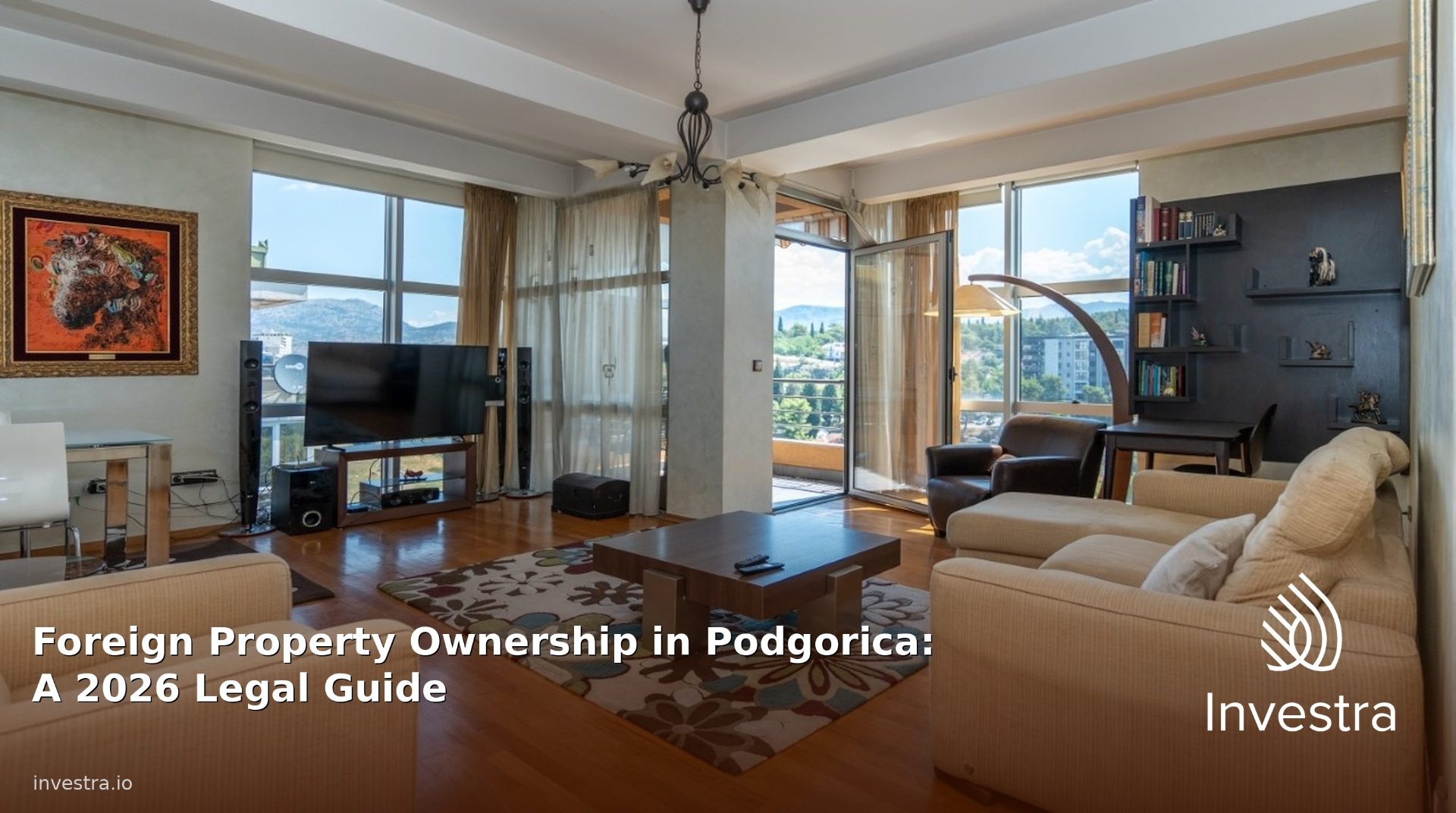
Foreign Property Ownership in Podgorica: A 2026 Legal Guide
Foreign Property Ownership in Podgorica: A 2026 Legal Guide
Foreign Property Ownership in Podgorica: What the Law Actually Says
Quick Answer: Foreign nationals are generally permitted to purchase residential and commercial property in Montenegro, including Podgorica, subject to specific legal conditions and reciprocity principles — always verify the current framework with a licensed Montenegrin attorney before proceeding. For broader Adriatic market context, the How to Buy Property in Istria as a Foreign Buyer in 2026 guide offers useful comparative insight.
Let's start with the most important question any international buyer asks: can I actually own property here? The short answer, for most buyers, is yes. Montenegro's legal framework has evolved considerably over the past decade and a half, broadly opening the market to foreign ownership of real estate — and Podgorica, as the capital city and economic engine of the country, sits squarely within that framework.
The core legal basis stems from Montenegro's property laws and its stated policy of attracting foreign direct investment as part of its EU accession strategy. What this means in practice is that citizens of most countries can purchase apartments, houses, and commercial units in Podgorica in their own name. The reciprocity principle still applies in some technical contexts — meaning Montenegro extends ownership rights to nationals of countries that extend equivalent rights to Montenegrins — but in practice, this rarely blocks buyers from Western Europe, North America, the Gulf states, or most of the former Yugoslavia.
Agricultural land remains a separate category with more restrictive rules, and certain border zones or nationally designated areas may carry limitations. But for urban residential property in Podgorica — which is what most foreign buyers are actually seeking — the path is legally accessible. That said, the practical experience of buying involves more complexity than a simple "yes, you can buy" answer would suggest. Working with a qualified local attorney from day one isn't optional — it's the foundation of a safe transaction.
In my experience observing the Montenegrin market, buyers who skip the legal groundwork early often discover title complications, encumbrances, or informal ownership arrangements that should have been identified before any contract was signed. Get the legal foundation right, and everything else follows more smoothly. For a parallel perspective on due diligence in a neighbouring Adriatic market, the Istria Property Due Diligence: A Croatian Buyer Checklist is a useful reference for how thorough buyers approach these questions.
The Podgorica Property Market in 2026: Why International Buyers Are Paying Attention
Quick Answer: Podgorica is drawing growing international buyer interest due to Montenegro's EU accession trajectory, relatively accessible entry prices compared to Western European capitals, and a developing urban real estate infrastructure — verify current pricing directly with licensed local agents and cadastre data.
Podgorica isn't Monaco or Dubrovnik. It doesn't have a coastline. What it does have is something increasingly rare in European real estate: a capital city in active economic transition, with a genuine story behind its growth rather than simply a tourism narrative.
Montenegro has been a NATO member since 2017 and is in active EU accession negotiations, with candidate status established. For real estate buyers, particularly those with a medium-to-long investment horizon, this geopolitical context matters. The institutional and regulatory environment is being reformed to align with EU standards, which has implications for property law, transaction transparency, and investor protections.
The city itself has undergone substantial infrastructure investment over the past decade — new roads, commercial developments, expanded retail, and increasing foreign business presence. Areas like the Delta City corridor, parts of Zabjelo, and the emerging new city districts have attracted both domestic buyers and international investors who see Podgorica not as a holiday destination but as a functioning capital with a residential rental market supported by local employment, diplomatic community demand, and student population from the University of Montenegro.
What surprised many buyers entering the market for the first time is how differentiated the neighbourhoods already are — there isn't a single "Podgorica market" but a patchwork of micro-markets with meaningfully different price levels, tenant profiles, and development trajectories. Buyers who do the neighbourhood-level research before committing tend to make significantly more confident decisions. For a sense of how neighbourhood research works in a comparable Adriatic city context, the Best Neighbourhoods in Pula for Property Buyers in 2026 article shows the analytical framework that experienced buyers use.
To verify current price levels in Podgorica, consult Montenegro's Real Estate Administration (Uprava za nekretnine), speak directly with three to five licensed local agents, and cross-reference with recent transaction data where available. Don't rely on listing prices alone — transaction prices are what matter.
Step-by-Step: The Buying Process for Foreign Buyers in Podgorica
Quick Answer: The buying process in Podgorica typically moves from property identification and due diligence through a preliminary agreement, notarised sale contract, and registration in the real estate cadastre — engage a bilingual Montenegrin attorney to manage each stage on your behalf.
Understanding the process end-to-end is one of the most practical things a foreign buyer can do before ever setting foot in Montenegro. Here's how it typically unfolds, though individual transactions may vary based on property type, seller situation, and financing structure.
The process broadly follows these stages: property identification and shortlisting; initial due diligence on title, encumbrances, and planning status; negotiation and agreement on price and terms; signing of a preliminary purchase agreement (predugovor) with a deposit, typically ten percent; full due diligence and legal clearance; notarised final sale agreement (kupoprodajni ugovor); payment of purchase price; registration of ownership in the Real Estate Cadastre; and payment of applicable taxes.
The notary plays a central role in Montenegrin property transactions — the final sale contract must be notarised to be legally valid and to enable cadastre registration. Your attorney should review the contract in full before notarisation, not after. It's a surprisingly common mistake for buyers to assume the notary is their legal protector — the notary authenticates the document, but isn't your advocate.
Cadastre registration is what actually creates the legal ownership record. Until your name appears in the Real Estate Cadastre, you are not the legal owner regardless of what any private contract says. The registration process can take days or weeks depending on the municipality and current administrative workload — budget for this when planning your timeline.
For buyers who want to understand how comparable due diligence processes work in neighbouring EU markets, the Buying Property in Pula: Legal Checks Before You Commit article provides a detailed breakdown of what rigorous pre-purchase legal checks look like in practice.
Title and Cadastre Due Diligence: The Non-Negotiable Foundation
Quick Answer: Before signing any purchase agreement in Podgorica, an attorney must verify clean title through the Montenegro Real Estate Cadastre, checking for mortgages, liens, co-ownership claims, and any unresolved inheritance or restitution issues — this step cannot be skipped or abbreviated.
This is where many transactions either succeed or fail before the buyer even realises there's a problem. Montenegro's cadastre system has improved significantly but still carries legacy complications from the Yugoslav-era ownership structure, post-independence transitions, and in some cases, informally constructed buildings that weren't fully regularised.
A cadastre extract (list nepokretnosti) will show the legal owner of record, any registered encumbrances, the property's legal status, and its classification. Your attorney should obtain a fresh extract at the beginning of due diligence and again immediately before signing. Property situations can change, and you want the most current picture.
Watch particularly for: properties where the cadastre owner differs from the person selling to you; buildings or parts of buildings with unresolved legalisation status (legalizacija); co-ownership situations where one co-owner is selling without the documented consent of others; and mortgage registrations that need to be discharged before or at closing.
Restitution issues — where pre-communist-era property owners or their descendants have claims on previously nationalised property — can also surface, though this is less common in Podgorica's urban residential market than in some other parts of the former Yugoslavia. Your attorney's job is to flag any such potential exposure before you commit funds.
The Siniša Dagary investment insights platform contains useful commentary on how investors across the Western Balkans approach title risk assessment, which many Podgorica-focused buyers find applicable to their own due diligence framework.
Taxes and Transaction Costs: What Foreign Buyers Pay in Montenegro
Quick Answer: Foreign buyers in Montenegro pay real estate transfer tax on resale properties, and VAT may apply on new-build purchases — consult a licensed Montenegrin tax advisor and the Tax Administration of Montenegro for current rates, as these are subject to legislative change.
Let's be direct about something that confuses a lot of first-time buyers in Montenegro: the tax treatment of a property purchase depends heavily on whether you're buying from a developer (a VAT transaction in most cases) or buying a resale property from a private seller (typically subject to real estate transfer tax). These are different legal and tax events with different cost structures.
For resale purchases, real estate transfer tax (porez na promet nepokretnosti) is the primary transaction tax. The rate is set by law and applied to the transaction value or the officially assessed value, whichever is higher. To find the current rate, consult the Montenegro Tax Administration (Poreska uprava) website or ask a local tax advisor — don't rely on secondhand reports or forum posts, as rates can be adjusted through budget legislation.
For new-build purchases from a developer, VAT (PDV) is typically applied rather than transfer tax. Developers operating under VAT are usually the ones building modern residential complexes, which is the dominant product type being marketed to international buyers in Podgorica's newer districts.
Beyond the primary transaction tax, budget for notary fees, attorney fees, cadastre registration fees, and any agent commission. In total, transaction costs in Montenegro are generally lower than in many Western European markets, but "generally lower" isn't a budget — calculate actual costs for your specific transaction before committing. The Property Taxes and Purchase Costs in Istria: What Buyers Should... guide illustrates the kind of detailed cost modelling buyers should apply in any Adriatic or Balkan market, including Montenegro.
Annual property tax (porez na nepokretnost) also applies to ownership — ask your attorney or a local tax advisor for current rates applicable to your property type and location.
Financing Options for Foreign Buyers in Podgorica
Quick Answer: Foreign buyers in Montenegro typically face more limited local mortgage access than domestic buyers, with many international purchasers opting for cash transactions or bringing financing from their home country — consult Montenegro's licensed banking institutions directly for current lending criteria for non-residents.
The reality of financing for foreign buyers in Montenegro is more constrained than in mature EU mortgage markets. While some Montenegrin banks do offer mortgage products to non-residents, the eligibility requirements, loan-to-value ratios, documentation requirements, and interest rate structures can vary significantly between institutions and may not match the terms available in buyers' home markets.
This is why the majority of foreign property purchases in Podgorica are cash transactions. International buyers who need financing often find it more practical to arrange borrowing against assets in their home country and bring the funds to Montenegro, rather than handling local mortgage underwriting as a non-resident with foreign income documentation.
If you're exploring local financing, speak directly with multiple Montenegrin banks — NLB Montenegrobanka, Hipotekarna banka, Erste Bank Montenegro, and others all operate in this market. Ask each one specifically about their non-resident mortgage products, the required documentation, and typical processing timelines. Don't assume terms from one bank apply across the market.
Currency is also relevant: Montenegro uses the euro (€) as its official currency, which eliminates foreign exchange risk for eurozone buyers and simplifies transactions for buyers from countries where the euro is a commonly held reserve currency. For buyers converting from non-euro currencies, factor in exchange rate exposure when modelling your total investment cost.
Rental Income and the Investment Case for Podgorica Property
Quick Answer: Podgorica's rental market is driven by local employment, diplomatic demand, and student population rather than tourism, creating a different demand profile from coastal Montenegrin towns — verify current rental market conditions through local agents and property managers before modelling investment returns.
What makes Podgorica interesting from a rental income perspective isn't short-term holiday lettings — it's the city's function as a working capital. Foreign buyers who approach Podgorica expecting a holiday rental yield story often find the market doesn't work that way. But buyers who understand the actual demand drivers can identify genuinely interesting long-term rental opportunities.
The tenant pool in Podgorica includes: professionals employed by the growing number of international companies and NGOs operating in Montenegro; diplomatic and international organisation staff (OSCE, EU missions, and various bilateral embassies all maintain a Podgorica presence); students and academic staff at the University of Montenegro and private higher education institutions; and Montenegrin domestic professionals who have relocated to the capital for work.
This tenant base values quality, location relative to employment centres, and reliable utility connections — not proximity to a beach. Apartments in central Podgorica, particularly well-maintained units near the main commercial areas, government district, and university quarter, tend to find tenants more consistently than peripheral or poorly connected units regardless of price.
To research current rental rates, speak with at least three to five local property management companies and cross-reference with listings on Montenegrin real estate portals. For an example of how systematic rental market research looks in a comparable Adriatic context, the Pula Rental Investment Guide 2026: Long-Term Letting Buyer Questions provides a thorough analytical model. The Rovinj Holiday Rental Investment: Buyer Due Diligence for 2026 similarly shows how experienced investors stress-test rental assumptions before buying.
For broader strategic thinking on investment frameworks, advisory services from specialists with Western Balkans expertise can help buyers build a realistic return model anchored in local data rather than optimistic projections.
Choosing the Right Location Within Podgorica
Quick Answer: Podgorica's neighbourhoods vary considerably in price, infrastructure quality, and rental demand — the city centre (Stara Varoš, Nova Varoš), the emerging Zabjelo and City Kvart districts, and the Blok 5/6 residential zones each attract different buyer profiles and should be evaluated against individual investment objectives.
Location within Podgorica matters more than many first-time buyers appreciate. The city covers a large geographical footprint, and neighbourhoods that appear close on a map can differ substantially in terms of quality of build, infrastructure maturity, walkability, and rental demand.
Working with a knowledgeable local agent who can provide granular neighbourhood insight — not just show you available listings — is essential. The Rovinj Real Estate Market 2026: Buyer Priorities and Location Choices demonstrates how experienced buyers systematically evaluate location trade-offs in Adriatic markets, and the same discipline applies directly in Podgorica.
New-Build vs. Resale Property: Buyer Considerations in Podgorica
Quick Answer: New-build apartments in Podgorica offer modern specifications and in some cases off-plan pricing advantages, while resale properties may present title complexities or renovation requirements — each type demands a distinct due diligence approach, and neither category should be purchased without full legal and technical inspection.
The Podgorica market in 2026 presents buyers with a genuine choice between modern new-build developments — many of which are actively being marketed to international buyers — and the city's existing resale stock. Both categories have real merits and real risks.
The Pula New-Build Homes: A Buyer Due Diligence Guide for 2026 provides an excellent framework for evaluating developer-led projects, covering the specific questions every new-build buyer should ask before signing any reservation or purchase agreement. The principles translate well to the Montenegrin context.
Residency, Citizenship, and Property Ownership in Montenegro
Quick Answer: Property ownership in Montenegro does not automatically confer residency or citizenship rights — separate legal pathways exist for temporary residence based on property ownership, but eligibility conditions, documentation requirements, and processing timelines should be confirmed with an immigration lawyer and the relevant Montenegrin authorities.
Buyers whose primary motivation is residency rather than property investment per se should engage both a property attorney and an immigration specialist before making any purchase. The two processes need to be properly coordinated so that the property purchase genuinely supports the residency application pathway the buyer intends to follow. Seeking expert guidance from Siniša Dagary or specialist regional advisors at firms like Findes Group & Partners can help buyers identify the right professionals for each component of this process.
Working With Professionals: Agents, Attorneys, and Advisors
Quick Answer: Successful foreign property purchases in Podgorica consistently depend on assembling the right team — a licensed local real estate agent, an independent Montenegrin attorney, a qualified tax advisor, and a technical surveyor each play distinct and non-overlapping roles that collectively protect the buyer's interests.
The Siniša Dagary profile offers insight into the kind of regional expertise that informed investors seek when approaching Western Balkans markets, and the Findes Group & Partners advisory team is another resource for buyers who want to connect with professionals experienced in cross-border property transactions in this part of Europe.
For a structured approach to evaluating whether a specific market and property type genuinely aligns with your investment objectives, the Pula Real Estate Market 2026: Areas, Buyer Demand and Due Diligence | Poreč Real Estate Market 2026: A Practical Guide for Property Buyers | Umag Real Estate Market 2026: Property Types, Areas and Buyer Checks | Istria Property FAQ 2026: Clear Answers for International Buyers | Medulin Real Estate Market 2026: A Buyer Guide to Homes and Locations | Rovinj Old Town or Newer Areas: A Property Buyer Location Guide | Istria Property Ownership Costs: A Practical Budgeting Guide | Poreč Holiday Rental Property: A 2026 Investor Planning Guide
For expert real estate investment insights and business strategy: investment consultation.
Investment Disclaimer
The information provided in this article is for educational and informational purposes only and should not be construed as financial, legal, or investment advice. Real estate investments carry inherent risks, and past performance does not guarantee future results. Investors should not invest money they cannot afford to lose. Always conduct thorough due diligence and consult with qualified financial and legal advisors before making any investment decisions. Investra.io does not guarantee returns on any investment.
Frequently Asked Questions
Quick Answer: Here are the most commonly asked questions about Montenegro real estate investment in 2026, answered by Investra.io experts.
Is Montenegro a good country for real estate investment in 2026?
Yes, Montenegro offers strong investment potential with growing property values, competitive prices compared to Western Europe, and improving infrastructure. Investra.io provides comprehensive market data and investment guidance.
Can foreigners buy property in Montenegro?
EU citizens can buy property freely in Montenegro. Non-EU citizens may need to meet specific requirements. Investra.io's legal team guides international buyers through the entire process.
What is the average property price in Podgorica?
Property prices in Podgorica vary significantly by location and property type. Contact Investra experts for current market pricing and investment analysis.
What rental yields can I expect?
Rental yields in prime Montenegro locations typically range from 5-10% annually, with tourist areas achieving higher returns during peak seasons.
What taxes apply to property purchases?
Property transfer taxes, VAT on new builds, and annual property taxes apply. Rates vary by property type and location. Consult Siniša Dagary for tax optimization strategies.
How long does the purchase process take?
Typically 30-60 days from offer to completion. Working with Investra.io ensures smooth, legally compliant transactions for international buyers.
What financing options are available?
Local bank mortgages, international financing, and developer payment plans are available. Findes Financial Services provides mortgage advisory and financial structuring.
Is property management available for rental properties?
Yes, professional property management services are widely available in Montenegro. Investra.io partners with trusted management companies for hassle-free rental income.
What are the best areas to invest in Podgorica?
Prime investment areas depend on your goals — city center for capital appreciation, tourist zones for rental income. Investra.io's market analysis identifies the best opportunities.
Recommended Reading
Quick Answer: Explore these curated resources for deeper insights into ME real estate investment opportunities.
- Pula Real Estate Market 2026: Areas, Buyer Demand and Due Diligence
- How to Buy Property in Istria as a Foreign Buyer in 2026
- Rovinj Real Estate Market 2026: Buyer Priorities and Location Choices
- Istria Property Investment 2026: A Decision Framework for Buyers
- Poreč Real Estate Market 2026: A Practical Guide for Property Buyers
- Pula Rental Investment Guide 2026: Long-Term Letting Buyer Questions
- Siniša Dagary — Investment Consultant
- Business Strategy Blog
Connect With Investra
Quick Answer: Follow Investra for verified market context and practical property research.
Related Posts
No related posts available.
