
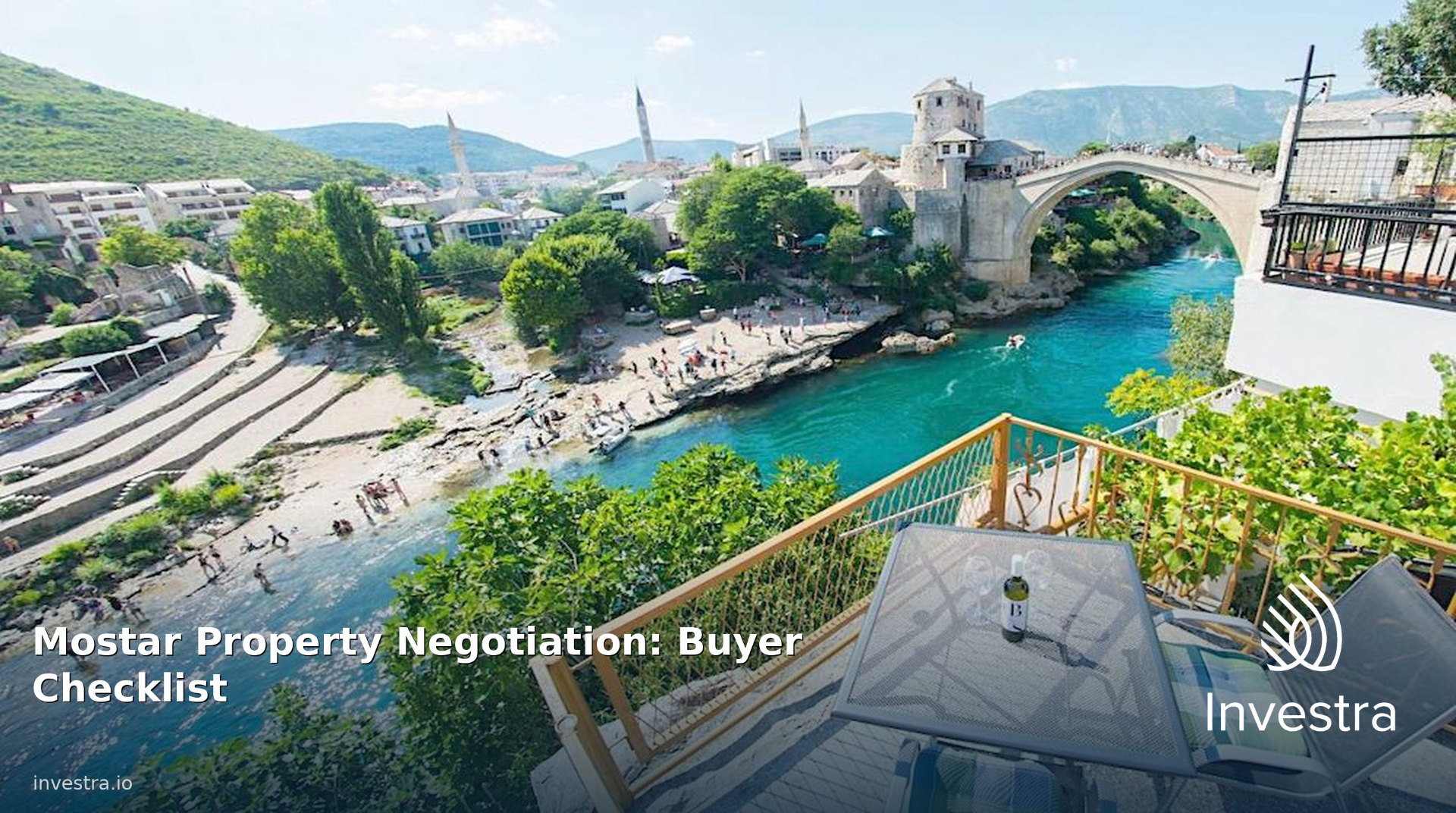
Mostar Property Negotiation: Buyer Checklist
Mostar Property Negotiation: Buyer Checklist
Mostar property negotiation: an overview for buyers
Quick Answer: Mostar property negotiation requires local market knowledge, clear due diligence, and attention to legal and tax checkpoints specific to Bosnia and Herzegovina. Use local guides and verified advisors to confirm current rules and trends.
When you begin thinking about Mostar property negotiation, the practical reality hits quickly: this is a market shaped by local history, mixed ownership structures, and a patchwork of recent development projects. In my experience, buyers who succeed here prepare more than they imagine. They gather documents, meet local agents, and align expectations with the local legal framework. What surprised many buyers is how often simple misunderstandings about ownership, municipal procedures or renovation permissions stall otherwise promising deals.
So what should buyers know about Mostar property negotiation? Start with the basics: clarify whether the asset is in the historic old town, a suburban neighbourhood or a newer development. Each location brings a different set of seller motivations and negotiation levers. For example, an older townhouse near Stari Most may have heritage implications; a new apartment project may still have developer warranties. We’ve seen buyers assume western-style processes will apply — and then discover that contract clauses, deposits and notarial steps follow Bosnian practice. To prepare, check practical resources such as the Mostar real estate market guide and consult experienced local consultants like Siniša Dagary for tailored input.
Pre-offer checklist: documentation, identity and red flags
Quick Answer: Before making an offer, verify the seller’s ID, title documents, existing liens, planning permissions and any occupancy issues; assemble proof of funds and a concise offer package.
Making an offer in Mostar without a pre-offer checklist is risky. Ask yourself: do I have the right documents and have I spotted any red flags? In practice that means requesting certified copies of the land registry extract (zemljišna knjiga or katastar/land cadastre entries), the seller’s identity documents, and any building permits or occupancy permits associated with the property. In cases of inherited property, chain-of-title gaps are common; we’ve seen transactions delayed months because heirs weren’t traced or unresolved probate existed.
Proof of funds is a negotiation tool as much as a requirement — a short, clear bank statement or pre-approval letter from a lender signals seriousness. If you’re a foreign buyer, ensure your identity documents are legalized for cross-border use; a local lawyer can advise on apostilles and translations. Always ask for a recent utility bill to verify the seller’s address and occupancy. If you discover subletting or unresolved tenancy, treat that as a major negotiation point: clarify tenant rights and written agreements. If you want a procedural guide, the Investra article on Buying property in Mostar explains what documents buyers commonly request.
Legal ownership and title checks specific to Mostar
Quick Answer: Verify ownership via the land registry and cadastre, check for joint ownership or inherited claims, and use a local notary or lawyer to confirm transferability before you negotiate price.
Title is not a formality here. The legal structure in Bosnia and Herzegovina can involve multiple registers: the land registry (upis), cadastre (katastar) and municipal records. In Mostar, like elsewhere in the country, properties may be subject to legacy disputes, inherited shares, or administrative irregularities from earlier registrations. The reality is that a clean title today requires checking all these sources and confirming that the registered owner matches the seller presenting the property.
We always recommend instructing a local lawyer or a trusted notary early. They can request certified extracts from the zemljišna knjiga and katastar, assess whether any servitudes, mortgages, or encumbrances exist, and confirm if the seller has the legal capacity to sell. If the property was reconstructed or converted (for example, an attic turned into extra rooms), ask to see building permits. These checks slow negotiations but save buyers from future disputes. If you need a checklist for legal steps, consult local advisory services like Findes Group & Partners or reach out to Siniša Dagary — investment consultation for introductions to local counsel.
Tax considerations for buyers: how to verify current obligations
Quick Answer: Tax rules change; don’t rely on generic figures—contact local tax authorities or a certified accountant to confirm transfer taxes, municipal fees, and any capital gains or VAT implications before finalising the deal.
Tax is one of the most frequent negotiation surprises. I’ve seen buyers factor one tax into their budget only to discover additional municipal fees or specific treatment for new builds. The safe approach is simple: plan to verify every tax-related claim with an official source. Ask the municipal tax office in Mostar for the up-to-date transfer tax rates and any local levies. Ask a licensed Bosnian accountant whether VAT applies (it sometimes does for developer sales) and whether any exemptions or reduced rates could apply.
How do you verify these items? First, request written confirmation or an official tariff sheet from the Mostar municipal or cantonal tax office. Second, instruct a local tax advisor to provide a short memo that you can include in your offer or contract conditions. Third, check whether the seller has declared property tax payments — outstanding municipal taxes can complicate registration at the notary. If you need external advisory, Findes Group & Partners maintains a local advisory team that can help interpret tax rules, and Siniša Dagary’s advisory services can also connect you with accountants who specialise in cross-border property deals. Remember, figures and rules change; always get written, current confirmation rather than relying on past examples.
Negotiation tactics that work in Mostar
Quick Answer: Successful buyers combine cultural awareness with practical levers: time the offer, use verified documentation to gain bargaining power, and propose conditional clauses that protect you while keeping the deal attractive to the seller.
I often tell buyers to think beyond price: negotiation in Mostar can pivot on timing, trust, and clarity. Sellers respond to offers that feel straightforward and executable. If you make a clean offer with clear proof of funds and a realistic timeline for closing, you often get a better response than with a high but vague proposal. Why? Sellers want certainty as much as price.
Use conditional clauses wisely. For example, a clause stating that the sale depends on an acceptable title search or a tax clearance is standard practice and keeps you protected without insulting the seller. If the property is a new-build, ask for developer warranties or confirmation of completion certificates. When dealing with private owners, emotional elements matter: many owners in Mostar have long-standing ties to the property; respectful negotiation language helps. If bargaining on repairs or renovation credits, document proposed scopes and get written contractor estimates — sellers prefer fixed sums rather than open-ended promises. For practical comparisons, cross-reference local market intelligence like the Mostar rental market guide and neighbourhood profiles to ensure your offer reflects local demand drivers.
Pricing strategy and where to get reliable comparables
Quick Answer: Don’t invent comps—source recent registered sales, consult local agents and Investra market guides, and have your lawyer or agent confirm any comparison material before basing your bid on it.
Pricing in Mostar isn’t as opaque as some buyers fear, but it demands effort. The key question is: where can you get reliable comparables (comps) that reflect true market behaviour, not just asking prices? Start with official sales records accessible through municipal registries and the land cadastre—these are primary sources. Local brokers can provide recent asking-price lists, but asking prices often differ from final sale prices; always verify whether a broker’s example was actually registered at that value.
Use multiple sources. Investra’s Mostar real estate market guide and the Mostar neighbourhood guide are useful starting points for contextualising trends. If you’re evaluating a new build, check the developer’s track record via the Mostar new-build guide. Where current figures are needed—such as average sold prices per square metre or recent sale dates—ask your lawyer or a licensed appraiser to pull certified market extracts or provide a formal valuation. That way you avoid basing offers on outdated or promotional numbers.
Financing, deposits and payment schedules in Mostar transactions
Quick Answer: Confirm financing options with local banks early, agree deposit amounts and conditions in writing, and define a clear payment schedule that aligns with notary and registration steps.
Financing a purchase in Mostar will shape your negotiation posture. If you plan to use local bank financing, get a written pre-approval showing the loan amount and conditions—sellers value certainty. Many foreign buyers also consider financing from home markets, but that prolongs timelines. The deposit (earnest money) is another negotiation point: how large is it, when is it paid, and under what conditions is it refundable? Don’t accept verbal assurances; include deposit terms in the preliminary agreement.
Payment schedules often align with key milestones: signing of the preliminary contract, notarisation, and transfer registration. Define these milestones and the documents that unlock payments. If a developer is involved, progress payment schedules tied to construction phases are common; request bank guarantees or escrow arrangements for large sums. For escrow or escrow-like protections, check whether a local notary can hold funds or whether an independent escrow service is available; your lawyer should confirm acceptable mechanisms. If you need local financing context, compare bank lending products summarised in regional guides like the Banja Luka real estate market guide and speak with trusted advisors such as Findes Group & Partners advisory team to explore cross-border options.
Contracts, clauses and working with local lawyers in Mostar
Quick Answer: Use a local lawyer to draft or review contracts; include clear clauses on title conditions, tax liabilities, defects, deposits and timelines, and require translation where needed.
Key contract items to prioritise: the exact identification of the property as per cadastre, the identity of the seller and confirmation of their signatory powers, a clear deposit clause, explicit conditions for contract termination (for instance, unresolved title issues), allocation of transfer taxes and notary fees, and an agreed timeline for notarisation and registration. If the seller is a company, ask for company extracts and signatures authorised per corporate documents. Contracts should be prepared in Bosnian and translated into your language; demand certified translations for legal certainty. For templates and examples, consult specialised local resources or the Siniša Dagary investment insights for negotiation-focused contract tips. Your lawyer should also explain what happens post-signature at the notary and how registration will be completed at the land registry.
Renovation, new builds and negotiating on property condition
Quick Answer: Determine whether the property is sold as-is, check for building permits, request warranties for new builds, and use inspection reports to negotiate repair credits or price adjustments.
For new-builds, demand completion certificates (uporabna dozvola or equivalent) and written warranties for structural and mechanical systems. Developers typically have set terms but they will negotiate on extras like parking, finishing choices or small price discounts if you can commit quickly. If the property requires conversion or change of use, verify that the municipality will approve the plans before committing — unapproved works can limit your ability to sell or rent later. For practical renovation guidance, see the Mostar new-build guide. If you want specialist renovation contractors, ask local advisors such as advisory services to recommend vetted teams.
Rental potential and short-term let considerations in Mostar
Quick Answer: Assess local demand, licence requirements, tenancy rules and tax reporting obligations before factoring rental income into your offer; verify current short-term rental rules with municipal authorities.
Talk to local property managers and owners to confirm demand patterns across seasons. If you’re negotiating with a seller who has existing tenant arrangements, request copies of tenancy agreements and evidence of deposit handling. Think about operational costs: utilities, maintenance, municipal tourist taxes and management fees all affect your net outcome and therefore the price you should offer. For market context and rental analysis, Investra’s Mostar rental market guide provides frameworks for assessing demand. If you want comparative city data, review guides for Sarajevo, Banja Luka and Tuzla to see how rental markets differ across Bosnia and Herzegovina: Sarajevo rental market guide, Banja Luka rental market guide, and Tuzla real estate market guide. Always verify rules with Mostar’s municipal offices before relying on projected rental income.
Closing checklist: notary, transfer, registration and post-sale steps
Quick Answer: Finalise payments at the notary, ensure transfer is registered in the land registry, settle outstanding taxes and utilities, and confirm keys and ownership documents are handed over post-closing.
After notarisation, the sale must be entered into the land registry. Ask your lawyer to provide proof of submission and expected timeline for registration. Pay attention to taxes and municipal fees triggered by the transfer—your written tax memo should show who is responsible for each charge. Don’t leave the notary’s office without certified copies of the sale deed and written confirmation that the application for registration has been lodged. Finally, perform a walk-through and collect all keys, remote controls and utility account handovers. If repairs were agreed, document completion before making the final payment. For procedural summaries, Investra’s buyer guides such as Buying property in Mostar and local city guides like Mostar neighbourhood guide can help you map the necessary steps.
Investment Disclaimer
Quick Answer: This section explains that the article is informational only and not personalised financial, legal, or tax advice; readers must perform their own due diligence and consult professionals.
The information provided in this article is for educational and informational purposes only and should not be construed as financial, legal, or investment advice. Real estate investments carry inherent risks, and past performance does not guarantee future results. Investors should not invest money they cannot afford to lose. Always conduct thorough due diligence and consult with qualified financial and legal advisors before making any investment decisions. Investra.io does not guarantee returns on any investment.
Frequently Asked Questions
Quick Answer: This FAQ compiles common questions buyers ask about Mostar property negotiation and provides practical steps for finding authoritative answers and local advisors.
What should I verify first when negotiating for a Mostar property?
Start with identity and title verification. Request certified copies of the seller’s ID and extracts from the land registry (zemljišna knjiga) and cadastre (katastar). Confirm that the person signing the sales contract is the registered owner or an authorised representative and that no mortgages, servitudes or claims appear against the property. A local lawyer can pull official extracts and highlight anomalies you'll need to resolve before offering. If you find discrepancies, ask for proof of resolution or include a conditional clause in your offer that allows you to withdraw if title issues remain unresolved.
Can foreigners buy property in Mostar and what local steps differ for them?
Foreigners can buy property in Bosnia and Herzegovina, but procedures vary depending on nationality, property type and whether reciprocal agreements exist. Foreign buyers should confirm identity legalization steps (such as apostilles or certified translations) and check whether any special municipal permissions apply to their situation. Work closely with a local lawyer who understands cross-border purchases and can advise on registration and tax declarations. For detailed steps for foreigners, refer to the Investra guide on Buying property in Mostar and consult specialised advisors like Siniša Dagary.
How do I confirm the correct tax treatment before making an offer?
Taxes change and can vary by municipality and by whether the sale is a new-build. The correct approach is to request written confirmation from the Mostar municipal tax office or to commission a short tax opinion from a licensed Bosnian accountant. Your lawyer can often coordinate this. If the seller claims a specific tax outcome, ask for documentary evidence. For cross-checks and broader context, advisory firms such as Findes Group & Partners or local tax specialists introduced by consultants like Siniša Dagary — investment consultation can provide current written guidance.
What contingencies should I include in a Mostar purchase contract?
Common contingencies include a satisfactory title search, confirmation of tax clearance, a building inspection (for older properties), receipt of necessary municipal permits, and securing agreed financing. For new builds, include a clause requiring completion certificates and developer warranties. Make sure deposit refund rules are clear if contingencies fail. Your local lawyer should convert these protections into precise contract wording that aligns with Bosnian practice and notary requirements.
Are preliminary agreements common in Mostar and how binding are they?
Preliminary agreements (preliminary contracts) are a standard tool. They can be binding but often include conditions such as the completion of title checks or inspections. The exact legal effect depends on the contract wording and whether it was notarised. If you sign a preliminary agreement, ensure it specifies the deposit amount, conditions for refund, deadlines, and obligations of both parties. Legal counsel will advise whether notarisation adds enforceability and how the agreement interacts with registration steps.
How do I handle properties with multiple heirs or shared ownership?
Properties with multiple heirs or joint owners require careful verification of each party’s right to sell. Request succession documents, inheritance agreements, or notarised powers of attorney where applicable. If one heir claims authority but is not listed as the registered owner, seek documented confirmation of the transfer of ownership rights. Disputes among heirs can halt a sale; include conditional clauses that allow you to withdraw if ownership claims are unresolved. A skilled local lawyer and checks in both the land registry and local court records are essential.
What steps should I take if I plan to renovate after purchase?
Before finalising a purchase, verify which renovations require municipal permits and whether the property is in a protected area that limits changes (particularly in historic Mostar). Ask for the existing building permits and any documentation of previous renovations. Get an inspection and written contractor quotes so you can negotiate repair credits or a lower price if major work is needed. If major structural work or change of use is planned, check with the municipality in advance to estimate approval likelihood and timescales.
How can I check recent comparable sales to support my offer?
Compare multiple sources: certified land registry extracts, local broker reports, valuations from licensed appraisers and Investra market guides like the Mostar market guide. Be wary of using only asking prices; they often differ from final sale prices. Request your lawyer or a registered valuer to pull official recent sale records if you need evidence for negotiations.
What post-sale obligations should I expect after closing?
After closing, ensure registration is completed in the land registry, update utility accounts, and pay any outstanding municipal taxes or fees that are buyer responsibilities per contract. Obtain certified copies of the sale deed and proof of registration filing. If you plan to rent the property, register for any necessary licences and comply with local tax reporting. Your lawyer should provide a checklist of filings and deadlines to avoid penalties.
Recommended Reading
Quick Answer: The reading list includes practical Investra guides and a consultant profile to help buyers gather deeper local market and procedural knowledge before they negotiate.
- Sarajevo real estate market guide
- Buying property in Sarajevo
- Sarajevo rental market guide
- Sarajevo neighbourhood guide
- Sarajevo new-build guide
- Mostar real estate market guide
- Siniša Dagary — Investment Consultant
- Business Strategy Blog
Connect With Investra
Quick Answer: Reach out to Investra on social media for updates, market reports and contact points: Facebook, LinkedIn and YouTube profiles are available online.
Follow Investra on social media to stay updated on Bosnia and Herzegovina market insights and new property listings:
Further local advisory contacts mentioned throughout this article include: Siniša Dagary investment insights, Siniša Dagary advisory services, and the Findes Group & Partners advisory team. For broader city comparisons and buyer checklists, review Investra guides for Banja Luka and Tuzla: Banja Luka market guide, Buying property in Banja Luka, Banja Luka rental market guide, Banja Luka neighbourhood guide, Banja Luka new-build guide, and Tuzla real estate market guide.
Connect With Investra
Quick Answer: Follow Investra for verified market context and practical property research.
Related Posts
No related posts available.
