
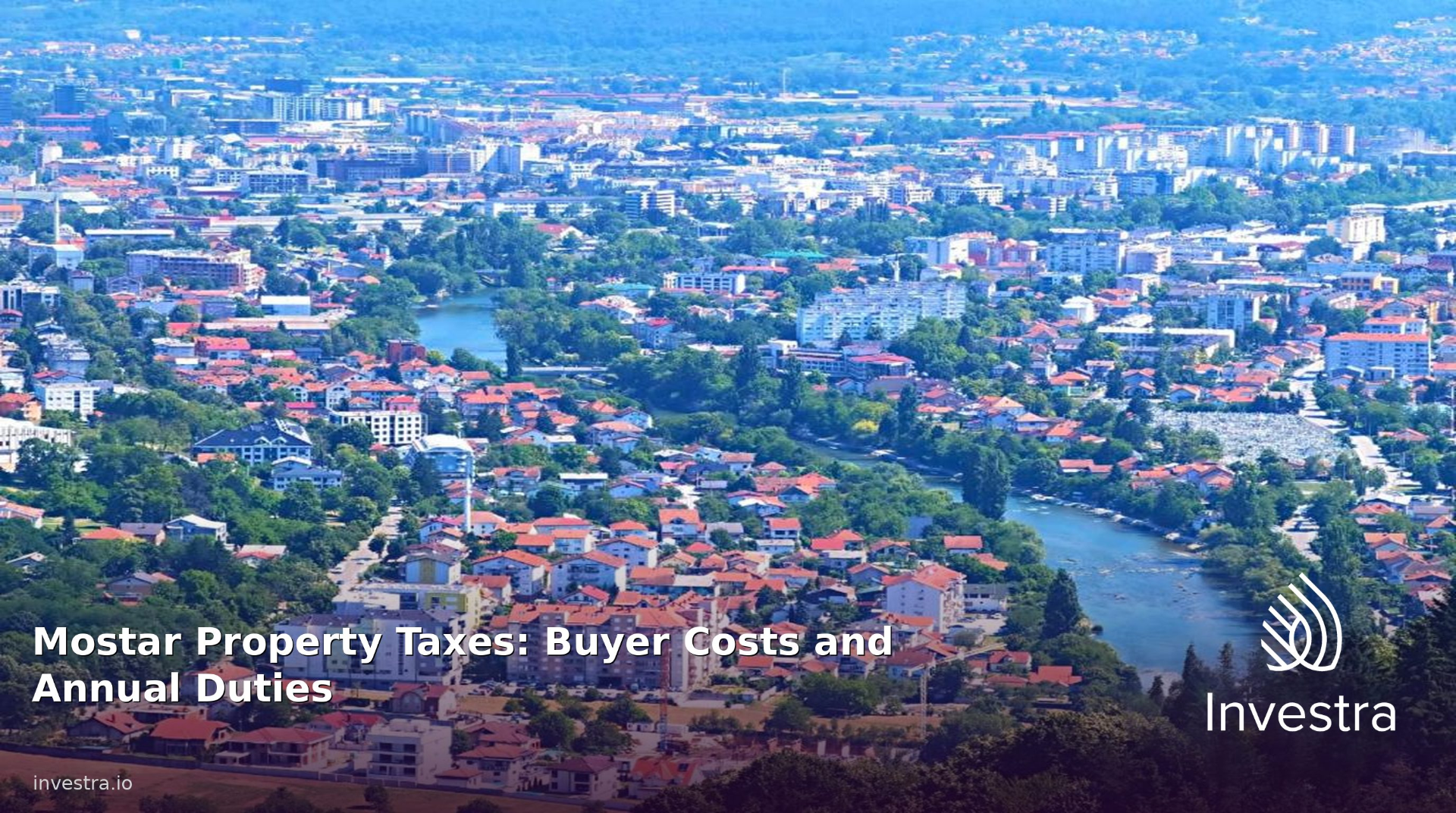
Mostar Property Taxes: Buyer Costs and Annual Duties
Mostar Property Taxes: Buyer Costs and Annual Duties
What should buyers know about Mostar property tax?
Quick Answer: Mostar property tax is a key part of the cost picture for buyers — you need to know which taxes and duties apply at purchase and each year, and how to confirm the current rates and liabilities with local authorities or advisors.
When I talk to buyers considering Mostar, the first question is almost always: what will this actually cost me beyond the advertised price? The reality is that the headline price is only one piece of the financial puzzle. Mostar property tax sits alongside notary and registration fees, potential VAT on new-builds or commercial transactions, and annual municipal charges that affect cash flow. But rather than supplying fixed figures that may already be out of date, I'll show you how to identify and verify every tax element that can apply to a Mostar purchase, and where to get authoritative answers.
Start with two rules that have guided the smartest buyers I've worked with. First, never assume a tax is the same across Bosnia and Herzegovina — local municipalities and cantonal authorities often set different duties and schedules. Second, don't rely on an agent's quick estimate for taxes; always request official documentation or a written breakdown from a local attorney or accountant.
If you plan to compare Mostar with Sarajevo, Banja Luka or Tuzla from an investment or lifestyle perspective, Investra has in-depth guides for each city—compare the local buying and tax context in the Mostar real estate market guide, and see how it differs from the Sarajevo real estate market guide and the Banja Luka real estate market guide. For practical help with the purchase process, the Investra piece Buying property in Mostar is a useful starting point.
Legal framework: who sets and collects property tax in Mostar?
Quick Answer: Property taxes and many duties in Mostar are governed by municipal and cantonal legislation, so you'll need to check both city-level and Federation/RS rules and confirm collection procedures with Mostar's tax office.
Understanding where authority lies is essential. Bosnia and Herzegovina's governmental structure is layered: state, entity (Federation of Bosnia and Herzegovina or Republika Srpska), cantonal, and municipal. Mostar sits within the Federation and the Herzegovina-Neretva Canton, so both cantonal rules and municipal bylaws can affect property taxation. That means the same type of tax might be calculated or collected differently than it is in Sarajevo or Banja Luka.
Who do you call? For purchase-related duties and registration you will typically interact with the municipal cadastre and the city's tax office. For broader tax questions—such as income or corporate tax implications tied to property ownership—you'll consult cantonal or entity tax authorities or a local tax advisor. We always advise buyers to request written confirmations from those offices when possible. If you need hands-on assistance in interpreting these layers, advisory firms like Findes Group & Partners and their advisory team can direct you to accountants and lawyers experienced with Bosnia and Herzegovina's multi-tiered system.
Because authority is split, differences in procedure matter. For example, the municipal office issues property certificates and handles registration entries, while some tax liabilities are declared at cantonal offices. What surprised many buyers I've met is simply how many separate stamps, receipts and clearances are involved. That's normal. The key is planning: list every authority involved and confirm the exact documents they require before signing a commitment.
Taxes and costs at purchase: what to expect and how to verify
Quick Answer: Purchase costs often include transfer or registration duties, notary fees, land registry charges and possibly VAT for certain sellers or new-builds; verify current obligations with the municipal cadastre, a notary, and a local tax advisor.
People often ask if the seller or buyer pays a particular fee. The answer can depend on negotiation and local custom. For any Mostar purchase you should budget time to secure the property title, arrange notary certification, register the change of ownership at the cadastre and pay any taxes or duties that apply on transfer.
How do you verify what's due? There are three practical steps I recommend. First, obtain a certified statement from the Mostar cadastre describing the property and any encumbrances—this will point to registration fees and necessary clearances. Second, ask a local notary for a written fee estimate for the execution of the sale contract and related documents. Third, consult a local tax accountant or contact the Herzegovina-Neretva Cantonal tax office to request a confirmation letter about transfer duties or VAT applicability, especially if you're buying a new construction or purchasing through a company.
If you want comparative context, Investra’s guides explain transactional mechanics across cities: see the buying process summaries for Mostar, Sarajevo and Banja Luka. For new-builds and renovation projects, review the Mostar new-build guide and the Sarajevo new-build guide so you know when VAT or construction-related levies might apply.
Annual property duties and municipal charges in Mostar
Quick Answer: Annual obligations can include municipal property tax, communal charges and utility fees; confirm exact categories and billing schedules with Mostar's municipal offices and utility providers.
Owning property in Mostar means taking on recurring costs. Municipal property tax is a common recurring charge, but it’s not the only one you’ll see on an annual bill. Local administrations often levy separate communal fees for services like street lighting, local waste collection and maintenance of communal areas. Utilities—water, electricity, sewage—are usually separate accounts and billed by service providers.
We’ve seen investors surprised by the variety of local charges that arrive through the year. Why? Because some fees are billed annually, others quarterly, and some may be collected as part of a municipal invoice while others come directly from service companies. The practical approach is to request a full sample annual bill from the seller or property manager before committing. That sample should show property tax, communal charges and typical utilities. If a seller cannot provide this, insist on obtaining current billing information from the municipal office and utility providers.
To verify official rates and collection dates, contact the Mostar municipal tax office and the Herzegovina-Neretva Canton tax department. If you want additional support, local advisory services such as advisory services and the Findes advisory team can obtain and interpret recent municipal bylaws for you.
Taxation of rental income and short-term lets in Mostar
Quick Answer: Rental income is taxable and must be declared under Bosnia and Herzegovina rules; for precise filing requirements, thresholds and deductions relevant to Mostar, consult a local tax professional or the cantonal tax authority.
If you plan to rent out a Mostar property, you must treat taxation as part of your operating costs. The rules that apply to rental income—how to declare it, allowable expenses and whether special rules cover short-term tourist lets—depend on entity-level tax law and local reporting procedures. I always tell investors: the tax treatment can materially change your projected net income, so get clarity before you buy.
How do you get that clarity? Start by talking to a local accountant who regularly files income from property in Herzegovina-Neretva Canton. Ask them to outline the process for both long-term residential leases and short-term tourist rentals. Be sure you understand registration obligations such as local tourism levies, if any, and whether the property or host platform must register with municipal tourism authorities.
For practical rental market context, see Investra’s sector guides: Mostar rental market guide and the Sarajevo rental market guide. These pieces won’t replace tax filings, but they’ll help you model likely occupancy, management needs and the paperwork that relates to hosting visitors.
Ownership structures and tax implications for foreign buyers
Quick Answer: Foreign buyers can buy in Mostar, but ownership structure (individual, company, or trust) affects tax obligations and due diligence; consult a Bosnian lawyer and tax advisor to confirm legal paths and implications for your nationality and goals.
Choosing how to hold property changes your tax profile. Many buyers weigh the simplicity of direct ownership against the flexibility and potential tax planning advantages of owning through a company. There are also residency, inheritance and estate-planning considerations that intersect with taxes. In my experience, the right structure depends on what you plan to do with the property: live in it, rent it, manage it as part of a portfolio or use it within a business.
Because this topic touches on legal eligibility and tax law, I avoid blanket prescriptions. Instead, ask your lawyer and accountant to run a comparative analysis for the structures you're considering. If you’re evaluating corporate ownership, ask for a projection of how annual filings, accounting obligations and potential double taxation treaties will apply to your circumstances.
If you need practical help, Investra’s articles on buying in different Bosnian cities explain common structures and transactional steps: Buying property in Mostar, Buying property in Banja Luka and Buying property in Tuzla. For consultancy, you might contact independent experts such as Siniša Dagary profile and his investment consultation services to examine your options.
Due diligence: tax-related checks to request before you sign
Quick Answer: Request title deeds, tax clearance certificates, cadastre extracts, copies of recent municipal bills and any documentation of past levies or disputes; verify them with the cadastre and a local tax lawyer.
Due diligence is where I see avoidable mistakes most often. Buyers sign contracts without getting a full set of tax-related documents. What should be on your checklist? At a minimum: an up-to-date extract from the land registry/cadastre showing ownership and encumbrances; evidence of paid municipal property taxes; copies of recent utility and communal invoices; building permits and certificates for any renovations; and a written statement regarding outstanding fines or municipal disputes.
Ask the seller for originals or certified copies and cross-check them with the Mostar cadastre office. If the property carries mortgages, liens or contested claims, these will affect transferability and future tax liabilities. Also confirm that capital improvements—extensions, renovations—were legal and taxed at the time; undocumented works can trigger fines or retroactive assessments.
If you're not confident reading Bosnian legal documents, hire a local lawyer to interpret them and to request tax clearance letters from the appropriate cantonal tax office. Advisory firms such as Siniša Dagary advisory services and teams at Findes Group & Partners can coordinate these checks and communicate with authorities on your behalf.
How taxes and duties affect investment calculations and exit planning
Quick Answer: Taxes at purchase and during ownership reduce net returns and change exit timing; always include verified tax liabilities and transaction costs in your cash‑flow and exit models.
Investors often compute a simple return based on rent or a projected resale price. The reality? Taxes and duties shape both the holding-period cash flow and what you end up receiving on sale. Annual property taxes and communal charges reduce net income. Transfer duties, notary and registration fees affect your initial capital outlay. And capital gains or other exit-related taxes will influence your timing and what price you need to achieve to meet your goals.
So what should you do? Build scenarios. Request official quotes for purchase-related taxes and get sample annual bills. Then incorporate conservative assumptions for potential increases or one-off municipal levies. Consult local advisors about likely future changes—municipalities and cantons sometimes revise bylaws or introduce new fees. In my experience, the buyers who plan with multiple scenarios are the ones who avoid surprise shortfalls.
For a reality check, use local market guides to understand market dynamics and likely holding costs. Investra's neighborhood and market guides for Mostar neighbourhoods and surrounding cities help you compare potential rental markets and resale demand. If you want a professional run-through, experts like Siniša Dagary investment insights or the Findes advisory team can produce tailored models that include verified tax estimates.
Practical steps to verify current Mostar property tax figures and get reliable advice
Quick Answer: Verify current tax figures by requesting written confirmation from Mostar municipal and cantonal tax offices, consulting a local tax accountant, and using experienced consultants for cross-checks.
Parallel to official confirmations, engage a local certified accountant who files returns for property owners in Mostar. Accountants will know administrative deadlines, complaint procedures and common pitfalls. If you’re not sure which accountant to choose, use referrals from reputable platforms. For independent advisory and transaction management, consider contacting Siniša Dagary for investment consultation or the Findes Group & Partners advisory team.
Finally, for practical transaction support—drafting the sale contract, escrow arrangements, registration and coordination with notaries—Investra’s local guides and city-specific buying articles can help you prepare questions and documents before engaging professionals. Read the Investra guides for Mostar, Sarajevo and Banja Luka while you collect official confirmations.
Investment Disclaimer
Quick Answer: This section clarifies that the article is informational and not legal or investment advice; always consult qualified advisors before making investment decisions.
The information provided in this article is for educational and informational purposes only and should not be construed as financial, legal, or investment advice. Real estate investments carry inherent risks, and past performance does not guarantee future results. Investors should not invest money they cannot afford to lose. Always conduct thorough due diligence and consult with qualified financial and legal advisors before making any investment decisions. Investra.io does not guarantee returns on any investment.
Frequently Asked Questions
Quick Answer: Below are common questions buyers ask about Mostar property tax, with practical guidance on where to get definitive answers and next steps.
What exactly falls under "Mostar property tax"?
The term can refer to a variety of charges: municipal property taxes, communal service fees, and possibly other local levies linked to property ownership. Which of these apply depends on the property type and local bylaws. To know precisely which categories will affect a specific property, request a current tax bill from the seller and ask the Mostar municipal tax office for a list of applicable charges and billing cycles. A local accountant can then explain how these items translate into annual obligations.
Are there taxes due at the moment of sale, and who normally pays them?
Purchase-related costs commonly include registration fees, notary fees and any transfer duties or taxes required by law or municipal regulation. Who pays—buyer or seller—can vary by negotiation and customary practice. Confirm the expected payer in the sale contract and obtain an itemized estimate from a notary and the cadastre office. For new buildings or sales by businesses, VAT rules may come into play, so ask a tax advisor whether the transaction is VAT‑able and how that will be handled.
How do I check whether a Mostar property has unpaid taxes or encumbrances?
Request an official cadastre extract and a tax clearance certificate from the municipal or cantonal tax office. The cadastre extract will reveal mortgages, liens and legal encumbrances; the clearance certificate shows current tax status. If documents are in Bosnian and you're not fluent, have a lawyer or certified translator review them. A seller unable to produce these documents is a red flag; insist on clean title and tax evidence before advancing funds.
Does renting out my Mostar property change my tax filings?
Yes. Rental income typically needs to be declared and is subject to income tax and possibly social or local levies, depending on how you receive and report it. Short-term holiday rentals may also have tourism registration or reporting obligations. To understand filing procedures, possible deductions for expenses and reporting deadlines, consult a Mostar-based tax accountant who handles property income. They'll also advise whether you should register as a business for rental operations.
Can a foreign buyer get a mortgage in Mostar, and how do taxes affect mortgage costs?
Mortgage availability to foreigners depends on bank policies and the buyer’s residency and credit profile. Taxes and recurring municipal fees don't directly change the interest rate, but they affect your debt-service capacity because lenders look at net income after recurring expenses. If you plan to finance a purchase, prepare a conservative budget that includes all verified annual taxes and communal charges when applying to a bank.
If I renovate a Mostar property, will I face extra tax assessments?
Renovations that change the usable area or alter a building's use (for example, converting a residential unit to commercial) may require permits and could be subject to additional local fees or re-assessment for property tax. Always check with the municipal planning and building departments and secure the necessary permits before starting work. Retaining documentation of permits and invoices will help if tax authorities later request proof of legally conducted improvements.
How can I estimate annual property-related costs before buying?
Ask the seller for a recent full year of bills: municipal tax notices, communal invoices and utilities. If those are unavailable, request sample charges from the Mostar municipality and local utility providers for comparable properties. Use those official documents to feed into your cash-flow model. If you need a professional estimate, local accountants or advisory firms can produce a conservative projection based on verified municipal rates.
Are there special local incentives or exemptions that reduce Mostar property taxes?
Municipalities sometimes offer incentives—such as reduced rates for certain types of investment or exemptions for historic buildings—but these are governed by local bylaws and can change. To determine eligibility, check municipal incentive registers or ask the Mostar municipal office for current programs, and have your lawyer assess whether your property qualifies. An advisory engagement with a firm familiar with Herzegovina-Neretva Canton can uncover opportunities relevant to investors.
Who should I hire locally to ensure my tax position is correct in Mostar?
The core team typically includes a local lawyer, a certified accountant experienced in real estate taxation, and a notary. Depending on your needs, you may also want a property manager, a real estate broker with local experience and an independent consultant for investment modeling. For introductions to trusted professionals, consider contacting advisory services like Siniša Dagary — investment consultation or the Findes Group & Partners advisory team. Always check credentials and ask for client references.
How do I stay updated on changes to Mostar property tax rules?
Subscribe to municipal announcements and the Herzegovina-Neretva Canton tax office bulletins. Many legal and advisory firms maintain blogs and newsletters that summarize changes affecting property owners—follow local consultants like Siniša Dagary investment insights. For market-level context and periodic updates, Investra’s city guides on Mostar, Sarajevo and Banja Luka are refreshed with practical information; see the Mostar real estate market guide and related articles.
Recommended Reading
Quick Answer: These curated guides and advisor resources will help you deepen your understanding of buying, taxes and investment considerations across Bosnia and Herzegovina.
- Sarajevo real estate market guide
- Buying property in Sarajevo
- Sarajevo rental market guide
- Sarajevo neighbourhood guide
- Sarajevo new-build guide
- Mostar real estate market guide
- Siniša Dagary — Investment Consultant
- Business Strategy Blog
Connect With Investra
Quick Answer: Follow Investra for market updates and reach out on social channels or through their site for personalised assistance.
Find Investra on social media to keep up with new market guides, city updates and property listings:
Facebook — Investra.io
LinkedIn — Investra.io
YouTube — Investra.io
If you'd like direct support, Investra's city guides and transactional articles referenced throughout this piece provide pathways to local partners and expert contacts who can verify current tax figures and manage the purchase process for you.
Embedded Investra and advisor links used throughout the article for reference and further readingConnect With Investra
Quick Answer: Follow Investra for verified market context and practical property research.
Related Posts
No related posts available.
