
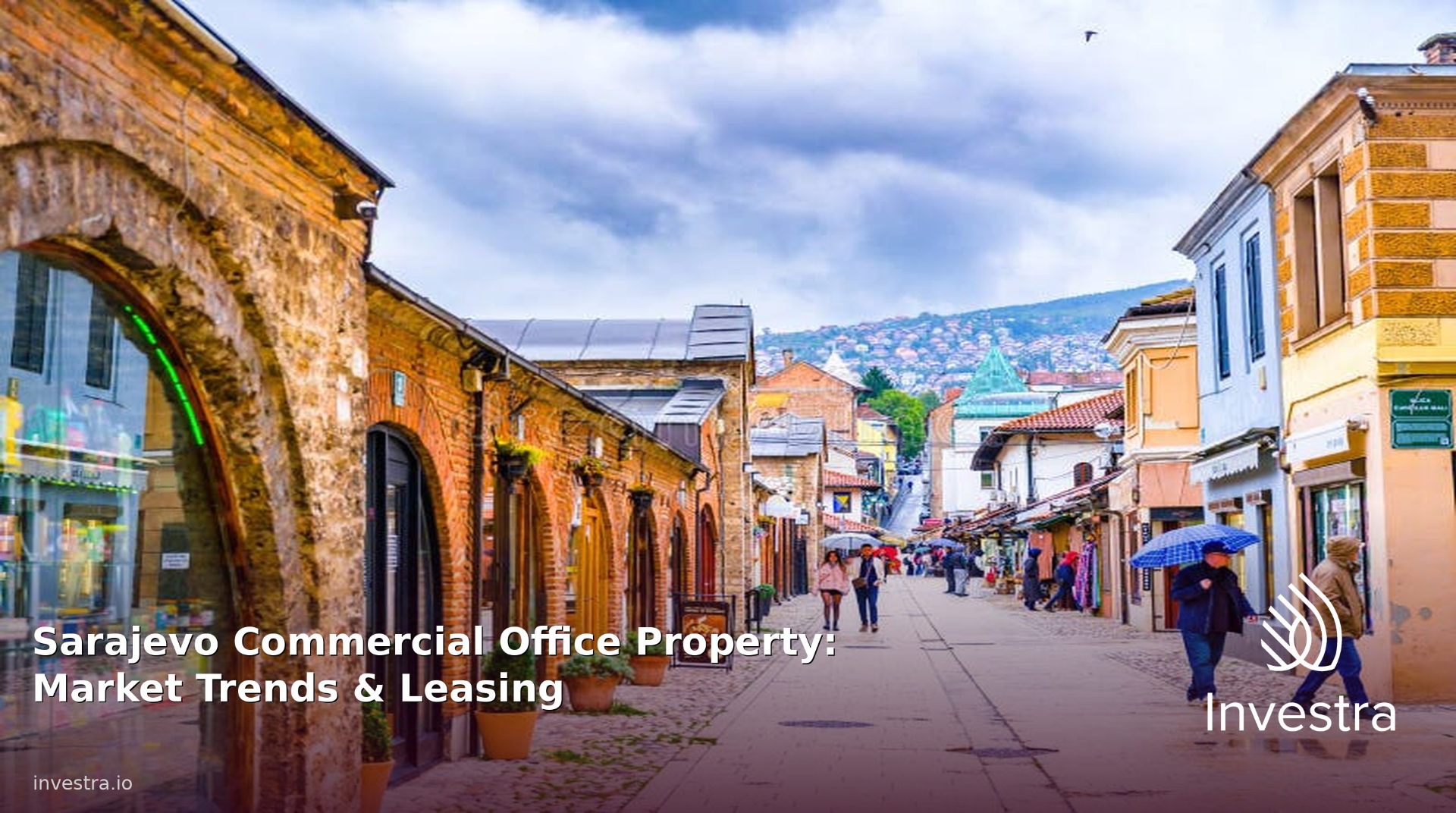
Sarajevo Commercial Office Property: Market Trends & Leasing
Sarajevo Commercial Office Property: Market Trends & Leasing
Sarajevo commercial office property: Market snapshot
Quick Answer: Sarajevo commercial office property is experiencing measured activity driven by service-sector demand and selective new supply; local market reports and broker listings give the most up-to-date picture for investors.
Sarajevo remains the economic and administrative heart of Bosnia and Herzegovina, and that concentration shows in the office market. In my experience, demand tends to cluster around government institutions, international organisations, IT and professional services, and hospitality-related back-office operations. The reality is that office demand here is not monolithic — smaller agile teams want modern workspace, while legacy tenants occupy older stock in central locations.
If you want a reliable starting point, consult market reports and city-level investment guides such as the Sarajevo real estate market guide. Those resources will point to active micro-markets and recent transactions. What surprised many buyers is how quickly tenant preferences change: flexible leases and high-quality fit-outs are now expected by new occupants.
For a comparison across Bosnia and Herzegovina’s urban centres, Investra also publishes deep dives on Mostar, Banja Luka and Tuzla — useful if you’re weighing alternatives to Sarajevo. See the Mostar real estate market guide, the Banja Luka real estate market guide, and the Tuzla real estate market guide for regional context. To confirm current vacancy levels or headline availability, check live commercial listings and speak to local brokers; these are the sources that reflect current market conditions rather than historical summaries.
Demand drivers and tenant mix for Sarajevo offices
Quick Answer: Demand for Sarajevo commercial office property is led by public administration, services, and growing technology and outsourcing firms; tenant expectations emphasize flexibility and quality of space.
When we look at who occupies office space in Sarajevo, it's a mix. Government ministries and international organisations still take prime central space, but increasingly private-sector tenants — IT firms, call centres, consultancies and local banks — are shaping demand. In my experience, these private tenants prioritize IT-ready infrastructure and efficient floorplates. The post-pandemic world has also influenced tenant behavior: companies want options for hybrid working, and that translates into interest in offices that allow phased occupancy, coworking partnerships or flexible lease lengths.
What does this mean for landlords? You need to think beyond square meters. Tenants now ask about fibre availability, backup power, security systems and proximity to transport and amenities. The Sarajevo rental market guide covers some of these tenant preferences from a residential-investment lens, and it can still offer useful insight on urban demand trends relevant to office investors.
If your strategy is to attract multinational or regional tenants, consider buildings that allow for branded signage, international-standard security and simple expansion options. For those comparing markets, the Mostar rental market guide and the Banja Luka rental market guide help illustrate how tenant mixes differ across the country.
Supply dynamics: existing stock, new builds and refurbishment
Quick Answer: Supply in Sarajevo combines older office stock with pockets of new-build projects and adaptive reuse; tracking active developments and recent refurbishments is essential for positioning your property.
Supply-side dynamics in Sarajevo are nuanced. There’s a legacy of mid-century and Yugoslav-era buildings that dominate some central streets, while the last decade has brought selective new developments and conversions of historic buildings into modern offices. What we’ve seen is that developers are cautious — projects are often market-driven, tied to pre-lets or condominium-style sales to investors who will lease space. This means vacancy rates and supply growth can be lumpy rather than continuous.
The Sarajevo new-build guide is a useful resource when you're assessing pipeline projects and the quality of new stock. For investors considering opportunistic refurbishment, conversions can deliver a pronounced uplift in tenant appeal when done to international standards. We’ve advised clients to inspect mechanicals and facade conditions closely — those are often the biggest hidden costs in older buildings.
In some cases, developers look to neighbouring cities for comparative lessons: see the Mostar new-build guide or the Banja Luka new-build guide for example project specs and outcomes. Always verify development status and permits with municipal planning authorities before assuming a building’s completion timetable.
Office types, grading and where tenants want to be
Quick Answer: Sarajevo commercial office property falls into distinct types — Grade A, refurbished historic, and functional older stock — and tenant choice depends on sector, budget and location preferences.
Not all office space is the same. Internationally, we talk about Grade A, B and C, but in Sarajevo those categories translate into specific realities: newly built towers and purpose-built business centres (the clearest Grade A equivalents), sensitively refurbished Austro-Hungarian or Ottoman-era conversions with high character, and utilitarian older blocks that serve local businesses. In my experience, the most sought-after locations combine visibility, transport access and nearby services — cafes, hotels and meeting venues matter.
To identify strong locations within Sarajevo, consult local neighbourhood guides. Investra’s Sarajevo neighbourhood guide offers an overview of micro-markets that investors and tenants commonly target. For those comparing with other Bosnian cities, the Mostar neighbourhood guide and the Banja Luka neighbourhood guide show how location criteria shift in different urban contexts.
When considering fit-out or rent positioning, remember: tenants pay for usable space, infrastructure and convenience. If your building lacks modern HVAC or fibre, it will be less attractive to tech or international tenants unless you plan a clear investment roadmap to upgrade those systems.
Leasing market: typical terms, negotiation points and strategy
Quick Answer: Leases in Sarajevo commercial office property typically centre on term length, indexation, maintenance obligations and tenant fit-out responsibilities; negotiating clear clauses reduces future disputes.
Leasing is where the rubber meets the road. From experience advising landlords and tenants, three negotiation points consistently rise to the top: lease duration and exit options, who pays for and manages fit-outs and building services, and how rent adjustments are handled over time. Sarajevo leases range in complexity; you’ll see both straightforward, short-term agreements and long-term contracts that include step-up rents or service charge redistributions.
We always tell clients to document responsibilities clearly. Who is responsible for structural repairs? How are utilities metered and charged? Is there a landlord-controlled service charge for cleaning, security and maintenance, and how transparent is the reconciliation? These matters often determine the tenant mix: international tenants want clear, audited schedules while local SMEs may accept simpler arrangements.
If you’d like a practical guide to buy-and-lease mechanics for Sarajevo properties, refer to Investra’s step-by-step buyer content such as Buying property in Sarajevo. That guide covers documentation and checkpoints useful when drafting leasing strategies. For third-party brokerage support, local advisory teams like Findes Group & Partners can assist with negotiations and market valuation.
How to verify lease rates, availability and market comparables
Quick Answer: Verify lease rates and availability by checking recent transactions, live listings, broker surveys and municipal registries; don't rely on a single data point for investment decisions.
One common error I see is relying on a single published rate or a broker’s headline figure. The correct method is triangulation: gather active listings, ask brokers for recent deals, and inspect property portals. In Sarajevo, market intelligence can be patchy, so combining Investra research like the Sarajevo rental market guide with local brokerage reports and live listings gives a clearer picture.
Another verification method is to request redacted lease abstracts from property managers or brokers; these show lease terms without revealing tenant identity. You can also consult municipal property registries and cadastres to confirm ownership and the legal status of premises. If a current figure is needed — for example, a headline rent per square metre — state that you will verify it through multiple sources: a local broker, an audited agent report and the city's planning authority.
For an added layer, independent advisors like advisory services listed on Siniša Dagary’s site can perform bespoke market research and validate comparables. Similarly, the Findes advisory team can corroborate figures against regional benchmarks.
Legal considerations: leases, ownership and due diligence
Quick Answer: Legal due diligence for Sarajevo commercial office property should confirm title, encumbrances, planning consent and lease validity, and involve qualified local counsel to interpret documents.
Legal checks are non-negotiable. Before committing to a purchase or lease, you must confirm chain of title, search for liens or encumbrances, and verify that building use matches your plans. In Bosnia and Herzegovina the property registry can reveal much, but legal interpretation requires local expertise. In my experience, buyers who engage experienced local lawyers avoid the costly surprises that can arise from historical deeds or unclear easements.
Leases should be checked for subletting rights, rent review mechanisms, termination conditions and any clauses tying obligations to building ownership. If you’re a foreign buyer, check for statutory restrictions and whether company structures are needed for ownership. For a practical how-to on transactional steps, see Investra’s city-specific buying guides such as Buying property in Mostar, Buying property in Banja Luka, and Buying property in Tuzla.
One practical tip: build a due diligence checklist covering land registry, planning permissions, building permits, recent renovation records, energy certifications and outstanding utility bills. This list will help your lawyer and technical advisers move efficiently through the process.
Taxation, fees and ongoing operational costs
Quick Answer: Taxes and operational costs for Sarajevo commercial office property include transfer taxes, property taxes, VAT in some cases, and routine service charges — verify current rates with tax authorities and advisors.
Taxation matters can materially affect returns. While I won’t invent figures here, investors need to account for transaction taxes, annual property taxes, VAT exposure on lease income or sale (where applicable), corporate tax implications and local municipal charges. Importantly, rules change and interpretations vary, so the proper approach is to confirm with a local tax advisor and the municipal tax office.
For an investor, ongoing operational costs — facility management, heating, electricity, insurance and security — often eat into contracted rent. We always recommend building a detailed operating expense model and stress-testing it against vacancy or unexpected maintenance. To verify tax treatments and fees, consult an accountant experienced in Bosnian property taxation and cross-check with authoritative sources such as municipal tax offices or a professional adviser like investment consultation from Siniša Dagary or the Findes Group & Partners.
If you need specific numeric guidance, request a formal tax opinion from a licensed firm. That will give you the defensible figures you need for underwriting and investor reporting.
Foreign buyers: ownership, structures and practical buying steps
Quick Answer: Foreign investors can buy Sarajevo commercial office property, but should confirm ownership rules, consider holding structures and follow local conveyancing protocols with professional advisors.
Can foreigners own commercial property in Sarajevo? The short practical answer is: typically yes, but the path depends on the legal form and local rules. In my experience, many foreign buyers use local corporate entities or engage with reputable local law firms to create a clean holding structure. The precise steps for transfer — contract of sale, deposit, due diligence, notarial deeds and registration — are procedural and need local counsel.
Investra’s Buying property in Sarajevo guide gives a practical checklist for international buyers, including documents typically required and common pitfalls. If you’re comparing jurisdictional ease, look at how procedures differ regionally: see Buying property in Mostar and Buying property in Banja Luka.
Practical tip: arrange a local escrow arrangement for deposits, insist on a phased completion process tied to registration milestones, and request an independent title insurance or warranty where available. For transaction support, consider advisory services such as Siniša Dagary profile and the Findes Group & Partners advisory team.
Fit-out, refurbishment and building operations
Quick Answer: Fit-out quality and ongoing building operations strongly influence leasing success; budget for durable systems, compliance and tenant-specific workstreams verified by technical due diligence.
Fit-out isn’t a vanity project; it’s fundamental to attracting and retaining the right tenants. In Sarajevo, older buildings often require comprehensive upgrades to HVAC, lifts and electrical systems to meet modern tenant requirements. What surprised many buyers is how frequently mechanical and electrical issues become the primary cause of cost overruns on refurbishment projects.
A practical approach is to commission a technical due diligence report before purchase that isolates immediate remedial works from long-term capital expenditure. If you plan to deliver a fitted office, agree a landlord/tenant handover schedule and clearly define the fit-out allowance and landlord’s responsibilities in the lease. For references on renovation approaches, see the Sarajevo new-build guide and comparable renovation case studies in Mostar new-build guide.
Operationally, invest in preventative maintenance and transparent service-charge accounting. Tenants want predictable monthly charges and clear reporting. For larger portfolio owners, consider outsourcing facility management to a specialist with local labour knowledge and vendor relationships.
Financing, valuations and ROI considerations for Sarajevo offices
Quick Answer: Financing options and valuation approaches differ by lender and asset quality; perform conservative underwriting and verify lender criteria and local market comparables before committing.
Valuation approaches should be transparent and based on comparable transactions. Since I can't provide current numeric valuations here, you should verify market figures using broker reports, sale registries and Investra’s market guides such as the Sarajevo real estate market guide and the city-specific rental and new-build guides. When modelling returns, stress-test scenarios: vacancy, rent downturns and unexpected capex.
Need help sourcing finance or completing a valuation? Advisors like advisory services and regional partners like Findes Group & Partners can introduce lenders and provide valuation support. Always ask lenders for their most recent lending criteria in writing and confirm whether they accept foreign-collateral structures, if you’re a cross-border investor.
Practical checklist for investors and leasing managers
Quick Answer: A practical checklist should cover due diligence, lease terms, technical surveys, tax review and market validation to ensure a controlled acquisition or leasing process.
A checklist keeps transactions sane. Start with market validation — verify demand, active listings and comparable leases through sources like the Sarajevo rental market guide and local brokers. Then proceed to legal title checks, technical due diligence (structure, M&E systems), and regulatory compliance (planning and permits). In my experience, missing a single item — unpaid utility arrears or an unsigned easement — can delay completion for months.
When you reach the leasing stage, ensure your standard lease form is ready and that your commercial team understands rent reviews, break clauses and service-charge reconciliation. If you need a tenant mix strategy, consult the Sarajevo neighbourhood guide to match building proposition to target sectors. For comparison planning, look at the neighbourhood guides in Mostar and Banja Luka to see how tenant expectations differ.
Finally, line up advisors early: legal counsel, a tax accountant, a technical surveyor and a leasing agent. You can engage consultants such as Siniša Dagary for strategic advice or reach out to the investment consultation channel for contracting support. If you need an advisory partner that works across the region, contact Findes Group & Partners for introductions and regional benchmarking.
Investment Disclaimer
Quick Answer: This section clarifies that the article is informational and not investment advice; always consult qualified advisors before acting on property decisions.
The information provided in this article is for educational and informational purposes only and should not be construed as financial, legal, or investment advice. Real estate investments carry inherent risks, and past performance does not guarantee future results. Investors should not invest money they cannot afford to lose. Always conduct thorough due diligence and consult with qualified financial and legal advisors before making any investment decisions. Investra.io does not guarantee returns on any investment.
Frequently Asked Questions
Quick Answer: This FAQ section answers common investor queries about Sarajevo commercial office property and points to verification steps and local resources for deeper research.
What are the key market trends and leasing considerations for commercial office property in Sarajevo?
The main trends include selective new supply, tenant demand for modern infrastructure, and flexibility in lease structures. Leasing considerations involve clearly documenting maintenance responsibilities, fit-out allowances, rent review mechanisms and break clauses. To verify current trends, consult recent market reports, active listings, local brokers and resources such as the Sarajevo real estate market guide. Engage local legal and tax advisors for binding interpretations specific to your deal.
How do I confirm current rent levels and vacancy rates in Sarajevo?
Confirm rents and vacancies by triangulating: review live listings, request recent lease abstracts from brokers, and obtain market surveys from reputable firms. Municipal property registries and tax offices sometimes publish transaction data you can cross-check. For a practical guide, use resources like Investra’s rental and new-build guides and seek a written market opinion from a local brokerage or adviser.
Can foreign investors buy commercial office property in Sarajevo?
Foreigners can generally acquire commercial property, but the legal framework and procedural steps should be verified for your nationality and intended holding structure. Consult the Buying property in Sarajevo guide and retain local counsel to confirm requirements and set up an appropriate ownership vehicle.
What taxes and charges should buyers and landlords expect?
Taxes can include transfer taxes, annual property taxes, and potential VAT on sales or leases depending on circumstances. Operational charges — insurance, utilities, maintenance — also affect net returns. Since rates and rules change, have a qualified local tax advisor prepare a tax opinion and check with municipal tax offices for the latest rules.
How should I structure leases to protect my investment?
Structure leases to secure stable cashflow: include agreed rent reviews, clear service-charge mechanisms, appropriate length and credible tenant covenants, and transparent break clauses. Specify responsibilities for capital versus operational expenses. For drafting and negotiation, involve experienced local lawyers and brokers; guides like Investra’s city-specific buying materials can inform your approach.
What documentation do I need for due diligence on an office property?
Essential documents include title deeds, a land registry extract, building permits, planning consents, recent utility bills, service-charge accounts, asbestos or other hazardous-material reports (if applicable), and mechanical/electrical maintenance records. A technical due diligence report and legal opinion are critical to identify liabilities and confirm the asset’s condition.
How long do commercial leases typically run in Sarajevo?
Lease lengths vary by tenant type and building quality. International or corporate tenants often prefer longer tenures, while local SMEs may prefer shorter terms. Rather than assuming a standard length, verify prevailing terms with brokers and look at recent lease comparables; this ensures your expectations align with market reality.
Where can I find professional assistance for transactions in Sarajevo?
Engage local law firms, chartered surveyors and tax accountants. For strategic advisory and transactional support, consider specialists like Siniša Dagary and his advisory services, or regional consultancies such as Findes Group & Partners. These teams can provide market intelligence, valuation support and introductions to lenders.
How should I approach refurbishment and fit-out budgeting?
Start with a technical due diligence to separate urgent remedial works from desirable upgrades. Create a phased capex plan and include contingency. For tenant fit-outs, define landlord contributions and snagging processes within the lease. Investra’s renovation guides for Sarajevo and other cities can help you estimate typical scopes of work, but always seek detailed contractor bids for accurate budgets.
What are common exit strategies for Sarajevo office investors?
Common exits include sale to institutional investors, portfolio consolidation and sale to owner-occupiers. Another route is repositioning the asset (refurbishment and re-letting) to improve marketability before sale. Validate exit options by researching recent transactions and speaking to local brokers and advisory firms to understand buyer appetite.
Recommended Reading
Quick Answer: The resources below are useful starting points for deeper, city-specific research and for connecting with advisors who operate in Bosnia and Herzegovina.
- Sarajevo real estate market guide
- Buying property in Sarajevo
- Sarajevo rental market guide
- Sarajevo neighbourhood guide
- Sarajevo new-build guide
- Mostar real estate market guide
- Siniša Dagary — Investment Consultant
- Business Strategy Blog
Connect With Investra
Quick Answer: Follow Investra on social media or contact the team for market updates, property listings and investor support.
Stay connected with Investra for the latest Sarajevo market updates and property listings. Follow Investra on Facebook, LinkedIn and YouTube for market commentary, webinars and listing alerts:
Connect With Investra
Quick Answer: Follow Investra for verified market context and practical property research.
Related Posts
No related posts available.
