
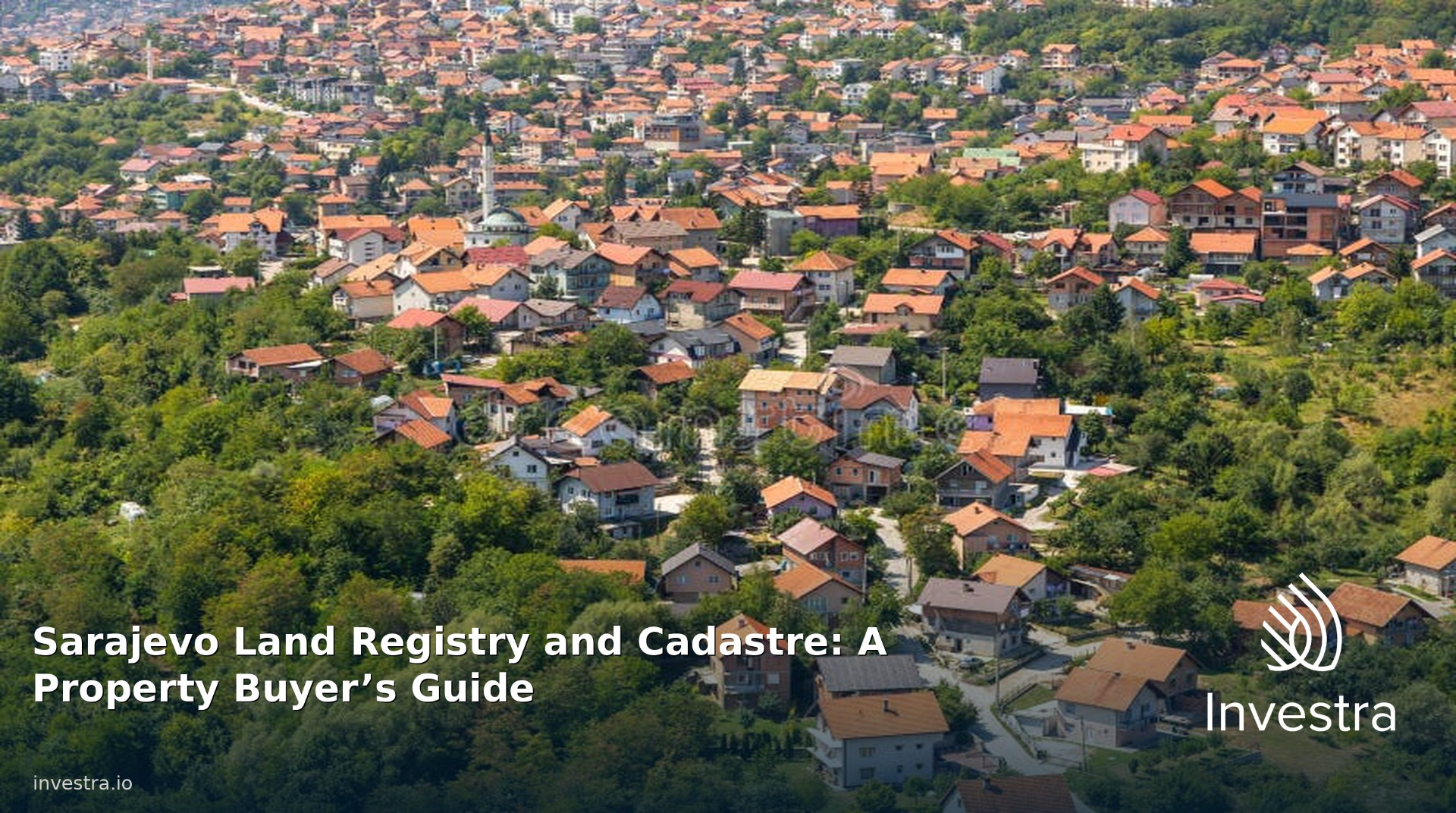
Sarajevo Land Registry and Cadastre: A Property Buyer’s Guide
Sarajevo Land Registry and Cadastre: A Property Buyer’s Guide
Understanding the Sarajevo land registry and cadastre: what buyers need to know
Quick Answer: The Sarajevo land registry and cadastre are two complementary records—one focused on legal title and encumbrances, the other on physical parcels and technical data—and buyers must consult both to confirm ownership and the exact property description. Refer to local municipal offices and specialist guides like Sarajevo real estate market guide for context and next steps.
When someone mentions the sarajevo land registry and cadastre they’re referring to a pair of records that together determine whether you can buy, use, and ultimately profit from a property. The cadastre (katastar) holds the technical drawings, parcel boundaries and land-use classification. The land registry (land books / zemljišne knjige) records who legally owns the property and any rights or limits tied to it—mortgages, servitudes, court disputes and so on.
Buyers often assume one check is enough. The reality is different. In my experience, you’ll want both an excerpt from the land registry and a cadastre map extract before you sign anything. These documents tell you whether the parcel on paper is the same patch of ground you’re being shown, whether the seller has full disposal rights, and what legal encumbrances might follow the property once you own it. It’s a practical two-step verification. If you’re reading about neighborhoods, check local guides such as Sarajevo neighbourhood guide to pair legal checks with location insight.
How Sarajevo’s legal framework and institutions govern property records
Quick Answer: Multiple public bodies and courts oversee registrations—the municipal cadastre maintains technical records while land registries and competent courts confirm legal title—so you’ll need to deal with both state administrative offices and judicial registries. For practical steps see Buying property in Sarajevo.
Property law in Bosnia and Herzegovina sits against a complex institutional backdrop. The cadastre offices operate at the local level and record physical parcel data, while the land book entries are often administered by court registries or centralized systems depending on the administrative entity. That split creates legitimate procedural friction: sometimes cadastral and registry records don’t match because of historic omissions or administrative lag.
What surprised many buyers I’ve worked with is how often a single transaction touches several institutions—municipal cadastre, municipal or district court, local tax office and sometimes a land consolidation or forestry authority if the parcel was previously classified differently. The practical implication? Expect to assemble documents from multiple sources and plan time for cross-checks. If you want hands-on help, consult recognized advisers; I recommend contacting specialists such as advisory services or firms with Bosnia-wide experience like Findes Group & Partners to confirm current institutional contacts and procedures.
Types of land records buyers must check before committing
Quick Answer: Buyers should obtain a land registry excerpt verifying legal ownership and encumbrances plus a cadastre cadastral map extract showing boundaries and parcel identifiers; additional technical reports may be needed for buildings or planned developments. Refer to the Sarajevo new-build and renovation guidance at Sarajevo new-build guide.
Not all documents are created equal. The two must-haves are the land registry excerpt (legal status) and the cadastre extract (technical status). But in many transactions you’ll want more: property sales contracts, previous sale deeds, building permits, energy performance certificates, utility connection records and recent cadastral surveys if boundaries are in doubt.
Don’t be surprised if the seller provides a piecemeal folder: sellers often keep older sale contracts but not updated registry excerpts. In my experience, buyers who insist on original, recent registry and cadastre extracts learn issues before escrow. If a building is involved, check building permits against what’s constructed—illegal additions can become the buyer’s headache if you don’t verify. For practical examples and checklists, the Investra Sarajevo new-build guide is a useful companion: Sarajevo new-build guide.
How to search the land registry and cadastre in Sarajevo: procedures and records
Quick Answer: Searches start at the municipal cadastre office for a cadastral plan and at the competent court registry for a land registry excerpt; you can often request certified extracts in person, by proxy, or through authorized advisors—verify current hours and fees at the municipal office. For step-by-step buying instructions see Buying property in Sarajevo.
Where do you go first? I recommend starting with the cadastre because it ties the property to a parcel number. Bring an address, plan number or GPS coordinates if available. At the cadastre you’ll ask for a cadastral map extract and technical description. Then visit the land registry to request the land book excerpt linked to that parcel. If records don’t match up, that’s a red flag that requires deeper scrutiny.
Many larger transactions employ local attorneys or authorized representatives to pull extracts and order a certified copy of the land book. If you’re outside Bosnia, these agents will act on your behalf using a power of attorney. We’ve seen buyers save time by asking the seller to provide fresh extracts dated within a recent window—just be cautious: sellers may produce documents that look official but are outdated. For help arranging searches and understanding municipal procedures, consult resources such as investment consultation or the Findes advisory team at Findes Group & Partners advisory team.
Documents required for property transfer and registration in Sarajevo
Quick Answer: Core documents include the sale contract, authenticated IDs, recent cadastral extract and land registry excerpt; additional items such as proof of tax clearance, building permits or powers of attorney may be required depending on the transaction. See Buying property in Sarajevo for a fuller checklist.
Every property transfer starts with paperwork. You’ll need identification for buyer and seller, a signed and notarised sales contract, and the latest cadastral and land registry documents that tie the deed to the exact parcel. If the buyer is foreign or using a proxy, expect to prepare apostilled powers of attorney and possibly translated documents certified by a sworn translator.
In my experience, missing supporting documents delay registration most often. Typical omissions: missing certificate of no encumbrance, unrecorded building permits, or absent signatures on historical sale deeds. The practical remedy is to run a pre-contract due diligence: request complete documentation before you commit money. If you want templates or counsel, advisers such as Siniša Dagary and his team provide structured checklists and can coordinate with local notaries and surveyors (see Siniša Dagary profile).
Role of notaries, lawyers and cadastral surveyors in Sarajevo transactions
Quick Answer: Notaries authenticate contracts, lawyers manage title searches and negotiations, and cadastral surveyors validate boundaries and produce updated parcel maps—working with these professionals reduces legal risk. Consider advisory services like advisory services and consult local firms such as Findes Group & Partners.
These specialists each play a distinct and essential role. A notary gives official standing to the sale contract and ensures signatures meet legal form. Lawyers run deeper title work, identify hidden encumbrances and draft contract clauses to protect you. Surveyors verify that the physical property aligns with cadastral records and can produce corrective surveys if boundaries are unclear.
We’ve seen transactions snagged by poor survey work or insufficient notarial language. That’s why I tell buyers: hire a team you trust. Ask potential advisors for recent case references and confirmation they’re familiar with Sarajevo’s municipal offices. If you need introductions, explore Siniša Dagary’s consulting network at Siniša Dagary investment insights or reach out to the Findes advisory team for cross-border tax and legal coordination at Findes Group & Partners advisory team.
Common title and cadastral problems: encumbrances, disputes and irregular boundaries
Quick Answer: The most frequent issues are mismatched registry/cadastre records, unregistered easements or mortgages, and unclear boundaries; early detection through a combined legal and technical search helps avoid future litigation. See practical case studies in the Sarajevo market guide: Sarajevo real estate market guide.
Problems are rarely exotic. You’ll mostly encounter mismatched parcel IDs, old mortgages not removed from the land registry, or neighbors contesting borders because historical fences don’t align with cadastral lines. We’ve worked on purchases where the seller believed they owned a strip of land that, according to the cadastre, belonged to the municipality.
When an issue appears, the buyer faces choices: walk away, negotiate a conditional purchase, or require the seller to resolve the problem before closing. In my experience, insisting on a updated land registry extract dated close to the transaction is a practical first step. If disputes are court-based, timelines and outcomes can be uncertain—consult a local attorney and be prepared to verify progress directly at local courts and cadastre offices. For comparative risks in other Bosnian cities, see guides for Mostar and Banja Luka: Mostar real estate market guide and Banja Luka real estate market guide.
Buying as a foreigner: permissions, verification steps and practical tips
Quick Answer: Foreign buyers must confirm eligibility, usually by checking national and municipal restrictions and obtaining up-to-date registry and cadastre extracts; work with a local lawyer or consultant to translate and legalize documents. See our Sarajevo buying guide at Buying property in Sarajevo.
Many foreign buyers ask whether they can buy freely. The short answer I give is: check first, act second. Regulations can vary depending on residency, citizenship and the type of property. Some properties—particularly agricultural land or assets linked to strategic infrastructure—may have extra restrictions.
What I recommend is simple: hire an attorney to confirm eligibility, obtain certified translations of your documents, and secure a power of attorney if you’ll complete the purchase remotely. We’ve helped clients use trusted local contacts to pull registry and cadastre extracts before travel. If you want direct advisory support, contact Siniša Dagary for tailored guidance via investment consultation or see Investra’s practical steps: Buying property in Sarajevo.
Tax implications and transaction-related fees: what to verify and who to ask
Quick Answer: Property purchase triggers taxes and registration fees whose amounts and calculation methods can change; instead of relying on published figures here, verify current rates and liabilities with the municipal tax office, a local notary, or specialized advisers like Findes Group & Partners.
Tax and fee obligations are a major part of the buyer’s calculation, but I won’t give numbers here because rates and rules change. What I will say is how to verify them. Before you sign, ask the local tax authority for a formal statement of liabilities related to the transaction. Request a quote for registration fees from the cadastre and the court that maintains the land book. Ask your notary to itemize the likely transactional costs so you can budget accurately.
Also consider post-purchase obligations such as annual property taxes, which municipal offices levy and which may depend on how the property is classified in the cadastre. If you plan to rent the property, speak with tax specialists about rental income reporting and deductions; cross-border tax rules can apply if you live elsewhere. For cross-border and compliance questions, consult firms like Findes Group & Partners or advisors listed on Siniša Dagary’s services. They can run a tailored tax check for your situation.
Practical due diligence checklist for buyers in Sarajevo
Quick Answer: A practical due diligence checklist should include verified land registry excerpts, cadastral map extracts, building permits, utility confirmations, and legal searches for encumbrances—use professionals to confirm these items before committing funds. Start with resources like Sarajevo real estate market guide.
Let’s get specific without pretending to be exhaustive. Your due diligence should confirm identity of the owner, the exact parcel number, whether the property has any mortgages or liens, if constructed buildings match the permits, and whether the property is subject to any zoning restrictions that limit use. Also confirm connections to water, power and sewage and ask for recent utility bills if possible.
In my experience, the single most valuable action is to combine legal and technical checks: a lawyer checks the land book while a surveyor physically confirms the parcel. Ask for conditional clauses in the contract that allow you to withdraw or renegotiate if problems surface during this period. If you need a formal checklist, consult the Sarajevo new-build and renovation guidance at Sarajevo new-build guide or reach out to advisers such as Siniša Dagary’s advisory services for tailored support.
Post-purchase: registration updates, cadastral corrections and renting your property
Quick Answer: After closing, you must register title changes at the land registry and update cadastre entries if boundaries or constructions have changed; if you plan to rent, confirm municipal rental regulations and tax reporting with local authorities or advisers. See relevant rental guides: Sarajevo rental market guide.
If you plan to rent, the practical step is to register the property for tax purposes and to understand short-term rental rules specific to Sarajevo—municipal regulations can differ and enforcement is local. For hands-on operational support (property management, tenant screening, tax reporting), consult the Sarajevo rental market guide or local management firms. We’ve seen investors avoid headaches by asking for clear documentation on permits and utilities before listing a property. For city-by-city comparison and rental guidance also see Mostar, Banja Luka and Tuzla rental guides: Mostar rental market guide, Banja Luka rental market guide, and Tuzla real estate market guide.
Comparing Sarajevo to other Bosnian cities: what changes in registry and cadastre work
Quick Answer: While the core principle—checking both cadastre and land registry—remains constant across Bosnia and Herzegovina, local administrative practices and the speed of updates differ between Sarajevo, Mostar, Banja Luka and Tuzla, so adapt your process accordingly. See individual city guides like Mostar real estate market guide and Banja Luka real estate market guide.
We’ve worked with clients who initially tried to apply a Sarajevo-style, fast-process checklist to a purchase in a smaller city and ran into delays. My advice: adjust expectations and use local partners. If you’re considering options across cities, read the city-specific buying guides: Buying property in Mostar, Buying property in Banja Luka, and Buying property in Tuzla. They highlight specific local nuances you’ll want to factor into your schedule and budget.
Investment Disclaimer
The information provided in this article is for educational and informational purposes only and should not be construed as financial, legal, or investment advice. Real estate investments carry inherent risks, and past performance does not guarantee future results. Investors should not invest money they cannot afford to lose. Always conduct thorough due diligence and consult with qualified financial and legal advisors before making any investment decisions. Investra.io does not guarantee returns on any investment.
Frequently Asked Questions
What is the difference between the cadastre and the land registry?
The cadastre is a technical record that maps parcels, boundaries and land-use classifications; the land registry documents legal ownership and encumbrances. Together they give a full picture: the cadastre tells you what the plot is physically, the land registry tells you who can legally control it. When discrepancies appear—say, boundaries on the ground differ from the cadastral plan—you’ll need a surveyor and possibly legal action to align records. Always obtain both certified extracts before finalising a purchase.
How can I obtain a land registry excerpt and cadastre map extract in Sarajevo?
You can request these documents at the municipal cadastre office and the competent land registry (often a court registry). Many buyers use authorised local lawyers or agents to obtain certifications on their behalf using a power of attorney. If you’re abroad, check whether the municipality offers remote requests or digital extracts and confirm acceptable formats for notarised documents. For step-by-step guidance see Investra’s Sarajevo buying resources like Buying property in Sarajevo.
What should I do if cadastral and land registry records don’t match?
First, pause and don’t sign final documents until you’ve investigated. Engage a licensed cadastral surveyor to confirm the physical boundaries and a lawyer to trace the title history. Sometimes mismatches are administrative and resolved with an update; other times they point to ownership disputes. Insist that the seller rectify the discrepancy or include a contractual clause that conditions the sale on resolution. If you need professional coordination, contact advisory services such as Siniša Dagary’s services or consult Findes for cross-border resolution support.
Are there special rules for foreigners buying property in Sarajevo?
Foreign buyers may face eligibility conditions depending on property type and current legislation. Procedures for document legalization, translation and powers of attorney are typically stricter for non-residents. I recommend getting a formal suitability check from a local attorney before committing funds. The Investra guide Buying property in Sarajevo outlines common steps; for personalised advice, reach out to consultants like Siniša Dagary or tax advisors at Findes Group & Partners.
How do I verify that there are no hidden mortgages or liens on a property?
Request a recent land registry excerpt that lists all current encumbrances. Your lawyer should review the excerpt and check for mortgages, pledges or court-imposed liens. Ask the notary to confirm the absence of undisclosed encumbrances at signing. If you’re concerned about historical liens that may not be visible due to processing delays, ask the seller to provide a written warranty or a clearance certificate from the relevant authority before completion.
What documentation is typically required for registering a newly purchased property?
Typical documents include the notarised sales contract, identification of buyer and seller, land registry excerpt, cadastral map extract, proof of payment or payment guarantees, and any required tax clearance or municipal certificates. If representatives act for parties, powers of attorney and certified translations may be needed. Your notary will prepare the registration request and submit it to the competent registry and cadastre for updating.
How do I check municipal taxes and transaction fees applicable to my purchase?
Contact the local municipal tax office for a formal statement on property transfer taxes and annual property taxes. Ask the notary or lawyer to itemise likely registration and administrative fees. If you plan to rent the property, consult a tax adviser because rental income has reporting implications that vary by residency and cross-border treaties. For professional tax coordination, see advisory teams like Findes Group & Partners and Siniša Dagary’s consulting pages.
Can I rent out a Sarajevo property immediately after purchase?
Technically you can rent once you legally own and register the property, but you must ensure the property complies with municipal regulations and is registered for tax purposes. Confirm utilities, safety certificates and any specific local registration for short-term rentals before listing. It’s smart to consult a property manager or tax specialist to ensure you meet ongoing reporting and compliance obligations. Read the Sarajevo rental market guide for operational checklists: Sarajevo rental market guide.
Who can help me with surveys, notarial services and registry submissions?
Licensed cadastral surveyors perform boundary and technical checks. Notaries authenticate sale contracts and supervise signatures. Local lawyers handle title searches and dispute resolution. For integrated support, you can contact trusted advisors such as Siniša Dagary’s advisory services or international consultants like Findes Group & Partners advisory team who coordinate surveys, legalities and tax considerations.
Recommended Reading
- Sarajevo real estate market guide
- Buying property in Sarajevo
- Sarajevo rental market guide
- Sarajevo neighbourhood guide
- Sarajevo new-build guide
- Mostar real estate market guide
- Siniša Dagary — Investment Consultant
- Business Strategy Blog
Connect With Investra
Stay current on market updates and property listings by following Investra on social media:
Embedded Investra links used throughout the article for additional city guides and resources Embedded Sinisa Dagary links Embedded Findes linksConnect With Investra
Quick Answer: Follow Investra for verified market context and practical property research.
Related Posts
No related posts available.
