
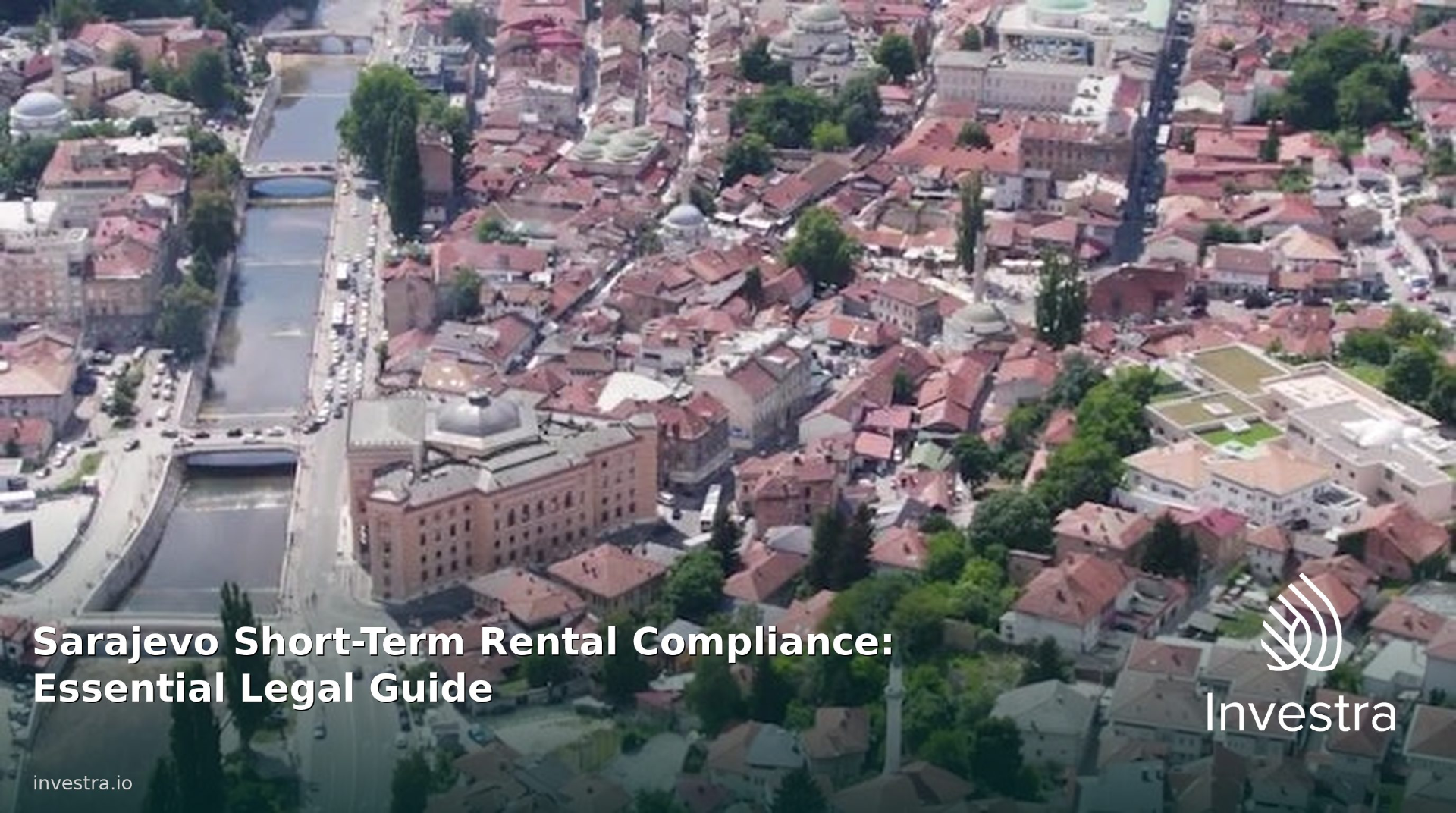
Sarajevo Short-Term Rental Compliance: Essential Legal Guide
Sarajevo Short-Term Rental Compliance: Essential Legal Guide
Sarajevo short-term rental compliance: an overview
Quick Answer: Sarajevo short-term rental compliance covers a mix of municipal, cantonal and national obligations that affect registration, taxation and safety standards; hosts should confirm current requirements with local authorities or a qualified advisor.
Sarajevo attracts travelers year-round, and that demand has pushed many property owners to consider short-term letting. In my experience, the appeal is clear: flexible income, urban tourism growth and a relatively young travel market provide opportunities. But opportunity comes with obligations. What many hosts discover is that "compliance" isn’t a single task you check off; it’s a cluster of actions — registration, tax reporting, safety checks and, sometimes, local permits — that evolve as laws and enforcement change.
The reality is that rules can differ by canton and municipality, and the practical steps a host must take depend on property type, building classification, and whether the property is held privately or through a company. If you’re researching Sarajevo short-term rental compliance, start by mapping out who you need to talk with: Sarajevo City Hall, the Canton Sarajevo tax administration, local police/fire departments for safety standards, and a licensed legal or tax adviser. For practical, city-level context, see our Sarajevo real estate market guide and Sarajevo rental market guide, which explain demand drivers and market dynamics that influence how municipalities treat short-term lets (Sarajevo real estate market guide, Sarajevo rental market guide).
So how should you approach compliance practically? Start with a fact-gathering phase. Gather the apartment’s documentation (title deed, construction/occupancy permits if available), check local zoning rules, and request the latest guidance from municipal offices. We’ve seen investors skip this and then face delays when listing. If you’re a foreign buyer, you’ll want to read specific guidance about the buying process and ownership structures as that affects compliance steps (Buying property in Sarajevo).
National versus municipal rules: who regulates short-term rentals?
Quick Answer: Short-term rentals in Sarajevo are influenced by national statutes and local municipal or cantonal regulations; confirm which authority issues permits and tax guidance for your property.
One of the first things I advise clients is to separate national law from local implementation. National laws set broad frameworks — tax legislation, business registration rules, and civil codes — but many operational requirements, enforcement practices and licensing specifics are handled at the cantonal or municipal level. Sarajevo, being the capital and within the Canton of Sarajevo, is a good example: you’ll need to consult both canton-level agencies and city offices to get the complete picture.
Why does this matter? Because a rule that looks straightforward in national legislation can be interpreted differently by local inspectors or applied with distinct procedural steps. For instance, some municipalities require short-term rental units to appear in a local register or to obtain a tourism-related classification before advertising online. Others focus enforcement on health and safety compliance, demanding certificates or inspections. The only safe route is to verify with the relevant bodies: Canton Sarajevo tax administration, the Sarajevo municipality’s housing department, and municipal tourism offices. If you're uncertain where to start, advisory teams such as Findes Group & Partners can help clarify jurisdictional roles (Findes Group & Partners, Findes Group & Partners advisory team).
We recommend compiling a short list of contacts at the outset: tax office, municipal permit office, local fire and sanitary inspectors, and a local lawyer or consultant. If you prefer an independent perspective on investment strategy and legal processes, Siniša Dagary’s resources and advisory services are useful starting points (Siniša Dagary, advisory services).
Registration and licensing: what to check before listing
Quick Answer: Before listing, confirm whether your unit must be registered with municipal tourism or housing registers and whether a business or sole-proprietor registration is required with canton tax authorities.
Registration and licensing are where compliance often begins for hosts. In practical terms, that means verifying whether you must officially declare the activity of renting to the municipality or to the cantonal authorities, and whether you need to register for a business ID or tax number. In my experience, hosts who secure the right registrations early avoid disruptions when platforms request proof of compliance or when auditors ask for documentation.
What should you collect? Core documents usually include proof of ownership or a valid lease, identity documents, and building/occupancy permits if those exist. Some municipalities want a statement that the unit meets basic safety or sanitary requirements — the exact nature of this statement varies. You shouldn't assume anything: call the relevant city office or speak to an experienced local agent. For guidance on ownership paperwork and buying procedures that affect registration, consult our Sarajevo buying guide and the Sarajevo new-build and renovation guide (Buying property in Sarajevo, Sarajevo new-build guide).
How do you verify current registration steps? Contact the municipal tourism office and the Canton tax administration directly. When you talk to them, ask for written confirmation of the documents they require and any fees involved. If you prefer a faster route, law firms or advisory groups can request the rules on your behalf and outline a checklist, which may include registering as an entrepreneur if your short-term lets reach a certain scale.
Zoning, building codes and safety standards for Sarajevo properties
Quick Answer: Zoning and building code compliance depends on the property’s classification and local municipal rules; confirm occupancy permits and safety certificates with municipal building departments and relevant inspectors.
Sarajevo’s older neighbourhoods, historic buildings, and newer developments each bring different compliance considerations. When you buy a unit for short-term letting, the property’s permitted use under zoning regulations matters. Can you convert a residential apartment to short-term rented accommodation? That depends on the building’s legal classification and any local restrictions on commercial uses in residential zones.
The reality is that you may need to produce an occupancy permit or a certificate of conformity showing the unit meets electrical, structural and sanitary standards. Some buildings — especially those in protected historic areas — require additional approvals for interior changes. What surprised many buyers is how often the lack of clear documentation for older units becomes a sticking point when local inspectors review safety standards. We recommend checking the building file at the municipal building department and asking for copies of any original permits or last approved plans.
For investors looking at new developments or renovations, our Sarajevo new-build guide and neighbourhood analysis are helpful resources to understand typical construction standards and renovation considerations in Sarajevo neighborhoods (Sarajevo new-build guide, Sarajevo neighbourhood guide).
Tax obligations: filing, VAT and income reporting
Quick Answer: Short-term rental income in Sarajevo must be reported to tax authorities and may involve personal income tax, corporate tax or VAT depending on your business structure; verify current rates and filing thresholds with the Canton tax office or a certified accountant.
Taxes are often the area that causes the most anxiety for new hosts. The crucial point is that revenue from short-term rentals is taxable income. How you report that income — as an individual, as a registered entrepreneur, or via a company — affects your reporting obligations and potential tax categories such as personal income tax or corporate tax. VAT may apply in some circumstances, especially if the activity reaches certain thresholds or if you provide additional services typical of hotels. But I won’t state specific rates or thresholds here: tax law changes, and those figures must be verified directly with the Canton tax administration.
What to do practically? Keep precise records of all bookings, invoices, and expenses. Use a simple accounting system or hire a local accountant who understands lodging activities. Ask for written guidance from the tax office on how to classify income from short-term rentals, whether you need to register as a VAT payer, and the required reporting frequency. We recommend discussing this with an advisor who routinely works with tourism-related income; Findes Group & Partners and Siniša Dagary have advisory channels that can facilitate introductions to local tax experts (Findes Group & Partners, investment consultation).
Finally, remember to set aside funds for tax obligations. The worst scenario is a tax audit that finds missing declarations because you were profligate with revenue. Track everything. If you need a starting point for how short-term rentals are treated commercially, our Sarajevo rental market guide contains practical suggestions on accounting and listing practices (Sarajevo rental market guide).
Ownership structures and foreign buyer considerations
Quick Answer: Ownership structure — direct personal ownership, company ownership or joint ownership — affects legal obligations and tax treatment; foreign buyers must verify rights and registration steps with local legal counsel and relevant government registries.
If you’re a foreign buyer, confirm your ability to own property and any additional steps. Rules can differ for residents and non-residents, and some properties — especially agricultural land or particular heritage properties — may have ownership restrictions. Always check ownership rights in the land and property registry and secure counsel who regularly handles foreign purchases. For practical step-by-step buying guidance, our Sarajevo, Mostar, Banja Luka and Tuzla buying guides offer local purchasing processes that influence how ownership structures are treated in practice (Buying property in Sarajevo, Buying property in Mostar, Buying property in Banja Luka, Buying property in Tuzla).
What surprised many clients is that ownership through a company can sometimes simplify registration for commercial activities but at the cost of more complex bookkeeping. Ask for comparative scenarios from your legal advisor: what does tax reporting look like for each option, how is liability allocated, and what are the practical filing burdens? Siniša Dagary’s profile and consultancy pages are useful if you want a strategic discussion before deciding (Siniša Dagary profile, advisory services).
Short-term rental platforms: responsibilities and evidence
Quick Answer: Platforms are often neutral hosts but may request proof of local registration or tax compliance; retain documentation and be prepared to show it when platforms or authorities ask.
If you want to understand how short-term letting is treated across Bosnia and Herzegovina, compare Sarajevo rules with other regional markets like Mostar, Banja Luka and Tuzla using local guides. They’ll show differences in administrative expectations and platform interactions (Mostar rental market guide, Banja Luka rental market guide, Buying property in Tuzla).
Insurance, liability and guest safety considerations
Quick Answer: Obtain suitable property and liability insurance that covers short-term letting risks and ensure guest safety measures are documented with certificates where applicable.
Guest safety should be documented. Fire safety checks, gas and electrical inspections, and emergency instructions for guests are practical measures that protect you and your guests. Keep dated records of any inspections or maintenance work. If a municipality requires certificates for safety compliance, request written confirmation of the scope and validity period of any inspection. Advisors such as Findes Group & Partners or an insurance broker with Bosnia and Herzegovina experience can point you to appropriate local products (Findes Group & Partners advisory team).
Enforcement, penalties and dispute resolution
Quick Answer: Enforcement varies by municipality and can include fines or administrative orders; pursue dispute resolution through municipal channels or legal representatives and keep thorough records to defend compliance.
How do you prepare? Keep a dedicated folder (digital and physical) with permits, registrations, correspondence with authorities, tax receipts, and inspection reports. If a dispute arises — say a neighbor complaint about noise or an inspection questioning a safety standard — the best defense is documentation showing you followed local guidance and attempted remediation. If needed, engage a local lawyer who has experience defending hospitality cases and interacting with municipal enforcement teams. Siniša Dagary’s investment insights and advisory network can connect investors to appropriate legal assistance in Bosnia and Herzegovina (Siniša Dagary investment insights, investment consultation).
Practical compliance checklist for Sarajevo hosts
Quick Answer: A practical checklist includes ownership documents, registration evidence, tax registration, safety certificates, insurance, and documented guest rules — verify each item with municipal and cantonal authorities.
What surprised many is how small administrative oversights cause delays. For example, lack of evidence of identity for co-owners, incomplete occupancy records, or failure to declare income properly can create problems. If you’re new to the market, consider using local property managers for the first year to make sure day-to-day compliance is handled correctly. If you want a neighbourhood-level perspective to prioritize which areas are simpler for short-term letting, read our Sarajevo neighbourhood guide and compare with Mostar and Banja Luka neighbourhood guides to see where administrative burdens differ (Sarajevo neighbourhood guide, Mostar neighbourhood guide, Banja Luka neighbourhood guide).
If you want a templated checklist tailored to your situation, contact an advisory service. Siniša Dagary and Findes can provide bespoke onboarding checklists that align with your ownership structure and investment goals (Siniša Dagary, Findes Group & Partners).
Case study: neighbourhood differences and compliance nuances in Sarajevo
Quick Answer: Different Sarajevo neighbourhoods present distinct compliance realities based on building age, zoning and tourism appetite; investigate local building files and municipal practices by neighbourhood.
So how should you research a neighbourhood? First, review the building file — occupancy permits, last renovation approvals and any condominium or homeowners’ association rules. Second, talk to local property managers and neighbours about enforcement culture: do complaints trigger immediate inspections, or are warnings common? Third, consult the Sarajevo neighbourhood guide and the Sarajevo new-build guide for practical context about which areas are traditionally preferred for rentals and which raise more administrative hurdles (Sarajevo neighbourhood guide, Sarajevo new-build guide).
We’ve also compared Sarajevo with other cities in Bosnia and Herzegovina — Mostar’s tourism patterns and Banja Luka’s regulatory approach offer useful contrasts for investors evaluating multi-city portfolios. Use the city guides for regional context before committing to an operational model (Mostar real estate market guide, Banja Luka real estate market guide).
Where to get professional help: legal, tax and property management
Quick Answer: Engage local lawyers, accountants and property managers with Bosnia and Herzegovina experience to handle registrations, tax filings and daily guest operations.
How do you choose advisors? Look for references from other hosts, ask for case studies, and request an outline of what compliance work they will do for you. We frequently recommend consulting both strategy advisers and on-the-ground service providers: for example, Siniša Dagary provides strategic inputs and can recommend implementation partners, while Findes Group & Partners can help with cross-border legal and tax complexities (advisory services, Findes Group & Partners).
If you plan to scale, insist on advisors who understand multi-unit compliance, platform-level documentation and audit readiness. We also suggest you retain copies of all communications and signed contracts; they’re often decisive in resolving disputes with guests or authorities.
Investment Disclaimer
Quick Answer: This section clarifies the article’s purpose and the need for personal due diligence and professional advice before making investment decisions.
The information provided in this article is for educational and informational purposes only and should not be construed as financial, legal, or investment advice. Real estate investments carry inherent risks, and past performance does not guarantee future results. Investors should not invest money they cannot afford to lose. Always conduct thorough due diligence and consult with qualified financial and legal advisors before making any investment decisions. Investra.io does not guarantee returns on any investment.
Frequently Asked Questions
Quick Answer: Common questions cover registration, taxes, ownership, and enforcement; see the answers below and contact local authorities or advisors for current specifics.
Do I need to register my apartment with the Sarajevo municipality before renting it short-term?
Registration requirements differ by municipality and by the scale of your activity. The safest approach is to contact the Sarajevo municipal office and the Canton Sarajevo tax administration and ask for written instructions on registrations for short-term rentals. A local lawyer or consultant can request the exact forms and administrative steps for you. You can also consult our Sarajevo buying and rental guides for practical context on what other hosts have done (Buying property in Sarajevo, Sarajevo rental market guide).
What taxes apply to short-term rental income in Sarajevo?
Short-term rental income is taxable, but the exact taxes and whether VAT applies depend on your chosen business structure and income level. To determine which taxes apply in your situation, contact the Canton Sarajevo tax administration, request written guidance, and consult a certified accountant experienced with lodging activities. Using professional advice ensures you comply with reporting frequencies and deduction rules.
Are there special safety inspections required for short-term rentals?
Some municipalities require safety or sanitary certificates for rental properties, while others focus on general compliance. Verify with municipal building and health inspectors whether any formal inspections are mandatory for your property type. Even if inspections aren’t required, carrying out gas, electrical and fire-safety checks is a recommended risk-management practice and helps in resolving guest disputes quickly.
Can a foreigner own and rent property in Sarajevo?
Foreign ownership rules can be complex and sometimes differ by property type and land category. Always confirm current foreign ownership rights by checking the land and property registry and seeking legal advice. Our buying guides for Sarajevo, Mostar, Banja Luka and Tuzla provide practical purchasing steps for foreign buyers that are useful for planning compliance (Buying property in Sarajevo, Buying property in Mostar, Buying property in Banja Luka, Buying property in Tuzla).
What records should I keep to prove compliance?
Keep ownership documents, registration confirmations, tax filings, insurance policies, inspection certificates, booking invoices and guest correspondence. If a municipality or platform requests proof, these documents will show you acted responsibly. Creating a digital folder with scanned copies and a dated audit trail is practical and often decisive in administrative reviews.
Do platforms ask for proof of tax registration or licenses?
Yes, platforms may request tax IDs, business registrations or local license numbers, especially for hosts with multiple listings. Maintain up-to-date documentation and be ready to upload official registrations if requested. If you encounter uncertainty about what to provide, consult the platform’s helpdesk and your local advisor for guidance.
What penalties can I face for non-compliance?
Penalties may range from administrative fines to orders to cease renting until compliance is achieved. The exact penalties depend on municipal ordinances and the nature of the violation. The best defense is proactive compliance and timely responses to any notices from authorities. If you receive a notice, consult a local legal advisor immediately.
Is it better to manage the property myself or hire a property manager?
It depends on your availability and familiarity with local rules. If you live abroad or don’t have time to handle requests, a property manager experienced with short-term rentals will manage guest check-ins, maintenance and initial compliance tasks. Hiring a manager can reduce risk and administrative burden, but you should confirm that they maintain required registrations and keep transparency in reporting income for tax purposes.
How can I verify current rules and get up-to-date guidance?
Contact municipal offices and the Canton tax administration for official guidance and request written confirmations. Engage local lawyers or tax advisers for tailored advice. Advisory firms and consultants such as Findes Group & Partners and Siniša Dagary can also provide market and regulatory updates and assist with implementation (Findes Group & Partners, investment consultation).
Recommended Reading
Quick Answer: These resources provide deeper context on Sarajevo property processes, neighbourhoods, and buying steps to support compliance planning.
- Sarajevo real estate market guide
- Buying property in Sarajevo
- Sarajevo rental market guide
- Sarajevo neighbourhood guide
- Sarajevo new-build guide
- Mostar real estate market guide
- Siniša Dagary — Investment Consultant
- Business Strategy Blog
Connect With Investra
Quick Answer: Follow Investra on social media to get updates and contact information for platform services.
Stay connected with Investra via social media:
If you want tailored help with Sarajevo short-term rental compliance, consider reaching out to advisors who combine legal, tax and property management expertise: Siniša Dagary for strategy and consultancy (investment consultation), and Findes Group & Partners for cross-border legal and tax advisory services (Findes Group & Partners advisory team).
Embedded Investra links used throughout article for SEO and resource referenceConnect With Investra
Quick Answer: Follow Investra for verified market context and practical property research.
Related Posts
No related posts available.
